Why do people avoid cutting their nails after sunset, fear the number thirteen or believe that an eye twitch can predict future news? Science Behind Superstitions – Part 2 continues the journey with ten more familiar beliefs, examining how pattern detection, coincidence, cultural tradition and social reinforcement can make superstitions feel convincing.
Table of Contents
SCIENCE BEHIND SUPERSTITIONS BOOK SERIES
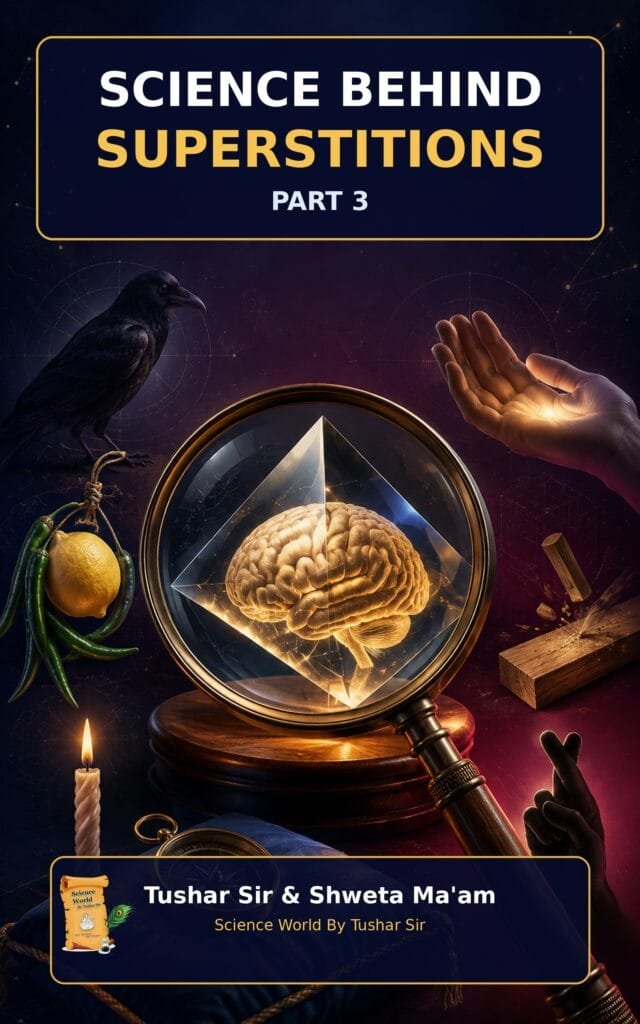
Science Behind Superstitions – Part 3
Ten More Beliefs Explored Through Science, Psychology and Evidence
Why do certain beliefs survive for generations? Are they based on observation, fear, coincidence or misunderstanding?
Science Behind Superstitions – Part 3 investigates ten more familiar beliefs and examines the possible logic, psychology and scientific reasoning behind them. Written in clear and accessible language, this book encourages readers to question assumptions, evaluate evidence and develop a more rational understanding of everyday superstitions.
By Tushar Sir & Shweta Ma’am
About the Book
Science World By Tushar Sir
Looking Beyond Belief to Discover the Evidence
Superstitions are often passed from one generation to another without anyone stopping to ask how they began or whether they have a logical explanation.
Science Behind Superstitions – Part 3 continues this fascinating investigation by examining ten more familiar beliefs through science, psychology and rational observation. Instead of simply accepting or rejecting each belief, the book explores the circumstances that may have helped it develop.
Readers discover how coincidence, pattern recognition, fear, cultural traditions and cognitive biases can influence the way people understand everyday events.
Question. Observe. Understand.
TEN DIFFERENT TOPICS
Part 3 presents ten fresh beliefs without repeating the superstitions examined in the first volume.
WHAT DOES THE EVIDENCE SHOW?
Each chapter considers what can be observed or tested and distinguishes possible explanations from unsupported claims..
QUESTION THE CLAIM—NOT THE PERSON
The book encourages critical thinking while respecting the cultural background and personal experiences connected with traditional beliefs.
Part 3 encourages readers to ask three essential questions: What is the claim? What evidence supports it? Is there another reasonable explanation?
Why Can a Superstition Feel So Convincing?
A superstition may feel true even when there is no reliable evidence supporting it. This happens because the human brain naturally searches for patterns, remembers meaningful coincidences and learns from the people and traditions around it.
Understanding these mental processes helps us evaluate beliefs more fairly and accurately.
Pattern Recognition
The brain constantly searches for connections between events. Sometimes it identifies a relationship even when two events occurred together only by chance.
Confirmation Bias
People tend to notice and remember experiences that support an existing belief while overlooking the many occasions when the prediction did not come true.
Coincidence and Probability
Unusual coincidences are memorable. When a predicted event happens soon after a ritual or sign, it may appear connected even though coincidence provides a simpler explanation.
Social Learning
Beliefs are often learned from parents, relatives and communities. Repetition by trusted people can make an idea feel true before it has been independently examined.
The Need for Control
Protective rituals can reduce anxiety during uncertain situations. The feeling of comfort is real, but it does not necessarily mean that the ritual controls external events.
Scientific thinking encourages us to ask whether an explanation is supported by repeatable evidence or strengthened mainly by memory, expectation and coincidence.
INSIDE THE BOOK
From protective charms and animal behaviour to lucky gestures and travel rituals, Part 3 examines ten familiar superstitions. Each chapter explores how the belief may have originated and what science, psychology and evidence reveal about it.
Explore 10 Fascinating Indian Traditions
01 — Lemon and Chillies Ward Off Evil
Why are lemons and green chillies hung outside homes, shops and vehicles? Explore the symbolism, practical explanations and psychological reassurance associated with this familiar protective charm.
02 — Sweeping After Dark Drives Away Wealth
This belief may have developed when homes had poor lighting and valuable objects could accidentally be swept away. Discover how an old practical warning gradually became connected with wealth and fortune.
03 — An Itchy Palm Predicts Money
An itchy palm is often interpreted as a sign of financial gain or loss. Science instead connects itching with dry skin, irritation, allergies and other physical causes.
04 — A Crow Calling Announces Guests
Many people believe that a crow calling near the house means visitors are coming. This chapter examines crow behaviour, coincidence and the human tendency to remember predictions that appear to come true.
05 — A Howling Dog Predicts Death
A dog’s howl can sound mysterious or frightening, especially at night. Learn how dogs use howling for communication and how their sensitive hearing allows them to respond to sounds humans may not notice.
06 — Throwing Water Behind a Traveller Brings Success
In some traditions, water is thrown behind a person beginning an important journey. Explore how this symbolic ritual may offer encouragement and emotional reassurance without directly controlling the journey’s outcome.
07 — Sleeping with the Head North Is Harmful
Does sleeping direction genuinely affect health? This chapter examines traditional explanations, geomagnetic claims and the environmental factors that influence sleep more directly.
08 — Crossed Fingers Change Luck
Crossing the fingers is commonly used to express hope for a favourable result. Discover the history of this gesture and how positive expectations can influence confidence without changing chance itself.
09 — Birthday Candle Wishes Come True
Making a silent wish before blowing out birthday candles is a much-loved tradition. This chapter explores its cultural appeal and explains why meaningful rituals can strengthen hope and motivation.
10 — Knocking on Wood Prevents Misfortune
People often knock on wood after mentioning something positive. Explore the possible historical origins of this custom and how small protective rituals can temporarily reduce anxiety.
Part 3 does not simply label these beliefs as true or false. It asks what can be tested, what evidence shows and what practical or symbolic meaning may exist behind the tradition.
How Each Superstition Is Investigated
Every belief has a story. Rather than simply labelling a superstition as true or false, this book follows a clear and respectful method to understand how it began, why people continue to believe it and what reliable evidence reveals.
01. Identify the Belief
Each chapter begins with a clear explanation of the superstition, including how people commonly interpret and practise it.
02. Explore Its Possible Origin
The book considers the historical, cultural or practical circumstances that may have contributed to the development of the belief.
03. Examine the Scientific Explanation
Relevant ideas from biology, psychology, behaviour, the environment and everyday science are used to investigate the claim.
04. Evaluate the Evidence
The belief is compared with observation, logical reasoning and available evidence instead of being judged through fear or assumption.
05. Reach a Balanced Conclusion
Every chapter ends with a simple takeaway that respects cultural traditions while clearly separating symbolic meaning from scientifically supported facts.
Curiosity Is the Beginning of Scientific Thinking
When readers learn to question claims, observe carefully and look for evidence, they develop critical-thinking skills that can help them far beyond the subject of superstitions.
About the Authors

Science World By Tushar Sir creates educational books, science resources, question banks and thought-provoking content designed to make learning clearer, more practical and more enjoyable.
Tushar Sir and Shweta Ma’am are educators and authors committed to making science understandable, engaging and relevant to everyday life. Through the Science Behind Superstitions
Book Series, they encourage readers to explore traditional beliefs with curiosity, cultural sensitivity and a scientific outlook. Their goal is to inspire people—especially young readers—to ask questions, examine evidence and make informed conclusions.
Discover more educational books and resources from Science World By Tushar Sir.
Buy Science Behind Superstitions – Part 3
CONTINUE THE JOURNEY
Can a crow really announce the arrival of guests? Does knocking on wood prevent misfortune? Can crossed fingers change luck?
Discover the possible origins, psychology and scientific explanations behind these and seven more familiar beliefs in Science Behind Superstitions – Part 3.
Written in simple and engaging language, this book helps readers explore traditions respectfully while developing a more evidence-based understanding of the world.
Book-feature checklist
✓ Ten familiar superstitions investigated
✓ Clear scientific and psychological explanations
✓ Respectful exploration of cultural beliefs
✓ Easy-to-understand language
✓ Ideal for students, teachers, parents and curious readers
FAQs
EXPLORE THE COMPLETE COLLECTION
Four Books. Forty Beliefs. One Journey from Fear to Understanding.
Science Behind Superstitions is a four-part series exploring familiar beliefs through science, psychology, history, culture and logical reasoning. Each volume contains ten different topics and can be read independently.
SCIENCE BEHIND SUPERSTITIONS – PART 1
Begin the series with ten familiar beliefs involving black cats, broken mirrors, eclipses, crows, owls, spilled salt and other everyday superstitions.
SCIENCE BEHIND SUPERSTITIONS – PART 2
Continue with ten more beliefs involving luck, predictions, relationships, physical sensations and destiny—all examined with evidence.
SCIENCE BEHIND SUPERSTITIONS – PART 3
Continue the journey with another fresh collection of beliefs examined through possible origins, psychology, scientific reasoning and cultural context.
SCIENCE BEHIND SUPERSTITIONS – PART 4
Complete the four-volume collection with ten further beliefs explored through evidence, observation, history and logical thinking.
QUESTION THE BELIEF. EXAMINE THE EVIDENCE.
Discover the Complete Science Behind Superstitions Series. Explore forty fascinating beliefs across four books and discover how culture, psychology, coincidence and practical observations can shape the way people understand the world.