
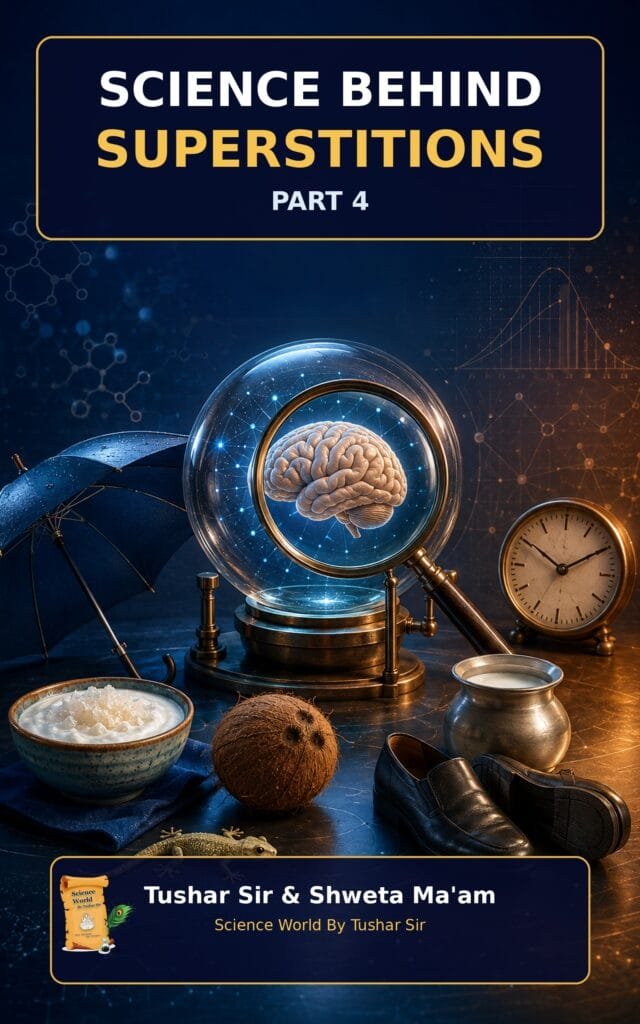
Science Behind Superstitions – Part 4 examines ten more familiar beliefs connected with household habits, food rituals, luck and everyday customs. From whistling after dark and opening an umbrella indoors to eating curd and sugar before an important task, this book explores how such beliefs may have developed and what science, psychology and evidence reveal about them.
Written by Tushar Sir and Shweta Ma’am, Part 4 encourages readers to appreciate cultural traditions while learning to separate symbolic meaning, coincidence and psychological comfort from scientifically testable facts.
Table of Contents
SCIENCE BEHIND SUPERSTITIONS BOOK SERIES
Science Behind Superstitions – Part 4
Ten More Familiar Beliefs Examined with Evidence
Why do people avoid whistling after dark? Can opening an umbrella indoors really bring bad luck? Does eating curd and sugar guarantee success?
Science Behind Superstitions – Part 4 examines ten more household beliefs, food rituals and everyday customs through science, psychology and logical reasoning. Discover how these traditions may have developed and learn to distinguish cultural meaning from evidence-based fact.
By Tushar Sir & Shweta Ma’am
About the Book
Science World By Tushar Sir
Everyday Traditions Through the Lens of Science
Many superstitions begin as simple household advice, symbolic rituals or explanations created during a time when scientific knowledge was limited. As these ideas pass from one generation to another, their original purpose may be forgotten and replaced by fear, luck or supernatural meaning.
Science Behind Superstitions – Part 4 examines ten more beliefs connected with daily life, household behaviour, food practices and important occasions. From whistling after dark and opening an umbrella indoors to breaking a coconut before beginning something new, every chapter asks where the belief may have originated and whether reliable evidence supports it.
Respect the Tradition. Examine the Claim.
A custom may have historical, emotional or cultural value without possessing the supernatural power often associated with it. Understanding this difference allows readers to honour traditions while making decisions based on observation, logic and evidence.
INSIDE THE BOOK
Ten Everyday Beliefs Under the Scientific Lens
Part 4 investigates ten superstitions connected with household behaviour, food rituals, important occasions and predictions about the future. Each chapter considers the belief’s possible origin, cultural meaning, psychological influence and relationship with scientific evidence.
01. Whistling After Dark Attracts Danger
Why is whistling at night discouraged in many families? This chapter explores how concerns about silence, safety and disturbing others may have gradually developed into warnings about danger or supernatural forces.
02. Opening an Umbrella Indoors Brings Bad Luck
Opening an umbrella inside a small room could damage objects or accidentally injure someone. Discover how a practical safety warning may have become associated with bad luck.
03. Curd and Sugar Guarantee Success
Eating curd and sugar before an examination, journey or important task is a familiar practice. The food may provide comfort and energy, but success still depends on preparation, ability and circumstances.
04. A Kajal Dot Protects a Baby from the Evil Eye
A small kajal dot is often applied as a symbol of protection. This chapter separates its cultural and emotional significance from claims that it can provide scientifically demonstrated protection against misfortune.
05. A Lizard Falling on You Predicts the Future
Traditional interpretations sometimes connect the place where a lizard lands with future events. Science explains such incidents through animal movement, gravity and chance rather than prediction.
06. Milk Boiling Over Brings Prosperity
Milk overflowing during a ceremony is often interpreted as a sign of abundance. Explore the symbolism behind this ritual and the ordinary physical process that causes heated milk to rise and overflow.
07. Haircuts on Certain Weekdays Cause Misfortune
Why do some traditions discourage cutting hair on particular days? This chapter considers historical schedules, social customs and religious practices while examining whether the day of a haircut can affect luck.
08. A Stopped Clock Predicts Death
A stopped clock can appear unsettling, especially when noticed near an unfortunate event. The chapter examines mechanical failure, coincidence and the human tendency to connect emotionally powerful events.
09. Breaking a Coconut Guarantees Success
Breaking a coconut is an important symbolic ritual before new beginnings. It may inspire focus and confidence, but no ritual can guarantee an outcome independent of effort and circumstances.
10. Upside-Down Shoes Cause Quarrels
Shoes placed upside down are sometimes believed to create arguments in the home. This chapter investigates how expectations, household order and coincidence may strengthen the belief despite the absence of a direct causal connection.
THE METHOD BEHIND THE BOOK
From Traditional Belief to Evidence-Based Understanding
Every superstition has a story. Instead of immediately declaring a belief true or false, Science Behind Superstitions – Part 4 follows a clear five-step approach to understand where the belief may have originated, why it continues to feel convincing and whether reliable evidence supports it.
01. Identify the Belief
Each chapter begins by clearly describing the superstition and how it is commonly understood or practised. This provides the cultural context needed for a respectful investigation.
02. Explore Its Possible Origin
The book considers the historical, social or practical circumstances that may have helped the belief develop. Some superstitions may have begun as safety advice, household discipline or symbolic customs.
03. Examine the Scientific Explanation
Relevant ideas from physics, biology, psychology, probability and everyday science are used to explore what may actually be happening.
04. Evaluate the Evidence
The claim is compared with observation, logical reasoning and repeatable evidence. Coincidence, selective memory and expectation are also considered before reaching a conclusion.
05. Reach a Balanced Conclusion
Every chapter ends with a simple takeaway that respects the tradition’s cultural meaning while clearly distinguishing symbolism from scientifically supported fact.
UNDERSTANDING THE DIFFERENCE
Tradition, Practical Origins and Scientific Evidence
Superstitions often contain several layers. A belief may carry cultural meaning, may have developed from an old practical concern and may also include a supernatural claim that cannot be supported by reliable evidence.
Cultural Meaning
Traditions can connect people with family, community and shared history. Rituals such as breaking a coconut or eating curd and sugar may provide encouragement, strengthen a sense of belonging and mark an important occasion.
This emotional and symbolic value can remain meaningful even when the tradition does not control the final outcome.
Possible Practical Origin
Some beliefs may have begun as practical advice. Opening a large umbrella inside a small room could cause damage, whistling at night could disturb others and keeping shoes properly arranged could support cleanliness and household order.
Over time, a practical warning may become connected with bad luck, danger or misfortune.
Scientific Evidence
Science asks whether a claim can be observed, tested and repeated. If a belief says that an action guarantees success, predicts death or causes quarrels, the claim must be supported by reliable evidence rather than isolated coincidences.
A lack of scientific support does not remove a tradition’s cultural value—it only means that its factual claim has not been demonstrated.
| Belief | Cultural or practical meaning | Evidence-based conclusion |
|---|---|---|
| Opening an umbrella indoors | Avoids accidental damage or injury | Opening it does not alter luck |
| Curd and sugar before a task | Provides familiarity and reassurance | It cannot guarantee success |
| Milk boiling over | Symbolises abundance and prosperity | Overflow results from heating and foaming |
| Breaking a coconut | Marks a new beginning and encourages focus | It cannot guarantee an outcome |
THE PSYCHOLOGY OF BELIEF
Why Can a Superstition Feel So Convincing?
Human beings naturally search for patterns, explanations and a sense of control. These abilities help us understand the world, but they can also lead us to connect events that occurred together only by chance.
A superstition may therefore feel accurate because of the way the brain notices, remembers and interprets experiences—not necessarily because the belief has been scientifically proven.
Pattern Recognition
The brain is constantly searching for connections between events. If something good or bad happens after a particular sign or ritual, the two events may appear connected even when they occurred together only by chance.
Confirmation Bias
People tend to remember occasions that support an existing belief and overlook the occasions when the prediction failed. A single memorable match can therefore feel more convincing than many unnoticed failures.
Coincidence and Probability
Unusual coincidences attract attention. If an umbrella is opened indoors and something unpleasant happens later, the sequence may feel meaningful even though similar events occur without any connection.
Social Learning
Many beliefs are learned from parents, relatives and communities during childhood. Repetition by trusted people can make an idea feel true before it has been independently questioned or tested.
The Need for Control
Uncertainty can create anxiety. Rituals performed before an examination, journey or new beginning may provide comfort and confidence, but the feeling of control does not prove that the ritual controls the outcome.
Get Science Behind Superstitions – Part 4
CONTINUE THE JOURNEY
Can whistling after dark really attract danger? Does opening an umbrella indoors bring bad luck? Can eating curd and sugar guarantee success?
Discover the possible origins, cultural meanings, psychology and scientific explanations behind these and seven more familiar beliefs in Science Behind Superstitions – Part 4.
Written in clear and accessible language, this book helps readers explore traditions respectfully while developing a more logical and evidence-based understanding of everyday claims.
Part of the four-book Science Behind Superstitions series published under Science World By Tushar Sir.
Book-feature checklist
✓ Ten familiar superstitions investigated
✓ Clear scientific and psychological explanations
✓ Respectful examination of cultural traditions
✓ Simple, reader-friendly language
✓ Useful for students, teachers, parents and curious readers
By Tushar Sir & Shweta Ma’am
MEET THE AUTHORS
About the Authors
Tushar Sir and Shweta Ma’am are the authors of the Science Behind Superstitions book series. Their shared aim is to make scientific thinking clear, engaging and accessible to readers of different ages.
Tushar Sir
Tushar Sir is an educator and the creator of Science World By Tushar Sir. Through educational books and digital content, he encourages students and general readers to approach everyday questions with curiosity, observation and logical reasoning.
Shweta Ma’am
Shweta Ma’am is the co-author of the Science Behind Superstitions series. She contributes to presenting cultural beliefs, human behaviour and scientific explanations in a clear, balanced and reader-friendly manner.
A Shared Mission
Together, the authors explore the relationship between tradition, psychology and science without mocking cultural practices. Their books encourage readers to respect cultural meaning while asking whether factual claims are supported by reliable evidence.
Science World By Tushar Sir
Making science understandable, useful and connected with everyday life.