
🧠 CHAPTER-WISE MIND MAPS
Class 9 Science Mind Maps
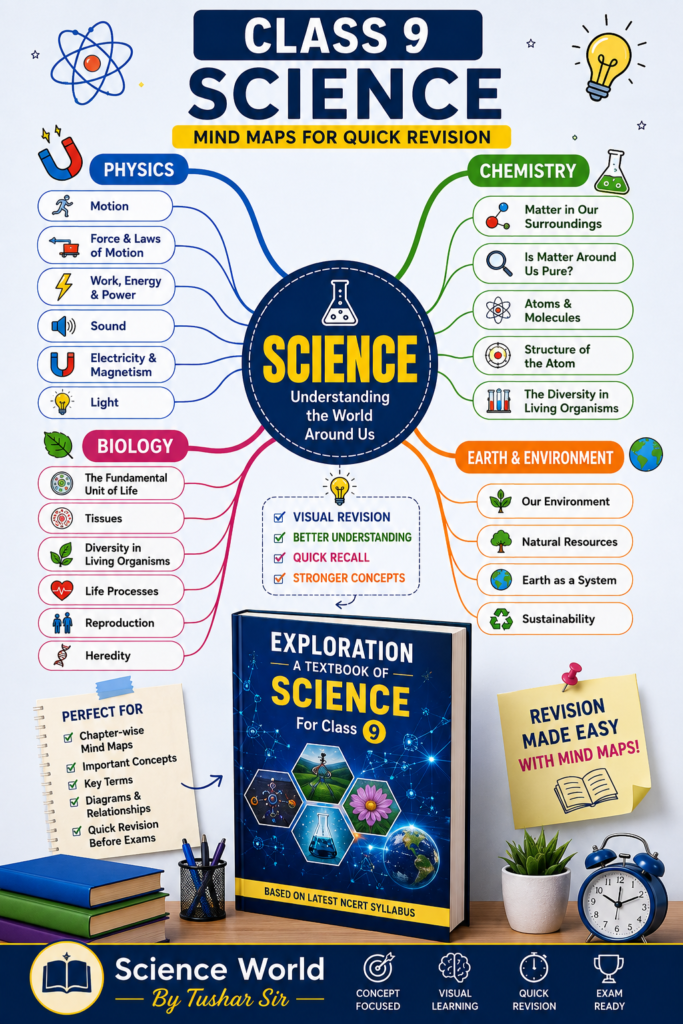
Revise Class 9 Science quickly with chapter-wise mind maps that organize important concepts, key terms, processes, and scientific relationships in a simple visual format. Use these mind maps for quick revision before tests and examinations.
✓ 13 Chapters • ✓ Visual Revision • ✓ NCERT-Based
Why Use Class 9 Science Mind Maps?
Mind maps turn lengthy Science chapters into organized visual summaries. They help students connect related concepts, recall important information quickly, and revise chapters more efficiently.
🧠 Visualize Concepts
See important concepts and their relationships in a structured visual format instead of revising isolated points.
⚡ Quick Revision
Review major concepts, keywords, processes, and connections in much less time before a test or examination.
🔗 Connect Related Ideas
Understand how different concepts within a Science chapter are connected to each other.
🎯 Remember Key Points
Use visual organization to make important definitions, terms, facts, and processes easier to recall.
📚 Chapter-wise Learning
Revise one Class 9 Science chapter at a time with a focused visual summary of its important concepts.
📝 Exam Revision
Use mind maps as a final revision tool after completing your detailed study and before school examinations.
💡 Smart Revision Tip
Study first, visualize next, recall later. Use a mind map after learning a chapter to check how much you can remember without reopening the entire textbook.
Chapter-wise Class 9 Science Mind Maps
Explore chapter-wise Class 9 Science mind maps covering the key concepts, important terms, processes, and relationships from the NCERT Exploration curriculum. Use them for quick revision and visual recall.
Chapter 1
Entering the World of Secondary Science
Visualize scientific methods, observations, measurements, laboratory skills, and the foundations of scientific inquiry.
Chapter 2
Cell: The Building Block of Life
Revise cell structure, organelles, their functions, and the organization of living cells through a visual summary.
Chapter 3
Tissues in Action
Connect the important concepts of plant and animal tissues, their structures, functions, and roles.
Chapter 4
Describing Motion Around Us
Quickly revise motion, distance, displacement, speed, velocity, and other key concepts.
Chapter 5
Exploring Mixtures and Their Separation
Organize concepts related to mixtures, solutions, components, properties, and separation techniques.
Chapter 6
How Forces Affect Motion
Visualize force, interactions, motion, and the effects of forces on objects.
Chapter 7
Work, Energy, and Simple Machines
Connect work, energy, power, and simple machines in an easy-to-revise visual format.
Chapter 8
Journey Inside the Atom
Revise atomic structure, subatomic particles, and important developments in models of the atom.
Chapter 9
Atomic Foundations of Matter
Review atoms, molecules, chemical formulae, and the fundamental ideas behind the composition of matter.
Chapter 10
Sound Waves: Characteristics and Applications
Visualize sound production, propagation, characteristics of sound, and important applications.
Chapter 11
Reproduction: How Life Continues
Organize key concepts related to reproduction, life cycles, and the continuity of life.
Chapter 12
Patterns in Life: Diversity and Classification
Revise biological diversity, classification, groups of organisms, and important relationships between them.
Chapter 13
Earth as a System: Energy, Matter, and Life
Connect Earth’s systems, energy, matter, and life through a concise visual chapter summary.
Looking for complete chapter preparation? Explore our Class 9 Science Notes, NCERT Solutions, and Question Banks for additional practice and revision.
What’s Included in Our Class 9 Science Mind Maps?
Each mind map is designed to condense important chapter information into a clear visual structure, helping students see connections between concepts and revise the most important points efficiently.
Key Concepts
Important concepts from each chapter are organized around central ideas so students can understand the overall structure of the topic.
Important Terms & Definitions
Key scientific terms and important definitions are highlighted for quick recall during revision.
Processes & Relationships
Related concepts, processes, and scientific relationships are connected visually to make them easier to understand.
Formulas & Key Facts
Important formulas, quantities, facts, and scientific relationships are presented in a concise revision-friendly format where relevant.
Concept Connections
Follow the branches of the mind map to see how different ideas within a chapter relate to one another.
Quick Revision Points
Use the completed mind map as a quick reference when revising a chapter before a test or examination.
💡 Best Way to Use a Mind Map
Don’t just look at the mind map—try to recreate it from memory. Study the chapter first, review the mind map, close it, and then recall the main branches and concepts yourself.
How to Use Class 9 Science Mind Maps for Revision
A mind map works best when it is used alongside active learning. Follow these simple steps to turn a visual summary into an effective revision tool.
① Learn the Chapter
Understand First
Read the relevant NCERT chapter and understand the concepts before relying on the mind map for revision.
② Review the Mind Map
See the Big Picture
Look at the central topic, major branches, and smaller connections to understand how the chapter is organized.
③ Connect the Concepts
Follow the Branches
Trace the connections between related concepts, processes, definitions, and important scientific ideas.
④ Recall Without Looking
Test Your Memory
Close the mind map and try to recall the main branches and important points yourself.
⑤ Revisit Before Exams
Quick Revision
Return to the mind map during revision sessions to refresh important concepts without rereading the entire chapter.
💡 Active Recall Tip
Try drawing the mind map yourself. After studying a chapter, take a blank sheet and recreate the main branches from memory. Then compare your version with the original and fill in anything you missed.
How Class 9 Science Mind Maps Help with Exam Revision
Mind maps are especially useful when you need to revise a large amount of Science content in a limited amount of time. Use them at different stages of your preparation to keep important concepts fresh.
Before a Class Test
Review the mind map after studying a chapter to quickly refresh the important concepts and connections before a test.
During Regular Revision
Use mind maps as a quick revision reference between detailed study sessions to keep previously learned concepts fresh.
Before Examinations
Review chapter mind maps to revisit the major concepts, terms, processes, and relationships across the syllabus.
Last-Minute Revision
When time is limited, use mind maps to recall the overall structure of a chapter instead of rereading every page.
📖 Detailed Study
Use your NCERT textbook and detailed notes when you need to learn and understand a concept thoroughly.
🧠 Visual Revision
Use the mind map after learning to quickly recall the chapter structure and important connections.
Frequently Asked Questions About Class 9 Science Mind Maps
Find answers to common questions about Class 9 Science mind maps, including how to use them for revision, chapter-wise availability, NCERT alignment, and exam preparation.
Class 9 Science mind maps are visual summaries that organize important concepts, terms, processes, and relationships from each Science chapter in a structured format.
Yes. The mind maps are organized around the concepts and topics covered in the Class 9 Science NCERT Exploration curriculum.
The resource is organized chapter-wise across the Class 9 Science syllabus, covering all 13 chapters listed on this page.
Mind maps provide a visual overview of a chapter, helping students quickly review major concepts and understand how different ideas are connected.
Yes. A mind map is most useful as a revision tool after you have studied and understood the chapter in detail.
Yes. They can be useful for refreshing important concepts, terms, processes, and relationships during revision before tests and examinations.
No. Mind maps are a revision aid, not a replacement for the textbook. Students should study the NCERT material thoroughly and then use mind maps for review and recall.
Study the mind map, close it, and try to reproduce its main branches and concepts from memory. Then compare your recall with the original and revise anything you missed.
Yes. They can help break a large topic into smaller connected ideas, making the overall structure easier to review. For difficult concepts, use them alongside detailed explanations and textbook study.
You can combine mind maps with Class 9 Science Notes, NCERT Solutions, MCQs, Question Banks, Sample Papers, and the Complete Class 9 Science Study Guide for more comprehensive preparation.
Explore More Class 9 Science Resources
Mind maps are excellent for visual revision, but complete Science preparation requires learning, practice, and assessment. Explore our other Class 9 Science resources to strengthen your preparation from every angle.
📘Class 9 Science Notes
Study chapter-wise concepts, important points, diagrams, and revision notes.
📝Class 9 Science NCERT Solutions
Find clear solutions and explanations for NCERT in-text and exercise questions.
🧠Class 9 Science MCQs
Test your understanding with chapter-wise multiple-choice questions and answers.
📚Class 9 Science Question Banks
Strengthen your preparation with chapter-wise practice questions and solutions.
📄Class 9 Science Sample Papers
Test your preparation with sample papers and exam-style practice.
🏠Complete Class 9 Science Guide
Explore all Class 9 Science resources, chapters, and study materials in one place.
Make Class 9 Science Revision Faster & Smarter
Use chapter-wise Class 9 Science mind maps to quickly review important concepts, connect related ideas, and strengthen your recall before tests and examinations. Combine visual revision with detailed notes, NCERT Solutions, MCQs, and practice resources for complete preparation.