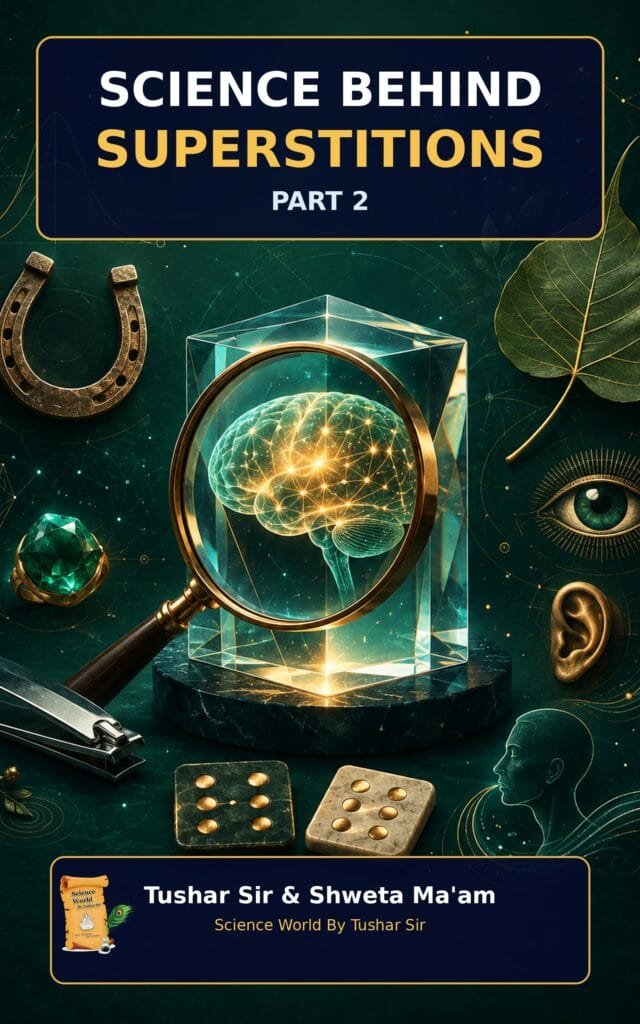
Why do people avoid cutting their nails after sunset, fear the number thirteen or believe that an eye twitch can predict future news? Science Behind Superstitions – Part 2 continues the journey with ten more familiar beliefs, examining how pattern detection, coincidence, cultural tradition and social reinforcement can make superstitions feel convincing.
Table of Contents
SCIENCE BEHIND SUPERSTITIONS BOOK SERIES
Science Behind Superstitions – Part 2
Ten More Familiar Beliefs Examined with Evidence
Can ringing ears reveal that someone is talking about you? Do hiccups mean someone is remembering you? Can gemstones change destiny?
Part 2 investigates ten more familiar beliefs through evidence, science, psychology, history and practical reasoning. Written by Tushar Sir and Shweta Ma’am, the book examines claims—not people—and respectfully separates cultural symbolism from ideas that can be scientifically tested.
About the Book
Science World By Tushar Sir
Ten More Beliefs. A Deeper Search for Evidence.
Science Behind Superstitions – Part 2 continues the series with ten new beliefs drawn from everyday life, cultural traditions and popular folklore. Why is cutting nails after sunset considered harmful? Can twitching eyes predict future events? Are some gifts capable of damaging relationships? Can gemstones influence destiny? The book examines such questions by asking what can be observed, what can be tested and what available evidence actually shows. It also explores how pattern detection, confirmation bias, post hoc reasoning and social reinforcement can make ordinary coincidences feel meaningful.
The purpose is not to ridicule the people who follow these beliefs. Instead, Part 2 examines the claims respectfully, separates symbolic traditions from testable statements and helps readers make informed choices.
TEN DIFFERENT TOPICS
Part 2 presents ten fresh beliefs without repeating the superstitions examined in the first volume.
WHAT DOES THE EVIDENCE SHOW?
Each chapter considers what can be observed or tested and distinguishes possible explanations from unsupported claims..
QUESTION THE CLAIM—NOT THE PERSON
The book encourages critical thinking while respecting the cultural background and personal experiences connected with traditional beliefs.
Part 2 encourages readers to ask three essential questions: What is the claim? What evidence supports it? Is there another reasonable explanation?
WHAT READERS WILL DISCOVER
Why Ordinary Experiences Can Feel Like Predictions
Part 2 explores how the human mind searches for patterns, remembers successful predictions and connects unrelated events. Readers learn why some beliefs can feel convincing even when reliable evidence is unavailable.
PATTERN DETECTION
Discover how the human brain naturally searches for connections between events—even when those events may be unrelated.
CONFIRMATION BIAS
Learn why people tend to remember occasions that support a belief while overlooking the many times the prediction did not come true.
AFTER THIS, THEREFORE BECAUSE OF THIS
Explore why an event happening after a ritual, sign or warning does not automatically prove that the first event caused the second.
SOCIAL REINFORCEMENT
Understand how repeated family warnings, community stories and shared experiences can strengthen a belief across generations.
WHAT CAN BE TESTED?
Learn to identify whether a claim can be observed, measured or tested—and what kind of evidence would be required to support it.
SYMBOLIC MEANING OR SCIENTIFIC CLAIM?
Recognise that a tradition may carry cultural or emotional meaning without necessarily having a scientifically proven effect.
By recognising these thinking patterns, readers can approach surprising claims with curiosity while avoiding conclusions based only on coincidence, fear or expectation.
INSIDE THE BOOK
Part 2 investigates ten different beliefs connected with household rules, natural sensations, lucky objects, relationships and destiny. Each chapter asks why the belief began, how it continues and whether reliable evidence supports its central claim.
Explore 10 Fascinating Indian Traditions
01 — Cutting Nails After Sunset
Why were people traditionally warned not to cut their nails after dark? Explore possible connections with poor lighting, sharp tools, cleanliness and household conditions before modern electricity.
02 — The Peepal Tree After Dark
Why do some people fear approaching a Peepal tree at night? Examine sacred symbolism, darkness, unfamiliar sounds, nocturnal animals and the stories associated with ancient trees.
03 — A Horseshoe Brings Good Luck
How did an ordinary iron object become a symbol of luck and protection? Discover the historical value of iron, the importance of horses and the power of cultural symbolism.
04 — Eye Twitching Predicts Good or Bad News
Can an involuntary eye twitch predict a future event? Explore ordinary physical explanations and how expectation can turn a natural sensation into a personal prediction.
05 — The Number Thirteen Is Unlucky
Why do some buildings skip the thirteenth floor and some people avoid the number entirely? Examine historical associations, cultural differences and expectation-driven fear.
06 — Ringing Ears Mean Someone Is Talking About You
Can a sound experienced in the ear reveal a distant conversation? Explore how internal auditory sensations, coincidence and memorable social events become connected.
07 — Hiccups Mean Someone Is Remembering You
Why are hiccups associated with another person thinking about us? Examine the physical nature of hiccups and the emotional appeal of turning an ordinary reflex into a social message.
08 — Stepping Over Someone Stops Their Growth
Can stepping over a person affect their height? Discover how rules involving respect, personal space and safety may become transformed into claims about physical growth.
09 — Certain Gifts Cause Separation
Can giving shoes, watches or sharp objects damage a relationship? Explore symbolism, expectation, relationship anxiety and the possibility of self-fulfilling behaviour.
10 — Gemstones Can Change Destiny
Can wearing a particular stone alter future events? Examine the cultural importance of gemstones, their emotional value and the difference between personal symbolism and testable evidence.
Part 2 does not simply label these beliefs as true or false. It asks what can be tested, what evidence shows and what practical or symbolic meaning may exist behind the tradition.
WHY CHOOSE PART 2?
A Respectful and Evidence-Based Exploration
Part 2 expands the series with ten fresh topics and a stronger focus on how patterns, expectations and social influence shape belief. It encourages readers to investigate claims carefully without losing respect for the people or traditions connected with them.
Ten completely new topics
NO REPEATED CHAPTERS
Part 2 explores ten beliefs that are different from those examined in Part 1, giving readers a fresh collection of questions and discoveries.
Evidence-first approach
ASK WHAT THE EVIDENCE SHOWS
The chapters distinguish personal experience and popular stories from observations that can be independently tested or verified.
Psychology made simple
UNDERSTAND HOW BELIEFS GROW
Pattern detection, confirmation bias, expectation and social reinforcement are explained through familiar examples rather than complicated terminology.
Symbolism versus scientific claims
MEANING IS NOT THE SAME AS PROOF
The book recognises that an object or practice may have cultural meaning without possessing the supernatural power sometimes attributed to it.
Respectful questioning
EXAMINE CLAIMS, NOT PEOPLE
Part 2 avoids mocking believers. It encourages thoughtful discussion and focuses on whether the claim itself is supported by evidence.
Accessible and engaging
MADE FOR EVERYDAY READERS
Clear language, focused chapters and familiar examples make the book suitable for readers without a specialised scientific background.
Part 2 is ideal for readers who enjoyed the first volume and are ready to examine more complex claims involving luck, prediction, relationships and destiny.
Who Should Read Part 2?
Science Behind Superstitions – Part 2 is designed for readers who want to understand why predictions, lucky objects, physical sensations and symbolic traditions can feel convincing—even when reliable evidence is uncertain or unavailable.
Readers of Part 1
READERS CONTINUING THE SERIES
Discover ten completely different beliefs and continue developing the evidence-checking skills introduced in the first volume.
Students and young readers
STUDENTS AND YOUNG READERS
Learn how to recognise patterns, question predictions, compare explanations and distinguish coincidence from cause and effect.
Parents and families
PARENTS AND FAMILIES
Use familiar beliefs about luck, gifts, health sensations and destiny to begin respectful conversations about evidence and tradition.
Teachers and educators
TEACHERS AND EDUCATORS
Use relatable examples to introduce confirmation bias, testable claims, alternative explanations and critical-thinking skills.
Science, psychology and culture enthusiasts
CURIOUS GENERAL READERS
Explore the fascinating connection between human psychology, cultural symbolism, everyday experiences and scientific reasoning.
Part 2 can be read independently. However, reading it alongside Part 1 provides a wider exploration of how superstitions develop, spread and influence everyday decisions.
About the Authors
Science World By Tushar Sir creates educational books, science resources, question banks and thought-provoking content designed to make learning clearer, more practical and more enjoyable.
Tushar Sir and Shweta Ma’am are educators and authors committed to making science understandable, engaging and relevant to everyday life. Through the Science Behind Superstitions
Book Series, they encourage readers to explore traditional beliefs with curiosity, cultural sensitivity and a scientific outlook. Their goal is to inspire people—especially young readers—to ask questions, examine evidence and make informed conclusions.
Discover more educational books and resources from Science World By Tushar Sir.
Buy Science Behind Superstitions – Part 2
CONTINUE THE JOURNEY
Ten More Beliefs. More Questions. Deeper Understanding.
Can an eye twitch predict future news? Does the number thirteen bring bad luck? Can certain gifts cause separation—or gemstones change destiny?
Science Behind Superstitions – Part 2 examines these claims using science, psychology, cultural history and evidence-based reasoning. Written by Tushar Sir and Shweta Ma’am, this book invites readers to investigate surprising claims without mocking the people who follow them. Discover how patterns, expectations, coincidence and social influence can transform ordinary experiences into powerful beliefs.
Book-feature checklist
✓ Ten completely new superstitions
✓ No repeated chapters from Part 1
✓ Scientific and psychological perspectives
✓ Pattern detection and confirmation bias explained
✓ Cultural symbolism separated from testable claims
✓ Clear language and familiar examples
✓ Suitable for students, families and curious readers
FREQUENTLY ASKED QUESTIONS
Questions About Science Behind Superstitions – Part 2
Find answers about Part 2’s content, evidence-based approach, connection with Part 1, intended readers and available formats.
Science Behind Superstitions – Part 2 examines ten more familiar beliefs through evidence, science, psychology, history and cultural context. It helps readers understand why these claims develop and why they can feel convincing.
The subtitle is Ten More Familiar Beliefs Examined with Evidence.
The book explores cutting nails after sunset, the Peepal tree after dark, horseshoes, eye twitching, the number thirteen, ringing ears, hiccups, stepping over someone, gifts believed to cause separation and gemstones claimed to change destiny.
No. Part 2 contains ten different chapters and does not repeat the superstitions examined in the first volume.
No. Part 2 can be read independently because every chapter provides the background needed to understand its topic. Reading both books offers a broader exploration of superstition and human belief.
No. The book encourages readers to examine claims carefully and compare traditional explanations with available evidence. It does not encourage blind belief.
No. The book examines claims—not people. Traditions are discussed respectfully, and cultural symbolism is distinguished from statements that can be scientifically tested.
Not necessarily. Some customs may have possible historical or practical origins, while their supernatural claims may lack reliable evidence. The book helps readers recognise this difference.
Part 2 introduces ideas such as pattern detection, confirmation bias, post hoc reasoning, expectation and social reinforcement using simple everyday examples.
The book examines the cultural and emotional meaning of gemstones while asking whether reliable, testable evidence supports claims that they can alter future events.
Yes. Its clear language and familiar examples can help students develop curiosity, evidence-checking habits and critical-thinking skills.
No. Scientific and psychological ideas are presented in accessible language for general readers.
The book is written by Tushar Sir and Shweta Ma’am and published under the educational brand Science World By Tushar Sir.
Visitors should check the current Amazon listing for available Kindle and paperback formats.
Use the Amazon purchase buttons on this page to view the book, check current availability and choose your preferred format.
EXPLORE THE COMPLETE COLLECTION
Four Books. Forty Beliefs. One Journey from Fear to Understanding.
Science Behind Superstitions is a four-part series exploring familiar beliefs through science, psychology, history, culture and logical reasoning. Each volume contains ten different topics and can be read independently.
SCIENCE BEHIND SUPERSTITIONS – PART 1
Begin the series with ten familiar beliefs involving black cats, broken mirrors, eclipses, crows, owls, spilled salt and other everyday superstitions.
SCIENCE BEHIND SUPERSTITIONS – PART 2
Continue with ten more beliefs involving luck, predictions, relationships, physical sensations and destiny—all examined with evidence.
SCIENCE BEHIND SUPERSTITIONS – PART 3
Continue the journey with another fresh collection of beliefs examined through possible origins, psychology, scientific reasoning and cultural context.
SCIENCE BEHIND SUPERSTITIONS – PART 4
Complete the four-volume collection with ten further beliefs explored through evidence, observation, history and logical thinking.
QUESTION THE BELIEF. EXAMINE THE EVIDENCE.
Discover the Complete Science Behind Superstitions Series. Explore forty fascinating beliefs across four books and discover how culture, psychology, coincidence and practical observations can shape the way people understand the world.