Superstitions are often followed without questioning their origins—but are all of them completely irrational? Some beliefs may have developed from observations about health, safety, nature, psychology or community life. Science Behind Superstitions – Part 1 begins an engaging journey into familiar traditional beliefs and examines their possible meanings through science, history and logical thinking.
Table of Contents
SCIENCE BEHIND SUPERSTITIONS BOOK SERIES
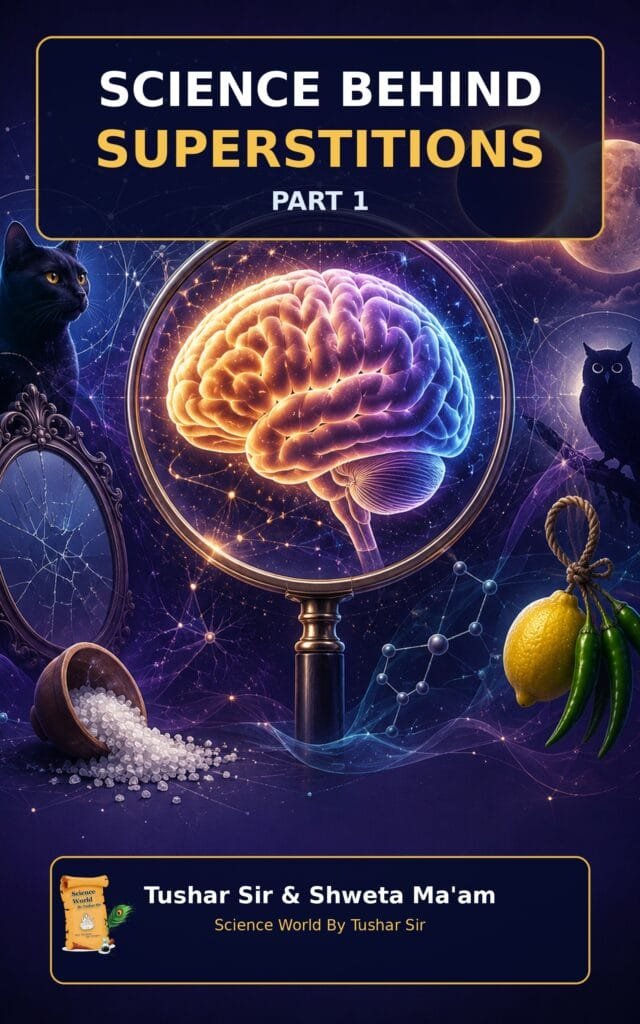
Science Behind Superstitions – Part 1
Exploring the Scientific and Logical Reasons Behind Traditional Beliefs
Why do people avoid certain actions, consider particular signs lucky or unlucky, and continue following beliefs passed down through generations?
Written by Tushar Sir and Shweta Ma’am, this engaging book investigates ten familiar superstitions through science, psychology, history and practical reasoning. It encourages readers to question respectfully, examine evidence and understand the difference between meaningful tradition and unsupported fear.
About the Book
Where Curiosity Meets Traditional Belief
Science Behind Superstitions – Part 1 is the opening volume of an engaging series that explores familiar beliefs through science, psychology, history and logical thinking. This book examines ten such beliefs in clear and accessible language. It does not ask readers to accept every tradition blindly or reject it without consideration. Instead, it encourages them to investigate the origin of each belief, examine possible explanations and form an informed conclusion.
The book’s purpose is to promote curiosity, cultural understanding and a scientific outlook while treating traditional beliefs with sensitivity and respect.
BALANCED EXPLANATIONS
Examine every belief through possible scientific, historical, psychological and practical perspectives.
THINK, QUESTION AND DISCOVER
Develop the habit of asking questions, examining evidence and reaching informed conclusions.
THINK, QUESTION AND DISCOVER
Develop the habit of asking questions, examining evidence and reaching informed conclusions.
This book is not about promoting or mocking superstitions. It is about understanding how beliefs begin, why they continue and what evidence can teach us about them.
WHAT READERS WILL DISCOVER
Look Beyond the Belief and Explore the Reason
Every superstition has a story. Some beliefs may have originated from practical observations, while others may have grown through fear, coincidence, social influence or misunderstanding. Science Behind Superstitions – Part 1 helps readers examine these possibilities from several perspectives.
PRESENT-DAY RELEVANCE
Consider whether a traditional belief remains useful, has become misunderstood or should be reconsidered in modern life.
SCIENTIFIC PERSPECTIVE
Understand whether ideas involving health, hygiene, nature, safety or observation could be connected with a belief.
PSYCHOLOGY OF BELIEF
Discover how fear, expectation, memory, coincidence and confirmation bias can make superstitions feel convincing.
CULTURE AND HISTORY
Examine how historical conditions, local customs and community experiences can influence traditional beliefs.
MYTH VERSUS FACT
Learn to distinguish between possible practical reasoning, symbolic traditions and claims that lack reliable evidence.
PRESENT-DAY RELEVANCE
Consider whether a traditional belief remains useful, has become misunderstood or should be reconsidered in modern life.
The book encourages readers to remain curious, respect cultural traditions and evaluate every claim using observation, evidence and logical thinking.
INSIDE THE BOOK
Explore 10 Fascinating Indian Traditions
01 — A Black Cat Crossing Your Path
Why is the sudden appearance of a black cat considered unlucky in some cultures but viewed positively in others? Explore the influence of folklore, fear, cultural conditioning and selective memory.
02 — Sneezing Before Leaving Home
Can a natural reflex predict the success of a journey? Discover how interruptions, coincidence and remembered outcomes may have transformed an ordinary sneeze into a warning sign.
03 — Sweeping the Floor After Sunset
Why were people traditionally advised not to sweep after dark? Examine possible connections with poor lighting, the accidental loss of valuable objects and changing household conditions.
04 — Lemon and Chillies at the Door
Explore the symbolism associated with hanging lemon and chillies at entrances, along with the cultural and practical explanations commonly offered for this familiar tradition.
05 — Breaking a Mirror Means Seven Years of Bad Luck
How did a broken mirror become connected with years of misfortune? Discover the historical value of mirrors, the danger of broken glass and the symbolic ideas associated with reflections.
06 — Eating or Going Outside During an Eclipse
Separate genuine eclipse safety—especially the danger of looking directly at the Sun—from traditional restrictions involving food, travel and ordinary outdoor activities.
07 — A Crow Calling Announces a Visitor
Can a crow really predict the arrival of a guest? Examine crow behaviour, environmental cues and the human tendency to connect memorable coincidences.
08 — Seeing an Owl Brings Misfortune
Discover how nocturnal behaviour, unusual calls and cultural stories shaped fearful beliefs about owls—while science reveals their important ecological role.
09 — Spilling Salt Brings Bad Luck
Why did spilling salt become an unlucky sign? Explore its historical value, importance in food preservation and the way costly accidents can develop into warnings and omens.
10 — An Itchy Palm Predicts Money
Can an itching sensation predict financial gain or loss? Examine ordinary physical causes, expectation, confirmation bias and why successful predictions are remembered more easily.
Each chapter goes beyond a simple “true or false” answer. It helps readers understand how beliefs originate, why they survive and how evidence can guide present-day decisions.
OUR APPROACH
From Traditional Belief to Informed Understanding
Every chapter follows a simple and balanced approach. Readers first encounter the familiar belief, explore how it may have originated, examine relevant scientific or psychological ideas and then consider its meaning in present-day life.
THE TRADITIONAL BELIEF
The chapter begins by clearly explaining what people believe, how the superstition is commonly expressed and the behaviour associated with it.
POSSIBLE ORIGINS
Readers explore the historical, cultural, environmental or practical circumstances that may have contributed to the development of the belief.
SCIENTIFIC PERSPECTIVE
The belief is examined using relevant ideas from science, health, psychology, nature, safety or human behaviour without forcing an explanation where evidence is unavailable.
PRESENT-DAY UNDERSTANDING
Readers consider whether the belief has practical value, remains culturally symbolic, has been misunderstood or lacks reliable scientific support.
This method encourages readers to respect cultural traditions while recognising that evidence—not fear or coincidence—should guide important decisions.
WHY CHOOSE THIS BOOK
A Respectful and Evidence-Based Exploration
Science Behind Superstitions – Part 1 offers more than a collection of unusual beliefs. It provides a structured, reader-friendly journey that combines curiosity, cultural awareness and critical thinking.
BALANCED PERSPECTIVE
The book neither promotes superstitions nor dismisses traditions without examination. It encourages readers to consider different explanations before reaching a conclusion.
SIMPLE EXPLANATIONS
Scientific, psychological and historical ideas are presented in clear language, making the book accessible to students, families and general readers.
MORE THAN ONE VIEWPOINT
Each belief is explored through possible cultural, scientific, historical, practical and psychological perspectives instead of relying on a single explanation.
RESPECT FOR TRADITION
Traditional beliefs are discussed thoughtfully and respectfully without mocking any religion, community, culture or individual.
ENCOURAGES CRITICAL THINKING
Readers learn to ask meaningful questions, recognise coincidences, examine evidence and distinguish between possibility and proven fact.
ENGAGING READING EXPERIENCE
Focused chapters and attractive visuals make each topic interesting and approachable without overwhelming the reader with unnecessary technical language.
Whether you already question superstitions or are beginning to explore them for the first time, this book offers an engaging starting point for moving from inherited belief to informed understanding.
Who should read these books?
Created for Curious Readers of All Ages
Students and Young Readers
Develop curiosity, scientific awareness and the habit of asking meaningful questions.
Parents and Teachers
Parents and Teachers
Use familiar beliefs to begin thoughtful discussions about science, culture and evidence.
Science Enthusiasts
Explore how scientific ideas can be connected with customs and everyday observations.
Readers Interested in Indian Culture
Understand traditional beliefs through a balanced combination of history, logic and science.
You do not need a specialised scientific background to enjoy this book—only curiosity and a willingness to question, explore and learn.
About the Authors

Science World By Tushar Sir creates educational books, science resources, question banks and thought-provoking content designed to make learning clearer, more practical and more enjoyable.
Tushar Sir and Shweta Ma’am are educators and authors committed to making science understandable, engaging and relevant to everyday life. Through the Science Behind Superstitions
Book Series, they encourage readers to explore traditional beliefs with curiosity, cultural sensitivity and a scientific outlook. Their goal is to inspire people—especially young readers—to ask questions, examine evidence and make informed conclusions.
Discover more educational books and resources from Science World By Tushar Sir.
FREQUENTLY ASKED QUESTIONS
Questions About Science Behind Superstitions – Part 1
Find answers about the book’s content, purpose, intended readers, formats and connection with the complete Science Behind Superstitions series.
- What is Science Behind Superstitions – Part 1 about?
Science Behind Superstitions – Part 1 explores ten familiar beliefs through possible scientific, psychological, historical, cultural and practical explanations. It encourages readers to examine evidence and develop informed conclusions.
- Which superstitions are covered in the book?
The book examines beliefs involving black cats, sneezing before leaving home, sweeping after sunset, lemon and chillies, broken mirrors, eclipses, calling crows, owls, spilled salt and itchy palms.
- Does the book promote superstitions?
No. The book does not encourage blind belief. It helps readers understand how superstitions may originate and why evidence and logical thinking should guide important decisions.
- Does the book disrespect religion or traditional culture?
No. Traditional beliefs are discussed respectfully and sensitively. The purpose is to encourage curiosity and understanding—not to mock any religion, culture, community or individual.
- Does every superstition have a scientific explanation?
Not necessarily. Some beliefs may have possible practical or historical origins, while others may lack reliable scientific evidence. The book encourages readers to recognise this important difference.
- Is this book suitable for students?
Yes. Its accessible language, familiar examples and structured explanations can help students develop scientific awareness, curiosity and critical-thinking skills.
- Do readers need a scientific background?
No. Scientific and psychological ideas are explained in straightforward language. Readers only need curiosity and a willingness to question and learn.
- Is this book part of a series?
Yes. It is the first volume in the four-part Science Behind Superstitions Book Series. Each part explores a different collection of beliefs.
- Do the books need to be read in order?
No. Every volume contains a separate collection of topics and can be read independently. Part 1 is an excellent starting point for the series.
- Who are the authors?
Science Behind Superstitions – Part 1 is written by Tushar Sir and Shweta Ma’am under the educational brand Science World By Tushar Sir.
- In which formats is the book available?
The book is available through Amazon. Visitors should check the current Amazon listing for available Kindle and paperback formats.
- Where can I buy the book?
Use the Amazon purchase buttons on this page to view the book, check current availability and select your preferred format.
Our other books
Science Behind Rituals Book Series
Explore scientific perspectives behind Indian rituals, sacred symbols and traditional practices.
Academic Books for 9 to 12 class
Discover more accessible science books created for students and curious readers.
Devotional Books
Explore scientific perspectives behind Indian rituals, sacred symbols and traditional practices.
Science Behind Everyday Things
Discover more accessible science books created for students and curious readers.