
Science Behind Rituals Part 2: 10 Traditional Practices Explained
Have you ever wondered why we touch the feet of elders, why we perform Aarti, why we blow a conch during पूजा, or why Tulsi and Peepal trees are considered sacred?
These are familiar traditions that many of us see or practise in our daily lives.
But have you ever stopped and asked:
Why do we do these things?
The second book in the Science Behind Rituals series takes this curiosity further.
Science Behind Rituals – Part 2 explores 10 traditional Indian practices and examines their scientific, psychological, cultural, environmental and practical aspects.
The goal is not to blindly accept every traditional explanation—or to reject traditions simply because they are old. Instead, the book encourages readers to observe, question, investigate and understand.
Table of Contents
🔬 What Is Science Behind Rituals – Part 2?
Science Behind Rituals – Part 2 is a continuation of the Science Behind Rituals series by Science World By Tushar Sir.
The book explores familiar practices and asks simple but fascinating questions:
- Why do we touch the feet of elders?
- Why do we perform Aarti?
- Why do we blow the conch?
- Why is Tulsi worshipped?
- Why is the Peepal tree considered sacred?
- Why do we chant mantras?
- Why is Ganga water considered special?
- Why do we keep a Kalash during worship?
- Why do we observe silence during prayer?
- Why do we visit temples?
Each topic provides an opportunity to look at tradition through curiosity and critical thinking.
10 Rituals Explored in Science Behind Rituals – Part 2
1. Why Do We Touch the Feet of Elders?
Touching the feet of elders is a traditional way of showing respect and seeking blessings.
But what lies behind this familiar practice?
This chapter explores its cultural, psychological and social significance and examines how practices of respect and intergenerational relationships have developed within Indian society.
2. Why Do We Perform Aarti?
Aarti is an important part of many Hindu पूजा and religious ceremonies.
A lamp or flame is traditionally moved in a circular motion while prayers, music and other elements may accompany the ceremony.
But why do we perform Aarti?
This chapter explores the significance of light, sound, fragrance and devotion while considering the different cultural and traditional aspects of the practice.
3. Why Do We Blow the Conch (Shankh)?
The sound of a Shankh, or conch shell, is familiar during many religious ceremonies.
But why has the conch been used in Indian traditions for centuries?
This chapter explores the connection between the conch, sound, breathing and tradition, helping readers understand the practice from different perspectives.
4. Why Is Tulsi Worshipped?
The Tulsi plant occupies a special place in many Indian households and traditions.
It has cultural, religious and historical importance, while the plant itself is also an interesting subject from a botanical and environmental perspective.
This chapter explores the traditional, environmental and medicinal significance associated with Tulsi, while encouraging readers to distinguish traditional beliefs from scientifically established facts.
5. Why Is the Peepal Tree Considered Sacred?
The Peepal tree is one of India’s most culturally significant trees.
Why has it been respected for generations?
This chapter explores the Peepal tree from the perspectives of biodiversity, ecology, environmental conservation and cultural tradition.
It also provides an opportunity to understand how plants and trees can become deeply connected with human communities.
6. Why Do We Chant Mantras?
Mantra chanting is an important part of many traditional and spiritual practices.
Repeated sounds and rhythmic chanting can involve attention, breathing and concentration.
This chapter explores how rhythmic chanting may relate to concentration, controlled breathing, relaxation and mindfulness, while keeping the distinction between evidence-based observations and spiritual beliefs clear.
7. Why Is Ganga Water Considered Special?
The River Ganga has enormous cultural and religious significance in India.
Millions of people associate the river with sacred traditions.
But what makes Ganga water scientifically and environmentally interesting?
This chapter explores the ecological, cultural and scientific characteristics associated with the Ganga and encourages readers to examine claims about sacred water carefully.
8. Why Do We Keep a Kalash During Worship?
The Kalash is commonly seen during पूजा, festivals and religious ceremonies.
It may contain or be decorated with elements such as water, coconut and mango leaves.
But why are these objects used together?
This chapter explores the symbolic and traditional significance of the Kalash and examines the different elements associated with this important ritual object.
9. Why Do We Observe Silence During Prayer?
Silence is an important part of many prayer and spiritual practices.
But silence can also influence how we interact with our surroundings and our own thoughts.
This chapter explores how quiet moments may support concentration, reflection, relaxation and mindfulness, while also examining the cultural significance of silence during prayer.
10. Why Do We Visit Temples?
Temples are more than places of worship.
They can also be important spaces for architecture, community life, cultural heritage and traditional practices.
Why have temples played such an important role in Indian society?
This chapter explores how temple spaces can contribute to community interaction, mindfulness, cultural preservation and a sense of mental peace.
🧠 Tradition Meets Scientific Thinking
One of the central ideas behind Science Behind Rituals – Part 2 is that we should learn to distinguish between different kinds of explanations.
A traditional practice may have:
- Cultural significance
- Religious meaning
- Historical importance
- Symbolic value
- Practical aspects
- Psychological effects
- Environmental connections
But a traditional explanation is not automatically a scientific explanation.
For example, if someone says that a particular ritual has a specific health benefit, we should ask:
What evidence supports that claim?
This is where scientific thinking becomes valuable.
🔎 How Should We Examine a Traditional Practice?
A simple approach is:
Observe
Look carefully at what people actually do.
Ask
Ask why the practice exists.
Investigate
Explore its history, cultural context and scientific claims.
Check Evidence
Separate documented evidence from assumptions or popular explanations.
Understand
Form a balanced conclusion based on the available information.
Science encourages questions—not blind acceptance or blind rejection.
🌿 Why Are These Rituals Interesting?
Traditional practices are often connected to much more than religion alone.
They can tell us about:
Culture — how communities preserve traditions.
History — how practices developed over generations.
Psychology — how rituals can influence attention, behaviour and emotions.
Environment — how plants, rivers and natural resources became part of cultural traditions.
Social behaviour — how rituals bring families and communities together.
Symbolism — how ordinary objects can acquire cultural and spiritual meanings.
This makes traditional rituals fascinating subjects for exploration.
📚 What’s Inside Science Behind Rituals – Part 2?
The book contains 10 chapters covering:
- Why Do We Touch the Feet of Elders?
- Why Do We Perform Aarti?
- Why Do We Blow the Conch (Shankh)?
- Why Is Tulsi Worshipped?
- Why Is the Peepal Tree Considered Sacred?
- Why Do We Chant Mantras?
- Why Is Ganga Water Considered Special?
- Why Do We Keep a Kalash During Worship?
- Why Do We Observe Silence During Prayer?
- Why Do We Visit Temples?
The book combines:
- 🔬 Scientific explanations
- 🏛️ Historical and cultural significance
- 🧠 Psychological and emotional perspectives
- ❤️ Practical and health-related insights
- ⚖️ Myth vs Science comparisons
- 📖 Quick review questions
👨🎓 Who Can Read This Book?
Science Behind Rituals – Part 2 is suitable for:
- Students
- Curious young readers
- Parents
- Teachers
- Readers interested in Indian traditions
- Readers interested in science and culture
- Anyone who enjoys asking “Why?”
The book can also be useful as a starting point for discussion, observation and critical thinking.
📖 Science Behind Rituals – Part 2
The first book in the series introduced familiar rituals such as Namaste, removing footwear before entering temples, ringing temple bells, applying tilak, lighting a diya, burning camphor, using incense and offering flowers.
Part 2 continues the journey with 10 new topics.
Together, the books encourage readers to look at familiar traditions with a fresh perspective.
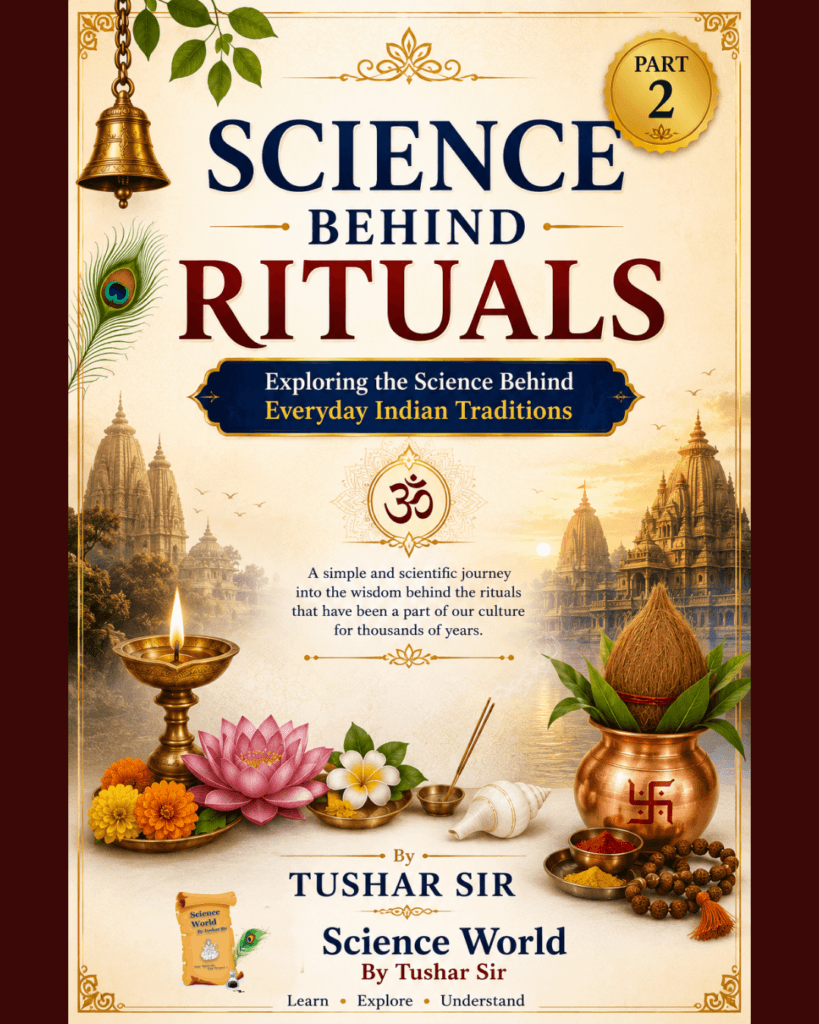
🛒 Get Science Behind Rituals – Part 2
Want to explore these traditional practices in greater detail?
Science Behind Rituals – Part 2 is available on Amazon.
📚 Explore the Science Behind Rituals Series
Book 1: Science Behind Rituals 1
Book 2: Science Behind Rituals 2
Book 3: Science Behind Rituals 3
Book 4: Science Behind Rituals 4
👉 Explore the complete Science Behind Rituals series
🧪 Science World By Tushar Sir
At Science World By Tushar Sir, learning isn’t limited to textbooks.
Science can begin with something we see every day.
A bell.
A diya.
A tree.
A river.
A prayer.
A traditional greeting.
And a simple question:
“Why?”
Science Behind Rituals – Part 2 invites you to ask that question and explore the answers.
Learn • Explore • Understand
Read. Question. Explore. Understand. Next part – 3