
Science Behind Rituals Part 1: 10 Traditional Practices Explained
Have you ever wondered why we fold our hands while saying Namaste, why we remove our shoes before entering a temple, why we ring a temple bell, or why we light a diya during पूजा?
These practices are familiar to millions of people, but the reasons behind them are often less familiar.
But what happens when we become curious and ask:
“Why do we actually do this?”
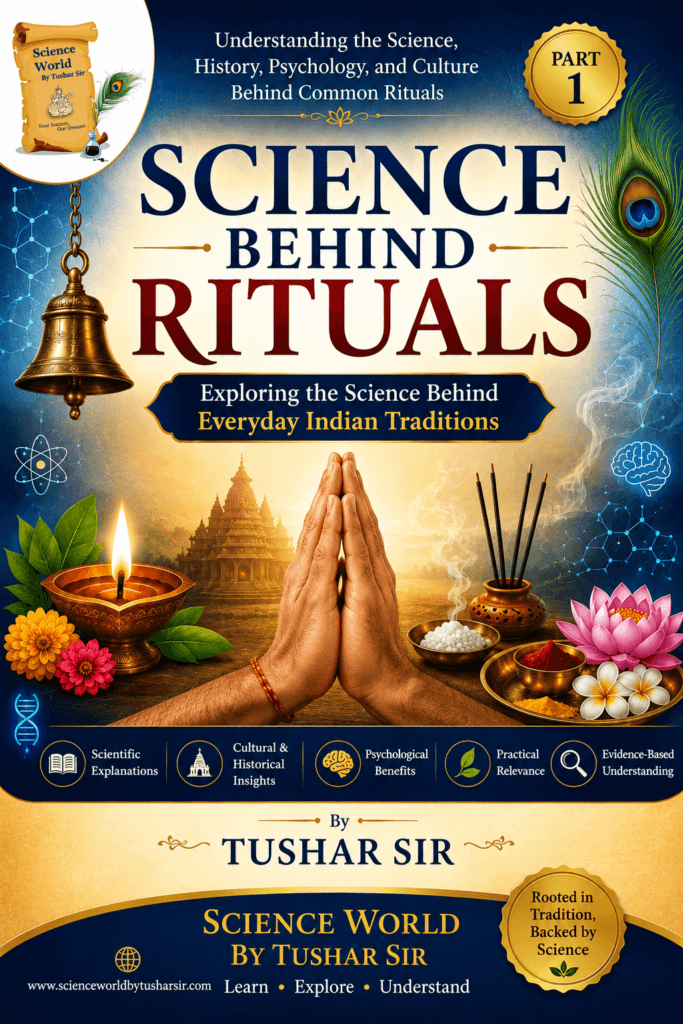
That question is at the heart of the Science Behind Rituals book series by Science World By Tushar Sir.
Our traditions are filled with rituals that have been followed for generations. Some are connected with culture, spirituality, hygiene, symbolism, social practices, or observations about human behaviour and the environment.
Table of Contents
🔬 What Are Rituals?
A ritual is a traditional or customary action performed in a particular way, often repeatedly and in a specific context.
Rituals can be connected with:
- Religious practices
- Festivals and celebrations
- Temples and places of worship
- Family traditions
- Social customs
- Daily practices
Many rituals have been passed from one generation to another. Over time, their original context or explanation may not always remain clear.
This makes them interesting subjects for curiosity, observation, reasoning and scientific thinking.
🌿 Why Do We Follow Traditional Rituals?
Traditional practices can have different origins and meanings.
Some may have developed from religious beliefs, some from cultural customs, and others may have practical or symbolic explanations.
The important thing is to develop the habit of asking questions.
Instead of simply asking:
“Is this tradition old?”
we can also ask:
“What is the purpose of this practice?”
“How did this tradition develop?”
“Is there a practical explanation?”
“What does science actually say?”
This approach encourages us to explore traditions with an open and curious mind.
📖 10 Fascinating Rituals Explored in the Book
The first book in the Science Behind Rituals series explores several familiar practices.
1. What Are Rituals?
Before exploring individual practices, it is important to understand what a ritual actually means.
This chapter introduces the idea of rituals and why traditional practices become an important part of communities and everyday life.
2. Why Do We Fold Hands — Namaste?
Namaste is one of the most recognizable traditional greetings.
But why do we bring our palms together?
Is it simply a greeting, or does the gesture have a deeper cultural and symbolic meaning?
This chapter explores the practice of folding hands while greeting others and encourages readers to look beyond simply repeating a tradition.
3. Why Do We Remove Shoes Before Entering a Temple?
Have you ever stopped at the entrance of a temple and removed your shoes without thinking about it?
This common practice raises an interesting question:
Why is footwear removed before entering many places of worship?
The chapter explores the practice and the possible cultural, cleanliness-related and symbolic aspects associated with it.
4. Why Do We Ring the Temple Bell?
The sound of a temple bell is familiar to many people.
But why is the bell rung?
Is it simply part of the ritual, or is there a reason behind this traditional practice?
This chapter examines the tradition and encourages readers to distinguish between traditional explanations, symbolic meanings and scientific evidence.
5. Why Do We Apply Tilak?
The tilak is an important traditional practice found in different parts of India.
People may apply it during पूजा, religious ceremonies, festivals and other occasions.
But what does the tilak represent?
And why is it applied?
This chapter explores the cultural and traditional significance of this familiar practice.
6. Why Do We Light a Diya?
The sight of a glowing diya is closely associated with many Indian religious and cultural occasions.
A small flame can carry deep symbolic meaning.
But beyond symbolism, what can we learn by examining the practice through observation and scientific reasoning?
This chapter explores the tradition of lighting a diya and its significance.
7. Why Do We Burn Camphor (Kapoor)?
Camphor is commonly used during पूजा and religious rituals.
When camphor burns, it behaves differently from many ordinary solid substances, making it an interesting material to observe.
This chapter explores why camphor is traditionally used and examines the practice from a scientific and observational perspective.
8. Why Do We Use Incense Sticks (Agarbatti)?
The fragrance of incense is familiar in many homes and places of worship.
But why are incense sticks used?
What happens when an incense stick burns?
And what should we understand about the traditional explanations surrounding its use?
This chapter explores the practice of using agarbatti and encourages scientific curiosity about something we often take for granted.
9. Why Do We Offer Flowers to God?
Flowers are an important part of many पूजा and religious traditions.
Different flowers may be associated with different deities, festivals and occasions.
But why are flowers offered?
This chapter explores the cultural, symbolic and traditional significance of offering flowers.
10. Why Do We Light Incense Sticks?
The final chapter returns to another familiar practice involving incense.
Why has burning incense become such a common part of पूजा and other traditional settings?
The chapter encourages readers to look at this everyday ritual carefully and understand the difference between traditional belief and scientifically supported explanation.
🧠 Tradition Meets Curiosity
One of the most interesting things about traditional practices is that they give us an opportunity to ask questions.
Science does not require us to stop being curious about traditions.
Instead, scientific thinking encourages us to examine claims carefully.
A useful approach is: Observe → Ask → Investigate → Understand
Not every traditional practice needs to have a scientific explanation, and not every popular explanation associated with a ritual is necessarily scientifically established.
That distinction is important.
The goal is not to blindly accept or reject a tradition.
The goal is to understand it better.
📚 About the Book
Science Behind Rituals is designed for curious readers who want to explore familiar Indian rituals from a different perspective.
The book covers 10 commonly observed practices, including:
- Namaste
- Removing shoes before entering a temple
- Ringing temple bells
- Applying tilak
- Lighting a diya
- Burning camphor
- Using incense sticks
- Offering flowers
- And more
It combines curiosity, traditional practices and scientific thinking to encourage readers to ask questions about the world around them.
Ideal for:
- Students
- Curious young readers
- Parents
- Teachers
- Readers interested in Indian traditions
- Anyone who enjoys learning the reasons behind everyday practices
🔎 Explore the Science Behind Everyday Rituals
The next time you visit a temple, attend a पूजा, or see someone performing a traditional practice, don’t just observe it.
Ask a question.
Why do we do this?
That simple question can lead to a fascinating journey of discovery.
📖 Get the Book
If you would like to explore these topics in greater detail, you can read Science Behind Rituals.
🛒 Available on Amazon
📚 Explore the Complete Science Behind Rituals Series
This is Book 1 of the Science Behind Rituals series.
More books in the series explore additional traditional practices and the questions surrounding them.
Book 1: Science Behind Rituals 1
Book 2: Science Behind Rituals 2
Book 3: Science Behind Rituals 3
Book 4: Science Behind Rituals 4
👉 Explore all books in the series
🧪 Science World By Tushar Sir
Learn • Explore • Understand
At Science World By Tushar Sir, our goal is to make learning interesting, understandable and connected to the world around us.
Because science isn’t limited to a textbook.
Sometimes, it begins with a simple question:
“Why?”
Read. Question. Explore. Understand.
For more eBooks and Paper books visit our Book Showcase website: www.scienceworldbytusharsir.com