
Introduction
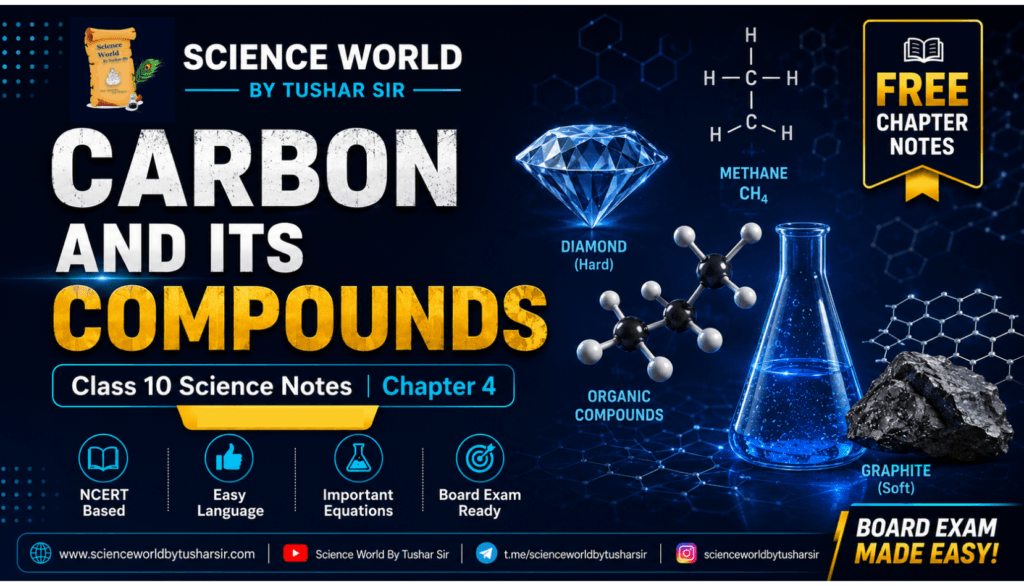
Carbon is one of the most fascinating and important elements in chemistry. It is known as the “element of life” because all living organisms contain carbon compounds. From the food we eat and the clothes we wear to medicines, fuels, plastics, and even the DNA in our cells, carbon plays a vital role in our daily lives.
Unlike most elements, carbon has the unique ability to form millions of stable compounds. This remarkable property makes it the foundation of organic chemistry, a branch of chemistry that deals with carbon-containing compounds.
In this chapter, you will learn about the unique properties of carbon, how it forms covalent bonds, the versatile nature of carbon, different types of carbon compounds, hydrocarbons, functional groups, ethanol, ethanoic acid, soaps, detergents, and their applications in everyday life.
Understanding these concepts will help you build a strong foundation for higher studies in chemistry and perform well in the CBSE Class 10 Board Examination.
Learning Objectives
After studying this chapter, you will be able to:
- Understand the unique properties of carbon.
- Explain why carbon forms covalent bonds.
- Draw electron dot structures of simple carbon compounds.
- Describe the versatile nature of carbon.
- Understand catenation and tetravalency.
- Classify different carbon compounds.
- Learn about hydrocarbons and functional groups.
- Explain the properties and uses of ethanol and ethanoic acid.
- Differentiate between soaps and detergents.
- Apply carbon chemistry concepts to real-life situations.
Carbon – The Element of Life
Carbon is represented by the symbol C and has an atomic number of 6.
Electronic Configuration
Carbon has six electrons.
Its electronic configuration is:
2, 4
This means:
- First shell (K shell): 2 electrons
- Second shell (L shell): 4 electrons
Since carbon has four electrons in its outermost shell, it is tetravalent.
Why is Carbon So Important?
Carbon is one of the most abundant elements found on Earth and in living organisms.
It forms the backbone of:
- Carbohydrates
- Proteins
- Fats
- Vitamins
- DNA
- RNA
- Medicines
- Fuels
- Plastics
- Synthetic fibres
Nearly 90% of known chemical compounds contain carbon.
Occurrence of Carbon
Carbon occurs in both free state and combined state.
Free State
Carbon exists naturally as:
- Diamond
- Graphite
- Coal
Combined State
Carbon occurs in compounds such as:
- Carbon dioxide (CO₂)
- Methane (CH₄)
- Limestone (CaCO₃)
- Petroleum
- Natural gas
- Living organisms
Physical Properties of Carbon
- Non-metal
- Exists in different forms (allotropes)
- High melting point
- Poor conductor of electricity (except graphite)
- Forms covalent compounds
- Burns in oxygen to form carbon dioxide
Chemical Properties of Carbon
Carbon:
- Forms covalent bonds.
- Shows tetravalency.
- Exhibits catenation.
- Forms single, double, and triple bonds.
- Combines with many elements such as hydrogen, oxygen, nitrogen, chlorine, and sulphur.
These properties make carbon highly versatile.
Why Doesn’t Carbon Form Ionic Compounds?
To become stable, carbon needs four more electrons to complete its outer shell.
There are two possibilities:
Option 1: Gain Four Electrons
This is difficult because:
- The nucleus cannot strongly attract four additional electrons.
- The resulting ion would be highly unstable.
Option 2: Lose Four Electrons
This is also difficult because:
- A large amount of energy is required.
- Carbon would form a highly charged ion (C⁴⁺), which is unstable.
Therefore, carbon neither gains nor loses four electrons.
Instead, it shares electrons.
Covalent Bonding
Definition
A covalent bond is a chemical bond formed by the sharing of electron pairs between atoms.
Carbon forms covalent bonds with:
- Hydrogen
- Oxygen
- Nitrogen
- Chlorine
- Other carbon atoms
Why Does Carbon Form Covalent Bonds?
Carbon forms covalent bonds because:
- It has four valence electrons.
- Sharing electrons is energetically more favourable than gaining or losing four electrons.
- Covalent bonds are strong and stable.
Formation of Hydrogen Molecule (H₂)
Each hydrogen atom has one electron.
Both hydrogen atoms share one electron each.
Result:
Both atoms achieve a stable duplet configuration.
H • + • H
↓
H : H
Formation of Chlorine Molecule (Cl₂)
Each chlorine atom has seven valence electrons.
Each shares one electron.
Both complete their octet.
Cl : Cl
Formation of Oxygen Molecule (O₂)
Each oxygen atom has six valence electrons.
Each oxygen shares two electrons.
This forms a double covalent bond.
O = O
Formation of Nitrogen Molecule (N₂)
Each nitrogen atom has five valence electrons.
They share three pairs of electrons.
This forms a triple covalent bond.
N ≡ N
Formation of Methane (CH₄)
Methane is the simplest carbon compound.
Carbon has four valence electrons.
Each hydrogen has one valence electron.
Carbon shares one electron with each hydrogen atom.
As a result:
- Carbon completes its octet.
- Each hydrogen completes its duplet.
Chemical formula: CH₄
Formation of Carbon Dioxide (CO₂)
Carbon shares two pairs of electrons with each oxygen atom.
Each oxygen forms a double bond with carbon.
Structure:
O = C = O
Chemical formula:
CO₂
Formation of Water (H₂O)
Although not a carbon compound, water is a good example of covalent bonding.
Structure:
H — O — H
Oxygen shares one electron with each hydrogen atom.
Characteristics of Covalent Compounds
Covalent compounds have several unique properties.
1. Low Melting and Boiling Points
Since the forces between molecules are weak, less energy is needed to separate them.
Examples:
- Methane
- Carbon dioxide
2. Poor Conductors of Electricity
Covalent compounds do not produce free ions.
Therefore, they cannot conduct electricity.
Exception:
Graphite conducts electricity because it contains free electrons.
3. Usually Insoluble in Water
Most carbon compounds do not dissolve in water.
They dissolve in organic solvents.
Examples:
- Benzene
- Petrol
- Kerosene
4. Usually Exist as Gases or Liquids
Many covalent compounds are gases or liquids at room temperature.
Examples:
- Methane
- Carbon dioxide
- Ethanol
Ionic vs Covalent Compounds
| Ionic Compounds | Covalent Compounds |
|---|---|
| Formed by transfer of electrons | Formed by sharing of electrons |
| Conduct electricity in molten or aqueous state | Poor conductors of electricity |
| High melting and boiling points | Low melting and boiling points |
| Usually soluble in water | Usually insoluble in water |
| Strong electrostatic forces | Weak intermolecular forces |
Everyday Applications of Covalent Compounds
Covalent compounds are found in many products we use daily.
Examples include:
- LPG
- Natural gas
- Petrol
- Diesel
- Plastic bottles
- Medicines
- Perfumes
- Cooking oil
- Wax
- Sugar
Did You Know?
💎 Diamond and graphite are both made entirely of carbon atoms. However, because their atoms are arranged differently, diamond is one of the hardest natural substances, while graphite is soft and slippery and is used in pencil leads.
Exam Tip
Remember: Carbon forms covalent bonds because it has four valence electrons and cannot easily gain or lose four electrons. This concept is one of the most frequently asked theory questions in the CBSE Class 10 Science examination.
Quick Revision
- Carbon has an atomic number of 6.
- Electronic configuration of carbon is 2, 4.
- Carbon is tetravalent.
- Carbon usually forms covalent bonds by sharing electrons.
- Covalent compounds generally have low melting and boiling points.
- They are poor conductors of electricity.
- Carbon forms single, double, and triple covalent bonds.
- Methane (CH₄) is the simplest carbon compound.
- Carbon dioxide (CO₂) contains two double covalent bonds.
Versatile Nature of Carbon
Carbon is called the “Versatile Element” because it has the unique ability to form a very large number of compounds. Scientists have discovered millions of carbon compounds, and thousands of new compounds are prepared every year.
The two main reasons for the versatile nature of carbon are:
- Tetravalency
- Catenation
These properties make carbon the backbone of organic chemistry.
Why is Carbon Called a Versatile Element?
Carbon is versatile because it can:
- Form four covalent bonds.
- Bond with other carbon atoms.
- Form long chains of carbon atoms.
- Form branched chains.
- Form ring structures.
- Form single, double, and triple bonds.
- Combine with many other elements such as hydrogen, oxygen, nitrogen, sulphur, chlorine, and halogens.
Because of these abilities, carbon forms compounds ranging from simple methane (CH₄) to complex molecules like proteins and DNA.
Tetravalency of Carbon
Definition
Tetravalency is the property of carbon by which each carbon atom forms four covalent bonds.
Carbon has four electrons in its outermost shell and requires four more electrons to complete its octet. Instead of gaining or losing four electrons, carbon shares electrons and forms four covalent bonds.
Examples of Tetravalency
Methane (CH₄)
Carbon forms one bond with each of the four hydrogen atoms.
Total bonds formed by carbon = 4
Carbon Tetrachloride (CCl₄)
Carbon forms one bond with each chlorine atom.
Again, carbon forms four covalent bonds.
Importance of Tetravalency
Tetravalency allows carbon to:
- Form stable compounds.
- Create long molecular chains.
- Form a variety of organic compounds.
- Bond with many different elements.
Without tetravalency, life as we know it would not exist.
Catenation
Definition
Catenation is the property of carbon by which carbon atoms bond with one another to form long chains, branched chains, and ring structures.
The word catenation comes from the Latin word catena, meaning “chain.”
Why Does Carbon Show Catenation?
Carbon exhibits catenation because:
- Carbon-carbon covalent bonds are very strong.
- Carbon atoms are small in size.
- Carbon can form stable single, double, and triple bonds with other carbon atoms.
This makes long carbon chains stable and durable.
Types of Carbon Chains
Carbon atoms can arrange themselves in different ways.
1. Straight Chain
Example: C – C – C – C – C
Example compound:
Pentane (C₅H₁₂)
2. Branched Chain
Example: 2-Methylbutane
3. Ring Structure
Carbon atoms can form closed rings.
Example: Cyclohexane
Advantages of Catenation
Because of catenation, carbon can form:
- Long chains
- Branched chains
- Rings
- Complex biological molecules
- Synthetic materials
Examples include:
- Plastics
- Rubber
- Nylon
- Proteins
- DNA
- Medicines
Carbon Forms Multiple Bonds
Besides single bonds, carbon can also form:
Single Bond
C — CExample:
Ethane (C₂H₆)
Double Bond
C = CExample:
Ethene (C₂H₄)
Triple Bond
C ≡ CExample:
Ethyne (C₂H₂)
Comparison of Single, Double and Triple Bonds
| Bond Type | Representation | Example |
|---|---|---|
| Single Bond | C—C | Ethane |
| Double Bond | C=C | Ethene |
| Triple Bond | C≡C | Ethyne |
Saturated Carbon Compounds
Definition
Carbon compounds containing only single covalent bonds between carbon atoms are called saturated compounds.
These compounds belong to the alkane family.
Examples
| Compound | Formula |
|---|---|
| Methane | CH₄ |
| Ethane | C₂H₆ |
| Propane | C₃H₈ |
| Butane | C₄H₁₀ |
Properties of Saturated Compounds
- Only single bonds
- Comparatively less reactive
- Undergo substitution reactions
- Burn with a clean blue flame
Unsaturated Carbon Compounds
Definition
Carbon compounds containing one or more double or triple bonds are called unsaturated compounds.
These are divided into:
- Alkenes (double bond)
- Alkynes (triple bond)
Examples: Alkene
Ethene
Formula:
C₂H₄
Contains one double bond.
Alkyne
Ethyne
Formula:
C₂H₂
Contains one triple bond.
Properties of Unsaturated Compounds
- More reactive
- Undergo addition reactions
- Burn with a yellow sooty flame
Difference Between Saturated and Unsaturated Compounds
| Saturated Compounds | Unsaturated Compounds |
|---|---|
| Single bonds only | Double or triple bonds present |
| Less reactive | More reactive |
| Alkanes | Alkenes and Alkynes |
| Substitution reactions | Addition reactions |
| Clean flame | Sooty flame |
Homologous Series
Definition
A homologous series is a family of organic compounds having:
- The same functional group
- Similar chemical properties
- The same general formula
- Consecutive members differing by one –CH₂– group
Characteristics of a Homologous Series
Members of a homologous series:
- Have the same functional group.
- Have similar chemical properties.
- Show a gradual change in physical properties.
- Differ by one carbon atom and two hydrogen atoms (–CH₂–).
Example: Alkane Series
| Compound | Formula |
|---|---|
| Methane | CH₄ |
| Ethane | C₂H₆ |
| Propane | C₃H₈ |
| Butane | C₄H₁₀ |
| Pentane | C₅H₁₂ |
Each successive compound differs by one CH₂ unit.
General Formulae
| Family | General Formula |
|---|---|
| Alkane | CₙH₂ₙ₊₂ |
| Alkene | CₙH₂ₙ |
| Alkyne | CₙH₂ₙ₋₂ |
Why is a Homologous Series Important?
It helps chemists:
- Predict properties of compounds.
- Classify organic compounds.
- Study large numbers of compounds easily.
- Understand trends in boiling and melting points.
Everyday Applications of Carbon Compounds
Carbon compounds are used in:
- LPG and CNG fuels
- Petrol and diesel
- Plastics
- Synthetic fibres
- Medicines
- Cosmetics
- Detergents
- Paints
- Food preservatives
- Fertilisers
Did You Know?
🧬 Scientists know more than 10 million carbon compounds, and new carbon compounds are discovered or synthesized every year. This is why organic chemistry is one of the largest branches of chemistry.
Exam Tip
Remember these two key terms:
Tetravalency = Four bonds formed by carbon
Catenation = Carbon atoms joining with other carbon atoms
Many CBSE board questions ask students to explain why carbon is called a versatile element. Always mention both tetravalency and catenation in your answer.
Quick Revision
- Carbon is called the versatile element.
- Tetravalency means carbon forms four covalent bonds.
- Catenation is the ability of carbon atoms to form chains and rings.
- Carbon forms single, double, and triple bonds.
- Saturated compounds contain only single bonds.
- Unsaturated compounds contain double or triple bonds.
- A homologous series is a group of compounds with the same functional group and similar chemical properties.
- Successive members of a homologous series differ by one –CH₂– group.
Hydrocarbons
Definition
Hydrocarbons are organic compounds that contain only carbon (C) and hydrogen (H) atoms.
They are the simplest carbon compounds and form the basis of organic chemistry.
Hydrocarbons are widely used as:
- Fuels
- Lubricants
- Raw materials for plastics
- Synthetic fibres
- Medicines
- Chemicals
Classification of Hydrocarbons
Hydrocarbons are mainly divided into two categories.
1. Saturated Hydrocarbons (Alkanes)
These hydrocarbons contain only single covalent bonds between carbon atoms.
General Formula
CₙH₂ₙ₊₂
Examples
| Compound | Molecular Formula |
|---|---|
| Methane | CH₄ |
| Ethane | C₂H₆ |
| Propane | C₃H₈ |
| Butane | C₄H₁₀ |
| Pentane | C₅H₁₂ |
2. Unsaturated Hydrocarbons
These hydrocarbons contain double or triple bonds between carbon atoms.
They are of two types:
(A) Alkenes
Contain at least one double bond (C=C).
General Formula
CₙH₂ₙ
Examples:
| Compound | Formula |
|---|---|
| Ethene | C₂H₄ |
| Propene | C₃H₆ |
| Butene | C₄H₈ |
(B) Alkynes
Contain at least one triple bond (C≡C).
General Formula
CₙH₂ₙ₋₂
Examples:
| Compound | Formula |
|---|---|
| Ethyne | C₂H₂ |
| Propyne | C₃H₄ |
| Butyne | C₄H₆ |
Difference Between Alkanes, Alkenes and Alkynes
| Property | Alkanes | Alkenes | Alkynes |
|---|---|---|---|
| Bond Type | Single | Double | Triple |
| Saturation | Saturated | Unsaturated | Unsaturated |
| General Formula | CₙH₂ₙ₊₂ | CₙH₂ₙ | CₙH₂ₙ₋₂ |
| Example | Methane | Ethene | Ethyne |
Functional Groups
Definition
A functional group is an atom or group of atoms attached to a carbon chain that determines the chemical properties of an organic compound.
Compounds with the same functional group show similar chemical reactions.
Common Functional Groups (CBSE Class 10)
| Functional Group | Symbol | Example |
|---|---|---|
| Alcohol | –OH | Ethanol |
| Aldehyde | –CHO | Ethanal |
| Ketone | >C=O | Propanone |
| Carboxylic Acid | –COOH | Ethanoic Acid |
| Halo Compound | –Cl, –Br, –I | Chloroethane |
Importance of Functional Groups
Functional groups help to:
- Classify organic compounds.
- Predict chemical properties.
- Name compounds correctly.
- Identify reactions of compounds.
Nomenclature of Carbon Compounds (Basic IUPAC Rules)
Chemists follow the IUPAC (International Union of Pure and Applied Chemistry) system to name organic compounds.
Step 1: Count the Carbon Atoms
| Number of Carbon Atoms | Prefix |
|---|---|
| 1 | Meth- |
| 2 | Eth- |
| 3 | Prop- |
| 4 | But- |
| 5 | Pent- |
| 6 | Hex- |
| 7 | Hept- |
| 8 | Oct- |
| 9 | Non- |
| 10 | Dec- |
Step 2: Identify the Type of Bond
| Bond | Suffix |
|---|---|
| Single | -ane |
| Double | -ene |
| Triple | -yne |
Step 3: Identify the Functional Group
Examples:
| Functional Group | Suffix |
|---|---|
| Alcohol | -ol |
| Aldehyde | -al |
| Ketone | -one |
| Carboxylic Acid | -oic acid |
Examples of Naming Compounds
| Formula | Name |
|---|---|
| CH₄ | Methane |
| C₂H₆ | Ethane |
| C₂H₄ | Ethene |
| C₂H₂ | Ethyne |
| C₂H₅OH | Ethanol |
| CH₃COOH | Ethanoic Acid |
Chemical Properties of Carbon Compounds
Carbon compounds undergo several important chemical reactions.
The four reactions included in the CBSE syllabus are:
- Combustion
- Oxidation
- Addition Reaction
- Substitution Reaction
1. Combustion Reaction
Definition
A combustion reaction is a reaction in which a carbon compound burns in the presence of oxygen to produce carbon dioxide, water, heat, and light.
Example
CH4+2O2→CO2+2H2O+Heat
Methane burns with a blue flame.
Characteristics
- Produces heat.
- Produces light.
- Releases carbon dioxide.
- Releases water vapour.
- Highly exothermic.
Everyday Examples
- Burning LPG
- Burning petrol
- Burning natural gas
- Cooking fuel
2. Oxidation Reaction
Definition
Oxidation is the addition of oxygen or removal of hydrogen from a compound.
Example
Ethanol reacts with an oxidising agent to form ethanoic acid.CH3CH2OH+2[O]→CH3COOH+H2O
Common oxidising agents:
- Alkaline potassium permanganate (KMnO₄)
- Acidified potassium dichromate (K₂Cr₂O₇)
3. Addition Reaction
Addition reactions occur mainly in unsaturated hydrocarbons because they contain double or triple bonds.
Example
Hydrogenation of EtheneCH2=CH2+H2NiCH3−CH3
Hydrogen is added across the double bond in the presence of a nickel catalyst.
Hydrogenation of Vegetable Oils
Vegetable oils are unsaturated.
Passing hydrogen through heated oil in the presence of nickel converts it into vanaspati ghee.
Applications
- Manufacture of margarine
- Vanaspati ghee production
- Food industry
4. Substitution Reaction
Saturated hydrocarbons undergo substitution reactions.
In this reaction, one atom is replaced by another atom.
Example
Methane reacts with chlorine in sunlight.CH4+Cl2SunlightCH3Cl+HCl
One hydrogen atom is replaced by chlorine.
Comparison of Addition and Substitution Reactions
| Addition Reaction | Substitution Reaction |
|---|---|
| Occurs in unsaturated compounds | Occurs in saturated compounds |
| Atoms are added | One atom replaces another |
| Double/triple bond changes to single bond | Carbon chain remains intact |
| Example: Hydrogenation of ethene | Chlorination of methane |
Important Reactions at a Glance
| Reaction Type | Example |
|---|---|
| Combustion | CH₄ + 2O₂ → CO₂ + 2H₂O |
| Oxidation | Ethanol → Ethanoic Acid |
| Addition | Ethene + H₂ → Ethane |
| Substitution | CH₄ + Cl₂ → CH₃Cl + HCl |
Everyday Applications
Carbon compounds are essential in:
- Cooking gas (LPG)
- Petrol and diesel
- Plastics
- Medicines
- Synthetic fibres
- Paints
- Cosmetics
- Perfumes
- Food preservatives
- Fertilisers
Did You Know?
🧪 Natural gas used in homes mainly contains methane (CH₄), the simplest hydrocarbon. It burns with a clean blue flame, making it an efficient and environmentally friendlier fuel compared to coal.
Exam Tip
Remember the reaction types:
- Combustion → Burns in oxygen
- Oxidation → Addition of oxygen
- Addition → Unsaturated compounds + Hydrogen
- Substitution → Saturated compounds + Halogen
These reactions are frequently tested in CBSE board examinations.
Quick Revision
- Hydrocarbons contain only carbon and hydrogen.
- Alkanes are saturated hydrocarbons.
- Alkenes contain double bonds.
- Alkynes contain triple bonds.
- Functional groups determine the chemical properties of organic compounds.
- IUPAC names are based on the number of carbon atoms, bond type, and functional group.
- Carbon compounds undergo combustion, oxidation, addition, and substitution reactions.
- Hydrogenation converts unsaturated vegetable oils into saturated fats using a nickel catalyst.
Ethanol (Ethyl Alcohol)
Definition
Ethanol is an organic compound belonging to the alcohol family. It contains the –OH (hydroxyl) functional group.
Molecular Formula
C₂H₅OH
Structural Formula
H H
| |
H — C — C — O — H
| |
H H
Functional Group
–OH (Hydroxyl Group)
Physical Properties of Ethanol
- Colourless liquid
- Pleasant characteristic smell
- Miscible (completely soluble) in water
- Neutral in nature
- Boiling point: 78°C
- Volatile and highly flammable
Chemical Properties of Ethanol
1. Combustion Reaction
Ethanol burns in the presence of oxygen to produce carbon dioxide and water.
Balanced Chemical Equation
C2H5OH+3O2→2CO2+3H2O+Heat
Observation
- Blue flame
- Large amount of heat released
- No smoke under complete combustion
2. Oxidation of Ethanol
When ethanol is oxidised using an oxidising agent such as alkaline potassium permanganate (KMnO₄) or acidified potassium dichromate (K₂Cr₂O₇), it forms ethanoic acid.
Balanced Equation
CH3CH2OH+2[O]→CH3COOH+H2O
Uses of Ethanol
Ethanol is widely used in everyday life.
Industrial Uses
- Manufacture of perfumes
- Medicines
- Paints
- Varnishes
- Cosmetics
- Organic solvents
Domestic Uses
- Hand sanitizers
- Cleaning agents
- Spirit lamps
- Laboratory fuel
Medical Uses
- Antiseptic
- Disinfectant
- Pharmaceutical preparations
Harmful Effects of Alcohol Consumption
Excessive consumption of alcoholic beverages containing ethanol may lead to:
- Liver damage
- Poor coordination
- Reduced concentration
- Addiction
- Health disorders
Health Note: Ethanol has valuable industrial and medical uses, but alcoholic beverages should never be consumed irresponsibly because excessive consumption is harmful to health.
Ethanoic Acid (Acetic Acid)
Definition
Ethanoic acid is a carboxylic acid containing the –COOH (carboxyl) functional group.
Molecular Formula
CH₃COOH
Structural Formula
       O
      ||
CH₃ — C — OH
Properties of Ethanoic Acid
- Colourless liquid
- Sour taste
- Pungent smell
- Weak acid
- Completely soluble in water
Why is it Called Glacial Acetic Acid?
Pure ethanoic acid freezes at about 16.6°C.
During winter it forms ice-like crystals.
Hence it is called glacial acetic acid.
Chemical Properties of Ethanoic Acid
1. Reaction with Sodium
Ethanoic acid reacts with sodium metal to produce sodium ethanoate and hydrogen gas.
Balanced Equation
2CH3COOH+2Na→2CH3COONa+H2
2. Reaction with Sodium Carbonate
Ethanoic acid reacts with sodium carbonate to produce carbon dioxide.
Balanced Equation
2CH3COOH+Na2CO3→2CH3COONa+CO2+H2O
Observation
- Brisk effervescence
- Carbon dioxide gas evolves
3. Reaction with Sodium Bicarbonate
CH3COOH+NaHCO3→CH3COONa+CO2+H2O
Uses of Ethanoic Acid
- Vinegar (about 5–8% solution)
- Food preservation
- Pickles
- Manufacturing dyes
- Textile industry
- Rubber industry
- Medicines
- Perfumes
Esterification Reaction
Definition
The reaction between an alcohol and a carboxylic acid in the presence of concentrated sulphuric acid (H₂SO₄) to form an ester and water is called esterification.
Balanced Equation
CH3COOH+C2H5OHConc. H2SO4CH3COOC2H5+H2O
Products:
- Ethyl ethanoate (Ester)
- Water
Characteristics of Esters
- Pleasant fruity smell
- Volatile liquids
- Used in perfumes
- Used as flavouring agents
- Used in cosmetics
Saponification Reaction
Definition
The alkaline hydrolysis of an ester to produce soap and alcohol is called saponification.
This reaction is used in the manufacture of soap.
Soap
Definition
Soap is the sodium or potassium salt of a long-chain fatty acid.
Examples:
- Sodium stearate
- Sodium palmitate
Raw Materials Used in Soap Making
- Vegetable oils
- Animal fats
- Sodium hydroxide (NaOH)
How Does Soap Clean?
Soap molecules have two parts.
1. Hydrophobic Tail
- Dissolves in grease and oil.
- Repels water.
2. Hydrophilic Head
- Attracted to water.
- Dissolves in water.
Together they form tiny spherical structures called micelles.
The grease gets trapped inside the micelles and is washed away with water.
Conditions Necessary for Micelle Formation
Micelles are formed only when the soap concentration is above a certain minimum value called the Critical Micelle Concentration (CMC).
Hard Water and Soap
Hard water contains calcium and magnesium ions.
Soap reacts with these ions to form an insoluble white substance called scum.
This reduces the cleansing action of soap.
Detergents
Definition
Detergents are synthetic cleansing agents that work effectively even in hard water.
They do not form scum with calcium or magnesium ions.
Advantages of Detergents
- Work in hard water
- Produce more lather
- Better cleaning ability
- Suitable for washing machines
Difference Between Soap and Detergent
| Soap | Detergent |
|---|---|
| Made from natural oils and fats | Made from synthetic chemicals |
| Forms scum in hard water | Does not form scum |
| Less effective in hard water | Effective in both soft and hard water |
| Biodegradable (most soaps) | Some detergents are non-biodegradable |
Advantages of Soap
- Eco-friendly
- Biodegradable
- Less harmful to the environment
- Made from renewable resources
Disadvantages of Soap
- Ineffective in hard water
- Forms scum
- Less lather in hard water
Advantages of Detergents
- Effective in all types of water
- Better cleansing
- No scum formation
- Suitable for modern washing machines
Everyday Applications
Carbon compounds are found in:
- Perfumes
- Vinegar
- Soaps
- Toothpaste
- Detergents
- Medicines
- Sanitizers
- Cosmetics
- Fuels
- Food preservatives
- Plastic products
Activity: Esterification
Materials
- Ethanol
- Ethanoic acid
- Concentrated sulphuric acid
- Test tube
Procedure
- Mix ethanol and ethanoic acid.
- Add a few drops of concentrated sulphuric acid.
- Warm the mixture gently.
Observation
A pleasant fruity smell is produced due to the formation of an ester.
Conclusion
Alcohol reacts with a carboxylic acid to form an ester.
Exam Tip
Memorise these key functional groups:
- Alcohol: –OH
- Carboxylic Acid: –COOH
- Ester: –COO–
Also remember the esterification equation, as it is one of the most frequently asked reactions in CBSE Class 10 examinations.
Did You Know?
🧼 Soap was first made thousands of years ago using animal fat and wood ash. Today, most soaps are produced from vegetable oils and sodium hydroxide, making them more environmentally friendly.
Quick Revision
- Ethanol belongs to the alcohol family and contains the –OH functional group.
- Ethanoic acid belongs to the carboxylic acid family and contains the –COOH functional group.
- Ethanol burns to produce carbon dioxide and water.
- Ethanol is oxidised to ethanoic acid.
- Ethanoic acid reacts with alcohol to form an ester (esterification).
- Esters have a pleasant fruity smell.
- Soap is produced by the saponification reaction.
- Soap forms micelles that help remove grease.
- Soap is less effective in hard water because it forms scum.
- Detergents clean effectively in both soft and hard water.
Important Definitions
1. Carbon
Carbon is a non-metallic element with the atomic number 6. It is the basic element of all organic compounds.
2. Covalent Bond
A covalent bond is a chemical bond formed by the sharing of electrons between atoms.
3. Tetravalency
Tetravalency is the property of carbon by which each carbon atom forms four covalent bonds.
4. Catenation
Catenation is the property of carbon to bond with other carbon atoms and form long chains, branched chains, and ring structures.
5. Hydrocarbon
A hydrocarbon is an organic compound made up of only carbon and hydrogen atoms.
6. Saturated Hydrocarbon
A hydrocarbon containing only single covalent bonds between carbon atoms is called a saturated hydrocarbon (alkane).
7. Unsaturated Hydrocarbon
A hydrocarbon containing one or more double or triple bonds between carbon atoms is called an unsaturated hydrocarbon (alkene or alkyne).
8. Functional Group
A functional group is an atom or group of atoms that determines the characteristic chemical properties of an organic compound.
9. Homologous Series
A homologous series is a family of organic compounds having the same functional group, similar chemical properties, and consecutive members differing by a –CH₂– group.
10. Ethanol
Ethanol (C₂H₅OH) is an alcohol containing the –OH functional group.
11. Ethanoic Acid
Ethanoic acid (CH₃COOH) is a carboxylic acid containing the –COOH functional group.
12. Esterification
Esterification is the reaction between an alcohol and a carboxylic acid in the presence of concentrated sulphuric acid to form an ester and water.
13. Saponification
Saponification is the reaction in which an ester reacts with an alkali to produce soap and alcohol.
14. Soap
Soap is the sodium or potassium salt of a long-chain fatty acid.
15. Detergent
A detergent is a synthetic cleansing agent that works effectively in both soft and hard water.
NCERT Keywords
- Carbon
- Covalent Bond
- Electron Dot Structure
- Tetravalency
- Catenation
- Hydrocarbon
- Alkane
- Alkene
- Alkyne
- Saturated Compound
- Unsaturated Compound
- Functional Group
- Homologous Series
- Ethanol
- Ethanoic Acid
- Esterification
- Ester
- Saponification
- Soap
- Detergent
- Micelle
- Hard Water
- Hydrogenation
- Combustion
- Oxidation
- Addition Reaction
- Substitution Reaction
Important Chemical Equations
| Reaction | Balanced Chemical Equation |
|---|---|
| Combustion of methane | CH₄ + 2O₂ → CO₂ + 2H₂O |
| Combustion of ethanol | C₂H₅OH + 3O₂ → 2CO₂ + 3H₂O |
| Oxidation of ethanol | CH₃CH₂OH + 2[O] → CH₃COOH + H₂O |
| Hydrogenation of ethene | CH₂=CH₂ + H₂ → CH₃–CH₃ (Ni catalyst) |
| Chlorination of methane | CH₄ + Cl₂ → CH₃Cl + HCl (Sunlight) |
| Esterification | CH₃COOH + C₂H₅OH → CH₃COOC₂H₅ + H₂O |
| Ethanoic acid + Sodium | 2CH₃COOH + 2Na → 2CH₃COONa + H₂ |
| Ethanoic acid + Sodium carbonate | 2CH₃COOH + Na₂CO₃ → 2CH₃COONa + CO₂ + H₂O |
| Ethanoic acid + Sodium bicarbonate | CH₃COOH + NaHCO₃ → CH₃COONa + CO₂ + H₂O |
Commonly Confused Concepts
| Concept 1 | Concept 2 | Difference |
|---|---|---|
| Tetravalency | Catenation | Tetravalency means carbon forms four bonds, while catenation is the ability of carbon atoms to bond with each other. |
| Saturated Compounds | Unsaturated Compounds | Saturated compounds have only single bonds; unsaturated compounds contain double or triple bonds. |
| Soap | Detergent | Soap forms scum in hard water, whereas detergents do not. |
| Ethanol | Ethanoic Acid | Ethanol is an alcohol (–OH), while ethanoic acid is a carboxylic acid (–COOH). |
| Addition Reaction | Substitution Reaction | Addition occurs in unsaturated compounds; substitution occurs mainly in saturated compounds. |
Real-Life Applications
The concepts in this chapter are closely connected to everyday life:
- LPG and CNG used as domestic fuels.
- Petrol and diesel used in vehicles.
- Ethanol used in sanitizers, medicines, and laboratories.
- Vinegar (ethanoic acid) used in cooking and food preservation.
- Soap and detergents used for cleaning.
- Plastics, synthetic fibres, paints, and cosmetics are made from carbon compounds.
- Organic chemistry is essential in pharmaceuticals, agriculture, and biotechnology.
One-Page Quick Revision
Remember These Points
- Carbon has atomic number 6 and electronic configuration 2,4.
- Carbon forms covalent bonds due to tetravalency.
- Carbon shows catenation, forming chains and rings.
- Hydrocarbons are compounds of carbon and hydrogen only.
- Alkanes are saturated; alkenes and alkynes are unsaturated.
- Functional groups determine the properties of organic compounds.
- Ethanol contains the –OH functional group.
- Ethanoic acid contains the –COOH functional group.
- Esterification forms esters with pleasant fruity smells.
- Soap works by forming micelles around grease.
- Detergents are more effective than soaps in hard water.
Board Exam Tips
✔ Learn all important functional groups.
✔ Practice drawing electron dot structures of:
- Methane (CH₄)
- Ethane (C₂H₆)
- Ethene (C₂H₄)
- Carbon dioxide (CO₂)
✔ Memorise the general formulae:
- Alkanes: CₙH₂ₙ₊₂
- Alkenes: CₙH₂ₙ
- Alkynes: CₙH₂ₙ₋₂
✔ Revise all important reactions:
- Combustion
- Oxidation
- Addition
- Substitution
- Esterification
✔ Practice writing balanced chemical equations.
✔ Solve NCERT in-text and exercise questions thoroughly.
Frequently Asked Questions (FAQs)
Q1. Why is carbon called the versatile element?
Carbon is called the versatile element because it shows tetravalency and catenation, enabling it to form millions of stable compounds.
Q2. Why does carbon form covalent bonds?
Carbon has four valence electrons and cannot easily gain or lose four electrons. Therefore, it shares electrons to complete its octet.
Q3. What is a hydrocarbon?
A hydrocarbon is a compound made only of carbon and hydrogen atoms.
Q4. What is the difference between saturated and unsaturated hydrocarbons?
Saturated hydrocarbons contain only single bonds, whereas unsaturated hydrocarbons contain one or more double or triple bonds.
Q5. What is a functional group?
A functional group is an atom or group of atoms that determines the chemical properties of an organic compound.
Q6. What is esterification?
Esterification is the reaction between an alcohol and a carboxylic acid in the presence of concentrated sulphuric acid to produce an ester and water.
Q7. Why do soaps not work well in hard water?
Soap reacts with calcium and magnesium ions present in hard water to form an insoluble scum, reducing its cleansing action.
Q8. Why are detergents preferred over soaps in hard water?
Detergents do not form scum with calcium and magnesium ions, making them more effective in hard water.
Q9. What is the function of a nickel catalyst in hydrogenation?
Nickel acts as a catalyst, speeding up the addition of hydrogen to unsaturated vegetable oils to produce saturated fats.
Q10. Which topics from this chapter are most important for the CBSE Board Examination?
Students should focus on:
- Covalent bonding
- Electron dot structures
- Tetravalency and catenation
- Hydrocarbons
- Functional groups
- Ethanol and ethanoic acid
- Esterification
- Soap and detergent
- Important chemical equations
Chapter Summary
Carbon is one of the most important elements in nature due to its ability to form a vast number of compounds. Its tetravalency and catenation make it the foundation of organic chemistry. In this chapter, you learned about covalent bonding, hydrocarbons, functional groups, homologous series, and the basic nomenclature of carbon compounds.
You also explored the chemical properties of carbon compounds, including combustion, oxidation, addition, and substitution reactions. The chapter further explained the properties and uses of ethanol and ethanoic acid, along with esterification, saponification, and the cleansing action of soaps and detergents.
These concepts are not only important for the CBSE Class 10 Science examination but also help in understanding many products and processes encountered in everyday life.
💡 Did You Know?
🌍 Carbon forms the backbone of all known living organisms. Everything from the DNA in your cells to the food you eat and the fuels you use contains carbon compounds, making carbon one of the most essential elements for life on Earth.
📚 Continue Learning
Previous Chapter: Metals and Non-Metals – Class 10 Notes (Chapter 3)
Next Chapter: Life Processes – Class 10 Notes (Chapter 5)
📘 Prepare Smarter with the Complete CBSE Class 10 Science Master Guide
These free notes provide a solid understanding of the chapter. For complete board exam preparation, explore the CBSE Class 10 Science Master Guide (2026–27 Edition) by Science World By Tushar Sir.
📖 What You’ll Get
- ✅ Complete theory for all chapters
- ✅ Chapter-wise MCQs
- ✅ Assertion & Reason Questions
- ✅ Case-Based Questions.
- ✅ Short & Long Answer Questions
- ✅ Mind Maps & Flowcharts
- ✅ Practice Papers
- ✅ Smart Revision Notes
- ✅ Exam Strategies for Higher Scores
📚 Available Formats
- 📕 Paperback Edition
- 📱 eBook Edition