INTRODUCTION (Life Processes Class 10 Notes)
It is simple to find that object is either living or non-living on the basis of following points:
- Nutrition: Process by which organisms obtain and utilise the nutrients. Plant nutrition involves the photosynthesis process animal nutrition involve taking of food inside the body and its digestion.
- Respiration: It is a process that involves breakdown of respiratory substrates through oxidation and release of energy.
- Excretion: The process involved removal of harmful or tonic washes from the body.
- Transport: It is a process in which the substances observed or synthesized in one part of body are carried to other parts of body.
- Control and coordination: It is the process that helps living organism to receive information from surrounding and behave accordingly in order to survive in the changing environment around them.
- Growth and development: Growth is a permanent increase in size of organism. Development is the whole series of changes which an organism goes through during its life cycle.
- Movement and locomotion: Movement of entire organism from one place to another is called locomotion. When the organism remains fixed moving only its body parts, it is called movement.
NUTRITION
All living organisms need nutrients to build up most of their own body molecules and to get energy for doing work.
- Nutrients are inorganic as well as organic substance which the organisms obtain from their surrounding in order to synthesize their body constituents and use them as a source of energy.
- Nutrition id defined as the process of intake of nutrients and its utilisation by an organism in various biological activities.
MODES OF NUTRITION
On the basis of mode of nutrition organisms are classified into two:
- Autotrophic
It is a kind of nutrition in which organism prepares their own organic food and utilising only the inorganic raw materials present in the surroundings. Such as plants are called Autotrophs.
- Heterotrophic
It is a kind of nutrition in which the organism derive energy from the intake and digestion of the organic substances prepared by autotrophic and other organic source.
TYPES OF HETEROTROPHIC NUTRITION
- Saprophytic nutrition– In this organism derive their nutrient from dead and decaying organic matter (that may be leaves, household wastes etc.) as mushroom.
- Parasitic nutrition– In this organism derives nutrient or food from other living organisms. Such as Cuscuta, fasciola, ascaris, Taenia etc.
- Holozoic nutrition. In this organism take food in the form of the complex organic matter by ingestion is called holozoic nutrition. Such as cow, tiger, human, etc.
NUTRITION IN PLANTS
Plant also needs organic food to fulfil their requirement of energy for various metabolic activities. Green plants are autotrophic since they synthesise their food by photosynthesis process.
- The process of photosynthesis can be defined as the conversion of photon energy into chemical energy by green parts of the plants.
6CO2 + 12H2O gives C6H12O6 + 6H2O + 6O2
- Chlorophyll is the coloured organic substance that absorbs visible light. The process of photosynthesis does not occur only in those cells which possess green coloured plastids called as Chloroplast. It is not usually found in upper and lower epidermis of green leaf except in guard cells of stomata. They occur in mesophyll cells that occupy the space b/w upper and lower epidermis.
- In chloroplast thylakoid is the site where chlorophyll and carotenoids are located and shows light reaction of photosynthesis.
FACTORS AFFECTING PHOTOSYNTHESIS
- Light
- Temperature.
- Carbon-di-oxide.
- Water
NUTRITION IN ANIMALS
Majority of invertebrates and all vertebrate eat food through the mouth. This is called ingestion. After ingestion they break up large organic molecules into smaller ones in their own body with help of enzymes. Simple molecules are then absorbed into the cells & utilised. This is known as digestion, absorption and assimilation, such kind of nutrition is called holozoic nutrition and the organisms are holozoic organism.
These organisms are classified in three:
- Herbivores: that eats only algae or plant materials. Such as cow, rabbit, goat, camel, horse, hippopotamus, deer, etc.
- Carnivores: that eats only flesh of other animal such as loin, tiger, lizard, frog, snake, vulture, etc.
- Omnivores: That eats both plants and animals as food. Such as Man, sparrow, rat, cockroach, bear, dog, ant etc.
NUTRITION IN AMOEBA
Amoeba is an aquatic protozoan that lives at bottom of freshwater pools and streams of water. It is microscopic organism. It occurs in water which has lot of vegetation, decaying organic matter and bacteria.
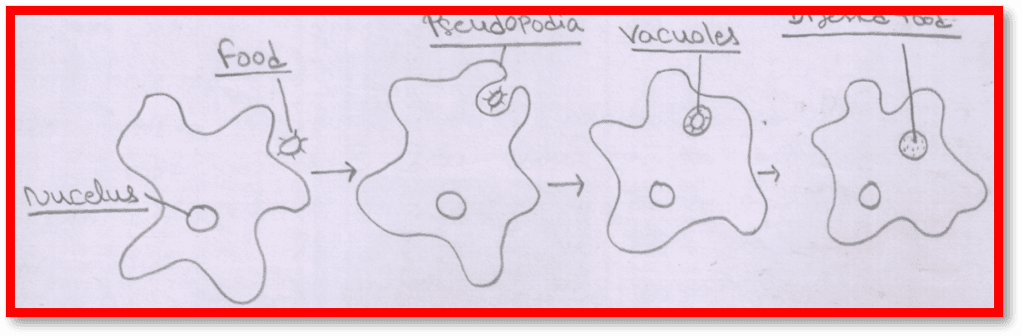
It shows the holozoic nutrition. Process of obtaining food is called phagocytosis and various steps that involves in its digestion are:
- Ingestion: Amoeba ingests the food by help of pseudopodia. After ingestion of food particle, it forms food vacuoles inside its body.
- Digestion: Food is digested in food vacuole by help of digestive enzymes due to which large molecules become converted into simpler form.
- Absorption: Digested food from vacuoles is directly absorbed into cytoplasm of Amoeba by process of dissension. After it food vacuoles become disappears.
- Assimilation: Absorbed food in cell of Amoeba is used to form energy through respiration. Remaining part of absorbed food used for growth of Amoeba. Thus, grow in size and then reproduce.
- Egestion: Amoeba has no fixed place for removing of undigested part of food, when a considerable amount of food collects inside amoeba, then its cell membrane ruptures at any place and wastes thrown from it.
Human Digestive system
Human beings are heterotrophic omnivore’s organisms. They obtain their food from plants, Animal and their products by holozoic mode of nutrition. Human digestive system consists of an alimentary canal and many digestive glands.
Alimentary canal is a long tube with muscular wall, glandular epithelial lining and varying diameter. It extends from mouth to the anal opening. Alimentary canal measures about 9-meter-long tube in which duct of several digestive glands open to secretes their respective digestive secretions. Alimentary canal consists of several organs.
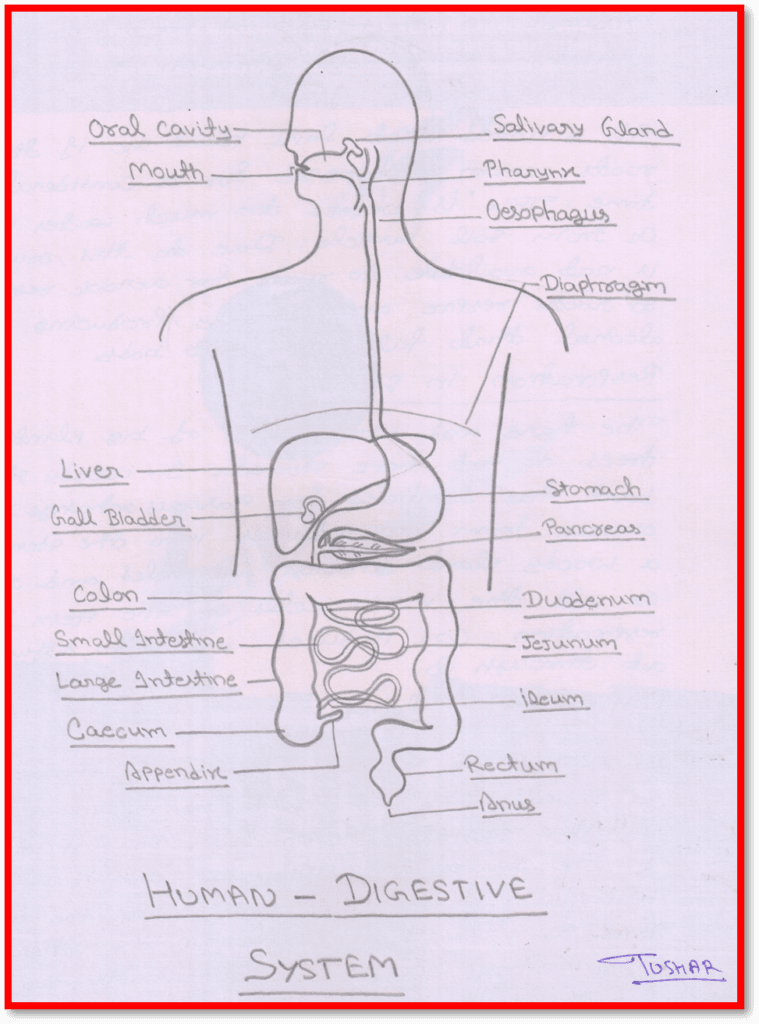
- Mouth: Opening of human digestive system which gives passage for ingestion of food. It is guarded by pair of labia.
- Oral Cavity: large space bounded above by the palate. There are pair of jaws and soft muscular tongue, each jaw has 16 teeth with formula I2/2, C1/1, Pm 2/2, M3/3 and four types of teeth in each jaw. Teeth cut the food into small pieces and chew them to make it soft for easy swallowing. Salivary gland secretes salvia in oral cavity through their duct that is ptyalin also called the salivary amylase. It acts on carbohydrate and splits into simple form thus digestion of carbohydrates begins from it.
- Pharynx: It is funnel shaped vertical canal that serves as a passage way for food from buccal cavity to the oesophagus.
- Oesophagus: It is a tubular structure which serves as to carry the food from pharynx to stomach. It is not concerned with digestion but represents the contraction and expansion of walls i.e. peristaltic movement.
- Stomach: It is site for food where it stored for short interval of time. Here protein digestion starts this will occur by the help of gastric juice (Action of pepsin).
- Small Intestine: It is the longest part of alimentary canal. It has three parts. Duodenum, jejunum & ileum. Here each type of food completely digested. In this pancreatic and bile juice help to increase its absorption area.
- Large intestine: It also consists of three parts Caecum, colon & Rectum. It is shorter but wider in diameter. It also secretes mucus for lubrication. Faecal matter is egested through the anus.
Digestion of fat
In small Intestine
Fat Bile juice Emulsified fat Lipase Fatty Acid
Digestion of Protein
Stomach
Protein pepsin peptones
small intestine
Peptones Trypsin Amino Acid
Digestion of carbohydrates
Mouth
Starch salivary Amylase maltose + Iso-maltose + dextrin.
Small intestine
Maltose maltase Glucose
Iso-maltose Isomaltase Glucose
Dextrin Dextrinase Glucose
ACCESSORY GLANDS
- Liver: It is the largest gland. Cell of which produce bile juice are called Hepatic cells. Bile juice has no enzyme but have bile salts that help in digestion of fat in small intestine. Bile also changes acidic medium into basic medium.
- Pancreas: It is second largest gland that poured into small intestine and help in all three types of the digestion by producing lipase for fat, Trypsin for protein & pancreatic amylase for starch.
- Gall bladder: It store bile Juice when there is (small Intestine) absence of fatty food.
- Salivary gland: it is subdivided into three parts, all of which produces the saliva that help in digestion of carbohydrate.
Hydrochloric Acid: It presents in gastric juice and help in activation of pepsin from its inactive form pepsinogen. It also helps to kill the bacteria that come along with food.
Mucus: It protects the internal layer of stomach from action of HCl.
DENTAL CARRIES
Formation of small cavities in teeth due to the action of acid forming bacteria and the improper dental care is called Dental carries. If teeth are not cleaned regularly, they become covered with a sticky, yellowish layer of food particles and bacterial cells called the Dental plaque.
RESPIRATION
The process of releasing energy from food is called Respiration. It involves taking in O2 into the cells, using it for releasing energy by burning food and then eliminated the waste products from body of human. It is essential process for life because it provides energy for carrying out the entire organism alive.
BREATHING AND RESPIRATION
- The mechanism by which organism obtain O2 from air and release CO2 is called as breathing. While respiration includes breathing and oxidation of food in cells of organism to release energy.
- Breathing is physical process while respiration is a biochemical process that requires many enzymes.
- Breathing involves with the lungs. While the respiration involves with the mitochondria of cells where food is oxidised.
- Respiration is just opposite to the photosynthesis. Because photosynthesis makes food by using CO2, water and sunlight and releasing O2 whereas respiration breaks food (like glucose) by using O2 and release CO2, water and energy.
Energy produced during respiration is stored in the form of ATP molecules in the cell of body of human.
- ADP + IP + Energy ATP (from respiration) (stored energy in cells)
- ATP ADP + IP + Energy (for use in cell)
Initial steps of glucose breakdown occur in the cytosol and results in the production of pyruvic acid (1 molecule of glucose give rise two molecules of pyruvic acid.)
- This pathway does not require oxygen. Fate of pyruvic acid determined by the presence or absence of O2. when O2 is not available pyruvic acid breakdown as an aerobically to produce either – ethyl alcohol and H2O in case of yeast and plant body or lactic acid in case of animal body cells this is three carbon compounds.
If oxygen is available pyruvic acid enters in mitochondria and breakdown aerobically and proceeds the kerb cycle. It results the complete breakdown of pyruvic acid resulting in the release of CO2 & H2O.
TYPES OF RESPIRATION
- Aerobic respiration is that which carried out in the presence of oxygen. Here the glucose molecule completely breakdown into CO2 and water. It produces large amount of energy that stored in the form of ATP molecules. Mitochondria are the sites of aerobic respiration in the cells.
Glucose Glycolysis Pyruvate kerb cycle CO2 + H2O + 38ATP
(1 molecule) In cytosol (2-molecules)
- Anaerobic respiration is that which takes place in absence of O2. Microscopic bacteria and some yeast obtain energy by this method. In this glucose breakdown into the ethanol and CO2 and release energy. This energy is then used by m/o. It produces much less energy.
Glucose glycolysis Pyruvate yeast C2H5OH + CO2 +2ATP
(1-molecule) In cytosol (2- molecules)
At some time anaerobic respiration takes place in human muscles mainly during vigorous physical exercise when oxygen gets used up faster in muscle cells than supplied by blood.
Glucose Glycolysis Pyruvic acid absence of O2 2lactic acid + 2ATP (1 molecule) In cytosol (2-molecule) Muscles
RESPIRATION IN PLANTS
Respiration in plants occurs at a slow rate. On the other hand, respiration in animals occurs at a much faster rate. During respiration in plants, there is a little transport of respiratory gases from one part of the plant to the other. On the other hand, respiratory gases are usually transported over long distances inside an animal during respiration.
Respiration in roots
Air presents in b/w the particles of soil. Roots of plants take the O2 required for respiration by the process of diffusion. Oxygen diffuses in root hairs and reaches all other cells of root for respiration. Carbon-di-oxide gas is produced in the cells of root during the respiration moves out through the same root hairs by process of diffusion.
It is noted that land plant dies if their roots remain water logged for a considerable time. This is because too much water expels O2 from soil particle. Due to this, oxygen is not available to roots for aerobic respiration so roots respire an-aerobically, producing the alcohol that kill the plant body.
Respiration in stems
The hard and woody stems of big plants or trees do not have stomata. In woody stems bark has lenticles for gaseous exchange. The oxygen from air diffuses into the stem of a woody plant through lenticles and reaches all the inner cells of the stem for respiration. CO2 produced are also diffuse out through it.
Respiration in leaves
Exchange of respiratory gases in the leaves takes place by the process of diffusion through the stomata. Oxygen from air diffuses in respiration in leaves occurs during the day time as well as at night. On the other hand, photosynthesis occurs only during the day time.
Day time when photosynthesis occurs O2 is produced. Leaves use some of this O2 for respiration and rest of O2 diffuses out into air during day time, CO2 produced by respiration is all used up in photosynthesis by leaves. Even more CO2 is taken in from air. Thus, net gas exchange in leaves during day time is; O2 diffuse out & CO2 diffuse in.
Night time when no photosynthesis occurs and hence no O2 is produced, O2 from air diffuses into leaves to carry to carry out respiration and CO2 produced by respiration diffused in and CO2 diffused out.
RESPIRATION IN ANIMALS
- In simple cellular (unicellular) animals like amoeba respiration takes place by the simple diffusion of gases through cell membrane.
- Earthworm used their skin to absorb O2 from air and remove CO2.
- Aquatic animals like fish, prawn have gills as respiratory organs which extract O2disolved in water.
- Insect like grasshopper, cockroach, housefly & a mosquito have tiny holes called spiracles on their body and air tubes called trachea for respiration.
- Respiratory organs of land animals such as man, birds, lizard, dog, and frog etc, are the lungs.
Respiration in Human being
Respiratory system in human being consists of two components: – Respiratory tract & Respiratory organs.
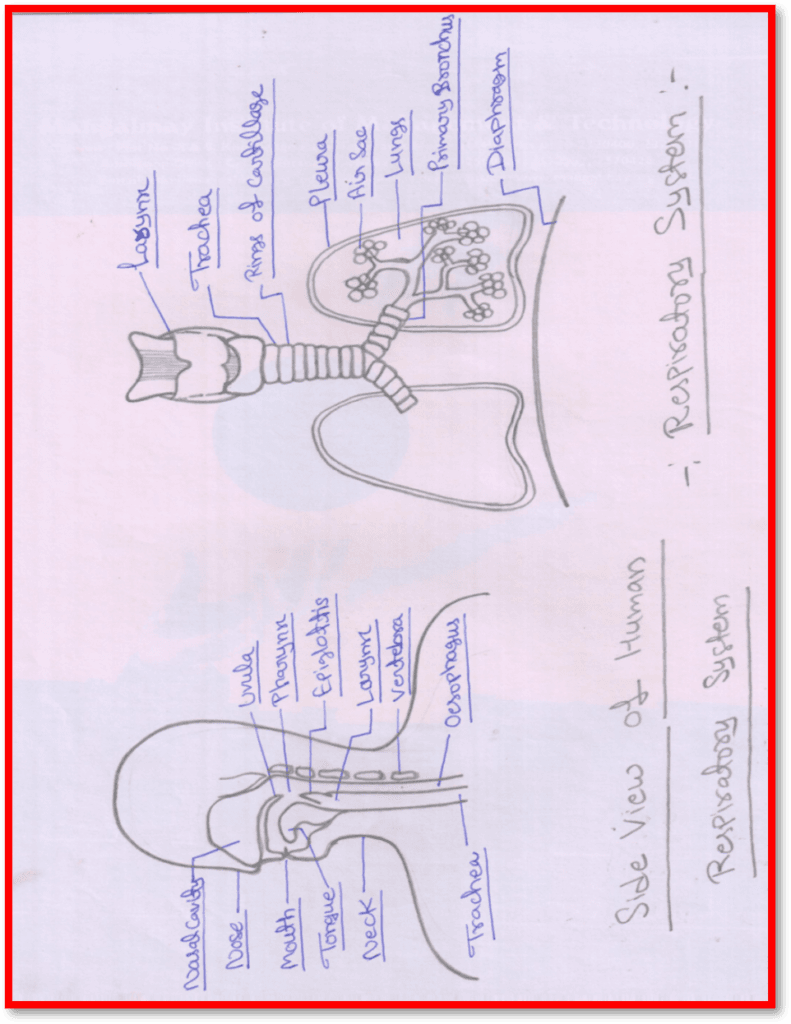
- The respiratory tract acts as a passage way for fresh air to flow from outside to the lungs and produced air from lungs to the exterior. Respiratory tract includes external nostrils nasal cavities, pharynx larynx & trachea. Respiratory tract is not concerned with the gaseous exchange. Trachea has rings of cartilage that prevent collapse of trachea.
- Respiratory organs are lungs which provide surface for exchange of gases. Lungs are pair in number, and lies in thoracic cavity. Lungs remain enclosed by pleura. In lungs major bronchi further divide into secondary bronchi which in tertiary bronchi and finally into bronchioles. Each bronchiole divides into smaller alveolar ducts that enter in air sac
Respiratory system is closely surrounded by the network of blood capillaries.
Voice box
It is also called larynx. It is an enlarged upper part of trachea, before puberty, it is similar in both series. In males it protrudes out and often called Adam’s apple, Vibration in vocal cord result in production of sound which is converted into speech by help of tongue.
📚 Available Formats
- 📕 Paperback Edition at 35% discount
- 📱 eBook Edition