
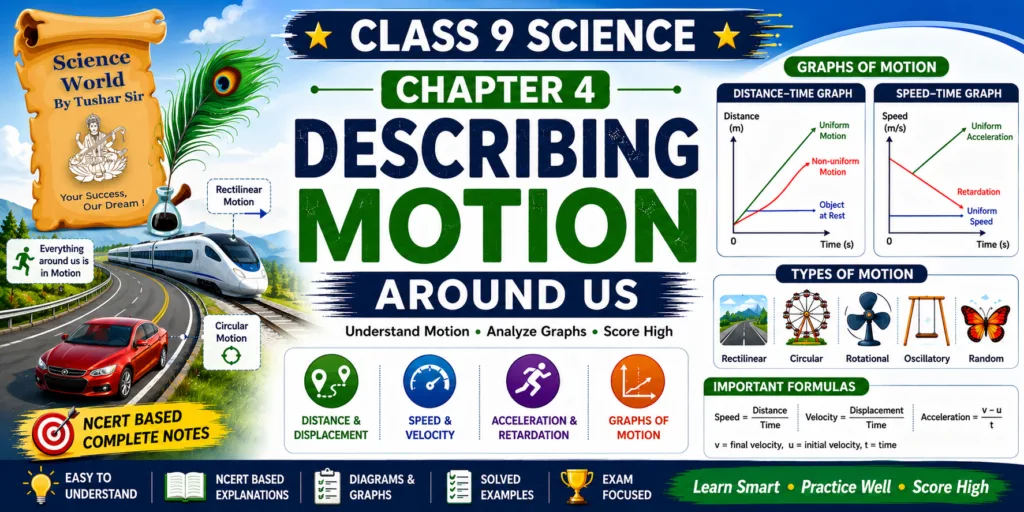
Introduction (Class 9 Science Chapter 4 Describing Motion Around Us Notes)
Welcome to the free notes for Class 9 Science Chapter 4 notes Describing Motion Around Us Notes. This chapter introduces the concepts of motion, distance, displacement, speed, velocity, acceleration, and equations of motion. These notes provide the key ideas for quick revision and exam preparation. (Class 9 Science Chapter 4 Describing Motion Around Us Notes)
Motion is one of the most common phenomena observed in our daily lives. From a bird flying in the sky to a car moving on a highway or the Earth revolving around the Sun, everything around us is either in motion or at rest. Understanding motion helps us explain how objects move, how fast they travel, and how their positions change over time.
This chapter introduces the basic concepts of motion, rest, distance, and displacement, which form the foundation for studying speed, velocity, acceleration, and graphs in later sections.
Based on the Latest NCERT Textbook
These notes are prepared according to the latest NCERT Exploration: Textbook of Science for Grade 9 and cover all important concepts in an easy-to-understand format.
Table of Contents
What is Motion?
Motion is the change in the position of an object with time with respect to a reference point.
If an object’s position changes over time, it is said to be in motion.
Examples
- A car moving on a road.
- A train leaving a station.
- A football rolling on the ground.
- A bird flying in the sky.
- The Earth revolving around the Sun.
What is Rest?
An object is said to be at rest if its position does not change with time with respect to its surroundings or a reference point.
Examples
- A parked bicycle.
- A book kept on a table.
- A tree standing in a garden.
- A building.
Motion is Relative
The state of motion depends on the observer’s reference point.
Example 1
A person sitting inside a moving train:
- Appears at rest to another passenger.
- Appears in motion to a person standing on the platform.
Example 2
A pilot sitting inside an aeroplane is at rest with respect to the aeroplane but moving with respect to the Earth.
Importance of Studying Motion
The study of motion helps us:
- Understand how vehicles move.
- Design safer roads and bridges.
- Predict the movement of planets and satellites.
- Improve sports performance.
- Develop transportation systems.
Types of Motion
The main types of motion are:
- Rectilinear Motion
- Circular Motion
- Rotational Motion
- Oscillatory Motion
- Periodic Motion
- Random Motion
Rectilinear Motion
Rectilinear motion is the motion of an object along a straight-line path.
It is the simplest form of motion.
Characteristics
- Straight-line movement.
- Direction remains the same.
- Simplest type of motion.
Examples
A stone falling vertically.
A train moving on a straight railway track.
A car travelling on a straight road.
A person walking in a straight line.
Circular Motion
Circular motion is the motion of an object along a circular path around a fixed centre.
During circular motion, the direction of the object continuously changes.
Characteristics
- Circular path.
- Fixed centre.
- Direction changes continuously.
- Speed may be constant or variable.
Examples
The Moon revolving around the Earth.
Hands of a clock.
A satellite revolving around the Earth.
A merry-go-round.
Rotational Motion
Rotational motion is the motion in which an object spins about its own fixed axis.
Characteristics
- Object rotates about its own axis.
- Every point of the object moves in a circular path.
- The axis remains fixed.
Examples
Bicycle wheel.
Ceiling fan.
Earth rotating on its axis.
Potter’s wheel.
Periodic Motion
Periodic motion is the motion that repeats itself after equal intervals of time.
All oscillatory motions are periodic, but not all periodic motions are oscillatory.
Examples
Pendulum of a clock.
Earth revolving around the Sun.
Hands of a clock.
Rotation of the Earth.
Random Motion
Random motion is the motion in which an object moves in an irregular and unpredictable path.
Characteristics
- No fixed path.
- Direction changes randomly.
- Impossible to predict exactly.
Examples
- Butterfly flying in a garden.
- Mosquito flying.
- Dust particles in air.
- Fish swimming in a pond.
Motion of the Earth
The Earth shows two types of motion simultaneously.
Rotation
- Earth rotates about its own axis.
- Time taken = 24 hours.
- Causes day and night.
Revolution
- Earth revolves around the Sun.
- Time taken = 365¼ days.
- Causes seasons.
Uniform Motion
An object is said to be in uniform motion if it covers equal distances in equal intervals of time.
Characteristics
- Speed remains constant.
- Distance covered is proportional to time.
Examples
- A train moving steadily at 60 km/h.
- A car travelling at constant speed on a highway.
Non-Uniform Motion
An object is said to be in non-uniform motion if it covers unequal distances in equal intervals of time or equal distances in unequal intervals of time.
Characteristics
- Speed changes continuously.
- Most motions in daily life are non-uniform.
Examples
- A bus moving through city traffic.
- A cyclist climbing a hill.
- A football during a match.
Difference Between Uniform and Non-Uniform Motion
| Uniform Motion | Non-Uniform Motion |
|---|---|
| Equal distances in equal time | Unequal distances in equal time |
| Speed remains constant | Speed changes |
| Simple calculations | More complex calculations |
Everyday Examples of Different Types of Motion
| Object | Type of Motion |
|---|---|
| Train on straight track | Rectilinear |
| Ceiling fan | Rotational |
| Clock hands | Circular |
| Child on swing | Oscillatory |
| Earth around Sun | Periodic |
| Butterfly | Random |
Distance and Displacement
Distance
Distance is the total length of the actual path travelled by an object.
SI Unit: metre (m)
Characteristics of Distance
- Scalar quantity.
- Always positive.
- Depends on the actual path followed.
- Can never be negative.
- Distance is always greater than or equal to displacement.
Displacement
Displacement is the shortest straight-line distance between the initial and final positions of an object.
SI Unit: metre (m)
Displacement is the shortest straight-line distance between the initial and final positions of an object along with its direction.
It is a vector quantity, meaning it has both magnitude and direction.
SI Unit
metre (m)
Characteristics of Displacement
- Vector quantity.
- Has direction.
- Can be positive, negative, or zero depending on the chosen direction.
- May be zero even when distance is not zero.
- Never greater than distance.
Example of Displacement
A student walks:
- 4 m east
- then 3 m west
Final position = 1 m east from the starting point.
Therefore,
- Distance = 7 m
- Displacement = 1 m east
Difference Between Distance and Displacement
| Distance | Displacement |
|---|---|
| Total path travelled | Shortest straight-line distance |
| Scalar quantity | Vector quantity |
| No direction | Has direction |
| Always positive | Can be positive, negative, or zero |
| Greater than or equal to displacement | Less than or equal to distance |
Speed
Speed is the distance travelled by an object in unit time.
It tells us how fast or slow an object is moving.
Formula of Speed
Speed=TimeDistance
or
Speed = Distance ÷ Time
SI Unit of Speed
The SI unit of speed is
metre per second (m/s)
Other commonly used units:
- kilometre per hour (km/h)
- centimetre per second (cm/s)
Conversion of Units
Convert km/h to m/s
Multiply by185
Example
72 km/h72×185=20m/s
Convert m/s to km/h
Multiply by518
Example
10 m/s10×518=36km/h
Distance-Time Formula Triangle
          Distance
        ─────────────
       Speed × Time
Remember:
- Distance = Speed × Time
- Speed = Distance ÷ Time
- Time = Distance ÷ Speed
Uniform Speed
An object has uniform speed if it covers equal distances in equal intervals of time.
Characteristics
- Speed remains constant.
- Motion is uniform.
- Easy to calculate.
Examples
- A train moving steadily at 60 km/h.
- An escalator moving at a fixed speed.
- A conveyor belt in a factory.
Non-Uniform Speed
An object has non-uniform speed if it covers unequal distances in equal intervals of time or equal distances in unequal intervals of time.
Characteristics
- Speed changes continuously.
- Very common in daily life.
- May increase or decrease.
Examples
- A bus moving in city traffic.
- A cyclist riding uphill.
- A football during a match.
Difference Between Uniform and Non-Uniform Speed
| Uniform Speed | Non-Uniform Speed |
|---|---|
| Constant speed | Speed keeps changing |
| Equal distances in equal intervals | Unequal distances in equal intervals |
| Easier calculations | More complex calculations |
| Example: Train on a straight track | Example: Car in traffic |
Average Speed
Average speed is the total distance travelled divided by the total time taken.
Formula
Average Speed=Total TimeTotal Distance
Example 1
A car travels 120 km in 3 hours.
Distance = 120 km
Time = 3 h
Average Speed
= 120 ÷ 3
= 40 km/h
Example 2
A student walks 600 metres in 10 minutes.
Average Speed
= 600 ÷ 10
= 60 m/min
Example 3
A train covers:
- 80 km in first hour
- 60 km in second hour
Total distance
= 80 + 60
= 140 km
Total time
= 2 hours
Average speed
= 140 ÷ 2
= 70 km/h
Example 4 (CBSE Type)
A bus travels:
- 100 km in 2 hours
- 60 km in 1 hour
Find average speed.
Solution
Total Distance
= 100 + 60
= 160 km
Total Time
= 2 + 1
= 3 hours
Average Speed
= 160 ÷ 3
= 53.3 km/h
Important Points
Average speed is calculated using total distance, not individual speeds.
Speed never tells the direction.
Speed is always positive.
Speed is a scalar quantity.
Speed depends only on distance and time.
Everyday Examples
- Walking speed ≈ 5 km/h
- Bicycle speed ≈ 15 km/h
- Motorcycle speed ≈ 50–80 km/h
- Car on highway ≈ 80–120 km/h
- Bullet train ≈ 300 km/h
- Aeroplane ≈ 800–900 km/h
Applications of Speed
Speed is used in:
- Road transport
- Railways
- Aviation
- Sports
- Weather forecasting
- Space research
Velocity
Velocity is the displacement of an object per unit time in a specified direction.
Unlike speed, velocity is a vector quantity because it has both magnitude and direction.
Formula of Velocity
Velocity=TimeDisplacement
or
Velocity = Displacement ÷ Time
SI Unit of Velocity
The SI unit of velocity is:
metre per second (m/s)
Other units include:
- kilometre per hour (km/h)
- centimetre per second (cm/s)
Characteristics of Velocity
- Vector quantity.
- Depends on displacement.
- Has both magnitude and direction.
- Can be positive, negative, or zero.
- Changes if either speed or direction changes.
Example of Velocity
A student walks 100 m east in 20 s.
Velocity
= 100 ÷ 20
= 5 m/s east
The direction east is an important part of the answer.
Difference Between Speed and Velocity
| Speed | Velocity |
|---|---|
| Scalar quantity | Vector quantity |
| Depends on distance | Depends on displacement |
| No direction | Direction is essential |
| Always positive | May be positive, negative, or zero |
| Example: 20 m/s | Example: 20 m/s north |
Uniform Velocity
An object has uniform velocity if it covers equal displacements in equal intervals of time without changing its direction.
Examples
- A train moving at a constant speed on a straight track.
- An aeroplane flying in a straight line at constant speed.
Non-Uniform Velocity
An object has non-uniform velocity if either its speed or its direction changes with time.
Examples
- A car taking a turn.
- A cyclist moving uphill.
- A football kicked across a field.
Average Velocity
Average velocity is the total displacement divided by the total time taken.
Formula
Average Velocity=Total TimeTotal Displacement
Example
A person walks:
- 80 m east
- then 20 m west
Final displacement
= 60 m east
Time taken
= 20 s
Average velocity
= 60 ÷ 20
= 3 m/s east
Acceleration
Acceleration is the rate of change of velocity with time.
Acceleration tells us how quickly the velocity of an object changes.
Formula
Acceleration=TimeChange in Velocity
ora=tv−u
where:
- u = Initial velocity
- v = Final velocity
- t = Time
- a = Acceleration
SI Unit of Acceleration
metre per second squared (m/s²)
Positive Acceleration
When the velocity of an object increases with time, the object has positive acceleration.
Example
A car speeds up from 20 m/s to 30 m/s.
Negative Acceleration (Retardation or Deceleration)
Retardation is the decrease in the velocity of an object with time.
It is also called negative acceleration or deceleration.
Example
A bus slows down while approaching a bus stop.
Difference Between Acceleration and Retardation
| Acceleration | Retardation |
|---|---|
| Velocity increases | Velocity decreases |
| Positive value | Negative value |
| Object speeds up | Object slows down |
Numerical Example 1
A car increases its velocity from 10 m/s to 30 m/s in 5 seconds.
Given
Initial velocity (u) = 10 m/s
Final velocity (v) = 30 m/s
Time (t) = 5 s
Solution
Acceleration
= (30 − 10) ÷ 5
= 20 ÷ 5
= 4 m/s²
Numerical Example 2
A train slows down from 25 m/s to 15 m/s in 5 seconds.
Solution
Acceleration
= (15 − 25) ÷ 5
= −10 ÷ 5
= −2 m/s²
The negative sign indicates retardation.
Everyday Examples of Acceleration
- A motorcycle speeding up after a traffic signal.
- A cricket ball after being hit by a bat.
- A rocket launching into space.
- A bicycle gaining speed while going downhill.
Everyday Examples of Retardation
A fan gradually stopping after being switched off.
A car applying brakes.
A train stopping at a station.
A football slowing down due to friction.
What is a Graph?
A graph is a visual representation of the relationship between two physical quantities.
In motion:
- Time is plotted on the X-axis (Horizontal axis).
- Distance or Speed is plotted on the Y-axis (Vertical axis).
Distance-Time Graph
A distance-time graph shows how the distance travelled by an object changes with time.
Axes of the Graph
- Horizontal (X-axis) → Time
- Vertical (Y-axis) → Distance
Distance (m)
↑
|
|
|
|
|____________→ Time (s)
Distance-Time Graph for Uniform Motion
When an object covers equal distances in equal intervals of time, the graph is a straight line.
Distance
↑
|
| /
| /
| /
| /
| /
|/____________________→ Time
Interpretation
- Straight line.
- Constant speed.
- Uniform motion.
Distance-Time Graph for an Object at Rest
If an object does not move, its distance remains constant.
The graph is a horizontal line.
Distance
↑
|
|──────────────
|
|
|
|_________________________→ Time
Speed-Time Graph for Retardation
If speed decreases uniformly, the graph slopes downward.
Speed
↑
|\
| \
| \
| \
| \
|______________→ Time
Equations of Motion
For uniformly accelerated motion:
- v = u + at
- s = ut + ½at²
- v² = u² + 2as
Where:
- u = Initial velocity
- v = Final velocity
- a = Acceleration
- t = Time
- s = Displacement
Graphical Representation of Motion
Distance–Time Graph
- Shows how distance changes with time.
- A straight line indicates uniform speed.
Velocity–Time Graph
- Shows how velocity changes with time.
- The slope of the graph gives acceleration.
Uniform Circular Motion
Uniform circular motion is the motion of an object along a circular path with constant speed.
Examples
- Earth revolving around the Sun.
- A stone tied to a string and rotated.
- Ceiling fan blades.
Everyday Applications of Motion Graphs
Motion graphs are used in:
- GPS navigation systems
- Sports performance analysis
- Traffic monitoring
- Railway scheduling
- Aviation
- Space missions
Solved Numerical (CBSE Type)
Question
A cyclist covers 60 km in 3 hours.
Find the speed.
Solution
Speed
= Distance ÷ Time
= 60 ÷ 3
= 20 km/h
Question
A train accelerates from 10 m/s to 30 m/s in 5 seconds.
Find the acceleration.
Solution
Acceleration
= (30 − 10) ÷ 5
= 20 ÷ 5
= 4 m/s²
Question
A runner completes one lap of a circular track and returns to the starting point.
Find:
- Distance
- Displacement
Answer
- Distance = Circumference of the track
- Displacement = 0
Common Mistakes to Avoid
❌ Confusing distance with displacement.
❌ Writing speed with a direction (speed has no direction).
❌ Forgetting to convert km/h into m/s when required.
❌ Confusing uniform motion with uniform velocity.
❌ Ignoring the direction while calculating velocity.
Important Terms
- Motion
- Distance
- Displacement
- Speed
- Velocity
- Acceleration
- Uniform Motion
- Non-uniform Motion
- Circular Motion
- Equations of Motion
Complete Chapter Summary
- Motion is the change in the position of an object with time.
- Motion is always measured with respect to a reference point.
- Distance is the total path travelled, while displacement is the shortest straight-line distance between two points.
- Speed is the distance travelled per unit time, whereas velocity is displacement per unit time in a specified direction.
- Acceleration is the rate of change of velocity, while retardation is a decrease in velocity.
- Motion can be rectilinear, circular, rotational, oscillatory, periodic, or random.
- A distance-time graph helps identify uniform and non-uniform motion.
- A speed-time graph helps determine constant speed, acceleration, and retardation.
- Understanding graphs makes it easier to analyse and compare different types of motion.
Complete Your Preparation
The notes above cover only the basic concepts of this chapter.
For complete exam preparation, get our premium study material prepared by Science World by Tushar Sir.
The complete study material includes:
✔ Detailed Notes
✔ Mind Maps
✔ NCERT Solutions
✔ MCQs with Answers
✔ Assertion & Reason Questions
✔ Case-Based Questions
✔ Competency-Based Questions
✔ Short & Long Answer Questions
✔ Practice Paper


FAQ
What is motion?
Motion is the change in the position of an object with time relative to a reference point.
What is the difference between distance and displacement?
Distance is the total path travelled, while displacement is the shortest straight-line distance between the starting and ending points.
What is the SI unit of speed?
The SI unit of speed is metre per second (m/s).
Are these notes enough for exams?
These notes are useful for quick revision. For complete preparation with NCERT solutions, MCQs, case-based questions, mind maps, and practice papers, the complete eBook is recommended.
📚 Looking for All Class 9 Science Chapters?
Access all 13 chapter-wise notes based on the latest NCERT Exploration: Textbook of Science for Grade 9 from one place.