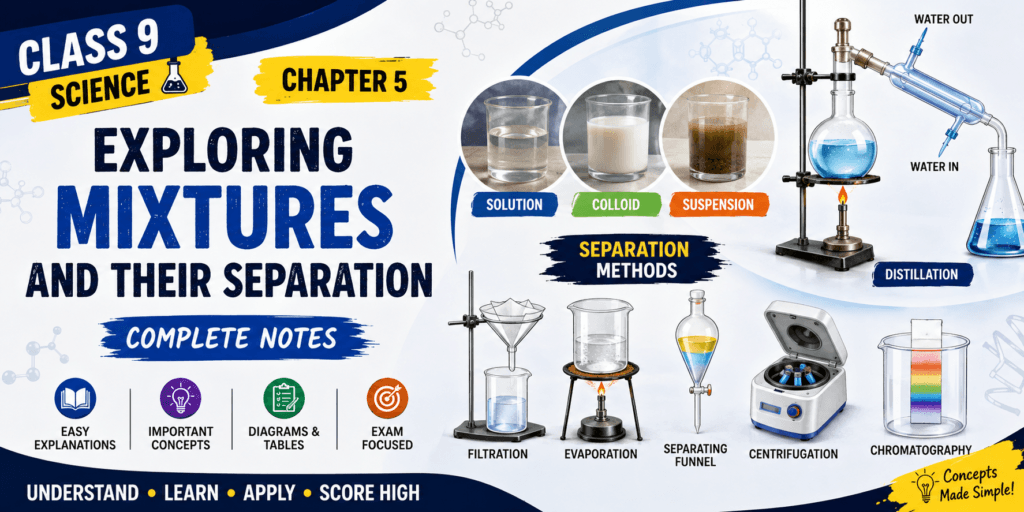
Introduction (Class 9 Science Chapter 5 Exploring Mixtures and Their Separation Notes)
Welcome to the free notes for Class 9 Science Chapter 5 notes – Exploring Mixtures and Their Separation. This chapter helps students understand the difference between pure substances and mixtures, different types of mixtures, and the methods used to separate their components. These notes are ideal for quick revision and exam preparation. (Class 9 Science Chapter 5 Exploring Mixtures and Their Separation Notes)
Look around your home. You will find milk, tea, fruit juice, air, soil, salt water, sugar solution, and many other materials.
Are these all the same? No.
Some are pure substances, while most are mixtures made by combining two or more substances.
Scientists study mixtures because separating useful substances from mixtures is important in industries, medicine, agriculture, environmental science, and daily life.
Examples include:
- Separating cream from milk
- Purifying drinking water
- Extracting salt from seawater
- Refining crude oil into petrol and diesel
- Separating oxygen from air
These notes are prepared according to the latest NCERT Exploration: Textbook of Science for Grade 9 and cover all important concepts in an easy-to-understand format.
Table of Contents
What is Matter?
Everything that occupies space and has mass is called matter.
Matter is made up of tiny particles called atoms and molecules.
Examples include:
- Water
- Air
- Iron
- Wood
- Paper
- Milk
- Soil
Matter exists in three common states:
| State | Shape | Volume |
|---|---|---|
| Solid | Fixed | Fixed |
| Liquid | No fixed shape | Fixed |
| Gas | No fixed shape | No fixed volume |
Classification of Matter
Matter can be classified into two broad categories.
Matter
│
├── Pure Substances
│ ├── Elements
│ └── Compounds
│
└── Mixtures
├── Homogeneous
└── Heterogeneous
What is a Pure Substance?
A pure substance is made up of only one kind of particle and has a fixed composition.
Its properties remain the same throughout the sample.
A pure substance cannot be separated into other substances using physical methods.
Examples include:
- Gold (24 carat)
- Distilled water
- Oxygen gas
- Copper
- Iron
- Carbon dioxide
Characteristics of Pure Substances
- Made of only one type of particle.
- Have fixed composition.
- Have definite melting point.
- Have definite boiling point.
- Show uniform properties.
- Cannot be separated by physical methods.
Types of Pure Substances
1. Elements
An element consists of only one type of atom.
Examples:
- Hydrogen
- Oxygen
- Nitrogen
- Iron
- Gold
- Silver
An element cannot be broken down into simpler substances by ordinary chemical methods.
Examples of Elements Around Us
| Element | Symbol | Uses |
|---|---|---|
| Oxygen | O | Breathing |
| Iron | Fe | Construction |
| Copper | Cu | Electrical wires |
| Gold | Au | Jewellery |
| Aluminium | Al | Utensils and aircraft |
2. Compounds
A compound is formed when two or more elements combine chemically in a fixed ratio.
Examples:
- Water (H₂O)
- Carbon dioxide (CO₂)
- Sodium chloride (NaCl)
- Ammonia (NH₃)
Properties of compounds are different from those of the elements that form them.
Example:
Hydrogen is highly combustible.
Oxygen supports burning.
But water neither burns nor supports burning.
What is a Mixture?
A mixture is formed when two or more substances are mixed physically without undergoing a chemical change.
Each substance keeps its own properties.
The composition of a mixture can vary.
Examples of Mixtures
- Air
- Milk
- Soil
- Tea
- Coffee
- Salt water
- Sugar solution
- Lemon juice
- Fruit salad
Characteristics of Mixtures
- Made by physical mixing.
- Components retain their original properties.
- Variable composition.
- No fixed melting point.
- No fixed boiling point.
- Can be separated using physical methods.
Pure Substance vs Mixture
| Pure Substance | Mixture |
|---|---|
| One type of particle | Two or more substances |
| Fixed composition | Variable composition |
| Fixed melting point | No fixed melting point |
| Fixed boiling point | No fixed boiling point |
| Cannot be separated physically | Can be separated physically |
| Uniform properties | Properties depend on composition |
Types of Mixtures
Homogeneous Mixture
A homogeneous mixture has a uniform composition throughout.
You cannot distinguish its components with the naked eye.
Examples:
- Salt solution
- Sugar solution
- Air
- Vinegar
- Brass
- Alcohol mixed with water
Characteristics
- Uniform appearance
- Single phase
- Components cannot be seen separately
- Stable
- Same composition throughout
Real-Life Examples
Air
Air contains:
- Nitrogen
- Oxygen
- Carbon dioxide
- Water vapour
- Noble gases
Yet it appears as one uniform mixture.
Salt Water
When salt dissolves completely in water, the mixture looks like pure water because the salt particles become evenly distributed.
Heterogeneous Mixture
A heterogeneous mixture has a non-uniform composition.
Different components can usually be seen separately.
Examples:
- Sand and water
- Soil
- Oil and water
- Fruit salad
- Concrete
Characteristics
- Non-uniform composition
- Two or more phases
- Components visible
- Can often be separated easily
Difference Between Homogeneous and Heterogeneous Mixtures
| Homogeneous | Heterogeneous |
|---|---|
| Uniform composition | Non-uniform composition |
| Single phase | Multiple phases |
| Components not visible | Components visible |
| Same properties throughout | Properties differ from place to place |
Why Do We Separate Mixtures?
Many substances found in nature are mixtures. Some components are useful, while others are unwanted impurities. Separation helps us obtain pure substances and remove harmful or unnecessary materials.
Importance of Separation
Separation of mixtures is done to:
- Remove unwanted impurities.
- Obtain pure substances.
- Recover valuable materials.
- Prepare safe drinking water.
- Separate medicines and chemicals.
- Recycle useful materials.
- Improve the quality of food products.
Daily Life Examples
- Removing stones from rice.
- Filtering tea leaves from tea.
- Churning butter from curd.
- Separating cream from milk.
- Purifying drinking water.
- Obtaining salt from seawater.
Choosing the Right Separation Method
The method used depends on the physical properties of the substances, such as:
- Particle size
- Solubility
- Density
- Boiling point
- Magnetic property
- Sublimation property
1. Handpicking
Definition
Handpicking is the process of manually removing unwanted solid particles from a mixture.
It is suitable when the impurities are:
- Present in small amounts.
- Easily visible.
- Larger than the desired particles.
Examples
- Removing stones from rice.
- Picking rotten fruits from fresh fruits.
- Removing small sticks from pulses.
Advantages
- Very simple.
- No equipment required.
- Cost-effective.
Limitations
- Suitable only for small quantities.
- Time-consuming.
- Cannot separate very fine impurities.
2. Threshing
Definition
Threshing is the process of separating grains from harvested crop stalks.
Traditionally, farmers used animals, while modern farms use threshing machines.
Principle
Threshing separates grains based on the force applied to detach them from stalks.
Examples
- Wheat
- Rice
- Barley
3. Winnowing
Definition
Winnowing is the process of separating lighter particles from heavier particles using wind or flowing air.
Principle
The difference in weight (density) allows lighter particles to be blown away while heavier particles fall vertically.
Examples
- Separating husk from wheat.
- Removing dry leaves from grains.
Advantages
- Simple method.
- Useful for large quantities.
Limitation
Requires wind or mechanical air flow.
4. Sieving
Definition
Sieving separates particles based on their size using a sieve.
Principle
Smaller particles pass through the holes, while larger particles remain on the sieve.
Examples
- Separating flour from bran.
- Removing stones from sand.
- Construction industries separate gravel from sand.
Advantages
- Fast.
- Easy.
- Useful for dry solids.
Limitation
Not useful when particles are nearly the same size.
5. Magnetic Separation
Definition
Magnetic separation is used to separate magnetic substances from non-magnetic substances.
Principle
Magnets attract magnetic materials such as iron, nickel, and cobalt.
Examples
- Iron filings from sand.
- Iron pieces from scrap.
- Recycling industries.
6. Sedimentation
Definition
Sedimentation is the process in which heavier insoluble particles settle at the bottom of a liquid.
Principle
Heavier particles settle due to gravity.
Example
Muddy water kept undisturbed.
After some time:
- Mud settles.
- Water remains above.
Advantages
- Simple.
- No machinery needed.
7. Decantation
Definition
After sedimentation, the clear upper liquid is carefully poured into another container without disturbing the sediment.
This process is called decantation.
Example
Separating clean water from muddy water.
Sedimentation + Decantation
These two methods are usually used together.
Muddy Water
      │
      ▼
Sedimentation
(Mud settles)
      │
      ▼
Decantation
(Clear water poured out)
8. Loading
Definition
Loading is the process of adding a substance like alum to speed up sedimentation.
Principle
Alum causes small suspended particles to stick together, forming larger particles that settle quickly.
Uses
- Water purification plants.
- Village ponds.
- Domestic water treatment.
9. Filtration
Definition
Filtration separates insoluble solids from liquids using a filter medium.
Principle
The liquid passes through the filter while solid particles remain behind.
Common Filter Materials
- Filter paper
- Cotton cloth
- Sand filters
- Membrane filters
Examples
- Filtering tea.
- Water purification.
- Coffee filters.
- Laboratory experiments.
Important Terms
Residue
The solid left on the filter paper.
Filtrate
The liquid collected after filtration.
Mixture
   │
   ▼
Filter Paper
   │
   ├── Residue (Solid)
   ▼
Filtrate (Liquid)
Difference Between Sedimentation and Filtration
| Sedimentation | Filtration |
|---|---|
| Heavy particles settle naturally | Uses a filter |
| Slow process | Faster |
| Not suitable for very fine particles | Removes finer particles |
| Uses gravity | Uses filter paper or membrane |
10. Evaporation
Definition
Evaporation is the process of converting a liquid into vapour to obtain the dissolved solid.
Principle
The solvent evaporates while the dissolved solid remains behind.
Examples
- Obtaining salt from seawater.
- Recovering sugar from sugar solution.
Advantages
- Simple method.
- Large-scale salt production.
Limitation
The solvent cannot be recovered.
Factors Affecting Evaporation
Evaporation becomes faster when:
- Temperature increases.
- Surface area increases.
- Wind speed increases.
- Humidity decreases.
Applications of Evaporation
- Salt production.
- Drying clothes.
- Cooling by sweating.
- Drying grains.
Flow Chart: Separation Methods
Mixture
│
├── Solid + Solid
│      ├── Handpicking
│      ├── Winnowing
│      ├── Sieving
│      ├── Magnetic Separation
│      └── Threshing
│
└── Solid + Liquid
       ├── Sedimentation
       ├── Decantation
       ├── Loading
       ├── Filtration
       └── Evaporation
Advanced Separation Techniques
Some mixtures cannot be separated by simple methods like filtration or evaporation. Scientists use advanced techniques based on differences in density, boiling point, solubility, and adsorption to separate such mixtures.
These methods are widely used in laboratories, hospitals, industries, and research centers.
11. Centrifugation
Definition
Centrifugation is the process of separating suspended particles from a liquid by rotating the mixture at high speed in a centrifuge machine.
The rapid spinning creates a force that pushes heavier particles outward and downward, causing them to settle quickly.
Principle
Centrifugation works on the difference in density of the particles.
Heavier particles move outward and settle, while lighter particles remain at the top.
Working
- The mixture is placed in centrifuge tubes.
- The tubes are rotated at very high speed.
- Heavier particles settle at the bottom.
- The clear liquid above is removed.
Examples
- Separating cream from milk.
- Separating blood cells from plasma.
- Separating butter from curd.
- Laboratory testing of blood samples.
Advantages
- Very fast process.
- Effective for very fine suspended particles.
- Used in medical and research laboratories.
Limitations
- Requires special equipment.
- More expensive than ordinary filtration.
12. Separating Funnel
Definition
A separating funnel is used to separate two immiscible liquids (liquids that do not mix with each other).
Principle
The method is based on the difference in density of the liquids.
The denser liquid settles at the bottom, while the lighter liquid floats on top.
Working
- Pour the liquid mixture into the funnel.
- Allow the liquids to settle into two layers.
- Open the stopcock.
- Collect the lower layer first.
- Close the stopcock before the upper layer reaches it.
Examples
- Oil and water.
- Kerosene and water.
- Petrol and water.
Everyday Uses
- Oil refineries.
- Chemical industries.
- Laboratory experiments.
Difference Between Miscible and Immiscible Liquids
| Miscible Liquids | Immiscible Liquids |
|---|---|
| Mix completely | Do not mix |
| Form one layer | Form two separate layers |
| Example: Alcohol + Water | Example: Oil + Water |
13. Sublimation
Definition
Sublimation is the process in which a solid changes directly into vapour without passing through the liquid state.
On cooling, the vapour changes back directly into a solid.
Principle
Only substances that undergo sublimation can be separated from mixtures using this method.
Sublimable Substances
- Camphor
- Ammonium chloride
- Iodine
- Naphthalene
Examples
- Separating ammonium chloride from common salt.
- Separating camphor from sand.
Advantages
- Produces a pure substance.
- Simple laboratory technique.
Limitations
- Only useful for sublimable solids.
14. Crystallization
Definition
Crystallization is the process of obtaining pure solid crystals from a saturated solution.
Principle
When a hot saturated solution cools slowly, pure crystals of the dissolved substance are formed.
Steps
- Prepare a saturated solution.
- Heat the solution.
- Filter if necessary.
- Cool the solution slowly.
- Collect the crystals.
Examples
- Copper sulphate crystals.
- Alum crystals.
- Sugar crystals.
Advantages
- Produces highly pure solids.
- Removes impurities effectively.
Applications
- Pharmaceutical industry.
- Chemical laboratories.
- Salt purification.
Difference Between Evaporation and Crystallization
| Evaporation | Crystallization |
|---|---|
| Solvent is lost | Solvent may be recovered in advanced setups |
| Product may contain impurities | Produces purer crystals |
| Heating is continuous | Slow cooling is important |
| Used for quick recovery | Used for obtaining high-purity solids |
15. Simple Distillation
Definition
Simple distillation is used to separate a solvent from a solution or to separate two liquids having a large difference in their boiling points.
Principle
The liquid with the lower boiling point vaporizes first. The vapour is then cooled and condensed back into a liquid.
Working
- Heat the mixture.
- The solvent changes into vapour.
- Vapour passes through a condenser.
- Vapour cools and becomes liquid again.
- The pure liquid is collected.
Examples
- Obtaining distilled water from salt water.
- Purifying water.
- Laboratory preparation of pure liquids.
Applications
- Water purification.
- Chemical industries.
- Laboratories.
- Hospitals.
16. Fractional Distillation
Definition
Fractional distillation is used to separate two or more miscible liquids having small differences in their boiling points.
Principle
Liquids vaporize at different temperatures.
A fractionating column allows repeated condensation and evaporation, improving separation.
Examples
- Alcohol and water.
- Liquid oxygen and liquid nitrogen.
- Components of crude oil.
Fractional Distillation of Petroleum
Crude oil contains many useful substances.
Fractional distillation separates them into:
- Petroleum gas (LPG)
- Petrol
- Naphtha
- Kerosene
- Diesel
- Lubricating oil
- Paraffin wax
- Bitumen
This process takes place in a fractionating tower.
Difference Between Simple and Fractional Distillation
| Simple Distillation | Fractional Distillation |
|---|---|
| Large boiling point difference | Small boiling point difference |
| No fractionating column | Uses fractionating column |
| Simpler apparatus | More complex apparatus |
| One-stage separation | Multiple stages of separation |
17. Chromatography
Definition
Chromatography is a technique used to separate different coloured or dissolved substances based on their different rates of movement through a stationary medium.
Principle
Different substances travel at different speeds because they have different solubilities and attractions towards the stationary phase.
Types
- Paper chromatography
- Thin-layer chromatography
- Column chromatography
(Class 9 mainly studies paper chromatography.)
Applications
- Separating colours in black ink.
- Detecting food colours.
- Drug testing.
- Forensic science.
- Environmental analysis.
Example Activity
Place a drop of black ink near the bottom of a strip of filter paper.
Dip the paper into water without immersing the ink spot.
As the water rises, different colours separate into bands.
This shows that black ink is actually a mixture of different coloured dyes.
Separation of Air into Its Components
Air is a homogeneous mixture of gases.
The major gases are:
| Gas | Approximate Percentage |
|---|---|
| Nitrogen | 78% |
| Oxygen | 21% |
| Argon | 0.93% |
| Carbon dioxide | 0.04% |
| Other gases | Trace amounts |
How Is Air Separated?
- Remove dust and water vapour.
- Compress the air.
- Cool it until it becomes liquid.
- Use fractional distillation to separate the gases based on their boiling points.
Uses of Separated Gases
- Oxygen: Medical use, welding, breathing support.
- Nitrogen: Food packaging, fertilizer production.
- Argon: Electric bulbs, welding.
- Carbon dioxide: Fire extinguishers, soft drinks.
Flow Chart: Advanced Separation Methods
Advanced Separation Methods
│
├── Centrifugation → Density difference
├── Separating Funnel → Immiscible liquids
├── Sublimation → Sublimable solids
├── Crystallization → Pure crystals
├── Simple Distillation → Solvent recovery
├── Fractional Distillation → Miscible liquids
└── Chromatography → Different movement of substances
Summary Table
| Method | Property Used | Example |
|---|---|---|
| Centrifugation | Density | Cream from milk |
| Separating Funnel | Density of immiscible liquids | Oil and water |
| Sublimation | Sublimation property | Camphor and sand |
| Crystallization | Solubility | Copper sulphate crystals |
| Simple Distillation | Boiling point | Distilled water |
| Fractional Distillation | Close boiling points | Petrol from crude oil |
| Chromatography | Different rates of movement | Colours in ink |
Important Definitions
- Centrifugation: Separation of suspended particles by rapid spinning.
- Separating Funnel: Apparatus used to separate immiscible liquids.
- Sublimation: Direct conversion of a solid into vapour and back into a solid.
- Crystallization: Formation of pure crystals from a saturated solution.
- Simple Distillation: Separation based on a large difference in boiling points.
- Fractional Distillation: Separation of miscible liquids with similar boiling points.
- Chromatography: Separation of dissolved substances based on different rates of movement.
Everyday Applications
| Method | Example |
|---|---|
| Handpicking | Stones from rice |
| Winnowing | Husk from grains |
| Sieving | Flour and bran |
| Threshing | Wheat grains |
| Sedimentation | Muddy water |
| Decantation | Clean water from mud |
| Loading | Water treatment plants |
| Filtration | Tea, coffee, water purifier |
| Evaporation | Salt from seawater |
Difference Between Pure Substance and Mixture
| Pure Substance | Mixture |
|---|---|
| Contains only one type of substance | Contains two or more substances |
| Fixed composition | Variable composition |
| Cannot be separated by physical methods | Can be separated by physical methods |
| Has definite properties | Properties depend on composition |
Solution
A solution is a homogeneous mixture in which one substance dissolves completely in another.
Components of a Solution
Solute
The substance that dissolves.
Example:
Salt in salt water.
Sugar in sugar solution.
Solvent
The substance that dissolves the solute.
Usually present in a larger amount.
Example:
Water.
Solution
The final homogeneous mixture formed after mixing the solute and solvent.
Example
Sugar + Water → Sugar Solution
- Sugar = Solute
- Water = Solvent
- Sugar solution = Solution
Types of Solutions
Solutions can exist in different states.
| Solute | Solvent | Example |
|---|---|---|
| Solid | Liquid | Salt in water |
| Liquid | Liquid | Alcohol in water |
| Gas | Liquid | Carbon dioxide in soft drinks |
| Gas | Gas | Air |
| Solid | Solid | Brass |
Characteristics of Solutions
- Homogeneous mixture.
- Transparent.
- Stable.
- Solute particles cannot be seen.
- Solute does not settle.
- Cannot be separated by filtration.
- Do not scatter light.
Particle Size in Solutions
The particles are extremely small.
Size is usually less than 1 nanometre (nm).
Because of this:
Examples of Solutions in Daily Life
- Salt water
- Sugar syrup
- Vinegar
- Soft drinks
- Lemon juice (filtered)
- Glucose solution
- Oral Rehydration Solution (ORS)
Factors Affecting Dissolving
Several factors affect how quickly a solute dissolves.
1. Stirring
Stirring increases contact between solute and solvent.
Result: Faster dissolving.
2. Temperature
Higher temperature usually increases the rate of dissolving for solids in liquids.
Example:
Sugar dissolves faster in hot tea than in cold water.
3. Particle Size
Smaller particles dissolve faster because they have a larger surface area.
Powdered sugar dissolves faster than sugar cubes.
Concentrated and Dilute Solutions
Dilute Solution
Contains a small amount of solute.
Example:
Light sugar water.
Concentrated Solution
Contains a large amount of solute.
Example:
Strong sugar syrup.
Saturated Solution
A saturated solution contains the maximum amount of solute that can dissolve at a given temperature.
Any extra solute remains undissolved.
Unsaturated Solution
Contains less solute than the maximum amount.
More solute can still dissolve.
Daily Life Applications
- Preparing ORS
- Making tea and coffee
- Soft drinks
- Medicines
- Salt solution for cooking
- Fertilizer solutions
- Laboratory chemicals
Suspension
A suspension is a heterogeneous mixture in which insoluble solid particles are dispersed in a liquid. These particles are large enough to be seen with the naked eye or under a simple microscope.
Unlike solutions, the particles in a suspension do not dissolve completely. If left undisturbed, they gradually settle at the bottom due to gravity.
Examples of Suspensions
- Muddy water
- Chalk powder in water
- Sand in water
- Flour mixed with water
- Paint (before stirring)
- Dust particles in water
Characteristics of a Suspension
- It is a heterogeneous mixture.
- Particles are visible to the naked eye.
- Particles are larger than those in solutions.
- The mixture appears cloudy or opaque.
- Particles settle down on standing.
- Can be separated by filtration.
- Shows the Tyndall effect (scattering of light).
Why Do Suspension Particles Settle?
The particles in a suspension are relatively large and heavy. Gravity pulls these particles downward, causing them to settle at the bottom after some time.
For this reason, medicines labeled “Shake Well Before Use” are usually suspensions.
Activity
Take a glass of water and add some chalk powder.
Observe the mixture.
You will notice:
- The water becomes cloudy.
- Chalk particles remain visible.
- After some time, the particles settle at the bottom.
This is a suspension.
Colloid
A colloid is a heterogeneous mixture in which very small particles of one substance are uniformly spread throughout another substance.
Although colloids appear to be uniform like solutions, they are actually heterogeneous when observed under powerful microscopes.
Examples of Colloids
- Milk
- Butter
- Jelly
- Fog
- Smoke
- Whipped cream
- Toothpaste
- Shaving foam
- Blood
- Gelatin
Components of a Colloid
Every colloid consists of two parts.
1. Dispersed Phase
The substance present as tiny particles.
Example:
Fat droplets in milk.
2. Dispersion Medium
The substance in which the dispersed particles are spread.
Example:
Water in milk.
Characteristics of Colloids
- Heterogeneous mixture.
- Appears homogeneous to the naked eye.
- Particles are intermediate in size.
- Particles do not settle down.
- Cannot be separated by ordinary filtration.
- Stable mixture.
- Scatter light (Tyndall effect).
Why Don’t Colloidal Particles Settle?
Colloidal particles are extremely small and continuously move due to collisions with molecules of the surrounding medium.
This continuous movement keeps them suspended.
Brownian Movement
The continuous random zigzag movement of colloidal particles is called Brownian movement.
It occurs because the particles are constantly bombarded by molecules of the surrounding medium.
Importance of Brownian Movement
- Prevents particles from settling.
- Maintains the stability of colloids.
- Confirms that molecules are continuously moving.
Tyndall Effect
The Tyndall effect is the scattering of light by colloidal or suspension particles.
When a beam of light passes through a colloid, its path becomes visible because the particles scatter the light.
Solutions do not show the Tyndall effect because their particles are too small.
Examples of the Tyndall Effect
Sunlight Through Dust
Sunlight entering a room through a small window becomes visible because dust particles scatter the light.
Car Headlights in Fog
The beam of headlights becomes clearly visible in fog because fog contains tiny water droplets that scatter light.
Cinema Hall
The path of the projector light becomes visible due to dust particles suspended in air.
Torch in a Dusty Room
The light beam is clearly visible because suspended dust particles scatter light.
Conditions Required for the Tyndall Effect
The Tyndall effect is observed when:
- Particle size is larger than solution particles.
- The medium is transparent.
- Light can pass through the mixture.
Difference Between Solution, Suspension and Colloid
| Property | Solution | Colloid | Suspension |
|---|---|---|---|
| Nature | Homogeneous | Heterogeneous (appears homogeneous) | Heterogeneous |
| Particle Size | Less than 1 nm | 1–1000 nm | More than 1000 nm |
| Visibility | Not visible | Not visible to naked eye | Visible |
| Settling of Particles | No | No | Yes |
| Filtration | Cannot be separated | Cannot be separated by ordinary filtration | Can be separated |
| Tyndall Effect | No | Yes | Yes |
| Stability | Stable | Stable | Unstable |
Real-Life Examples
Solution
- Salt water
- Sugar syrup
- Vinegar
- Soft drinks
Colloid
- Milk
- Butter
- Ice cream
- Jelly
- Blood
- Toothpaste
Suspension
- Muddy water
- Sand in water
- Chalk in water
- Flour in water
Applications of Colloids
Colloids are widely used in daily life.
Food Industry
- Milk
- Butter
- Ice cream
- Cheese
- Cream
- Sauces
Medicine
Many medicines are prepared as colloidal solutions to improve absorption in the body.
Examples include:
- Antacids
- Vaccines
- Some injectable drugs
Cosmetics
Many cosmetic products are colloids.
Examples:
- Face creams
- Lotions
- Shampoo
- Toothpaste
Agriculture
Colloidal formulations of fertilizers and pesticides help improve effectiveness and distribution.
Environment
Smoke and fog are examples of atmospheric colloids, which play a role in weather and air quality.
Importance of Studying Mixtures
Understanding mixtures helps us:
- Purify drinking water.
- Manufacture medicines.
- Process food products.
- Separate useful minerals from ores.
- Refine petroleum.
- Produce chemicals used in industries.
Chapter Summary
This chapter introduced the concept of pure substances and mixtures, helping us understand how materials around us are classified. We learned that mixtures can be homogeneous or heterogeneous, depending on whether their composition is uniform or non-uniform.
We also studied different types of mixtures such as solutions, colloids, and suspensions, and compared their properties based on particle size, visibility, stability, and their ability to scatter light.
Finally, we explored various methods of separation such as filtration, evaporation, centrifugation, distillation, chromatography, and crystallization. Each method is based on specific physical properties like particle size, density, solubility, boiling point, or sublimation.
Chapter Mind Map
                          MATTER
                              │
              ┌───────────────┴───────────────┐
              │                               │
      Pure Substances                    Mixtures
              │                               │
     ┌────────┴────────┐          ┌───────────┴───────────┐
     │                 │          │                       │
 Elements          Compounds  Homogeneous          Heterogeneous
                                      │                    │
                                  Solution       Colloid / Suspension
                                      │
                          Separation of Mixtures
                                      │
 ┌───────────────────────────────────────────────────────────────────┐
 │ Handpicking │ Winnowing │ Sieving │ Filtration │ Sedimentation │
 │ Decantation │ Evaporation │ Centrifugation │ Sublimation │
 │ Crystallization │ Distillation │ Fractional Distillation │
 │ Chromatography │ Separating Funnel │
 └───────────────────────────────────────────────────────────────────┘
Important Definitions
Matter
Anything that has mass and occupies space.
Pure Substance
A material made up of only one kind of particle with a fixed composition.
Mixture
A physical combination of two or more substances in any proportion.
Solution
A homogeneous mixture in which a solute dissolves completely in a solvent.
Suspension
A heterogeneous mixture in which insoluble particles settle on standing.
Colloid
A heterogeneous mixture with intermediate-sized particles that remain uniformly dispersed and do not settle.
Solute
The substance that gets dissolved.
Solvent
The substance that dissolves the solute.
Saturated Solution
A solution that cannot dissolve any more solute at a given temperature.
Unsaturated Solution
A solution that can dissolve more solute at a given temperature.
Important Differences
Difference Between Pure Substance and Mixture
| Pure Substance | Mixture |
|---|---|
| Fixed composition | Variable composition |
| One type of particle | Two or more substances |
| Definite melting and boiling points | No fixed melting or boiling point |
| Cannot be separated physically | Can be separated physically |
Difference Between Solution, Colloid and Suspension
| Property | Solution | Colloid | Suspension |
|---|---|---|---|
| Nature | Homogeneous | Heterogeneous (appears homogeneous) | Heterogeneous |
| Particle Size | Less than 1 nm | 1–1000 nm | More than 1000 nm |
| Visible Particles | No | No | Yes |
| Settling | No | No | Yes |
| Filtration | Not possible | Not by ordinary filtration | Possible |
| Tyndall Effect | No | Yes | Yes |
Difference Between Evaporation and Distillation
| Evaporation | Distillation |
|---|---|
| Solvent is lost | Solvent is recovered |
| Used to obtain dissolved solids | Used to obtain pure liquid |
| No condenser | Uses condenser |
| Simpler process | More advanced process |
Important Physical Properties Used in Separation
| Method | Property Used |
|---|---|
| Handpicking | Size and appearance |
| Winnowing | Difference in weight |
| Sieving | Particle size |
| Magnetic Separation | Magnetism |
| Sedimentation | Density |
| Decantation | Density |
| Filtration | Particle size |
| Evaporation | Volatility of solvent |
| Centrifugation | Density |
| Sublimation | Sublimation property |
| Crystallization | Solubility |
| Distillation | Boiling point |
| Fractional Distillation | Difference in boiling points |
| Chromatography | Difference in movement/solubility |
Real-Life Applications
The concepts of this chapter are used in many fields:
Home
- Filtering tea.
- Cooking food.
- Washing clothes.
- Purifying drinking water.
Agriculture
- Separating grains.
- Removing husk.
- Preparing fertilizers.
Industries
- Petroleum refining.
- Sugar manufacturing.
- Salt production.
- Chemical industries.
Hospitals
- Blood testing.
- Medicine preparation.
- Sterilized water production.
Environment
- Water treatment plants.
- Waste recycling.
- Air purification systems.
Competency-Based Learning
Situation 1
Your mother filters tea before serving.
Which separation method is used?
Answer: Filtration
Situation 2
Salt is prepared from seawater.
Which method is used?
Answer: Evaporation
Situation 3
A laboratory separates cream from milk.
Which method is used?
Answer: Centrifugation
Situation 4
Oil accidentally mixes with water.
Which apparatus is most suitable?
Answer: Separating Funnel
Situation 5
Black ink separates into different colours on filter paper.
Which technique is used?
Answer: Paper Chromatography
Common Mistakes Students Make
❌ Thinking all mixtures are heterogeneous.
✔ Many mixtures, such as salt solution and air, are homogeneous.
❌ Believing colloids settle on standing.
✔ Colloidal particles remain suspended due to Brownian movement.
❌ Confusing evaporation with distillation.
✔ Distillation recovers the solvent, while evaporation does not.
❌ Assuming filtration can separate dissolved salt from water.
✔ Filtration removes only insoluble particles.
❌ Forgetting that solutions do not show the Tyndall effect.
✔ Only colloids and suspensions scatter light.
Frequently Asked Questions (FAQs)
1. What is a mixture?
A mixture is a physical combination of two or more substances in any proportion without a chemical reaction.
2. Why is air called a homogeneous mixture?
Because all its gases are uniformly mixed and cannot be distinguished with the naked eye.
3. Which method is used to separate cream from milk?
Centrifugation.
4. Which method is used to obtain salt from seawater?
Evaporation.
5. What is the Tyndall effect?
It is the scattering of light by colloidal or suspension particles.
6. Why do suspension particles settle?
Because they are large and heavy enough to settle under gravity.
7. Which mixture shows the Tyndall effect?
Colloids and suspensions.
8. Why can’t dissolved salt be removed by filtration?
Because dissolved salt particles are much smaller than the pores of filter paper.
9. Which technique separates different colours in ink?
Paper chromatography.
10. What is the main difference between a solution and a suspension?
A solution is homogeneous and stable, whereas a suspension is heterogeneous and its particles settle on standing.
Quick Revision Sheet
Classification of Matter
- Matter → Pure Substance + Mixture
- Pure Substance → Element + Compound
- Mixture → Homogeneous + Heterogeneous
Types of Mixtures
- Solution
- Colloid
- Suspension
Important Separation Methods
- Handpicking
- Threshing
- Winnowing
- Sieving
- Magnetic Separation
- Sedimentation
- Decantation
- Loading
- Filtration
- Evaporation
- Centrifugation
- Separating Funnel
- Sublimation
- Crystallization
- Distillation
- Fractional Distillation
- Chromatography
Remember These Examples
| Method | Example |
|---|---|
| Filtration | Tea leaves from tea |
| Evaporation | Salt from seawater |
| Winnowing | Husk from grains |
| Sieving | Flour and bran |
| Centrifugation | Cream from milk |
| Separating Funnel | Oil and water |
| Sublimation | Ammonium chloride and sand |
| Chromatography | Colours in ink |
| Distillation | Distilled water |
| Fractional Distillation | Petroleum refining |
One-Line Revision
- Pure substances have a fixed composition.
- Mixtures have variable composition.
- Solutions are homogeneous mixtures.
- Suspensions settle on standing.
- Colloids show the Tyndall effect but do not settle.
- Filtration removes insoluble solids.
- Evaporation recovers the dissolved solid.
- Distillation recovers the solvent.
- Fractional distillation separates miscible liquids with close boiling points.
- Chromatography separates coloured or dissolved substances.
Exam Preparation Tips
- Learn all definitions using simple keywords.
- Memorize the comparison tables for solutions, colloids, and suspensions.
- Understand the principle behind each separation technique instead of only memorizing names.
- Practice drawing labelled diagrams of filtration, distillation, chromatography, and separating funnel.
- Solve NCERT in-text questions, exercise questions, and competency-based questions for thorough revision.
Complete Your Preparation
The notes above cover only the basic concepts of this chapter.
For complete exam preparation, get our premium study material prepared by Science World by Tushar Sir.
The complete study material includes:
✔ Detailed Notes
✔ Mind Maps
✔ NCERT Solutions
✔ MCQs with Answers
✔ Assertion & Reason Questions
✔ Case-Based Questions
✔ Competency-Based Questions
✔ Short & Long Answer Questions
✔ Practice Paper

FAQ
What is a mixture?
A mixture is a physical combination of two or more substances that can be separated by physical methods.
What is the difference between a homogeneous and a heterogeneous mixture?
A homogeneous mixture has a uniform composition, whereas a heterogeneous mixture has a non-uniform composition.
Which method is used to separate salt from seawater?
Evaporation is commonly used to separate salt from seawater.
Are these notes enough for exams?
These notes are useful for quick revision. For complete preparation with NCERT solutions, MCQs, mind maps, case-based questions, and practice papers, the complete eBook is recommended.
📚 Looking for All Class 9 Science Chapters?
Access all 13 chapter-wise notes based on the latest NCERT Exploration: Textbook of Science for Grade 9 from one place.