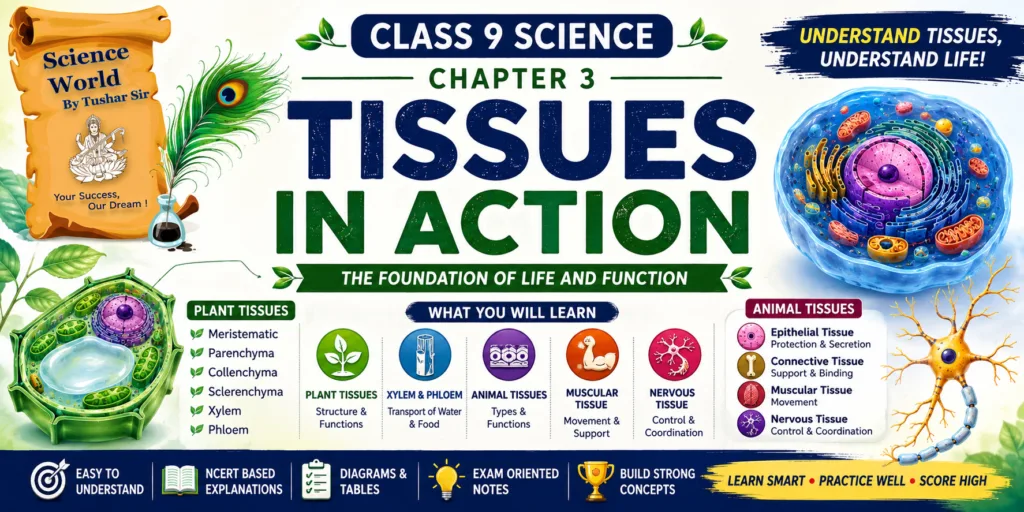
Introduction (Class 9 Science Chapter 3 Tissues in Action Notes)
Living organisms are made up of millions or even billions of cells. In multicellular organisms, similar cells group together to perform a specific function. Such groups of similar cells are called tissues.
The specialization of cells into tissues makes the functioning of organisms more efficient. Instead of every cell performing every function, different tissues perform different tasks. This concept is known as the division of labour.
Plants and animals have different types of tissues because they have different lifestyles and requirements. Plant tissues mainly provide support, transport, storage, and growth, whereas animal tissues help in movement, coordination, protection, and transport of substances.
This chapter explains the structure, classification, characteristics, and functions of plant and animal tissues in detail.
These notes are prepared according to the latest NCERT Exploration: Textbook of Science for Grade 9 and cover all important concepts in an easy-to-understand format.
Table of Contents
Learning Objectives
After studying this chapter, you will be able to:
- Define tissue and explain its importance.
- Understand why multicellular organisms require tissues.
- Differentiate between plant tissues and animal tissues.
- Classify plant tissues into meristematic and permanent tissues.
- Classify animal tissues into epithelial, connective, muscular, and nervous tissues.
- Explain the structure and functions of different tissues.
- Understand the concept of division of labour.
- Identify tissues in plants and animals using diagrams.
What is a Tissue?
Definition
A tissue is a group of similar cells having a common origin that work together to perform a specific function.
The cells of a tissue have similar structures and cooperate to perform a particular job.
Examples of Tissues
Plant Tissues
- Xylem
- Phloem
- Parenchyma
- Collenchyma
- Sclerenchyma
Animal Tissues
- Blood
- Bone
- Muscle
- Nerve
- Skin Epithelium
Why Do Organisms Need Tissues?
Single-celled organisms like Amoeba perform all life processes within one cell. However, multicellular organisms contain millions of cells.
If every cell performed every function, the body would not work efficiently.
Therefore, cells specialize into tissues.
Advantages of Tissues
Tissues provide several benefits:
- Division of labour
- Greater efficiency
- Better coordination
- Faster growth
- Improved repair of damaged parts
- Ability to perform complex functions
Division of Labour
Division of labour means that different tissues perform different functions.
Examples
- Muscle tissue helps in movement.
- Nervous tissue carries messages.
- Blood transports oxygen and nutrients.
- Xylem transports water.
- Phloem transports food.
Because each tissue performs a specialized function, the organism works more efficiently.
Difference Between Cell and Tissue
| Cell | Tissue |
|---|---|
| Basic structural and functional unit of life | Group of similar cells |
| Smallest living unit | Larger than a cell |
| Performs basic life processes | Performs a specific function |
| May exist independently (unicellular organisms) | Found mainly in multicellular organisms |
Types of Tissues
Tissues are broadly classified into two groups.
1. Plant Tissues
Found only in plants.
Functions include:
- Growth
- Support
- Food storage
- Transport of water
- Transport of food
2. Animal Tissues
Found only in animals.
Functions include:
- Protection
- Movement
- Transport
- Coordination
- Support
Plant Tissues
Plant tissues are divided into two major groups.
1. Meristematic Tissue
Responsible for plant growth.
Cells divide continuously.
2. Permanent Tissue
Formed from meristematic tissue.
Cells lose the ability to divide and perform specialized functions.
Animal Tissues
Animal tissues are classified into four major types.
- Epithelial Tissue
- Connective Tissue
- Muscular Tissue
- Nervous Tissue
Each type performs a unique function.
Characteristics of Plant Tissues
- Mostly made of dead cells (except some tissues).
- Provide mechanical support.
- Help in transport.
- Store food and water.
- Growth occurs only in meristematic tissues.
Characteristics of Animal Tissues
- Mostly made of living cells.
- Require more energy.
- Specialized for movement.
- Highly coordinated.
- Support rapid responses.
Plant vs Animal Tissues
| Plant Tissues | Animal Tissues |
|---|---|
| Growth mainly at specific regions | Growth occurs throughout the body |
| More dead tissues | Mostly living tissues |
| Provide support and transport | Movement and coordination |
| Less energy requirement | Higher energy requirement |
| Cell walls present | Cell walls absent |
Importance of Tissues
Tissues help organisms by:
- Performing specialized functions.
- Improving efficiency.
- Providing strength.
- Helping growth.
- Repairing damaged parts.
- Maintaining body functions.
Everyday Examples
- Skin is made of epithelial tissue.
- Blood transports oxygen throughout the body.
- Bones provide support.
- Muscles help us walk and run.
- Xylem carries water from roots to leaves.
- Phloem transports food from leaves to other plant parts.
Meristematic Tissue
Definition
Meristematic tissue is a group of actively dividing, immature cells that are responsible for the growth of plants.
These tissues are found only in the growing regions of plants.
Characteristics of Meristematic Tissue
Meristematic cells possess several unique characteristics:
- Cells divide continuously.
- Cells are small and spherical.
- Thin primary cell wall.
- Dense cytoplasm.
- Large nucleus.
- Vacuoles are absent or very small.
- Cells are tightly packed.
- No intercellular spaces.
- Living cells.
These characteristics help meristematic cells divide rapidly.
Functions of Meristematic Tissue
Meristematic tissue performs many important functions.
- Increases the length of roots and stems.
- Increases the thickness of stems and roots.
- Produces new leaves and flowers.
- Helps in wound healing.
- Replaces damaged tissues.
- Gives rise to permanent tissues.
Types of Meristematic Tissue
Meristematic tissues are classified on the basis of their location.
There are three types:
- Apical Meristem
- Intercalary Meristem
- Lateral Meristem
1. Apical Meristem
Definition
Apical meristem is present at the tips of roots and shoots.
It is responsible for the increase in the length of the plant.
Location
- Root tip
- Shoot tip
Functions
- Primary growth.
- Formation of new leaves.
- Formation of flowers.
- Increase in plant height.
- Development of young branches.
Example
When a plant grows taller every year, the growth occurs because of the apical meristem.
2. Intercalary Meristem
Definition
Intercalary meristem is present at the base of leaves or between the nodes of stems.
Location
- Base of leaves
- Internodes of grasses
- Bamboo
- Sugarcane
Functions
- Rapid elongation of stems.
- Regrowth after grazing.
- Increase in internode length.
Example
Grass quickly grows again after being cut because of the intercalary meristem.
3. Lateral Meristem
Definition
Lateral meristem is present along the sides of stems and roots.
It is responsible for increasing the thickness of plants.
Location
- Stem
- Root
Functions
- Secondary growth.
- Increase in girth.
- Formation of wood.
- Formation of bark.
Example
The thick trunk of a mango or neem tree develops due to the activity of the lateral meristem.
Comparison of the Three Types of Meristematic Tissue
| Type | Location | Function |
|---|---|---|
| Apical Meristem | Root and shoot tips | Increase in length |
| Intercalary Meristem | Base of leaves and internodes | Elongation of internodes |
| Lateral Meristem | Sides of stem and root | Increase in thickness |
Permanent Tissue
Cells produced by meristematic tissue gradually mature and lose their ability to divide.
These mature cells become permanent tissues.
Definition
Permanent tissue is a group of mature cells that have lost the ability to divide and perform specific functions.
Characteristics of Permanent Tissue
- Mature cells.
- Cells do not divide.
- Larger vacuoles present.
- Definite shape and size.
- Intercellular spaces may be present.
- Specialized functions.
- Living or dead cells.
Functions of Permanent Tissue
Permanent tissues help in:
- Storage of food.
- Mechanical support.
- Photosynthesis.
- Transport of water.
- Transport of food.
- Protection.
Difference Between Meristematic Tissue and Permanent Tissue
| Meristematic Tissue | Permanent Tissue |
|---|---|
| Cells divide continuously | Cells do not divide |
| Immature cells | Mature cells |
| Thin cell wall | Thin or thick cell wall |
| Vacuoles absent or very small | Large vacuoles present |
| Dense cytoplasm | Less dense cytoplasm |
| No intercellular spaces | Intercellular spaces may be present |
| Responsible for growth | Responsible for specialized functions |
Why Does a Plant Need Both Tissues?
Both tissues are essential for proper growth and survival.
Meristematic Tissue
- Produces new cells.
- Helps the plant grow.
Permanent Tissue
- Performs specialized activities.
- Supports the plant throughout its life.
Together, they ensure continuous growth and efficient functioning.
Everyday Examples
- The increase in the height of a sunflower is due to the apical meristem.
- Grass grows back quickly after mowing because of the intercalary meristem.
- The increasing thickness of a tree trunk each year is due to the lateral meristem.
- Mature leaves perform photosynthesis because they contain permanent tissues.
Simple Permanent Tissue
Definition
Simple permanent tissue is a tissue made up of only one type of similar mature cells that perform the same function.
Simple permanent tissues are of three types:
- Parenchyma
- Collenchyma
- Sclerenchyma
1. Parenchyma
Definition
Parenchyma is a simple permanent tissue made up of living, thin-walled cells.
It is the most common and widely distributed tissue in plants.
Characteristics of Parenchyma
- Living cells.
- Thin cellulose cell wall.
- Large central vacuole.
- Intercellular spaces present.
- Cells are usually oval, spherical, or polygonal.
- Soft tissue.
Location of Parenchyma
Parenchyma is found in:
- Cortex of roots
- Cortex of stems
- Pith
- Fruits
- Leaves
- Seeds
Functions of Parenchyma
Parenchyma performs several important functions.
1. Storage
Stores:
- Food
- Water
- Starch
- Sugars
2. Photosynthesis
Parenchyma containing chloroplasts is called Chlorenchyma.
It prepares food through photosynthesis.
3. Buoyancy
Parenchyma with large air spaces is called Aerenchyma.
It helps aquatic plants float on water.
4. Healing
Helps repair damaged plant tissues.
5. Support
Provides support when cells are fully filled with water (turgid).
Special Types of Parenchyma
Chlorenchyma
Contains chloroplasts.
Function:
- Photosynthesis.
Example:
- Green leaves.
Aerenchyma
Contains large air cavities.
Function:
- Provides buoyancy.
- Facilitates gaseous exchange.
Example:
- Lotus
- Water hyacinth
2. Collenchyma
Definition
Collenchyma is a simple permanent tissue made up of living elongated cells with unevenly thickened corners.
Characteristics of Collenchyma
- Living cells.
- Elongated shape.
- Uneven thickening at corners.
- Very little intercellular space.
- Flexible tissue.
Location of Collenchyma
Found in:
- Leaf stalk (petiole)
- Young stems
- Leaf margins
Functions of Collenchyma
- Provides mechanical support.
- Gives flexibility.
- Prevents tearing of leaves.
- Allows bending without breaking.
Everyday Example
The bending of a young stem without breaking is possible because of collenchyma.
3. Sclerenchyma
Definition
Sclerenchyma is a simple permanent tissue made up of dead cells with very thick, lignified cell walls.
Characteristics of Sclerenchyma
- Dead cells.
- Thick cell walls.
- Walls contain lignin.
- No cytoplasm.
- Very hard tissue.
- No intercellular spaces.
Location of Sclerenchyma
Found in:
- Coconut husk
- Seed coats
- Nuts
- Mature stems
- Around vascular bundles
Functions of Sclerenchyma
- Provides great strength.
- Gives rigidity.
- Protects seeds.
- Supports mature plant parts.
Everyday Example
The hard shell of a coconut is mainly due to sclerenchyma.
Difference Between Parenchyma, Collenchyma and Sclerenchyma
| Feature | Parenchyma | Collenchyma | Sclerenchyma |
|---|---|---|---|
| Nature | Living | Living | Dead |
| Cell Wall | Thin | Unevenly thickened | Very thick and lignified |
| Shape | Round or oval | Elongated | Long and narrow |
| Intercellular Spaces | Present | Very few | Absent |
| Function | Storage and photosynthesis | Flexibility and support | Strength and protection |
| Location | Cortex, pith, fruits | Leaf stalk, young stem | Coconut husk, seed coat |
Comparison of Simple Permanent Tissues
| Tissue | Living/Dead | Main Function |
|---|---|---|
| Parenchyma | Living | Storage and photosynthesis |
| Collenchyma | Living | Flexible support |
| Sclerenchyma | Dead | Mechanical strength |
Importance of Simple Permanent Tissues
Simple permanent tissues help plants by:
- Storing food and water.
- Preparing food.
- Supporting young stems.
- Providing flexibility.
- Giving mechanical strength.
- Protecting seeds and fruits.
Real-Life Examples
- Potato stores starch in parenchyma cells.
- Green leaves contain chlorenchyma for photosynthesis.
- Lotus floats due to aerenchyma.
- Banana leaf bends because of collenchyma.
- Coconut shell is hard because of sclerenchyma.
Complex Permanent Tissue
Definition
Complex permanent tissue is a tissue made up of different types of cells that work together to perform a common function, mainly the transport of substances in plants.
Types of Complex Permanent Tissues
There are two types:
- Xylem
- Phloem
Xylem
Definition
Xylem is a complex permanent tissue responsible for transporting water and dissolved minerals from the roots to the stems, leaves, and other parts of the plant.
It also provides mechanical support to the plant.
Components of Xylem
Xylem is made up of four types of cells:
- Tracheids
- Vessels
- Xylem Fibres
- Xylem Parenchyma
1. Tracheids
Characteristics
- Long and narrow cells.
- Dead at maturity.
- Thick lignified walls.
- Tapering ends.
Function
- Transport water.
- Provide mechanical support.
2. Vessels
Characteristics
- Long tube-like structures.
- Dead cells.
- Thick lignified walls.
- Wider than tracheids.
Function
- Rapid transport of water and minerals.
3. Xylem Parenchyma
Characteristics
- Living cells.
- Thin cell walls.
Function
- Stores food.
- Helps in lateral transport of water.
4. Xylem Fibres
Characteristics
- Dead cells.
- Thick lignified walls.
Function
- Provide strength and mechanical support.
Functions of Xylem
Xylem performs several important functions:
- Transports water from roots to leaves.
- Carries dissolved minerals.
- Provides strength to stems.
- Supports the plant body.
Phloem
Definition
Phloem is a complex permanent tissue responsible for transporting prepared food (sugars) from the leaves to all parts of the plant.
This process is called translocation.
Components of Phloem
Phloem consists of four types of cells:
- Sieve Tubes
- Companion Cells
- Phloem Parenchyma
- Phloem Fibres
1. Sieve Tubes
Characteristics
- Living elongated cells.
- End walls contain pores called sieve plates.
- Lack a nucleus at maturity.
Function
- Transport prepared food.
2. Companion Cells
Characteristics
- Living cells.
- Closely associated with sieve tubes.
Function
- Help sieve tubes in transporting food.
3. Phloem Parenchyma
Characteristics
- Living cells.
Function
- Store food.
- Help in lateral transport of nutrients.
4. Phloem Fibres
Characteristics
- Dead cells.
- Thick walls.
Function
- Provide mechanical strength.
Functions of Phloem
Phloem helps in:
- Transporting food from leaves.
- Supplying nutrients to growing parts.
- Storing food.
- Providing support.
Transportation in Plants
Plants require transportation because different parts perform different functions.
Water and Minerals
- Absorbed by roots.
- Transported upward by xylem.
Food
- Prepared in leaves by photosynthesis.
- Transported to all plant parts by phloem.
Difference Between Xylem and Phloem
| Xylem | Phloem |
|---|---|
| Transports water and minerals | Transports food |
| Movement is mainly upward | Movement can be upward and downward |
| Mostly dead cells | Mostly living cells |
| Provides mechanical support | Mainly transports food |
| Located towards the inner side of vascular bundle | Located towards the outer side |
Vascular Bundle
The combination of xylem and phloem forms a vascular bundle.
Importance
- Efficient transport of substances.
- Mechanical support.
- Connects roots, stems, and leaves.
Everyday Examples
- Water absorbed by roots reaches the leaves through xylem.
- Sugar produced in leaves is transported to fruits and roots by phloem.
- Tall trees remain upright because xylem provides strength.
- Sweet fruits receive sugars through the phloem.
Comparison of Plant Tissues
| Tissue | Nature | Main Function |
|---|---|---|
| Meristematic | Living | Growth |
| Parenchyma | Living | Storage and photosynthesis |
| Collenchyma | Living | Flexible support |
| Sclerenchyma | Dead | Strength |
| Xylem | Mostly dead | Water transport |
| Phloem | Mostly living | Food transport |
Animal Tissues
Definition
Animal tissues are groups of similar cells that work together to perform specific functions such as protection, support, movement, transport, and coordination.
1. Epithelial Tissue
Definition
Epithelial tissue is a protective tissue that covers the outer surface of the body and lines the internal organs and body cavities.
It acts as the first line of defence against injury, infection, and dehydration.
Characteristics of Epithelial Tissue
- Cells are closely packed.
- Very little intercellular space.
- Rest on a basement membrane.
- Can regenerate quickly.
- Mostly living cells.
Functions of Epithelial Tissue
- Protection.
- Absorption.
- Secretion.
- Excretion.
- Filtration.
- Diffusion of gases.
Types of Epithelial Tissue
A. Squamous Epithelium
Characteristics
- Thin and flat cells.
- Forms a smooth lining.
Location
- Lungs (alveoli)
- Blood vessels
- Mouth lining
Function
- Allows rapid diffusion.
- Protects delicate organs.
B. Cuboidal Epithelium
Characteristics
- Cube-shaped cells.
Location
- Kidney tubules
- Salivary glands
- Sweat glands
Function
- Secretion.
- Absorption.
C. Columnar Epithelium
Characteristics
- Tall, pillar-like cells.
Location
- Stomach
- Intestine
Function
- Absorbs nutrients.
- Secretes digestive enzymes and mucus.
D. Ciliated Epithelium
Characteristics
- Cells have tiny hair-like projections called cilia.
Location
- Respiratory tract
- Oviduct (Fallopian tube)
Function
- Moves mucus and dust particles.
- Helps move the ovum towards the uterus.
E. Glandular Epithelium
Characteristics
- Modified epithelial cells.
Function
- Produces and secretes substances such as hormones, enzymes, saliva, sweat, and mucus.
Summary of Epithelial Tissue
| Type | Location | Function |
|---|---|---|
| Squamous | Lungs, blood vessels | Diffusion and protection |
| Cuboidal | Kidneys, glands | Secretion and absorption |
| Columnar | Intestine | Absorption and secretion |
| Ciliated | Trachea, oviduct | Movement of mucus and ovum |
| Glandular | Glands | Secretion |
2. Connective Tissue
Definition
Connective tissue is a tissue that connects, supports, binds, protects, and transports materials throughout the body.
It is the most abundant tissue in animals.
Characteristics of Connective Tissue
- Cells are widely spaced.
- Matrix is abundant.
- Matrix may be solid, liquid, or semi-solid.
- Provides support and strength.
Types of Connective Tissue
A. Areolar Tissue
Location
- Between skin and muscles.
- Around blood vessels.
Functions
- Binds tissues together.
- Fills empty spaces.
- Supports organs.
B. Adipose Tissue
Location
- Beneath the skin.
- Around kidneys.
- Around the heart.
Functions
- Stores fat.
- Provides insulation.
- Protects organs.
C. Tendons
Connect
Muscle to bone.
Function
- Help in body movement.
- Strong and inelastic.
D. Ligaments
Connect
Bone to bone.
Function
- Hold bones together.
- Flexible and elastic.
E. Cartilage
Location
- Nose
- Ear
- Joints
- Trachea
Functions
- Provides flexibility.
- Reduces friction.
- Supports soft organs.
F. Bone
Characteristics
- Hard tissue.
- Rich in calcium salts.
Functions
- Supports the body.
- Protects internal organs.
- Produces blood cells (bone marrow).
- Stores minerals.
G. Blood
Blood is a fluid connective tissue.
Components
- Plasma
- Red Blood Cells (RBCs)
- White Blood Cells (WBCs)
- Platelets
Functions
- Transports oxygen.
- Carries nutrients.
- Removes wastes.
- Protects against infection.
- Helps in blood clotting.
Difference Between Tendons and Ligaments
| Tendons | Ligaments |
|---|---|
| Connect muscle to bone | Connect bone to bone |
| Strong and less elastic | Flexible and elastic |
| Help movement | Stabilize joints |
Difference Between Bone and Cartilage
| Bone | Cartilage |
|---|---|
| Hard | Flexible |
| Rich in calcium | Less calcium |
| Blood vessels present | Blood vessels absent |
| Forms skeleton | Supports soft parts |
Everyday Examples
- Skin is made of epithelial tissue.
- Fat stored under the skin is adipose tissue.
- Bones form the skeleton.
- Cartilage allows the nose and ears to bend without breaking.
- Blood carries oxygen from the lungs to body cells.
- Tendons help you lift objects by connecting muscles to bones.
- Ligaments stabilize the knee and elbow joints.
3. Muscular Tissue
Definition
Muscular tissue is a tissue made up of elongated muscle cells (muscle fibres) that contract and relax to produce movement.
It is responsible for all types of body movements.
Characteristics of Muscular Tissue
- Long and cylindrical cells.
- Contractile in nature.
- Rich in proteins (actin and myosin).
- Well supplied with blood vessels.
- Produce force and movement.
Functions of Muscular Tissue
- Movement of body parts.
- Maintenance of posture.
- Pumping of blood.
- Movement of food through the alimentary canal.
- Production of body heat.
Types of Muscular Tissue
There are three types of muscular tissue.
- Striated Muscle
- Smooth Muscle
- Cardiac Muscle
1. Striated Muscle (Skeletal Muscle)
Definition
Striated muscles are voluntary muscles attached to bones that help in body movement.
They are also called skeletal muscles.
Characteristics
- Long and cylindrical fibres.
- Multinucleate.
- Light and dark bands (striations) present.
- Work under our control.
Location
- Arms
- Legs
- Neck
- Face
Functions
- Walking
- Running
- Writing
- Lifting objects
- Body movements
2. Smooth Muscle (Unstriated Muscle)
Definition
Smooth muscles are involuntary muscles found in the walls of internal organs.
Characteristics
- Spindle-shaped cells.
- Single nucleus.
- No striations.
- Work automatically.
Location
- Stomach
- Intestine
- Urinary bladder
- Blood vessels
Functions
- Movement of food.
- Control of blood flow.
- Emptying of the urinary bladder.
- Digestion.
3. Cardiac Muscle
Definition
Cardiac muscles are involuntary muscles found only in the heart.
They contract continuously throughout life.
Characteristics
- Branched fibres.
- Striated appearance.
- Single nucleus.
- Never become tired.
- Contract rhythmically.
Functions
- Pump blood continuously.
- Maintain blood circulation.
- Supply oxygen and nutrients to the body.
Difference Between Types of Muscles
| Feature | Striated | Smooth | Cardiac |
|---|---|---|---|
| Control | Voluntary | Involuntary | Involuntary |
| Striations | Present | Absent | Present |
| Shape | Cylindrical | Spindle-shaped | Branched |
| Location | Attached to bones | Internal organs | Heart |
| Fatigue | Fatigue quickly | Fatigue slowly | Rarely fatigue |
4. Nervous Tissue
Definition
Nervous tissue is a specialized tissue that receives, processes, and transmits nerve impulses throughout the body.
It forms the brain, spinal cord, and nerves.
Structural Unit of Nervous Tissue
The basic structural and functional unit of nervous tissue is the neuron (nerve cell).
Structure of a Neuron
A neuron consists of:
- Cell body (Cyton)
- Dendrites
- Axon
- Nerve endings
Parts of a Neuron
1. Cell Body (Cyton)
Contains the nucleus and controls the activities of the neuron.
2. Dendrites
Short, branched extensions that receive nerve impulses from receptors or other neurons.
3. Axon
A long fibre that carries nerve impulses away from the cell body.
4. Nerve Endings
Transmit impulses to another neuron, muscle, or gland.
Functions of Nervous Tissue
- Receives stimuli.
- Conducts nerve impulses.
- Controls body activities.
- Coordinates different organs.
- Enables quick responses.
- Helps in thinking, learning, and memory.
Importance of Nervous Tissue
Without nervous tissue:
- Muscles cannot move properly.
- Reflex actions cannot occur.
- The body cannot respond to danger.
- Coordination between organs is lost.
Difference Between Plant and Animal Tissues
| Plant Tissues | Animal Tissues |
|---|---|
| Growth occurs at specific regions | Growth occurs throughout the body |
| Mostly dead tissues | Mostly living tissues |
| Support and transport | Movement and coordination |
| Cell wall present | Cell wall absent |
| Less energy required | More energy required |
Summary of Animal Tissues
| Tissue | Main Function |
|---|---|
| Epithelial | Protection and covering |
| Connective | Support and transport |
| Muscular | Movement |
| Nervous | Coordination and control |
Everyday Examples
- Running is possible due to striated muscles.
- Digestion occurs because of smooth muscles in the stomach and intestines.
- The heart beats continuously because of cardiac muscles.
- Touching a hot object and immediately withdrawing the hand is controlled by nervous tissue.
- Riding a bicycle requires coordination between muscles and nerves.
Important Definitions
Tissue
A group of similar cells working together to perform a specific function.
Meristematic Tissue
Actively dividing tissue responsible for plant growth.
Permanent Tissue
Mature tissue that performs specialized functions.
Xylem
Complex permanent tissue that transports water and minerals.
Phloem
Complex permanent tissue that transports food.
Epithelial Tissue
Protective tissue covering body surfaces and organs.
Connective Tissue
Tissue that connects, supports, and transports substances.
Muscular Tissue
Contractile tissue responsible for movement.
Nervous Tissue
Specialized tissue that transmits nerve impulses.
Neuron
The structural and functional unit of the nervous system.
Chapter Summary
- A tissue is a group of similar cells performing a common function.
- Plant tissues are classified into meristematic and permanent tissues.
- Permanent tissues are of two types: simple and complex.
- Parenchyma stores food and performs photosynthesis.
- Collenchyma provides flexible support.
- Sclerenchyma gives strength and rigidity.
- Xylem transports water and minerals.
- Phloem transports food.
- Animal tissues include epithelial, connective, muscular, and nervous tissues.
- Muscular tissue helps in movement.
- Nervous tissue controls and coordinates body activities.
Frequently Asked Questions (FAQs)
1. What is a tissue?
A tissue is a group of similar cells working together to perform a specific function.
2. Why are tissues important?
They provide division of labour, making the functioning of multicellular organisms more efficient.
3. What are the two main types of plant tissues?
- Meristematic tissue
- Permanent tissue
4. Which tissue transports water in plants?
Xylem transports water and minerals.
5. Which tissue transports food in plants?
Phloem transports food prepared during photosynthesis.
6. What are the four types of animal tissues?
- Epithelial
- Connective
- Muscular
- Nervous
7. Which muscle works without our control?
Smooth muscle and cardiac muscle are involuntary muscles.
8. Which muscle is found only in the heart?
Cardiac muscle.
9. What is the structural and functional unit of the nervous system?
The neuron.
10. Which tissue connects muscles to bones?
Tendons connect muscles to bones.
Exam Tips
- Learn the classifications of plant and animal tissues.
- Memorise the functions of parenchyma, collenchyma, and sclerenchyma.
- Remember: Xylem = Water, Phloem = Food.
- Practice the differences between tendons and ligaments.
- Learn the three types of muscular tissue with their locations.
- Understand the structure of a neuron and its parts.
- Draw neat, labelled diagrams of plant tissues, muscle types, and a neuron for better scoring.
Quick Revision
- Tissues are groups of similar cells performing specific functions.
- Meristematic tissues are responsible for plant growth.
- Permanent tissues perform specialized functions.
- Xylem carries water and minerals, while phloem transports food.
- Animal tissues include epithelial, connective, muscular, and nervous tissues.
- Striated muscles are voluntary, smooth muscles are involuntary, and cardiac muscles are found only in the heart.
- Neurons transmit nerve impulses and coordinate body functions.
Complete Your Preparation
The notes above cover only the basic concepts of this chapter.
For complete exam preparation, get our premium study material prepared by Science World by Tushar Sir.
The complete study material includes:
✔ Detailed Notes
✔ Mind Maps
✔ NCERT Solutions
✔ MCQs with Answers
✔ Assertion & Reason Questions (eBook only only)
✔ Case-Based Questions (in eBook only)
✔ Short & Long Answer Questions
✔ Practice Paper
FAQ
What is a tissue?
A tissue is a group of similar cells that work together to perform a specific function.
What are the two main types of plant tissues?
Meristematic tissue and permanent tissue.
How many types of animal tissues are there?
There are four main types: epithelial, connective, muscular, and nervous tissues.
Are these notes enough for exams?
These notes are useful for quick revision. For complete preparation with NCERT solutions, MCQs, case-based questions, mind maps, and practice papers, the complete eBook is recommended.
📚 Looking for All Class 9 Science Chapters?
Access all 13 chapter-wise notes based on the latest NCERT Exploration: Textbook of Science for Grade 9 from one place.