Introduction
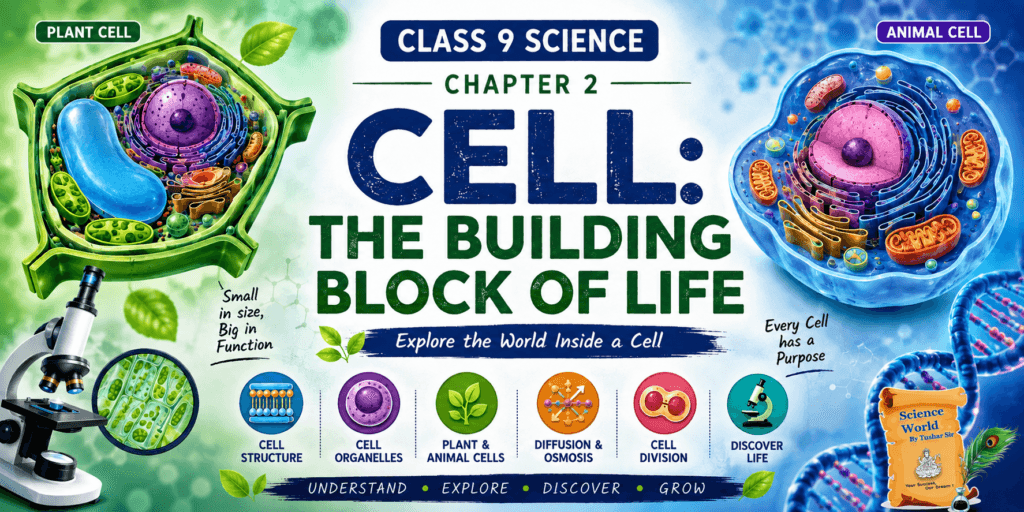
Welcome to the free notes for Class 9 Science Chapter 2 Cell: The Building Block of Life Notes. In this chapter, students learn about the discovery of cells, cell theory, plant and animal cells, cell organelles, and their functions. These notes cover the key concepts for quick revision and understanding.
Every living organism, whether it is a tiny bacterium or a giant banyan tree, is made up of cells. The cell is the smallest structural and functional unit of life. It performs all the essential activities required for the survival, growth, reproduction, and maintenance of an organism.
The discovery of cells marked the beginning of modern biology and helped scientists understand how living organisms are organized. Some organisms consist of a single cell, while others are made up of millions or even billions of cells working together.
In this chapter, you will learn about the discovery of cells, cell theory, types of cells, cell structure, cell organelles, plant and animal cells, diffusion, osmosis, plasmolysis, and the importance of cells in living organisms.
This chapter forms the foundation for understanding all future topics in biology.
These notes are prepared according to the latest NCERT Exploration: Textbook of Science for Grade 9 and cover all important concepts in an easy-to-understand format.
Table of Contents
Learning Objectives
After studying this chapter, you will be able to:
- Define a cell and explain its importance.
- Describe the discovery of the cell.
- Explain the Cell Theory.
- Differentiate between unicellular and multicellular organisms.
- Understand the structure of plant and animal cells.
- Identify the functions of major cell organelles.
- Explain diffusion and osmosis.
- Compare prokaryotic and eukaryotic cells.
- Appreciate the role of cells in maintaining life.
What is a Cell?
A cell is the basic structural and functional unit of life.
Every living organism is made up of one or more cells. Each cell performs specific functions necessary for the survival of the organism.
Cells may vary in shape, size, and function, but all cells carry out essential life processes.
Definition
A cell is the smallest structural, functional, and biological unit of a living organism capable of performing all life processes.
Why is the Cell Called the Basic Unit of Life?
The cell is called the basic unit of life because:
- All living organisms are made of cells.
- Cells perform all vital life processes.
- New cells arise from existing cells.
- Cells work together to form tissues, organs, and organ systems.
- The growth and development of organisms depend on cell division.
Discovery of the Cell
The discovery of the cell was one of the greatest achievements in biology.
Robert Hooke (1665)
In 1665, the English scientist Robert Hooke observed a thin slice of cork under a simple microscope.
He saw tiny box-like compartments that resembled small rooms. He called these compartments “cells”, meaning “small rooms.”
However, the cork cells observed by Hooke were dead cells.
Antonie van Leeuwenhoek (1674)
The Dutch scientist Antonie van Leeuwenhoek improved the microscope and became the first person to observe living cells, including bacteria and protozoa.
His observations opened the door to microbiology
Robert Brown (1831)
Robert Brown discovered the nucleus inside the cell.
The nucleus was later recognized as the control centre of the cell.
Matthias Schleiden (1838)
Schleiden concluded that all plants are made up of cells.
Theodor Schwann (1839)
Schwann concluded that all animals are made up of cells.
Together, Schleiden and Schwann proposed the Cell Theory.
Rudolf Virchow (1855)
Virchow stated:
“Omnis cellula e cellula”
This means:
All new cells arise from pre-existing cells.
Timeline of Cell Discovery
| Scientist | Contribution | Year |
|---|---|---|
| Robert Hooke | Discovered dead cells in cork | 1665 |
| Antonie van Leeuwenhoek | Observed living cells | 1674 |
| Robert Brown | Discovered the nucleus | 1831 |
| Matthias Schleiden | Plants are made of cells | 1838 |
| Theodor Schwann | Animals are made of cells | 1839 |
| Rudolf Virchow | New cells arise from existing cells | 1855 |
Cell Theory
The Cell Theory is one of the fundamental principles of biology.
Main Points of Cell Theory
- All living organisms are made up of one or more cells.
- The cell is the basic structural and functional unit of life.
- All new cells arise from pre-existing cells.
These three statements form the basis of modern biology.
Characteristics of Cells
Cells have several important features.
- They are microscopic in most organisms.
- They contain living material called protoplasm.
- They perform life processes.
- They reproduce through cell division.
- They respond to environmental changes.
- They require nutrients and energy.
Size of Cells
Cells vary greatly in size.
Very Small Cells
- Bacteria
- Mycoplasma
Large Cells
- Ostrich egg (largest single cell)
- Nerve cell (longest cell in the human body)
Most cells are too small to be seen without a microscope.
Shape of Cells
Cells have different shapes depending on their functions.
| Cell | Shape |
|---|---|
| Red Blood Cell | Biconcave |
| Nerve Cell | Long and branched |
| Muscle Cell | Long and cylindrical |
| White Blood Cell | Irregular |
| Plant Cell | Rectangular or polygonal |
| Amoeba | Irregular |
Number of Cells in Organisms
Living organisms can be classified according to the number of cells they contain.
Unicellular Organisms
These organisms consist of only one cell.
That single cell performs all life processes.
Examples
- Amoeba
- Paramecium
- Euglena
- Bacteria
- Yeast
Characteristics
- One cell performs all functions.
- Usually microscopic.
- Simple body organisation.
- Mostly reproduce by binary fission or budding.
Multicellular Organisms
These organisms consist of many cells.
Different cells perform different functions.
Examples
- Humans
- Mango tree
- Dog
- Fish
- Birds
Characteristics
- Large and complex body.
- Division of labour.
- Different tissues and organs.
- Better efficiency.
Difference Between Unicellular and Multicellular Organisms
| Unicellular | Multicellular |
|---|---|
| One cell | Many cells |
| Simple body organisation | Complex body organisation |
| Single cell performs all functions | Division of labour |
| Usually microscopic | Usually visible to the naked eye |
| Examples: Amoeba, Bacteria | Examples: Humans, Trees |
Importance of Cells
Cells are important because they:
- Build the body of organisms.
- Carry genetic information.
- Produce energy.
- Help in growth.
- Repair damaged tissues.
- Enable reproduction.
- Perform metabolism.
- Maintain life.
Everyday Examples
- Healing of a cut occurs because new cells replace damaged cells.
- Hair and nails grow due to continuous cell division.
- Fruits and vegetables grow because plant cells divide and enlarge.
- Human growth from infancy to adulthood is possible because billions of cells divide and specialize.
Key Terms
| Term | Meaning |
|---|---|
| Cell | Basic structural and functional unit of life. |
| Cell Theory | States that all organisms are made of cells, cells are the basic unit of life, and new cells arise from existing cells. |
| Unicellular Organism | Organism made of a single cell. |
| Multicellular Organism | Organism made of many cells. |
| Nucleus | Control centre of the cell. |
| Microscope | Instrument used to observe tiny objects such as cells. |
Basic Structure of a Cell
A typical cell consists of:
- Cell Membrane
- Cytoplasm
- Nucleus
In plant cells, an additional cell wall surrounds the plasma membrane.
Diagram of a Typical Cell
Protoplasm
Definition
Protoplasm is the living substance of a cell that includes the cytoplasm and the nucleus.
It is often called the physical basis of life because all essential life processes occur within it.
Components of Protoplasm
Protoplasm consists of:
- Cytoplasm
- Nucleus
Functions of Protoplasm
- Supports life activities.
- Carries out metabolism.
- Helps in growth and reproduction.
- Stores nutrients.
- Enables movement of substances.
Plasma Membrane (Cell Membrane)
Definition
The plasma membrane is a thin, flexible, living membrane that surrounds the cell and separates it from the external environment.
It is present in both plant and animal cells.
Characteristics of Plasma Membrane
- Thin and flexible.
- Living membrane.
- Protects the cell.
- Selectively permeable.
- Made mainly of lipids and proteins.
Selectively Permeable Membrane
The plasma membrane allows only certain substances to enter or leave the cell.
This property is called selective permeability.
For example:
- Oxygen enters the cell.
- Carbon dioxide leaves the cell.
- Nutrients enter.
- Waste materials exit.
Functions of Plasma Membrane
- Protects the cell.
- Gives shape to the cell.
- Controls movement of substances.
- Maintains the internal environment.
- Enables communication between cells.
Cell Wall
Definition
The cell wall is a strong, rigid, non-living outer covering present outside the plasma membrane in plant cells.
It is mainly composed of cellulose.
Animal cells do not have a cell wall.
Characteristics of Cell Wall
- Non-living.
- Rigid.
- Thick.
- Freely permeable.
- Made of cellulose.
Functions of Cell Wall
- Gives shape to the plant cell.
- Provides mechanical support.
- Protects the cell.
- Prevents bursting due to excess water.
- Maintains rigidity.
Difference Between Cell Wall and Plasma Membrane
| Cell Wall | Plasma Membrane |
|---|---|
| Non-living | Living |
| Present only in plant cells | Present in both plant and animal cells |
| Made of cellulose | Made of lipids and proteins |
| Freely permeable | Selectively permeable |
| Provides rigidity | Controls movement of substances |
Cytoplasm
Definition
Cytoplasm is the jelly-like semifluid substance present between the plasma membrane and the nucleus.
It contains cell organelles suspended in it.
Characteristics of Cytoplasm
- Colourless.
- Jelly-like.
- Living material.
- Contains organelles.
- Mostly made of water.
Functions of Cytoplasm
- Supports cell organelles.
- Site of many chemical reactions.
- Stores nutrients.
- Helps transport materials within the cell.
- Maintains cell shape.
Nucleus
The nucleus is one of the most important parts of the cell.
It acts as the control centre.
Definition
The nucleus is a membrane-bound organelle that controls all the activities of the cell and contains hereditary material (DNA).
Structure of the Nucleus
The nucleus consists of:
- Nuclear membrane
- Nucleoplasm
- Nucleolus
- Chromatin
1. Nuclear Membrane
It surrounds the nucleus.
It has tiny pores that allow the exchange of materials between the nucleus and cytoplasm.
2. Nucleoplasm
The jelly-like fluid present inside the nucleus.
It contains chromosomes and the nucleolus.
3. Nucleolus
A dense spherical body present inside the nucleus.
Function:
- Helps in the formation of ribosomes.
4. Chromatin
Chromatin is a thread-like network of DNA and proteins.
During cell division, chromatin condenses to form chromosomes.
Functions of the Nucleus
The nucleus:
- Controls all cell activities.
- Stores genetic information.
- Regulates growth.
- Controls reproduction.
- Directs protein synthesis.
- Transfers hereditary characters.
Chromosomes
Definition
Chromosomes are thread-like structures found inside the nucleus that carry genetic information.
Humans normally have 46 chromosomes (23 pairs) in each body cell.
Functions of Chromosomes
- Carry genes.
- Transfer hereditary traits.
- Control protein synthesis.
- Help during cell division.
Genes
Definition
Genes are small units of heredity present on chromosomes that determine inherited characteristics.
Examples of inherited traits:
- Eye colour
- Hair colour
- Blood group
- Height
Genes contain DNA, which carries genetic instructions.
DNA (Deoxyribonucleic Acid)
DNA is the hereditary material present inside chromosomes.
It contains instructions for:
- Growth
- Development
- Cell functioning
- Reproduction
DNA is responsible for passing characteristics from parents to offspring.
Comparison: Plant Cell vs Animal Cell (Basic)
| Plant Cell | Animal Cell |
|---|---|
| Cell wall present | Cell wall absent |
| Large vacuole | Small vacuoles |
| Usually rectangular | Usually irregular or rounded |
| Plastids present | Plastids absent |
| Rigid shape | Flexible shape |
(Detailed comparison will be covered later in the chapter.)
Everyday Examples
- The skin protects the body just as the plasma membrane protects the cell.
- A brick wall supports a house, similar to how the cell wall supports a plant cell.
- The nucleus acts like the principal of a school, controlling all activities.
- The cytoplasm is like the classroom where different activities take place.
What are Cell Organelles?
Definition
Cell organelles are specialized structures present inside the cytoplasm that perform specific functions necessary for the survival of the cell.
Most cell organelles are surrounded by membranes that separate them from the cytoplasm.
Major Cell Organelles
The important cell organelles are:
- Endoplasmic Reticulum (ER)
- Ribosomes
- Golgi Apparatus
- Mitochondria
- Lysosomes
- Vacuoles
- Plastids (Plant Cells Only)
Each organelle has a unique structure and function.
1. Endoplasmic Reticulum (ER)
Definition
The Endoplasmic Reticulum (ER) is a network of membrane-bound tubes and sacs present in the cytoplasm.
It acts as the transport system of the cell.
Types of Endoplasmic Reticulum
There are two types:
1. Rough Endoplasmic Reticulum (RER)
RER has ribosomes attached to its surface.
Functions
- Synthesizes proteins.
- Transports proteins.
- Helps in membrane formation.
2. Smooth Endoplasmic Reticulum (SER)
SER does not have ribosomes.
Functions
- Synthesizes fats (lipids).
- Detoxifies harmful chemicals and drugs.
- Stores calcium ions in certain cells.
Functions of Endoplasmic Reticulum
- Provides internal support.
- Transports substances within the cell.
- Helps in protein synthesis.
- Produces lipids.
- Assists in membrane formation.
2. Ribosomes
Definition
Ribosomes are tiny, non-membrane-bound organelles that synthesize proteins.
They are called the protein factories of the cell.
Location of Ribosomes
Ribosomes are found:
- Attached to Rough ER.
- Free in the cytoplasm.
Functions of Ribosomes
- Produce proteins.
- Help in growth.
- Repair damaged tissues.
- Produce enzymes and hormones.
Importance of Proteins
Proteins are needed for:
- Growth
- Body repair
- Enzyme production
- Hormone formation
- Muscle development
Without ribosomes, cells cannot survive.
3. Golgi Apparatus
Definition
The Golgi Apparatus is a stack of flattened membrane-bound sacs that modifies, packages, and transports proteins and lipids.
It is also called the Golgi Body or Golgi Complex.
Functions of Golgi Apparatus
- Modifies proteins.
- Packages proteins.
- Secretes substances.
- Forms lysosomes.
- Produces secretory vesicles.
Why is Golgi Apparatus Called the Post Office of the Cell?
It receives materials from the Endoplasmic Reticulum, packages them, labels them, and sends them to their destinations.
Hence, it is known as the post office or packaging centre of the cell.
4. Mitochondria
Definition
Mitochondria are double-membrane-bound organelles that produce energy for the cell through cellular respiration.
They are known as the powerhouses of the cell.
Structure of Mitochondria
Mitochondria have:
- Outer membrane
- Inner folded membrane (called cristae)
- Matrix
The folds increase the surface area for energy production.
Functions of Mitochondria
- Produce ATP (energy).
- Carry out cellular respiration.
- Supply energy for cell activities.
- Help in metabolism.
Why are Mitochondria Called the Powerhouse of the Cell?
Food is broken down inside mitochondria to release energy in the form of ATP (Adenosine Triphosphate).
ATP is used by cells for:
- Growth
- Movement
- Active transport
- Cell division
- Protein synthesis
5. Lysosomes
Definition
Lysosomes are small membrane-bound sacs containing digestive enzymes.
They digest unwanted substances inside the cell.
Functions of Lysosomes
- Digest food particles.
- Destroy bacteria.
- Remove worn-out organelles.
- Recycle cell materials.
Why are Lysosomes Called the Suicide Bags of the Cell?
If a cell is severely damaged, lysosomes may burst and release digestive enzymes that break down the cell itself.
Therefore, lysosomes are called suicide bags of the cell.
6. Vacuoles
Definition
Vacuoles are membrane-bound sacs used for storing water, food, minerals, pigments, and waste materials.
Vacuoles in Plant Cells
Plant cells contain:
- One large central vacuole.
Functions:
- Stores water.
- Maintains turgor pressure.
- Keeps the cell firm.
- Stores nutrients and pigments.
Vacuoles in Animal Cells
Animal cells usually have:
- Small vacuoles.
- Sometimes several small vacuoles.
Functions of Vacuoles
- Storage of food.
- Storage of water.
- Storage of minerals.
- Waste removal.
- Maintaining cell pressure.
Difference Between Plant and Animal Vacuoles
| Plant Cell | Animal Cell |
|---|---|
| One large vacuole | Many small vacuoles |
| Maintains rigidity | Mainly for storage |
| Occupies most of the cell | Occupies less space |
7. Plastids (Only in Plant Cells)
Definition
Plastids are membrane-bound organelles found only in plant cells and algae.
They manufacture or store food.
Types of Plastids
There are three types.
A. Chloroplast
Contains chlorophyll.
Function:
- Performs photosynthesis.
- Prepares food using sunlight.
Chloroplasts are called the kitchen of the cell because they manufacture food.
B. Chromoplast
Contains coloured pigments other than green.
Function:
- Gives colour to flowers and fruits.
Examples:
- Red tomatoes
- Yellow marigolds
- Orange carrots
C. Leucoplast
Colourless plastids.
Function:
- Store starch.
- Store oils.
- Store proteins.
Difference Between Chloroplast, Chromoplast and Leucoplast
| Chloroplast | Chromoplast | Leucoplast |
|---|---|---|
| Green | Coloured | Colourless |
| Contains chlorophyll | Contains pigments | No pigments |
| Photosynthesis | Colour to fruits/flowers | Food storage |
Plant Cell
A plant cell is the basic structural and functional unit of plants.
Plant cells have certain unique structures that help plants prepare food, store water, and maintain their shape.
Characteristics of Plant Cells
- Usually rectangular or polygonal in shape.
- Cell wall is present.
- Large central vacuole.
- Chloroplasts are present.
- Rigid outer covering.
- Usually fixed shape.
Animal Cell
An animal cell is the basic structural and functional unit of animals.
Animal cells lack some structures found in plant cells but possess flexibility to perform different functions.
Characteristics of Animal Cells
- Usually round or irregular in shape.
- Cell wall absent.
- Small vacuoles.
- Chloroplasts absent.
- Flexible outer membrane.
- Shape may change according to function.
Difference Between Plant Cell and Animal Cell
| Plant Cell | Animal Cell |
|---|---|
| Cell wall present | Cell wall absent |
| Chloroplasts present | Chloroplasts absent |
| Large central vacuole | Small or temporary vacuoles |
| Usually rectangular | Usually round or irregular |
| Rigid shape | Flexible shape |
| Photosynthesis occurs | Photosynthesis does not occur |
Similarities Between Plant and Animal Cells
Both plant and animal cells have:
- Plasma membrane
- Cytoplasm
- Nucleus
- Mitochondria
- Ribosomes
- Endoplasmic Reticulum
- Golgi Apparatus
These organelles perform similar functions in both types of cells.
Prokaryotic Cells
Definition
Prokaryotic cells are simple cells that do not have a true nucleus or membrane-bound organelles.
Their genetic material is present freely in the cytoplasm.
Characteristics of Prokaryotic Cells
- Very small and simple.
- No true nucleus.
- DNA is not enclosed by a nuclear membrane.
- Membrane-bound organelles are absent.
- Usually unicellular.
- Reproduce by binary fission.
Examples
- Bacteria
- Cyanobacteria (Blue-green algae)
Eukaryotic Cells
Definition
Eukaryotic cells are complex cells that contain a true nucleus and membrane-bound organelles.
Most plants, animals, fungi, and protists are made of eukaryotic cells.
Characteristics of Eukaryotic Cells
- Larger than prokaryotic cells.
- True nucleus present.
- Membrane-bound organelles present.
- Complex organization.
- Can be unicellular or multicellular.
Examples
- Plant cells
- Animal cells
- Fungi
- Amoeba
- Paramecium
Difference Between Prokaryotic and Eukaryotic Cells
| Prokaryotic Cell | Eukaryotic Cell |
|---|---|
| True nucleus absent | True nucleus present |
| Membrane-bound organelles absent | Membrane-bound organelles present |
| Smaller in size | Larger in size |
| Simple organization | Complex organization |
| DNA is free in cytoplasm | DNA enclosed within nucleus |
| Example: Bacteria | Example: Plants and Animals |
Movement of Substances Across the Plasma Membrane
Cells constantly exchange materials with their surroundings.
This movement occurs mainly by:
- Diffusion
- Osmosis
These processes help maintain the balance of water, gases, and nutrients.
Diffusion
Definition
Diffusion is the movement of particles from a region of higher concentration to a region of lower concentration until they are evenly distributed.
Diffusion does not require energy.
Examples of Diffusion
- Oxygen enters body cells from the blood.
- Carbon dioxide leaves body cells.
- Perfume spreads throughout a room.
- The smell of food spreads through the air.
Importance of Diffusion
Diffusion helps in:
- Exchange of gases.
- Movement of nutrients.
- Removal of waste products.
- Distribution of dissolved substances.
Factors Affecting Diffusion
The rate of diffusion depends on:
- Difference in concentration.
- Temperature.
- Size of particles.
- Surface area.
- Nature of the medium.
Higher temperature and greater concentration difference increase the rate of diffusion.
Osmosis
Definition
Osmosis is the movement of water molecules through a selectively permeable membrane from a region of higher water concentration (lower solute concentration) to a region of lower water concentration (higher solute concentration).
Osmosis occurs only in the presence of a selectively permeable membrane.
Conditions Required for Osmosis
- Presence of a selectively permeable membrane.
- Difference in water concentration.
- Water molecules must be able to move freely.
Importance of Osmosis
Osmosis helps in:
- Absorption of water by plant roots.
- Maintaining cell shape.
- Movement of water in living organisms.
- Opening and closing of stomata.
- Transport of water within plants.
Types of Solutions
The effect of osmosis depends on the surrounding solution.
1. Hypotonic Solution
A solution with lower solute concentration than the cell.
Effect
- Water enters the cell.
- Cell swells.
- Plant cell becomes turgid.
2. Hypertonic Solution
A solution with higher solute concentration than the cell.
Effect
- Water leaves the cell.
- Cell shrinks.
- Plant cell undergoes plasmolysis.
3. Isotonic Solution
A solution with the same solute concentration as the cell.
Effect
- No net movement of water.
- Cell remains unchanged.
Plasmolysis
Definition
Plasmolysis is the process in which the cytoplasm shrinks away from the cell wall due to the loss of water when a plant cell is placed in a hypertonic solution.
Process of Plasmolysis
- Plant cell is placed in a concentrated salt or sugar solution.
- Water moves out of the cell by osmosis.
- Cytoplasm shrinks.
- Plasma membrane pulls away from the cell wall.
- The cell becomes plasmolysed.
Importance of Plasmolysis
- Demonstrates osmosis.
- Helps preserve food using salt or sugar.
- Explains wilting of plants under dry conditions.
De-plasmolysis
Definition
De-plasmolysis is the process in which a plasmolysed cell regains water and returns to its normal state when placed in pure water or a hypotonic solution.
Everyday Examples
- Raisins swell when soaked in water due to osmosis.
- Fresh vegetables remain firm because their cells are turgid.
- Plants wilt during hot weather because they lose water.
- Pickles are preserved using salt, which causes water to leave microorganisms through osmosis.
- The smell of incense sticks spreads through a room by diffusion.
Key Terms
| Term | Meaning |
|---|---|
| Plant Cell | Cell with a cell wall, chloroplasts, and a large vacuole. |
| Animal Cell | Cell without a cell wall or chloroplasts. |
| Prokaryotic Cell | Cell lacking a true nucleus and membrane-bound organelles. |
| Eukaryotic Cell | Cell containing a true nucleus and membrane-bound organelles. |
| Diffusion | Movement of particles from higher to lower concentration. |
| Osmosis | Movement of water through a selectively permeable membrane. |
| Plasmolysis | Shrinking of the cytoplasm due to water loss in a hypertonic solution. |
| Deplasmolysis | Restoration of a plasmolysed cell after water enters it. |
Cell Division
Definition
Cell division is the process by which a parent cell divides to produce new daughter cells.
It is one of the most important characteristics of living organisms.
Why is Cell Division Important?
Cell division helps in:
- Growth of the body.
- Repair of damaged tissues.
- Replacement of worn-out cells.
- Reproduction in unicellular organisms.
- Formation of reproductive cells in multicellular organisms.
- Maintaining the continuity of life.
Types of Cell Division
There are two main types of cell division.
1. Mitosis
Mitosis is the process in which one parent cell divides to form two genetically identical daughter cells.
Characteristics
- Occurs in body (somatic) cells.
- Produces two daughter cells.
- Chromosome number remains the same.
- Helps in growth and tissue repair.
Importance of Mitosis
- Body growth.
- Healing of wounds.
- Replacement of dead cells.
- Asexual reproduction in some organisms.
2. Meiosis
Meiosis is the process in which one parent cell divides to form four daughter cells, each having half the number of chromosomes.
Characteristics
- Occurs in reproductive organs.
- Produces gametes (sperm and egg cells).
- Chromosome number is reduced by half.
- Creates genetic variation.
Importance of Meiosis
- Formation of gametes.
- Maintains chromosome number in a species.
- Produces variation among offspring.
Note: In Class 9, you only need a basic understanding of mitosis and meiosis. Detailed study is usually covered in higher classes.
Difference Between Mitosis and Meiosis
| Mitosis | Meiosis |
|---|---|
| Occurs in body cells | Occurs in reproductive cells |
| Produces 2 daughter cells | Produces 4 daughter cells |
| Chromosome number remains the same | Chromosome number is halved |
| Helps in growth and repair | Helps in reproduction |
| Daughter cells are genetically identical | Daughter cells are genetically different |
Cell Cycle
Before a cell divides, it passes through a series of stages called the cell cycle.
Stages of the Cell Cycle
- Growth Phase – The cell grows and performs its normal functions.
- DNA Replication – Genetic material is copied.
- Cell Division – The parent cell divides into daughter cells.
This cycle continues throughout the life of an organism.
Importance of Healthy Cells
Healthy cells ensure that:
- Organs function properly.
- Tissues remain healthy.
- The body grows normally.
- Diseases are prevented.
- Wounds heal efficiently.
Maintaining healthy cells requires a balanced diet, exercise, proper sleep, and good hygiene.
Levels of Organization in Living Organisms
Cells are organized into increasingly complex structures.
Cell
  ↓
Tissue
  ↓
Organ
  ↓
Organ System
  ↓
Organism
Example (Human Body)
- Muscle Cell
- Muscle Tissue
- Heart
- Circulatory System
- Human Being
Importance of Studying Cells
The study of cells helps scientists:
- Understand diseases.
- Develop medicines and vaccines.
- Improve agricultural crops.
- Study heredity and genetics.
- Advance biotechnology.
- Develop stem cell therapies.
Cell biology is one of the most important fields of modern science.
Applications of Cell Biology
Cell biology has many practical applications.
In Medicine
- Organ transplantation
- Cancer research
- Stem cell therapy
- Vaccine development
In Agriculture
- Tissue culture
- Disease-resistant crops
- Improved crop varieties
In Biotechnology
- Production of insulin
- Genetic engineering
- Development of new medicines
In Environmental Science
- Pollution control
- Conservation of biodiversity
- Waste management using microorganisms
Complete Chapter Summary
- The cell is the basic structural and functional unit of life.
- Robert Hooke discovered cells in cork, while Leeuwenhoek first observed living cells.
- Cell Theory states that all living organisms are made of cells, the cell is the basic unit of life, and new cells arise from pre-existing cells.
- Cells contain a plasma membrane, cytoplasm, nucleus, and cell organelles.
- The plasma membrane is selectively permeable, while the cell wall provides support in plant cells.
- The nucleus controls all cell activities and contains chromosomes and genes.
- Mitochondria are the powerhouse of the cell.
- Ribosomes synthesize proteins.
- Golgi Apparatus modifies and packages proteins.
- Lysosomes digest waste materials.
- Vacuoles store food, water, and waste.
- Chloroplasts perform photosynthesis.
- Plant cells differ from animal cells in the presence of a cell wall, chloroplasts, and a large vacuole.
- Diffusion and osmosis help transport substances across the plasma membrane.
- Cell division enables growth, repair, and reproduction.
Important Definitions
Cell
The smallest structural and functional unit of life.
Cell Theory
The theory stating that all living organisms are made of cells, the cell is the basic unit of life, and all new cells arise from pre-existing cells.
Plasma Membrane
A living, selectively permeable membrane surrounding the cell.
Cell Wall
A rigid, non-living outer covering found in plant cells.
Nucleus
The control centre of the cell containing genetic material.
Diffusion
Movement of particles from a region of higher concentration to a region of lower concentration.
Osmosis
Movement of water through a selectively permeable membrane from higher water concentration to lower water concentration.
Plasmolysis
Shrinkage of the cytoplasm due to water loss in a hypertonic solution.
Mitosis
Cell division producing two identical daughter cells.
Meiosis
Cell division producing four daughter cells with half the chromosome number.
Frequently Asked Questions (FAQs)
1. What is a cell?
A cell is the basic structural and functional unit of life.
2. Who discovered the cell?
Robert Hooke discovered cells in 1665 while observing a thin slice of cork under a microscope.
3. What is Cell Theory?
Cell Theory states that:
- All living organisms are made of cells.
- The cell is the basic unit of life.
- All new cells arise from pre-existing cells.
4. Why is the nucleus called the control centre of the cell?
Because it controls all cellular activities and contains the genetic material (DNA).
5. Why are mitochondria called the powerhouse of the cell?
Because they produce ATP, the energy required for various cellular activities.
6. What is the function of ribosomes?
Ribosomes synthesize proteins needed for growth and repair.
7. What is the difference between diffusion and osmosis?
Diffusion is the movement of particles from higher to lower concentration, whereas osmosis is the movement of water through a selectively permeable membrane.
8. What is plasmolysis?
Plasmolysis is the shrinkage of the cytoplasm away from the cell wall due to water loss in a hypertonic solution.
9. What is mitosis?
Mitosis is a type of cell division that produces two genetically identical daughter cells.
10. Why is cell division important?
Cell division is important for growth, repair, reproduction, and replacement of old or damaged cells.
15 Exam Tips
- Learn the definition of a cell.
- Memorise the Cell Theory.
- Revise the contributions of important scientists.
- Understand the functions of all major cell organelles.
- Learn the differences between plant and animal cells.
- Compare prokaryotic and eukaryotic cells.
- Revise diffusion and osmosis with examples.
- Understand plasmolysis and deplasmolysis.
- Memorise the functions of mitochondria, Golgi apparatus, and ribosomes.
- Learn the role of chloroplasts in photosynthesis.
- Practise labelled diagrams of plant and animal cells.
- Revise important biological terms.
- Understand the basics of mitosis and meiosis.
- Solve NCERT textbook questions.
- Review the chapter summary before exams.
Quick Revision
- Cells are the basic structural and functional units of life.
- The nucleus contains DNA, genes, and chromosomes.
- The plasma membrane regulates the movement of substances.
- Cell organelles perform specialized functions.
- Plant cells have a cell wall and chloroplasts, while animal cells do not.
- Diffusion and osmosis help transport substances across the plasma membrane.
- Cell division is essential for growth, repair, and reproduction.
- Healthy cells work together to form tissues, organs, organ systems, and ultimately a complete organism.
Complete Your Preparation
The notes above cover only the basic concepts of this chapter.
For complete exam preparation, get our premium study material.
The complete study material includes:
✔ Detailed Notes
✔ Mind Maps
✔ NCERT Solutions
✔ MCQs with Answers
✔ Assertion & Reason Questions
✔ Case-Based Questions
✔ Competency-Based Questions
✔ Short & Long Answer Questions
✔ Practice Paper

FAQ
What is a cell?
A cell is the smallest structural and functional unit of life.
Who discovered the cell?
Robert Hooke discovered the cell in 1665 while observing cork under a microscope.
What is the function of the nucleus?
The nucleus controls all the activities of the cell and contains genetic material.
Are these notes enough for exams?
These free notes are useful for revision. For complete preparation with solved questions, MCQs, mind maps, and practice papers, the complete eBook is recommended.
If these free notes helped you, take your preparation to the next level with our complete study material. Choose the chapter eBook, the complete Class 9 Science eBook, or the printed book to access detailed explanations, practice questions, and exam-focused content.
📚 Looking for All Class 9 Science Chapters?
Access all 13 chapter-wise notes based on the latest NCERT Exploration: Textbook of Science for Grade 9 from one place.