Introduction
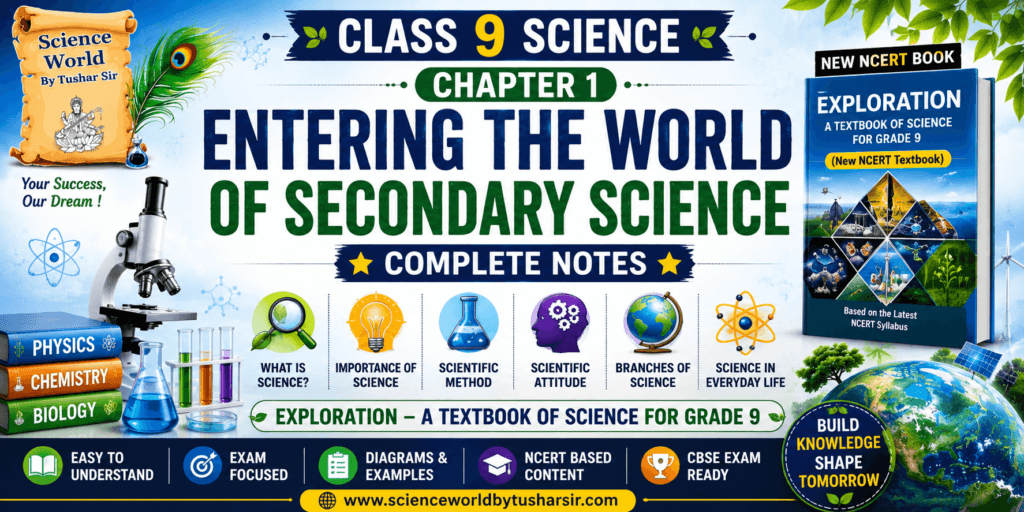
Welcome to the free notes for Class 9 Science Chapter 1 Entering the World of Secondary Science Notes. These notes are prepared according to the latest CBSE syllabus and are designed to help students understand the basic concepts of science in a simple and easy-to-learn format.
Science helps us understand the world around us through observation, experimentation, and logical thinking. As students enter secondary school, they begin to study science in greater depth. This chapter introduces the exciting world of secondary science and explains how scientific knowledge is developed, tested, and applied in everyday life.
From understanding natural phenomena to developing modern technologies, science plays an essential role in improving our quality of life. It encourages curiosity, critical thinking, problem-solving, and innovation.
In this chapter, you will learn about the nature of science, scientific inquiry, laboratory safety, measurement, SI units, scientific attitude, branches of science, and the importance of science in daily life.
This chapter lays the foundation for all the topics that you will study in Class 9 Science.
These notes are prepared according to the latest NCERT Exploration: Textbook of Science for Grade 9 and cover all important concepts in an easy-to-understand format.
Table of Contents
Learning Objectives
After studying this chapter, you will be able to:
- Understand the meaning of science.
- Explain the importance of science in everyday life.
- Describe the scientific method.
- Differentiate between observation, hypothesis, experiment, and conclusion.
- Identify the major branches of science.
- Understand the importance of laboratory safety.
- Learn the SI system of units.
- Develop a scientific attitude.
- Appreciate the role of science in sustainable development.
What is Science?
Science is the systematic study of the natural world through observation, experimentation, and logical reasoning.
It helps us understand:
- Living organisms
- Matter and energy
- Earth and space
- Natural phenomena
- Technology and innovation
Science is not just a collection of facts; it is a continuous process of discovering new knowledge.
Definition
Science is the systematic study of the natural world based on observation, experimentation, evidence, and logical reasoning.
Characteristics of Science
Science has several important characteristics.
- Based on facts and evidence.
- Uses observation and experiments.
- Follows logical reasoning.
- Results can be verified.
- Knowledge changes with new discoveries.
- Encourages curiosity and questioning.
Why Do We Study Science?
Science helps us:
- Understand nature.
- Improve health and medicine.
- Develop new technologies.
- Protect the environment.
- Solve everyday problems.
- Make informed decisions.
Without science, modern life would not be possible.
Science in Everyday Life
Science affects almost every aspect of our daily life.
At Home
- Cooking food
- Refrigerators
- Washing machines
- Microwave ovens
- Water purifiers
In Transportation
- Cars
- Trains
- Aeroplanes
- Electric vehicles
In Communication
- Smartphones
- Internet
- Television
- Satellites
In Healthcare
- Vaccines
- Medicines
- X-rays
- MRI scans
In Agriculture
- Improved seeds
- Fertilizers
- Irrigation systems
- Agricultural machinery
Importance of Science
Science is important because it:
- Improves living standards.
- Increases agricultural production.
- Prevents diseases.
- Protects natural resources.
- Encourages innovation.
- Supports economic development.
- Helps solve global challenges such as climate change.
Scientific Method
- Observation
- Identify the problem
- Form a hypothesis
- Perform experiments
- Record observations
- Analyze results
- Draw conclusions
Laboratory Safety Rules
- Wear safety equipment.
- Read instructions carefully.
- Handle chemicals safely.
- Keep the laboratory clean.
- Report accidents immediately.
Important Terms
- Science
- Observation
- Experiment
- Hypothesis
- Laboratory
- Measurement
- SI Units
Qualities of a Scientific Attitude
- Curiosity
- Open-mindedness
- Honesty
- Objectivity
- Patience
- Creativity
- Critical thinking
- Willingness to accept evidence
These qualities help scientists make reliable discoveries.
Science and Technology
Science and technology are closely related but different.
- Science discovers new knowledge.
- Technology applies scientific knowledge to solve practical problems.
For example:
- Science explains electricity.
- Technology uses electricity to develop appliances.
Branches of Science
Science is broadly divided into three major branches.
1. Physics
Physics is the study of matter, energy, force, motion, heat, light, electricity, and sound.
Examples
- Motion of vehicles
- Electricity
- Magnetism
- Gravity
2. Chemistry
Chemistry is the study of matter, its composition, properties, and changes.
Examples
- Cooking
- Rusting
- Medicines
- Fuels
- Acids and bases
3. Biology
Biology is the study of living organisms.
Examples
- Plants
- Animals
- Human body
- Microorganisms
- Genetics
Interdisciplinary Sciences
Modern science combines different branches.
Examples include:
- Biotechnology
- Environmental Science
- Microbiology
- Biochemistry
- Nanotechnology
- Space Science
These fields solve complex real-world problems by integrating knowledge from multiple disciplines.
Everyday Examples
- Switching on a light demonstrates electrical science.
- Boiling water involves changes in the state of matter.
- Growing plants requires knowledge of biology and environmental science.
- Using GPS in a mobile phone depends on satellite technology.
Key Terms
| Term | Meaning |
|---|---|
| Science | Systematic study of the natural world. |
| Observation | Careful examination using the senses or instruments. |
| Experiment | A planned investigation to test an idea. |
| Scientific Attitude | Logical and evidence-based approach to solving problems. |
| Technology | Practical application of scientific knowledge. |
| Physics | Study of matter and energy. |
| Chemistry | Study of substances and their changes. |
| Biology | Study of living organisms. |
Exam Tips
- Remember the definition of science in scientific language.
- Learn the three major branches of science with examples.
- Understand the difference between science and technology.
- Be able to explain the importance of science in everyday life with suitable examples.
- Revise the qualities of a scientific attitude, as they are often asked in examinations.
Quick Revision
- Science is based on observation, experimentation, and logical reasoning.
- Science helps us understand nature and improve human life.
- The three main branches of science are Physics, Chemistry, and Biology.
- Technology applies scientific knowledge for practical use.
- A scientific attitude includes curiosity, honesty, open-mindedness, and critical thinking.
- Science plays a vital role in health, communication, agriculture, transportation, and environmental protection.
What is the Scientific Method?
The scientific method is a step-by-step process used to solve scientific problems through observation, experimentation, and logical reasoning.
It ensures that scientific investigations are:
- Systematic
- Objective
- Reliable
- Repeatable
- Evidence-based
Definition
The scientific method is a systematic process of observing, questioning, forming a hypothesis, conducting experiments, analysing data, and drawing conclusions.
Steps of the Scientific Method
The scientific method generally follows these steps:
- Observation
- Identification of the Problem
- Formulation of Hypothesis
- Planning and Conducting Experiments
- Data Collection
- Data Analysis
- Drawing Conclusions
- Verification and Communication
Each step is discussed below.
Step 1: Observation
Observation is the first step in every scientific investigation.
Scientists carefully examine objects, events, or phenomena using their senses or scientific instruments.
Definition
Observation is the careful study of objects or events using our senses or scientific instruments to collect information.
Types of Observation
1. Qualitative Observation
Describes qualities without measurement.
Examples:
- The flower is red.
- The solution is cloudy.
- The iron nail is rusty.
2. Quantitative Observation
Includes numerical measurements.
Examples:
- The temperature is 32°C.
- The plant is 25 cm tall.
- The water boils at 100°C under standard atmospheric pressure.
Importance of Observation
Observation helps scientists:
- Identify problems.
- Collect accurate information.
- Develop new ideas.
- Plan experiments.
- Verify scientific facts.
Step 2: Identifying the Problem
After making observations, scientists identify a specific question or problem.
Examples
- Why do leaves turn yellow?
- Why does iron rust?
- Why do objects fall towards the Earth?
- Why do some plants grow faster than others?
A clear research question helps guide the investigation.
Step 3: Hypothesis
After identifying a problem, scientists propose a possible explanation called a hypothesis.
Definition
A hypothesis is a logical and testable prediction based on observations and existing knowledge.
A hypothesis is not a proven fact. It must be tested through experiments.
Examples of Hypotheses
- Plants grow faster when they receive more sunlight.
- Salt dissolves faster in warm water than in cold water.
- Seeds need water to germinate.
Characteristics of a Good Hypothesis
A good hypothesis should be:
- Clear
- Logical
- Testable
- Based on observations
- Simple and specific
Step 4: Experimentation
An experiment is conducted to test whether the hypothesis is correct.
Definition
An experiment is a carefully planned procedure used to test a hypothesis under controlled conditions.
Experiments should be fair and repeatable.
Variables in an Experiment
To obtain reliable results, scientists control different variables.
Independent Variable
The factor that is deliberately changed.
Example: Amount of sunlight given to a plant.
Dependent Variable
The factor that is measured or observed.
Example: Growth of the plant.
Controlled Variables
Factors kept constant throughout the experiment.
Examples:
- Type of plant
- Amount of water
- Type of soil
- Temperature
Keeping these constant ensures that only one factor is tested.
Fair Test
A fair test means changing only one variable while keeping all other conditions the same.
This ensures that the results are reliable and valid.
Step 5: Data Collection
During the experiment, observations and measurements are carefully recorded.
Definition
Data collection is the process of gathering observations and measurements during an investigation.
Types of Data
Qualitative Data
Descriptive information.
Examples:
- Colour changed from blue to green.
- Leaves became yellow.
Quantitative Data
Numerical information.
Examples:
- Height = 20 cm
- Temperature = 28°C
- Time = 15 minutes
Recording Data
Scientists record data using:
- Observation tables
- Charts
- Graphs
- Diagrams
- Photographs
- Laboratory notebooks
Accurate recording reduces errors and makes analysis easier.
Step 6: Data Analysis
After collecting data, scientists organise and interpret the results.
They look for:
- Patterns
- Relationships
- Trends
- Similarities
- Differences
Graphs and tables help present data clearly.
Step 7: Drawing Conclusions
After analysing the data, scientists decide whether the hypothesis is supported or rejected.
Definition
A conclusion is the final decision based on the analysis of experimental data.
A conclusion should:
- Be based on evidence.
- Answer the original question.
- Mention whether the hypothesis was correct.
Step 8: Verification and Communication
Scientific investigations should be repeatable.
Scientists:
- Repeat experiments.
- Compare results.
- Publish findings.
- Share discoveries with the scientific community.
This allows others to verify the results and build upon the research.
Example of the Scientific Method
Problem
Does sunlight affect plant growth?
Observation
Plants near windows appear healthier.
Hypothesis
Plants receiving more sunlight will grow taller.
Experiment
Grow two identical plants:
- Plant A receives sunlight.
- Plant B is kept in a dark place.
Provide both with the same amount of water, soil, and temperature.
Observation
Plant A grows taller and greener.
Plant B grows slowly and becomes pale.
Conclusion
The hypothesis is supported. Sunlight is essential for healthy plant growth.
Importance of the Scientific Method
The scientific method:
- Produces reliable knowledge.
- Reduces bias.
- Encourages logical thinking.
- Solves practical problems.
- Helps develop new technologies.
- Supports scientific discoveries.
Everyday Examples
- Testing which detergent removes stains more effectively.
- Comparing the growth of plants under different light conditions.
- Measuring how quickly sugar dissolves in hot and cold water.
- Investigating which material keeps water warm for the longest time.
Key Terms
| Term | Meaning |
|---|---|
| Scientific Method | A systematic process used to investigate scientific questions. |
| Observation | Careful examination using senses or instruments. |
| Hypothesis | A testable prediction based on observations. |
| Experiment | A planned investigation to test a hypothesis. |
| Variable | A factor that can change during an experiment. |
| Data | Information collected during an investigation. |
| Conclusion | Final decision based on experimental evidence. |
Exam Tips
- Learn the scientific method in the correct sequence.
- Understand the difference between observation and hypothesis.
- Be able to identify independent, dependent, and controlled variables in simple experiments.
- Remember that a hypothesis is testable, not a proven fact.
- Practise drawing the flowchart of the scientific method, as it is useful for short-answer questions.
Quick Revision
- The scientific method is a step-by-step process used in scientific investigations.
- Observation is the first step in solving a scientific problem.
- A hypothesis is a logical and testable prediction.
- Experiments must be fair, with only one independent variable changed.
- Data can be qualitative or quantitative.
- Conclusions are based on evidence collected during experiments.
- Scientific results should be repeatable and verifiable.
What is a Science Laboratory?
A science laboratory is a specially designed room equipped with instruments, chemicals, and apparatus used to perform scientific experiments safely.
It allows students to:
- Observe scientific phenomena.
- Perform experiments.
- Test hypotheses.
- Develop practical skills.
- Verify scientific theories.
Importance of a Science Laboratory
A laboratory helps students to:
- Learn by doing.
- Develop observation skills.
- Improve scientific thinking.
- Understand theoretical concepts.
- Build confidence in handling scientific equipment.
Laboratory Safety Rules
Safety is the first priority in every laboratory.
Students should always follow laboratory rules to prevent accidents.
General Laboratory Safety Rules
- Wear a lab coat or apron during experiments.
- Read the experiment instructions carefully before starting.
- Follow the teacher’s instructions at all times.
- Keep the laboratory clean and organized.
- Handle chemicals carefully.
- Never taste chemicals.
- Do not smell chemicals directly; use the wafting technique if instructed.
- Avoid running or playing inside the laboratory.
- Keep flammable materials away from flames.
- Report broken glassware or accidents immediately.
- Wash your hands after completing experiments.
Safety Symbols
Many chemicals and laboratory materials carry safety symbols to indicate hazards.
Some common safety symbols include:
| Symbol | Meaning |
|---|---|
| 🔥 | Flammable |
| ☠️ | Toxic |
| ⚡ | Electrical Hazard |
| ☣️ | Biohazard |
| ⚗️ | Corrosive Substance |
| ❗ | Warning / Caution |
Understanding these symbols helps prevent accidents.
Personal Protective Equipment (PPE)
Scientists use protective equipment to reduce the risk of injury.
Common PPE
- Safety goggles
- Lab coat
- Gloves
- Face mask (when required)
- Closed-toe shoes
Using PPE protects the eyes, skin, and respiratory system.
Common Laboratory Equipment
Scientists use different instruments depending on the experiment.
1. Beaker
A beaker is used to:
- Hold liquids.
- Mix solutions.
- Heat substances.
Beakers are available in different sizes.
2. Test Tube
A test tube is used for:
- Small-scale experiments.
- Heating small quantities of substances.
- Chemical reactions.
3. Test Tube Holder
It is used to hold a test tube while heating.
This prevents burns.
4. Measuring Cylinder
A measuring cylinder is used to measure the volume of liquids accurately.
It has graduated markings.
5. Conical Flask
A conical flask is used to:
- Mix chemicals.
- Carry out reactions.
- Reduce spillage while swirling liquids.
6. Funnel
A funnel is used to:
- Transfer liquids.
- Filter mixtures using filter paper.
7. Dropper
A dropper transfers small quantities of liquid one drop at a time.
8. Thermometer
A thermometer measures temperature.
It is commonly used in heating and cooling experiments.
9. Balance
A laboratory balance measures the mass of objects and chemicals accurately.
10. Bunsen Burner (or Spirit Lamp)
It provides heat for scientific experiments.
Students should use it only under supervision.
Importance of Measurement
Scientific observations become meaningful only when they are measured accurately.
Measurement helps scientists:
- Compare results.
- Record observations.
- Perform calculations.
- Conduct fair experiments.
Physical Quantities
A physical quantity is a measurable property of an object.
Examples:
- Length
- Mass
- Time
- Temperature
- Volume
- Force
SI System of Units
The International System of Units (SI) is the standard system of measurement used worldwide.
It ensures consistency and accuracy in scientific work.
Common SI Units
| Physical Quantity | SI Unit | Symbol |
|---|---|---|
| Length | metre | m |
| Mass | kilogram | kg |
| Time | second | s |
| Temperature | kelvin | K |
| Electric Current | ampere | A |
| Amount of Substance | mole | mol |
| Luminous Intensity | candela | cd |
Units Commonly Used in School Laboratories
| Quantity | Unit |
|---|---|
| Length | centimetre (cm), metre (m) |
| Mass | gram (g), kilogram (kg) |
| Volume | litre (L), millilitre (mL) |
| Temperature | degree Celsius (°C) |
| Time | second (s), minute (min) |
Measuring Length
Length is measured using:
- Ruler
- Metre scale
- Measuring tape
- Vernier calipers (advanced)
- Screw gauge (advanced)
For Class 9, a ruler and metre scale are commonly used.
Measuring Mass
Mass is measured using:
- Beam balance
- Electronic balance
The SI unit of mass is the kilogram (kg).
Measuring Volume
The volume of liquids is measured using:
- Measuring cylinder
- Pipette
- Burette
- Volumetric flask
For regular laboratory work, the measuring cylinder is commonly used.
Measuring Temperature
Temperature is measured using a thermometer.
Common unit:
- Degree Celsius (°C)
SI unit:
- Kelvin (K)
Accuracy
Definition
Accuracy is the closeness of a measured value to the true or accepted value.
Example
If the actual length of an object is 20.0 cm and you measure 20.1 cm, your measurement is highly accurate.
Precision
Definition
Precision is the closeness of repeated measurements to one another.
Example
A student measures the length of a pencil five times and obtains:
15.2 cm, 15.2 cm, 15.3 cm, 15.2 cm, 15.2 cm
These readings are precise because they are very close to each other.
Difference Between Accuracy and Precision
| Accuracy | Precision |
|---|---|
| Close to the true value | Close to repeated values |
| Indicates correctness | Indicates consistency |
| May not always be precise | May be precise but not accurate |
Sources of Experimental Errors
Errors may occur due to:
- Incorrect reading of instruments.
- Faulty equipment.
- Human mistakes.
- Improper calibration.
- Environmental conditions.
Scientists reduce errors by repeating experiments and using properly calibrated instruments.
Good Laboratory Practices
Students should:
- Record observations immediately.
- Use clean apparatus.
- Measure carefully.
- Label chemicals correctly.
- Return equipment after use.
- Dispose of waste safely.
- Clean the workspace after the experiment.
These habits improve both safety and accuracy.
Everyday Examples
- Using a kitchen measuring cup to prepare a recipe is an example of volume measurement.
- Checking body temperature with a thermometer is a scientific measurement.
- Wearing safety goggles while using chemicals protects the eyes.
- Measuring ingredients accurately ensures successful cooking, just as precise measurements improve scientific experiments.
Key Terms
| Term | Meaning |
|---|---|
| Laboratory | A place where scientific experiments are performed. |
| Measurement | Determining the value of a physical quantity. |
| SI Units | Internationally accepted standard units of measurement. |
| Accuracy | Closeness of a measured value to the true value. |
| Precision | Closeness of repeated measurements to each other. |
| PPE | Personal Protective Equipment used for safety. |
| Physical Quantity | A measurable property of an object or substance. |
Exam Tips
- Learn the SI units of common physical quantities.
- Understand the difference between accuracy and precision with examples.
- Memorise the uses of common laboratory equipment such as beakers, test tubes, and measuring cylinders.
- Always mention laboratory safety precautions when answering practical-based questions.
- Revise the definitions of measurement, physical quantity, and SI units, as they are commonly asked in exams.
Major Branches of Science
Science is broadly divided into three major branches:
- Physics
- Chemistry
- Biology
Each branch has a unique area of study but often works together with the others.
1. Physics
Definition
Physics is the branch of science that studies matter, energy, force, motion, heat, light, electricity, magnetism, and sound.
Physics explains how objects move, how machines work, and how energy is transferred.
Topics Covered in Physics
- Motion
- Force
- Work and Energy
- Heat
- Light
- Sound
- Electricity
- Magnetism
- Gravity
Applications of Physics
Physics is used in:
- Mobile phones
- Computers
- Satellites
- Electric vehicles
- Medical imaging (X-rays, MRI)
- Solar panels
- Aircraft and rockets
2. Chemistry
Definition
Chemistry is the branch of science that studies the composition, properties, structure, and changes of matter.
It helps us understand how substances react and form new materials.
Topics Covered in Chemistry
- Atoms
- Molecules
- Elements
- Compounds
- Mixtures
- Chemical Reactions
- Acids and Bases
- Metals and Non-metals
Applications of Chemistry
Chemistry is important in:
- Manufacturing medicines
- Food preservation
- Fertilizer production
- Cosmetics
- Paints
- Fuels
- Water purification
3. Biology
Definition
Biology is the branch of science that studies living organisms and their life processes.
It explains how plants, animals, and microorganisms grow, reproduce, and interact with the environment.
Topics Covered in Biology
- Cells
- Tissues
- Human Body
- Plants
- Animals
- Genetics
- Microorganisms
- Ecology
Applications of Biology
Biology is used in:
- Medicine
- Agriculture
- Biotechnology
- Environmental conservation
- Veterinary science
- Food production
Interdisciplinary Branches of Science
Modern scientific research combines knowledge from multiple branches.
Some important interdisciplinary fields are:
Biotechnology
Uses biology and technology to develop useful products such as vaccines, improved crops, and medicines.
Environmental Science
Studies the interaction between humans and the environment to solve environmental problems.
Microbiology
Studies microorganisms such as bacteria, fungi, algae, and viruses.
Biochemistry
Combines biology and chemistry to study chemical processes in living organisms.
Nanotechnology
Deals with materials and devices at the nanometre scale (one billionth of a metre).
Applications include:
- Medicine
- Electronics
- Water purification
- Energy storage
Space Science
Studies planets, stars, galaxies, satellites, and the universe.
It also includes space exploration and satellite technology.
Science and Technology
Science and technology are closely connected.
Science
Science discovers new knowledge through observation and experimentation.
Technology
Technology applies scientific knowledge to create useful tools, machines, and systems.
Difference Between Science and Technology
| Science | Technology |
|---|---|
| Discovers new knowledge | Applies scientific knowledge |
| Explains natural phenomena | Solves practical problems |
| Based on experiments | Based on innovation and design |
| Focuses on understanding | Focuses on application |
Importance of Science and Technology
Science and technology have transformed modern life.
They have improved:
- Healthcare
- Agriculture
- Communication
- Transportation
- Education
- Industry
- Environmental protection
Science in Daily Life
Science is present in almost everything we do.
At Home
- Refrigerators
- Air conditioners
- Water purifiers
- Washing machines
- Microwave ovens
In Schools
- Computers
- Smart classrooms
- Projectors
- Digital laboratories
In Hospitals
- MRI scanners
- CT scans
- Vaccines
- Surgical instruments
In Agriculture
- Irrigation systems
- High-yield seeds
- Fertilizers
- Farm machinery
In Communication
- Internet
- Smartphones
- Satellites
- Television
- GPS
Science and Society
Science contributes significantly to the development of society.
It helps in:
- Improving public health.
- Increasing food production.
- Protecting the environment.
- Developing renewable energy.
- Creating employment opportunities.
- Improving disaster management.
Scientific advancements make societies healthier, safer, and more productive.
Environmental Responsibility
Scientific progress should always be balanced with environmental protection.
Students can contribute by:
- Conserving water.
- Saving electricity.
- Planting trees.
- Reducing plastic use.
- Recycling waste.
- Using public transport.
- Protecting biodiversity.
Responsible use of science ensures sustainable development.
Careers in Science
Science offers a wide range of career opportunities.
Some popular careers include:
- Doctor
- Engineer
- Scientist
- Pharmacist
- Biotechnologist
- Environmental Scientist
- Agricultural Scientist
- Microbiologist
- Astronomer
- Teacher
- Researcher
- Data Scientist
- Forensic Scientist
- Nutritionist
- Wildlife Biologist
Each career contributes to solving important challenges and improving society.
Qualities of a Good Scientist
A successful scientist should have:
- Curiosity
- Honesty
- Patience
- Creativity
- Critical thinking
- Observation skills
- Problem-solving ability
- Teamwork
- Perseverance
These qualities help scientists make reliable discoveries and innovations.
Everyday Examples
- Doctors use biology and chemistry to diagnose and treat diseases.
- Engineers apply physics to design bridges, buildings, and vehicles.
- Farmers use agricultural science to improve crop production.
- Meteorologists use scientific data to predict weather.
- Mobile phones combine discoveries from physics, chemistry, computer science, and engineering.
Key Terms
| Term | Meaning |
|---|---|
| Physics | Study of matter, energy, force, and motion. |
| Chemistry | Study of substances and their changes. |
| Biology | Study of living organisms. |
| Biotechnology | Application of biology to develop useful products. |
| Environmental Science | Study of the environment and its protection. |
| Technology | Practical application of scientific knowledge. |
| Scientist | A person who studies and investigates scientific phenomena. |
Exam Tips
- Learn the definitions of Physics, Chemistry, and Biology accurately.
- Be able to distinguish between science and technology.
- Revise at least five applications of each major branch of science.
- Remember examples of interdisciplinary sciences such as biotechnology and environmental science.
- Questions based on the role of science in society and environmental responsibility are often asked in school examinations.
Importance of Observation
Observation is the foundation of every scientific discovery.
Scientists carefully observe natural events before conducting experiments.
Why is Observation Important?
Observation helps us to:
- Collect accurate information.
- Identify scientific problems.
- Compare results.
- Develop hypotheses.
- Draw logical conclusions.
Example
Observing that a plant grows toward sunlight may lead to an investigation about the effect of light on plant growth.
Critical Thinking in Science
Critical thinking means analysing information carefully before accepting it as true.
A student with critical thinking skills:
- Asks questions.
- Looks for evidence.
- Identifies mistakes.
- Evaluates different explanations.
- Makes logical decisions.
Critical thinking helps us distinguish facts from opinions and avoid misinformation.
Problem-Solving Skills
Science teaches us to solve problems using logical steps.
Problem-Solving Process
- Identify the problem.
- Collect information.
- Form a hypothesis.
- Conduct experiments.
- Analyse results.
- Draw conclusions.
- Suggest improvements if required.
These skills are useful in school, daily life, and future careers.
Scientific Communication
Scientific discoveries become useful only when they are shared with others.
Scientists communicate their findings through:
- Research papers
- Books
- Journals
- Conferences
- Diagrams
- Graphs
- Tables
- Presentations
Clear communication allows other scientists to verify and build upon existing knowledge.
Importance of Teamwork in Science
Many scientific discoveries are made by teams of scientists working together.
Teamwork helps in:
- Sharing ideas.
- Solving complex problems.
- Improving research quality.
- Completing projects efficiently.
Examples include space missions, vaccine development, and environmental conservation projects.
Ethics in Science
Ethics refers to moral principles that guide scientific work.
Scientists should always:
- Report results honestly.
- Respect living organisms.
- Avoid plagiarism.
- Use resources responsibly.
- Protect the environment.
- Conduct experiments safely.
Ethical scientific practices build trust in scientific discoveries.
Science and Sustainable Development
Science plays an important role in achieving sustainable development.
It helps us:
- Develop renewable energy.
- Reduce pollution.
- Improve agriculture.
- Conserve biodiversity.
- Manage natural resources wisely.
Students can contribute by:
- Saving electricity.
- Conserving water.
- Planting trees.
- Reducing plastic use.
- Practising the 3Rs (Reduce, Reuse, Recycle).
21st Century Scientific Skills
Modern science requires several important skills.
Essential Skills
- Observation
- Creativity
- Logical reasoning
- Critical thinking
- Communication
- Collaboration
- Digital literacy
- Data analysis
- Problem solving
- Innovation
These skills prepare students for future scientific and technological careers.
Complete Chapter Summary
- Science is the systematic study of the natural world through observation, experimentation, and logical reasoning.
- The three major branches of science are Physics, Chemistry, and Biology.
- The scientific method includes observation, hypothesis, experimentation, data collection, analysis, and conclusion.
- A science laboratory provides a safe place to perform experiments.
- Laboratory safety rules help prevent accidents.
- The SI system of units ensures uniform scientific measurements worldwide.
- Accuracy refers to closeness to the true value, while precision refers to consistency of repeated measurements.
- Science and technology work together to improve human life.
- Scientific knowledge contributes to healthcare, agriculture, communication, transportation, and environmental protection.
- Observation, critical thinking, teamwork, and ethical behaviour are essential qualities of successful scientists.
Important Definitions
Science
Science is the systematic study of the natural world based on observation, experimentation, and evidence.
Observation
Observation is the careful examination of objects or events using the senses or scientific instruments.
Hypothesis
A hypothesis is a logical and testable prediction based on observations.
Experiment
An experiment is a planned investigation used to test a hypothesis
Technology
Technology is the practical application of scientific knowledge to solve real-life problems.
Scientific Attitude
A scientific attitude is an approach based on curiosity, honesty, logical reasoning, and evidence.
Important Comparison Tables
Science vs Technology
| Science | Technology |
|---|---|
| Discovers knowledge | Applies knowledge |
| Explains natural phenomena | Solves practical problems |
| Based on observation and experiments | Based on innovation and application |
Accuracy vs Precision
| Accuracy | Precision |
|---|---|
| Close to the true value | Close to repeated values |
| Indicates correctness | Indicates consistency |
Physics vs Chemistry vs Biology
| Physics | Chemistry | Biology |
|---|---|---|
| Matter, force and energy | Matter and chemical changes | Living organisms |
| Motion, electricity | Atoms, molecules | Cells, plants, animals |
Frequently Asked Questions (FAQs)
1. What is science?
Science is the systematic study of the natural world through observation, experimentation, and logical reasoning.
2. What are the three main branches of science?
The three main branches are Physics, Chemistry, and Biology.
3. What is the scientific method?
The scientific method is a systematic process of observation, hypothesis, experimentation, analysis, and conclusion used to solve scientific problems.
4. Why is laboratory safety important?
Laboratory safety prevents accidents and ensures that experiments are performed safely and accurately.
5. What is the SI system of units?
The SI system is the internationally accepted standard system of measurement used in science.
6. What is the difference between accuracy and precision?
Accuracy is the closeness of a measurement to the true value, whereas precision is the closeness of repeated measurements to each other.
7. How does science help in everyday life?
Science improves healthcare, communication, transportation, agriculture, education, and environmental protection.
8. What is a scientific attitude?
A scientific attitude is an evidence-based approach that values curiosity, honesty, logical reasoning, and open-mindedness.
9. What is technology?
Technology is the practical application of scientific knowledge to develop useful tools, machines, and systems.
10. Why should students develop scientific thinking?
Scientific thinking helps students solve problems logically, make informed decisions, and understand the world more effectively.
15 Exam Tips
- Learn the definition of science accurately.
- Memorise the steps of the scientific method.
- Revise laboratory safety rules.
- Learn the SI units of common physical quantities.
- Understand the difference between accuracy and precision.
- Learn the uses of common laboratory equipment.
- Know the three branches of science with examples.
- Understand the difference between science and technology.
- Practise drawing the scientific method flowchart.
- Revise the qualities of a scientific attitude.
- Learn the applications of science in daily life.
- Understand the importance of environmental responsibility.
- Remember examples of interdisciplinary sciences.
- Solve all textbook and practice questions.
- Revise the chapter summary before the examination.
Quick Revision
Every student has a responsibility to use scientific knowledge for the benefit of society and the environment.
Science is based on observation, experimentation, and evidence.
The scientific method follows a logical sequence from observation to conclusion.
A laboratory helps students perform experiments safely.
Standard measurements are made using the SI system of units.
Physics, Chemistry, and Biology are the three major branches of science.
Science and technology work together to improve everyday life.
Scientific thinking develops curiosity, critical thinking, and problem-solving skills.
Chapter Summary – Class 9 Science Chapter 1 Entering the World of Secondary Science Notes
- ✅ Science is based on facts and evidence.
- ✅ Observation is the first step of the scientific method.
- ✅ Experiments help test ideas.
- ✅ Laboratory safety is important.
📘 Complete Your Chapter Preparation
The notes above cover only the basic concepts of this chapter.
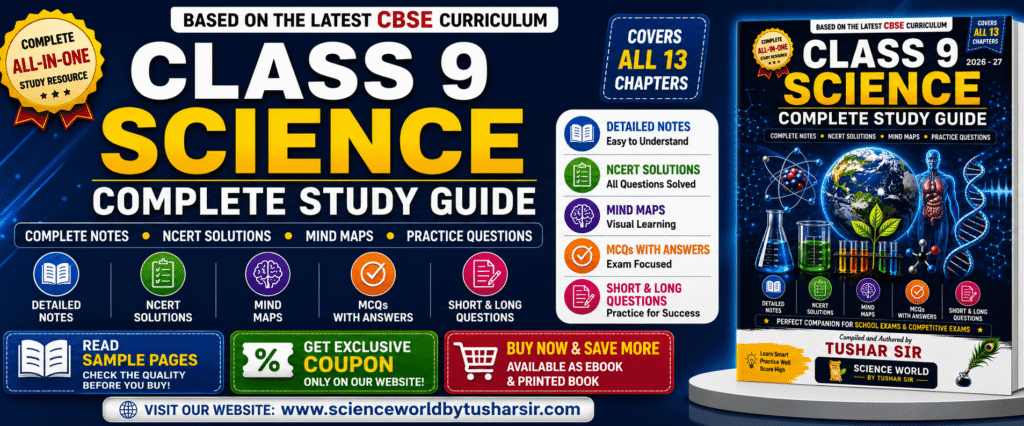
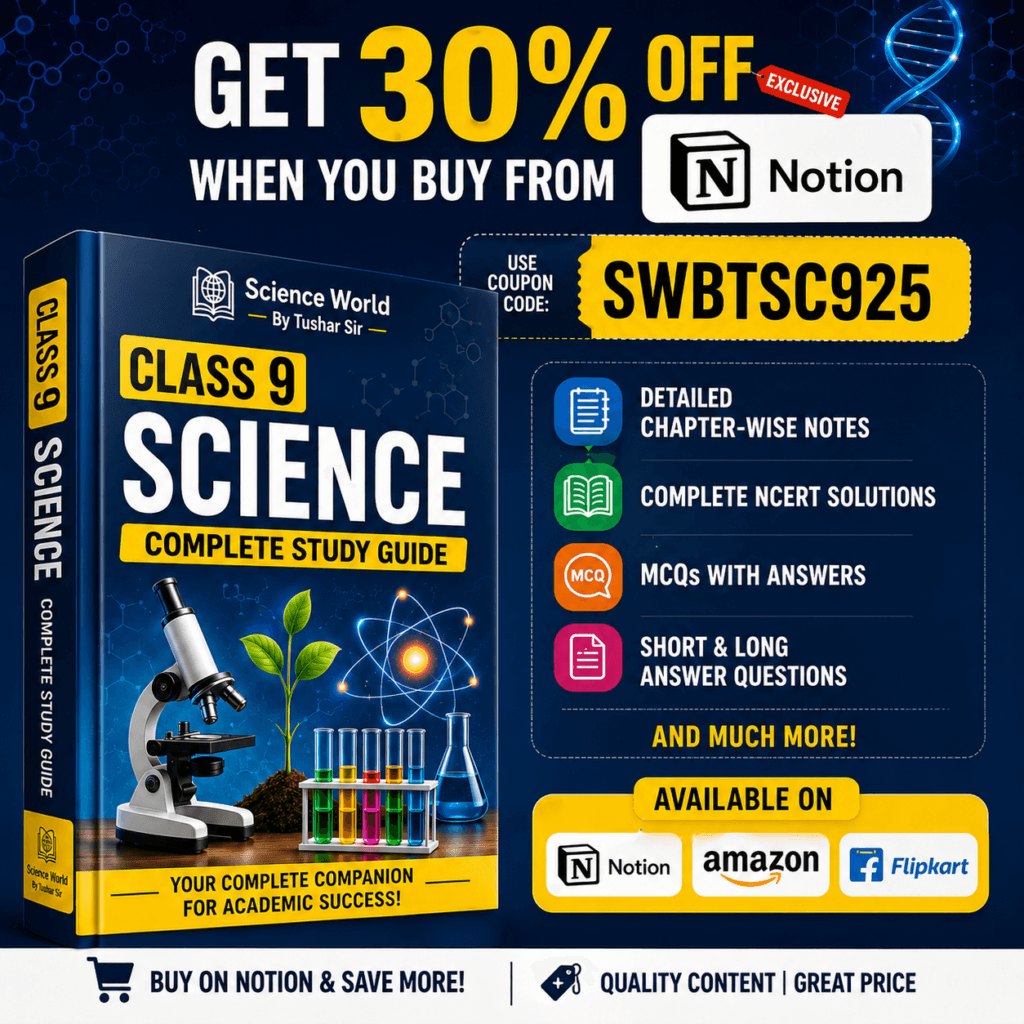
For complete exam preparation, get our premium study material prepared by Science World by Tushar Sir.
The complete study material includes:
✔ Detailed Notes
✔ Mind Maps
✔ Exam-Oriented Preparation
Frequently Asked Questions
Questions:
- What is the main objective of Chapter 1?
- Are these free notes enough for exams?
- Does the complete eBook include NCERT solutions?
- Is the printed book available online?
If these free notes helped you, take your preparation to the next level with our complete study material. Choose the chapter eBook, the complete Class 9 Science eBook, or the printed book to access detailed explanations, practice questions, and exam-focused content.
📚 Looking for All Class 9 Science Chapters?
Access all 13 chapter-wise notes based on the latest NCERT Exploration: Textbook of Science for Grade 9 from one place.