
NCERT Solutions for Class 9 Science Chapter 5, Exploring Mixtures and Their Separation, help students understand the nature of mixtures and the different methods used to separate their components. This chapter from the new NCERT textbook, Exploration: A Textbook of Science for Grade 9, connects scientific concepts with familiar materials and processes encountered in everyday life.
Students explore different types of mixtures, their properties, and suitable methods for separating their components. The chapter also develops an understanding of how the properties of substances can be used to design appropriate separation techniques. These NCERT Solutions provide clear explanations for textbook questions and activities and help students revise the chapter effectively.
NCERT Intext Solution
(For exact question see NCERT)
- Answer
Given:
- Percentage of ZnO = 4%
- Mass of talcum powder = 300 g


Answer: 12 g of zinc oxide is present in 300 g of talcum powder.
- Answer
Given:
- Volume of concentrate = 2 × 15 mL = 30 mL
- Total volume of juice = 150 mL
Answer: The concentration of orange juice concentrate is 20% (v/v).
- Preparation of vinegar from glacial acetic acid
Given:
- Glacial acetic acid = 100% acetic acid
- Vinegar contains 5% (v/v) acetic acid
To prepare vinegar, dilute glacial acetic acid with water so that acetic acid forms 5% of the total volume.
For example, to prepare 100 mL of vinegar:
- Take 5 mL of glacial acetic acid
- Add 95 mL of water
This gives:
Answer: Mix 5 mL of glacial acetic acid with 95 mL of water to obtain 100 mL of vinegar containing 5% (v/v) acetic acid.
- Answer
When hot saturated solutions of compounds A and B are cooled from 80°C to 60°C, the compound whose solubility decreases more sharply will deposit more solid crystals.
From the solubility curves (Activity 5.2), compound A shows a greater decrease in solubility between 80°C and 60°C than compound B. Therefore:
Answer: Solution A is likely to deposit more solid because its solubility decreases more on cooling.
- Answer
Yes, the size of common salt crystals depends on the rate of evaporation.
- If evaporation is slow: Large crystals are formed because the salt particles get more time to arrange themselves in a regular crystal structure.
- If evaporation is fast: Small crystals are formed because the particles have less time to arrange properly.
Answer: Decreasing the rate of evaporation produces larger crystals, while increasing the rate of evaporation produces smaller crystal
- Answer (i) Salt can be separated from a salt solution by evaporation or distillation. ✅ True
- Evaporation gives the salt as residue.
- Distillation can also separate the salt solution, where water is collected as distillate and salt remain behind.
(ii) Distillation can be used for separation of two liquids even when these have the same boiling point. ❌ False
Correction: Distillation can be used to separate two liquids only when they have different boiling points (or sufficiently different boiling points).
(iii) In paper chromatography, the solvent level should be above the sample spot at the beginning of the experiment. ❌ False
Correction: In paper chromatography, the solvent level should be below the sample spot at the beginning of the experiment; otherwise, the sample will dissolve directly into the solvent.
(iv) Evaporation and crystallization are the same processes. ❌ False
Correction: Evaporation and crystallization are different processes. Evaporation removes the solvent to obtain the solute, whereas crystallization is used to obtain pure crystals of a substance from its solution.
- Why do immiscible liquids form two separate layers in a separating funnel?
Immiscible liquids do not mix with each other because their molecules are not attracted strongly enough. Since they have different densities, they form separate layers in a separating funnel.
- The denser liquid settles at the bottom.
- The less dense liquid remains on the top.
Example: Oil and water form two separate layers, with water at the bottom and oil on the top.
- Is sublimation different from evaporation? Justify.
Yes, sublimation is different from evaporation.
| Sublimation | Evaporation |
| A solid changes directly into vapour without becoming liquid. | A liquid changes into vapour. |
| Occurs in substances like camphor, naphthalene, and ammonium chloride. | Occurs in liquids like water and alcohol. |
| Involves a change from solid to gas. | Involves a change from liquid to gas. |
Justification: In sublimation, a solid changes directly into vapour, whereas in evaporation, a liquid changes into vapour. Therefore, they are different processes.
- Answer: Clouds are colloids (specifically, an aerosol).
Reason: Tiny water droplets or ice crystals are dispersed in air and remain suspended without settling down quickly. They are large enough to scatter light but small enough to stay suspended, which are characteristics of a colloid.
- Answer
Cities with a lot of smoke and dust appear hazy because smoke and dust particles form a colloid in air. These particles scatter sunlight in different directions (Tyndall effect), reducing visibility and making the atmosphere look hazy.
Key Point:
Smoke + Dust particles in air → Colloid → Scattering of light (Tyndall effect) → Hazy appearance.
NCERT Exercise Solution
(For exact question see NCERT)
- Question
The correct option is:
(iv) Muddy water — Ht, Milk — Ht, Blood — Ht, Brass — Hm
Reason:
- Muddy water → Heterogeneous (Ht)
- Milk → Colloid, hence Heterogeneous (Ht)
- Blood → Heterogeneous (Ht)
- Brass → Homogeneous (Hm)
- Question
Given mixtures:
(a) Air and dust particles
(b) Copper sulphate and water
(c) Starch and water
(d) Acetone and water
Analysis
- (a) Air and dust particles ✔️ (Colloid)
- (b) Copper sulphate and water ✖️ (True solution)
- (c) Starch and water ✔️ (Colloid)
- (d) Acetone and water ✖️ (True solution)
Correct option: (iii) a and c
- Question
| Solution | Suspension | Colloid | |
| Properties | Small-sized particles (< 1 nm diameter) | Large-sized particles (>1000 nm diameter) | Moderate-sized particles (1–1000 nm) |
| Transparent | Settles down when left undisturbed | Particles remain evenly distributed | |
| Cannot be separated by filtration | Separated by filtration | Does not settle down | |
| Does not scatter light | Scatters light | Scatters light | |
| Homogeneous mixture | Heterogeneous mixture | Heterogeneous mixture | |
| Examples | Salt solution | Sand in water | Milk |
| Brass | Mud | Smoke | |
| Copper sulphate solution | Muddy water | Butter |
- Question
(i) Concentration of ingredients in the cake recipe
Total mass of mixture = 420 g + 75 g + 5 g = 500 g
Sugar concentration

Sodium hydrogen carbonate concentration

Flour concentration

Answer:
- Flour = 84%
- Sugar = 15%
- Sodium hydrogen carbonate = 1%
(ii) Brass contains 70% copper by mass. Find the quantities of copper and zinc in 120 g brass.
Copper
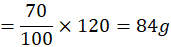
Zinc
 Answer:
- Copper = 84 g
- Zinc = 36 g
- Question
Yes, they form two separate layers because oil and water are immiscible liquids.
Since oil is less dense, it forms the upper layer.
Method of separation
Separating funnel
Apparatus used: Separating funnel
- Question
Assertion (A): Solutions do not exhibit the Tyndall effect. True
Reason (R): The particles in solutions are larger than 100 nm, so they cannot scatter light.
False (Particles are very small, less than 1 nm.)
Correct option: (iii) A is true, but R is false.
- Table 5.3
| Mixture | Method of Separation | Reason for Selection |
| Mud from muddy water | Filtration | Mud particles are insoluble and large enough to be retained by filter paper. |
| Plasma from other components in blood | Centrifugation | Components have different densities. |
| Naphthalene and sand | Sublimation | Naphthalene sublimes whereas sand does not. |
| Chalk powder and common salt | Dissolve in water followed by filtration and evaporation | Salt dissolves in water while chalk powder does not. |
| Common salt and water | Evaporation | Water evaporates leaving salt behind. |
| Oil from water | Separating funnel | Oil and water are immiscible liquids. |
| Pigments of the flower | Chromatography | Different pigments move at different rates. |
- Question
Boiling point of A = 60°C
Boiling point of B = 90°C
Method used:
Simple distillation
Reason: Liquid A has a lower boiling point and vaporizes first. The vapours are condensed and collected separately.
- Question
| Process | Preferred when |
| Evaporation | To obtain a dissolved solid from a solution. |
| Crystallization | To obtain pure crystals of a solid from its solution. |
| Distillation | To separate liquids having different boiling points or to obtain pure solvent. |
- Question
(i) What would happen if blood behaved like a true suspension inside the body?
Blood cells would settle down on standing, causing improper circulation and affecting the transport of oxygen and nutrients.
(ii) In a blood sample, identify the dispersed phase and the dispersion medium.
- Dispersed phase: Blood cells (RBCs, WBCs, platelets)
- Dispersion medium: Plasma
Question
- Step 1: Sublimation
- Step 2: Evaporation
- Step 3: Filtration
Correct sequence of separation:
- Sublimation → Separate naphthalene from the mixture.
- Add water and filter → Sand remains as residue; salt solution passes through.
- Evaporation → Obtain common salt from the filtrate.
Answer: Sublimation → Filtration → Evaporation
- Question
Distillation is effective because water and acetone have different boiling points. Acetone boils at about 56°C, whereas water boils at 100°C. On heating, acetone vaporizes first and is condensed separately.
- Question
(i) Mass of potassium nitrate required to prepare a saturated solution in 50 g of water at 40°C
From the table:
Solubility of KNO₃ at 40°C = 62 g per 100 g water
For 50 g water,
 = 31 g
Answer: 31 g of potassium nitrate
(ii) What happens when a saturated solution of potassium chloride prepared at 80°C is cooled to 25°C?
At 80°C, solubility of KCl = 54 g per 100 g water.
At 25°C, its solubility decreases to about 36 g per 100 g water.
Therefore, excess potassium chloride separates out as crystals.
Answer: As the solution cools, potassium chloride crystals are formed because its solubility decreases with temperature.
(iii) Effect of temperature on solubility
Increasing temperature generally increases the solubility of all four salts.
Comparison from 10°C to 80°C
| Salt | 10°C | 80°C | Increase |
| Potassium nitrate | 21 g | 167 g | Very large increase |
| Sodium chloride | 36 g | 37 g | Very small increase |
| Potassium chloride | 35 g | 54 g | Moderate increase |
| Ammonium chloride | 24 g | 66 g | Large increase |
Answer:
- Potassium nitrate shows the maximum increase in solubility.
- Sodium chloride shows the least increase.
- Potassium chloride and ammonium chloride show moderate increases.
- Question
(i) Calculate the mass percentage (% m/m)
Student A
Sugar = 20 g
Water = 80 g
Mass of solution = 100 g
 = 20%
= 20%
Student B
Sugar = 20 g
Water = 100 g
Mass of solution = 120 g
 = 16.67%
Student C
Sugar = 30 g
Water = 80 g
Mass of solution = 110 g
 = 27.27%
Answer:
- Student A = 20%
- Student B = 16.67%
- Student C = 27.27%
(ii) Whose solution is the most concentrated? Explain.
Answer: Student C’s solution is the most concentrated because it has the highest mass percentage (27.27%), which means it contains the greatest amount of sugar per unit mass of solution.
- Examine Fig. 5.26
(i) Identify the separation technique marked as S.
The technique marked S is Simple Distillation.
(ii) Label the apparatus A, B and C.
- A → Distillation flask (Round-bottom flask)
- B → Condenser (Liebig condenser)
- C → Receiver (Beaker/Conical flask)
(iii) Which of the following mixtures can be separated by the technique identified above?
Simple distillation is used to separate:
- A liquid from a dissolved solid, or
- Two miscible liquids having a sufficiently large difference in boiling points.
Using Table 5.5:
| Mixture | Boiling Points (°C) | Can be Separated by Simple Distillation? |
| (a) Water – Acetone | 100, 56 | Yes |
| (b) Water – Salt | Salt is non-volatile | Yes |
| (c) Acetone – Alcohol | 56, 78 | Yes |
| (d) Sand – Salt | — | No |
| (e) Alcohol – Chloroform | 78, 61 | No |
| (f) Alcohol – Benzene | 78, 80 | No |
Answer:
The mixtures that can be separated by the above technique are:
(a) Water – Acetone
(b) Water – Salt
(c) Acetone – Alcohol
Common Mistakes
Focus on mistakes such as:
- Confusing a mixture with a pure substance
- Choosing an unsuitable separation method
- Not identifying the property used for separation
- Confusing filtration with evaporation
- Confusing evaporation with distillation
- Giving a method without explaining why it works
- Incorrectly identifying homogeneous and heterogeneous mixtures
- Ignoring the physical properties of the components
FAQs
What is Chapter 5 of Class 9 Science?
Chapter 5 is Exploring Mixtures and Their Separation. It deals with mixtures, their components, their properties, and methods used to separate different components.
What are the important topics in Class 9 Science Chapter 5?
Important topics include mixtures, their properties, types of mixtures, separation techniques, and the selection of suitable separation methods based on physical properties.
What is a mixture?
A mixture consists of two or more substances that are combined physically and can generally be separated using suitable physical methods.
How are mixtures separated?
Mixtures can be separated using appropriate physical methods based on differences in properties of their components.
How do I choose a method for separating a mixture?
Identify the properties that differ between the components and select a separation technique that makes use of that difference.
Why is filtration used?
Filtration can be used when a solid component can be separated from a fluid using a suitable filter.
How should I prepare Chapter 5?
Read the NCERT chapter carefully, understand the properties of different mixtures, study the separation methods and their principles, and practise the textbook questions and activities.
Are NCERT Solutions enough to study Chapter 5?
NCERT Solutions help students understand and check textbook questions, but they should be used along with the NCERT textbook, activities, examples, and revision.
Is Chapter 5 important for Class 9 Science?
Yes. The chapter develops an understanding of mixtures and separation techniques and connects these concepts with practical situations and laboratory processes.