
Introduction
NCERT Solutions for Class 9 Science Chapter 10, Sound Waves: Characteristics and Applications, help students understand how sound is produced, transmitted, and perceived. This chapter from the new NCERT textbook, Exploration: A Textbook of Science for Grade 9, introduces students to the wave nature of sound and the characteristics that help us describe different sounds.
The solutions provide clear explanations for textbook questions and activities, helping students understand important concepts, solve numerical and application-based questions, revise key terms and prepare effectively for examinations.
NCERT Intext Solution
(For questions see the NCERT)
1.Question
Answer:
- By striking objects (e.g., bell, drum)
- By plucking strings (e.g., guitar, sitar)
- By blowing air (e.g., flute, whistle)
- By rubbing objects (e.g., rubbing hands, violin bow on strings)
- By vibrating membranes (e.g., tabla, drum)
- By vibrating vocal cords (human voice)
2.Question
| Musical Instrument | Vibrating Part |
| Guitar | Strings |
| Sitar | Strings |
| Violin | Strings |
| Tabla | Stretched membrane (skin) |
| Drum | Stretched membrane |
| Flute | Air column inside the flute |
| Trumpet | Air column inside the instrument |
| Harmonium | Reeds |
| Bell | Metal body of the bell |
| Piano | Strings |
3.Question
Answer: (ii) Both A and R are true, and R is the correct explanation of A.
Explanation: Sound cannot travel through a vacuum. When most of the air is pumped out of the jar, there is very little medium left for sound to travel through, so the bell’s sound cannot be heard. Hence, the reason correctly explains the assertion.
4.Question
Answer: (iii) A is true, but R is false.
Explanation:
- Assertion (A) is true because compressions and rarefactions travel through the medium as a sound wave propagates.
- Reason (R) is false because individual particles of the medium do not move continuously forward with the wave. They only oscillate back and forth about their mean positions.
Correct Option: (iii) A is true, but R is false.
5.Question
Answer: (ii) Energy carried by sound waves
Explanation: Sound waves transfer energy from the tuning fork to your ear. The air particles only vibrate back and forth about their mean positions; they do not travel all the way from the tuning fork to your ear.
Correct Option: (ii) Energy carried by sound waves.
6.Question
For the given density distributions:
See the Fig. 10.17 (a)
- Compressions (C): The dark, closely packed regions.
- Rarefactions (R): The light, sparsely packed regions.
Sequence:
C → R → C → R → C
Fig. 10.17 (b)
- Compressions (C): Dark dense regions.
- Rarefactions (R): Light sparse regions.
Sequence:
C → R → C → R → C
Graphs in (c) and (d)
- X-axis: Distance (or Position in the medium)
- Y-axis: Density of the medium
Draw a sinusoidal curve such that:
- C (Compression) corresponds to the crest (maximum density).
- R (Rarefaction) corresponds to the trough (minimum density).
For both (c) and (d), the curve should pass through:
C (peak) → R (trough) → C (peak) → R (trough) → C (peak).
This gives the graphical representation of density variation in a sound wave.
7.Question
Answer:
Yes, the thin rubber band vibrates faster than the thick rubber band.
- Frequency of thin rubber band: Higher
- Time period of thin rubber band: Lower
(As frequency increases, time period decreases.)
8. Question
Frequency = 20 Hz = 20 oscillations per second
Oscillations in 1 minute = 20 × 60 = 1200 oscillations
Answer: 1200 oscillations per minute
9. Question
From the graph, one complete wavelength is from 0 cm to 3 cm.

Half wavelength:

Answer: 1.5 cm
10.Question
Given:
- Speed of sound in air = 340 m/s
- Speed of sound in water = 1500 m/s
- Speed of sound in steel = 5000 m/s
(i) Ratio of speed in water to speed in air

Ratio = 1500 : 340 = 75 : 17 ≈ 4.41 : 1
(ii) Ratio of speed in steel to speed in water
 Ratio = 5000 : 1500 = 10 : 3 ≈ 3.33 : 1
11.Question
Given:
- Distance = 340 m
- Speed of sound in air = 340 m/s
- Speed of sound in steel = 5000 m/s
Time taken through air

Time taken through steel
Time difference
Can Gunjan distinguish the two sounds?
Yes, because the time difference (0.932 s) is much greater than 0.1 s, the minimum interval required to hear two sounds separately.
Answer:
- Time through air = 1 s
- Time through steel = 0.068 s
- Time difference = 0.932 s
- Yes, Gunjan can distinguish the two sounds.
12.Question
Given:
- Minimum time for echo = 0.2 s
- Speed of sound = 343 m/s
Since sound travels to the reflecting surface and back,

Answer: The reflecting surface should be placed at a minimum distance of 34.3 m
13.Question
Given:
- Time taken for echo to return = 4 s
- Speed of sound in seawater = 1500 m/s
The sound travels to the ocean floor and back, so:

Answer: The depth of the ocean is 3000 m (3 km).
NCERT Exercise Solution
(For questions see the NCERT)
1. Question
(ii) Sound needs a medium to propagate
2. For a sound wave propagating in a medium, increasing its frequency will increase its
(iii) Number of compressions per second
(Frequency = number of oscillations/compressions per second.)
3. Question
Frequency 

Answer: (ii) 5 Hz
4. Question
Answer: Reverberation is produced.
5.Question
(i) Greater wavelength: Wave (a)
(ii) Smaller amplitude: Wave (a)
6.Question
- A (maximum frequency) → Green curve (most oscillations)
- B → Red curve
- C (minimum frequency) → Blue curve (least oscillations)
7. Question
Draw a sinusoidal wave with:
- Amplitude = 3 units
- Wavelength = 4 cm
(One crest at +3 units, one trough at –3 units, and the distance between two successive crests = 4 cm.)
8. Question
Errors in the movie depiction:
- Sound cannot travel in space because there is no medium.
- Only the flash of light should be seen.
- Sound and light cannot reach together in space.
Answer: The explosion should be visible but not audible.
9.Question
Given:


 Answer: 0.01 s
10.Question
Given:
- Speed =

- Echo time =


Answer: 3812.5 m
11. Question
Given:
- Distance from obstacle =

- Round-trip distance =

- Speed =



Answer:  (about
  )
)
12. Question
Given:
- Distance = 1720 m
- Speed at 22°C = 344 m/s
- Speed at 0°C = 331 m/s
Time at 22°C:

Time at 0°C:

Extra time:

Answer: 0.20 s
13. Wavelength and Frequency
From Fig. 10.32, the distance from one compression to the next alternate compression is 8 cm, which represents 2 wavelengths.


Given speed:

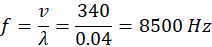
Wavelength = 4 cm
Frequency = 8500 Hz
14. Question
From Fig. 10.33:
- Wave A completes about 3 cycles in 7.5 cm
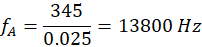
- Wave B completes about 1.5 cycles in 7.5 cm

 Wave A:
Wave B: 
15.Question
Given:

Since both sounds travel the same distance:

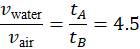
Therefore,

Answer: Speed in air : Speed in water = 2 : 9
Chapter Overview
This chapter explores the nature of sound and sound waves. Students learn how sound is produced and how it travels through a medium. The chapter also explains the characteristics that allow us to distinguish different sounds.
Students explore concepts such as vibration, propagation of sound, frequency, amplitude, time period, wavelength, and speed of sound, wherever covered in the current textbook. The chapter also connects sound-wave concepts with practical applications and everyday experiences.
Common Mistakes to Avoid in Chapter 10
Students should avoid:
- Confusing frequency with amplitude.
- Confusing pitch with loudness.
- Forgetting the units of frequency, wavelength, and speed.
- Using the wrong formula in numerical questions.
- Confusing vibration with propagation of a sound wave.
- Assuming that sound can travel without a medium, if the chapter establishes the need for a medium.
- Forgetting to convert units when required.
- Giving numerical answers without showing the calculation.
FAQs
What is Chapter 10 of Class 9 Science?
Chapter 10 of the new Class 9 Science textbook is Sound Waves: Characteristics and Applications. It introduces students to sound, its production and propagation, wave characteristics, and applications covered in the chapter.
How is sound produced?
Sound is produced when an object vibrates. The vibration creates disturbances that can propagate through a suitable medium.
What is frequency?
Frequency is the number of complete vibrations or cycles occurring per unit time. Its SI unit is hertz (Hz).
What is amplitude?
Amplitude describes the maximum displacement of a vibrating particle from its mean position. In the context of sound, it is associated with the strength or loudness of the sound.
What is the difference between pitch and loudness?
Pitch is related primarily to the frequency of a sound, while loudness is associated with the amplitude of the sound wave and how strongly the sound is perceived.
What are the important topics in Chapter 10?
Important topics include sound production, vibration, propagation of sound, characteristics of sound waves, frequency, amplitude, wavelength, pitch, loudness, and the applications covered in the current textbook.
How should I prepare Class 9 Science Chapter 10?
Read the NCERT chapter carefully, understand the diagrams and activities, learn the important terms and relationships, and practise the textbook questions and numerical problems. Use NCERT Solutions to check your answers.
Are NCERT Solutions enough to study Chapter 10?
NCERT Solutions are useful for understanding textbook questions, but students should also study the complete NCERT chapter, practise the activities, and solve numerical questions independently.
Is Chapter 10 important for the Class 9 Science exam?
Yes. Students should understand both the conceptual and numerical aspects of the chapter, especially the characteristics of sound waves and the applications discussed in the textbook.