
NCERT Solutions for Class 9 Science Chapter 4, Describing Motion Around Us, help students understand how the motion of objects can be observed, described, measured, and represented. This chapter from the new NCERT textbook, Exploration: A Textbook of Science for Grade 9, introduces important ideas related to motion and the quantities used to describe it.
Students explore concepts such as position, distance, displacement, speed, velocity, and acceleration, along with ways of representing motion. The solutions provide clear explanations for textbook questions and activities, helping students understand the concepts, solve problems step by step, and prepare effectively for examinations.
NCERT Intext Solution
In-Text Question 1
Answer: The displacement of the athlete will be zero when he returns to his starting point.
Since displacement is the shortest distance between the initial and final positions, it becomes zero if both positions are the same.
Total distance travelled will be equal to the distance covered while going plus the distance covered while returning.
For example, if the athlete runs 100 m forward and 100 m back, then:
- Distance travelled = 100 m + 100 m = 200 m
- Displacement = 0 m
In-Text Question 2
Answer: ✔ Yes
Fuel consumption depends on the total distance travelled because the engine has to work throughout the entire journey. The longer the distance covered, the more fuel is consumed.
(ii) Displacement
Answer: ✘ No
Fuel consumption does not depend on displacement. A vehicle may return to its starting point, making displacement zero, but fuel is still used because distance has been covered.
Example: A car travels 10 km and returns 10 km back.
- Distance travelled = 20 km
- Displacement = 0 km
Yet fuel is consumed for the entire 20 km journey.
Therefore, fuel used depends on total distance travelled, not displacement.
In-Text Question 3a
Answer: ✔ Yes.
The ball moves along the inclined track, which is a straight path. Therefore, its motion is a straight-line (rectilinear) motion.
In-Text Question 3b
Answer: ✔ Yes.
Since only the position of the ball along the track is important, the inclined path can be represented by a horizontal line showing the distances from O.
In-Text Question 3c
Answer: ✔ Equal.
Because the ball moves along a straight path in one direction without changing direction, the distance travelled and the magnitude of displacement are equal at every position.
| Position | Distance from O | Magnitude of Displacement |
| A | 40 cm | 40 cm |
| B | 50 cm (40+10) | 50 cm |
| C | 70 cm (40+10+20) | 70 cm |
| D | 100 cm (40+10+20+30) | 100 cm |
Thus,
- At A: Distance = Displacement = 40 cm
- At B: Distance = Displacement = 50 cm
- At C: Distance = Displacement = 70 cm
- At D: Distance = Displacement = 100 cm
Conclusion: Since the motion is along a straight line and in one direction, the distance travelled and displacement are equal at all positions.
In-Text Question 4
- Distance travelled north = 200 km
- Distance travelled south = 200 km
- Total distance = 200 + 200 = 400 km
- Total time = 3 + 2 = 5 h
(a) Average Speed


Average Speed = 80 km/h
(b) Average Velocity
The final position is the same as the starting position because the 200 km north journey is cancelled by the 200 km south journey.


 Average Velocity = 0 km/h
In-Text Question 5 a
Answer: The magnitude of average velocity is equal to average speed when the object moves:
- Along a straight line, and
- In one direction only (without changing direction).
In this case, 
Therefore, 
Example: A car travels 100 km east without turning back.
In-Text Question 5 b
Answer: This happens when the object returns to its starting point.
- Total displacement = 0
- Total distance travelled ≠ 0
Hence,
 but
but
 Example: A runner completes one full lap of a circular track and returns to the starting point.
- Displacement = 0
- Distance travelled = Circumference of the track
Therefore,
- Average velocity = 0
- Average speed ≠ 0 ✔️
NCERT Exercise Solution
Exercise question 1
Given:
- Distance between home and shop = 250 m
Journey:
- Home → Shop = 250 m
- Shop → Home = 250 m
- Home → Shop = 250 m
- Shop → Home = 250 m
(i) Total Distance Travelled

Answer: 1000 m
(ii) Displacement from Home
The father starts from home and finally returns home.
 Answer: 0 m
Exercise question 2
Given:
- Height of each floor = 3 m
- Starts at Ground Floor
- Goes to Fourth Floor
- Comes down to Second Floor
(i) Total Vertical Distance Travelled
Upward Journey:
Ground Floor → Fourth Floor
 Downward Journey:
Fourth Floor → Second Floor
 Total Distance
 Answer: 18 m
(ii) Displacement from Starting Point
Initial position = Ground Floor
Final position = Second Floor
 Answer: 6 m upward
Final Answers
| Question | Distance Travelled | Displacement |
| 1 | 1000 m | 0 m |
| 2 | 18 m | m upward |
Exercise question – 3
Answer: Yes, it is possible.
Acceleration occurs when there is a change in velocity. Velocity depends on both speed and direction.
Even if the speedometer shows a constant speed, the scooter can still be accelerating if it is changing direction, such as while taking a turn on a curved road.
Exercise question – 4
Given:
- Initial velocity,
 m/s
m/s - Final velocity,
 m/s
m/s - Time,
 s
s
(i) Average Acceleration


 (ii) Distance Travelled


 Exercise question – 5
Given:
- m/s
- m/s
 m
m
(i) Acceleration
Using:


 (ii) Time Taken
Using:

 Answer:
- Acceleration = -4 m/s²
- Time taken = 7 s
Exercise question – 6
Answer: No, objects A and B do not have equal velocity.
In a position-time graph, the slope of the graph represents velocity.
From Fig. 4.27:
- Line A is steeper than line B throughout the graph.
- Therefore, velocity of A is always greater than velocity of B.
Although the two graphs intersect at about 5 s (meaning both objects are at the same position at that instant), their slopes are different.
Hence, their velocities are not equal at any time.
Answer: No, because the slopes of their position-time graphs are different, indicating different velocities.
Exercise question – 7
From Fig. 4.28:
- Both A and B start from the same position and reach the same final position at s.
- Therefore, both have the same displacement in 10 s.
(i) ✔ Correct
Average velocity = Displacement / Time
Since both have the same displacement in the same time interval,

(ii) ✔ Correct
Both move continuously in the forward direction and cover the same distance in 10 s.
Therefore,

(iii) ✘ Incorrect
A does not cover a shorter distance than B.
(iv) ✘ Incorrect
Average speed depends on total distance and total time, not on speed during some segments only.
Answer: Correct options: (i) and (ii)
Exercise question – 8
Given: Initial speed,
 Final speed,
Time,
 Distance travelled

 Answer: Distance travelled = 450 m
Exercise question – 9
Stage 1: Accelerates from 0 to 20 m/s in 5 s


 Stage 2: Moves at constant speed

 Stage 3: Stops in 6 s
Total Distance

 Answer: Total distance travelled = 310 m
Exercise question – 10
Given:
Speed of bus,
Distance to obstacle,
 Reaction time,
 Retardation,
 Distance during reaction time
 Braking distance
Using

Since final velocity ,
Total stopping distance
Since
 the bus stops before reaching the obstacle.
Answer: Yes, the bus will stop before reaching the obstacle.
- Reaction distance = 5 m
- Braking distance = 20 m
- Total stopping distance = 25 m
- Distance available = 30 m ✔️
Exercise question – 11
Answer: Motion and rest are relative concepts.
- An object kept on the Earth’s surface is at rest with respect to the Earth because its position does not change relative to the surroundings.
- However, since the Earth itself is moving around the Sun, the object is also moving along with the Earth with respect to the Sun.
Therefore, an object on the Earth can be considered both at rest and in motion depending on the reference point chosen.
Exercise question – 12
(i) Displacement while cyclist is moving with constant velocity
The cyclist moves with constant velocity = 3 m/s from 20 s to 100 s.
Displacement is represented by the rectangular area under the graph between 20 s and 100 s.

(ii) Displacement when velocity is decreasing
Velocity decreases from 3 m/s to 2 m/s between 100 s and 120 s.
Displacement is represented by the trapezium area under the graph from 100 s to 120 s.
 Total Displacement in 120 s
Area 1: Triangle (0–20 s)

Area 2: Rectangle (20–100 s)

Area 3: Trapezium (100–120 s)

Total displacement
 Displacement = 320 m
Average Acceleration
Initial velocity:
Final velocity:
 Time:
Time:


 Exercise question – 13
Distance covered = Area under the velocity-time graph.
From the graph:
| Time Interval (h) | Velocity (km h⁻¹) |
| 0 – 1 | 7.0 to 7.5 |
| 1 – 3 | 7.5 (constant) |
| 3 – 5 | 7.5 to 7.0 |
| 5 – 6 | 7.0 to 6.2 |
| 6 – 7 | 6.2 (constant) |
Calculating area of each section:
- 0–1 h (Trapezium)
 1–3 h (Rectangle)
3–5 h (Trapezium)
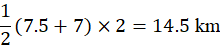
- 5–6 h (Trapezium)
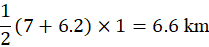
- 6–7 h (Rectangle)

Total Distance
Answer: ≈ 50 km
Exercise question – 14
Given:
- Constant velocity =

- Time =
 min
min  s
s - Acceleration =

- Accelerated time = s
Distance during first 120 s

Distance during next 6 s

Total Displacement
 Answer: 774 m
Exercise question – 15
Car A

Displacement:
Car B

Displacement:
Answers
Displacement of Car A = 12.5 m
Displacement of Car B = 15 m
Exercise question – 16
Given:
Length of minute hand  cm
cm
Time interval = 6 PM to 7:30 PM = 90 min
The minute hand completes:
revolutions.
(i) Distance travelled
(ii) Displacement
After 1.5 revolutions, the tip reaches the point diametrically opposite to the starting point.
(iii) Speed
(iv) Velocity (average)
Final Answers
Part
Answer
(i) Distance travelled 66 cm
(ii) Displacement 14 cm
(iii) Speed 0.733 cm min⁻¹
(iv) Average Velocity 0.156 cm min⁻¹
Common Mistakes
Focus on:
- Confusing distance with displacement
- Confusing speed with velocity
- Forgetting units
- Using the wrong formula
- Making calculation errors
- Confusing average speed with instantaneous speed, if applicable
- Misreading graph axes
- Giving a numerical answer without showing the calculation
- Using inconsistent units
This section can be particularly useful for Chapter 4 because students often lose marks through calculation and unit errors.
FAQs
What is Chapter 4 of Class 9 Science?
Chapter 4 is Describing Motion Around Us. It introduces students to the concepts and measurements used to describe the motion of objects.
What are the important topics in Class 9 Science Chapter 4?
Important topics include motion, position, distance, displacement, speed, velocity, acceleration, and the representation and interpretation of motion.
What is the difference between distance and displacement?
Distance refers to the total path travelled by an object, while displacement describes the change in position from the initial position to the final position, with direction where applicable.
What is the difference between speed and velocity?
Speed describes how quickly an object covers distance, while velocity describes the rate of change of displacement and includes direction.
What is acceleration?
Acceleration describes the rate at which velocity changes with time.
How should I prepare Chapter 4?
Read the NCERT chapter carefully, understand the concepts and graphs, memorise the required formulas only after understanding them, and practise numerical questions step by step.
How can I avoid mistakes in motion numericals?
Write the given values, identify what needs to be calculated, select the appropriate formula, maintain consistent units, show the calculation, and include the correct unit in the final answer.
Are NCERT Solutions enough to prepare Chapter 4?
NCERT Solutions are useful for understanding and checking textbook questions, but students should also study the textbook concepts, activities, graphs, examples, and practise problems independently.