
Propositions and Their Converses
Contents and Learning Goals
| Section | What it contains |
| Start Here | Learning goals and prerequisite ideas |
| Chapter Basics | Propositions, implications, converses, truth, and counterexamples |
| Key Forms and Results | Logical forms, algebraic results, number facts, and geometry facts |
| Guided Exercise Solutions | Exercise Set 9.1 with printed page and question references |
| Multiple Choice Questions | 20 original questions with a separate answer key |
| Assertion and Reason | 5 original items with explanations |
| Short Answer Practice | 10 original questions followed by worked answers |
| Long Answer Practice | 5 original questions followed by worked answers |
| Case Based Practice | 5 original cases followed by worked answers |
| Sample Paper | 40 marks with complete marking guidance and solutions |
Learning Goals
- identify the condition and conclusion in an if-then statement;
- write the converse of a proposition without changing its meaning;
- distinguish a proposition from its converse;
- justify a true statement with a valid argument;
- disprove a false statement using one valid counterexample;
- decide when a proposition and its converse are both true;
- apply these ideas to algebra, number theory, and geometry.
Prerequisite Check
1. State whether 18 is divisible by 6.
2. Write the factors of 12.
3. Give one rectangle that is not a square.
4. Complete the Pythagorean relation for a right triangle with legs a and b and hypotenuse c.
5. If x + 5 = y + 5, what operation isolates x and y?
Quick answers: yes; 1, 2, 3, 4, 6, 12; for example a 3 by 5 rectangle; a² + b² = c²; subtract 5 from both sides.
PART ONE
Chapter Basics
Build the language needed to test propositions and converses.
What Is a Proposition
A proposition is a statement with a definite truth value: it is either true or false. A question, command, or open sentence with an unspecified variable is not automatically a proposition.
| Statement | Proposition | Reason |
| Every multiple of 10 is even. | Yes | It has a definite truth value and is true. |
| Is 17 prime? | No | It is a question, not a statement. |
| x + 3 = 8 | Not yet | Its truth depends on the value of x. |
| There are 8 days in a week. | Yes | It has a definite truth value and is false. |
Condition and Conclusion
The statement “If P, then Q” has two parts. P is the condition, hypothesis, or antecedent. Q is the conclusion or consequent. It is written P ⇒ Q and read as “P implies Q.”
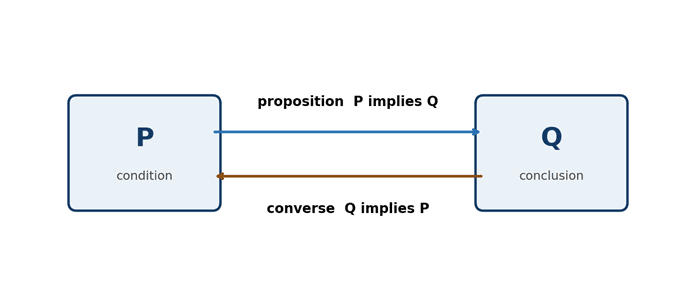
Reversing the two parts creates the converse.
Writing the Converse
The converse of P ⇒ Q is Q ⇒ P. Only the direction changes. The meaning of P and Q must stay the same.
Example: Original proposition: If an integer is divisible by 10, then it is divisible by 5. Converse: If an integer is divisible by 5, then it is divisible by 10. The original is true, while the converse is false because 15 is divisible by 5 but not by 10.
Truth and Counterexamples
A Converse Needs Its Own Test
A true proposition does not automatically make its converse true. Each direction is a separate claim and needs a separate justification.
| Status | Meaning |
| Both true | P is sufficient for Q, and Q is sufficient for P. We may write P ⇔ Q. |
| Original true converse false | P guarantees Q, but Q does not guarantee P. |
| Original false converse true | The reverse direction works, but the original direction does not. |
| Both false | Neither condition guarantees the other conclusion. |
How a Counterexample Works
To disprove “If P, then Q,” find one case in which P is true but Q is false. A case where P itself is false does not test the claim.
Claim: If a quadrilateral has four equal angles, then it is a square. A 3 cm by 5 cm rectangle has four right angles but does not have four equal sides. It is therefore a counterexample.
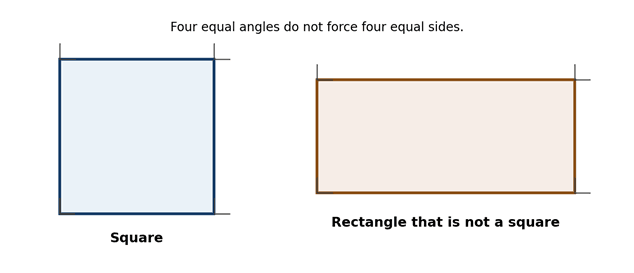
The rectangle satisfies the condition but not the claimed conclusion.
Proof and Disproof Checklist
1. Separate the condition P from the conclusion Q.
2. Write the converse by reversing the two parts.
3. For a true statement, give a reason that covers every allowed case.
4. For a false statement, give one case where the condition holds and the conclusion fails.
5. Test the original and converse independently.
PART TWO
Key Forms and Results
Use these compact forms as a reference while solving the chapter.
| Idea | Editable form | What it means |
| Proposition | P ⇒ Q | If P is true, Q must be true. |
| Converse | Q ⇒ P | The condition and conclusion are reversed. |
| Both directions | P ⇔ Q | P implies Q and Q implies P. |
| Counterexample | P true and Q false | One such case disproves P ⇒ Q. |
| Square equality over reals | x² = y² ⇒ x = y or x = -y | The converse of x = y ⇒ x² = y² needs both signs. |
| Cube equality over reals | x³ = y³ ⇒ x = y | Cubing is one-to-one on real numbers. |
| Common divisibility | m | n and k | n ⇒ lcm(m,k) | n | Use the least common multiple to test a converse. |
| Right triangle test | a² + b² = c² ⇔ right angle opposite c | The theorem and its converse are both true. |
Factor Count Facts
| Form of positive integer | Number of positive factors | Converse note |
| p² where p is prime | 3 | Exactly 3 factors forces the form p². |
| pq where p and q are unequal primes | 4 | Four factors can also occur for p³. |
| p³ where p is prime | 4 | This gives a counterexample to an incomplete converse. |
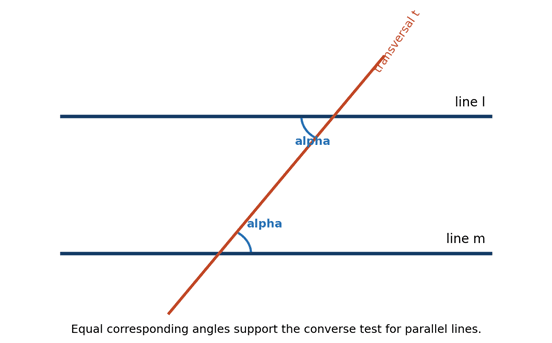
A standard geometry proposition and its valid converse.
Necessary and Sufficient Language
If P ⇒ Q, then P is sufficient for Q and Q is necessary for P. If P ⇔ Q, each condition is both necessary and sufficient for the other. This language helps explain why one direction may work while the other fails.
PART THREE
Expanded Formula Bank Chapter 9
Use this table before attempting the guided questions. Each row contains one formula or rule so that the required method can be identified quickly.
| No. | Concept or Use | Formula or Rule |
| 1 | Conditional statement | P ⇒ Q |
| 2 | Converse | Q ⇒ P |
| 3 | Contrapositive | ¬Q ⇒ ¬P |
| 4 | Inverse | ¬P ⇒ ¬Q |
| 5 | Biconditional | P ⇔ Q |
| 6 | Negation of an implication | ¬(P ⇒ Q) ⇔ P ∧ ¬Q |
| 7 | Counterexample test | One case with P true and Q false disproves P ⇒ Q |
| 8 | Necessary condition | P ⇒ Q means Q is necessary for P |
| 9 | Sufficient condition | P ⇒ Q means P is sufficient for Q |
| 10 | Divisibility form | a | b ⇔ b = ak for some integer k |
| 11 | Common-multiple rule | a | n and b | n ⇒ lcm(a,b) | n |
| 12 | GCD reduction | gcd(a,b) = gcd(a,b – a) when b > a |
| 13 | Prime factorisation | n = p₁ᵃ¹p₂ᵃ²⋯pₖᵃᵏ |
| 14 | Number of positive factors | d(n) = (a₁ + 1)(a₂ + 1)⋯(aₖ + 1) |
| 15 | Perfect-square test | Every exponent in the prime factorisation is even |
| 16 | Perfect-cube test | Every exponent in the prime factorisation is a multiple of 3 |
| 17 | Difference of squares | x² – y² = (x – y)(x + y) |
| 18 | Difference of cubes | x³ – y³ = (x – y)(x² + xy + y²) |
| 19 | Divisibility by 3 | N ≡ sum of the digits of N (mod 3) |
Guided Solutions to Exercise Set 9.1
Printed page references match the supplied 2026–27 Part II course book.
Keep the course book open beside this guide. Each item gives the printed page and question number, summarises the mathematical focus, and then presents the solution in separate, easy-to-follow steps. The original question wording is not repeated.
Printed Page 5
Question 1
Exercise Set 9.1 | Printed page 5
Problem focus: Test the parallel-lines statement and its converse using corresponding angles.
Solution
Formula or rule used Parallel lines ⇒ equal corresponding angles; equal corresponding angles ⇒ parallel lines.
Step 1 Original direction: true.
Step 2 Parallel lines cut by a transversal form equal corresponding angles.
Step 3 Converse: if a pair of corresponding angles is equal, the two lines are parallel.
Step 4 This converse is also true by the corresponding-angles criterion.
Question 2
Exercise Set 9.1 | Printed page 5
Problem focus: Test the statement about a square having equal angles and then reverse it.
Solution
Formula or rule used Square ⇒ four right angles; the converse must be tested separately.
Step 1 A square has four right angles, so the original statement is true.
Step 2 The converse says that a quadrilateral with four equal angles must be a square.
Step 3 This is false: a 3 cm by 5 cm rectangle has four equal right angles but is not a square.
Question 3
Exercise Set 9.1 | Printed page 5
Problem focus: Relate an isosceles triangle to equal segments from the incenter along the angle bisectors.
Solution
Formula or rule used AB = AC gives a line of symmetry; the converse requires proof or a counterexample.
Step 1 If AB = AC, the triangle is symmetric about the angle bisector from A.
Step 2 The two extended angle-bisector configurations correspond under this symmetry, so IE = IF.
Step 3 Thus the original direction is true.
Step 4 The converse is not true in every triangle.
Step 5 For example, a scalene triangle can be chosen with side lengths BC = √19, CA = 3, and AB = 5 for which the two segments are equal even though AB ≠ AC.
Answer Hence equal values of IE and IF alone do not force the triangle to be isosceles.
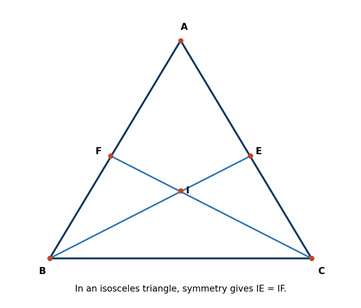
Symmetry proves the forward direction when AB = AC.
Question 4
Exercise Set 9.1 | Printed page 6
Problem focus: Test addition of the same number to equal quantities and reverse the statement.
Solution
Formula or rule used x = y ⇔ a + x = a + y.
Step 1 If x = y, adding a gives a + x = a + y, so the statement is true.
Step 2 Conversely, from a + x = a + y, subtract a from both sides to obtain x = y.
Step 3 Both directions are true.
Question 5
Exercise Set 9.1 | Printed page 6
Problem focus: Test the product of two perfect squares and the reversed claim.
Solution
Formula or rule used a = r² and b = s² ⇒ ab = (rs)².
Step 1 Write a = r² and b = s².
Step 2 Then ab = r²s² = (rs)², so the original statement is true.
Step 3 The converse is false: 2 × 8 = 16 is a perfect square, although neither 2 nor 8 is a perfect square.
Question 6
Exercise Set 9.1 | Printed page 6
Problem focus: Compare equality with equality of squares for real numbers.
Solution
Formula or rule used x² = y² ⇒ x = ±y.
Step 1 If x = y, then x² = y², so the original is true.
Step 2 The converse is false because equal squares allow opposite values.
Step 3 For example, x = 4 and y = -4 give x² = y² but x ≠ y.
Question 7
Exercise Set 9.1 | Printed page 6
Problem focus: Compare equality with equality of cubes for real numbers.
Solution
Formula or rule used x³ – y³ = (x – y)(x² + xy + y²).
Step 1 If x = y, then x³ = y³.
Step 2 Conversely, x³ = y³ gives x³ – y³ = (x – y)(x² + xy + y²) = 0.
Step 3 Over the reals, the second factor is non-negative and can be zero only when x = y = 0; in every case x – y = 0.
Step 4 Therefore x = y.
Step 5 Both directions are true.
Question 8
Exercise Set 9.1 | Printed page 6
Problem focus: Compare divisibility by 24 with simultaneous divisibility by 4 and 6.
Solution
Formula or rule used a | n and b | n ⇒ lcm(a,b) | n.
Step 1 Every multiple of 24 is a multiple of 4 and 6, so the original is true.
Step 2 The converse is false because being divisible by 4 and 6 guarantees divisibility by lcm(4,6) = 12, not necessarily by 24.
Step 3 Counterexample: 12.
Question 9
Exercise Set 9.1 | Printed page 6
Problem focus: Compare divisibility by 60 with simultaneous divisibility by 5 and 12.
Solution
Formula or rule used a | n and b | n ⇒ lcm(a,b) | n.
Step 1 The original is true.
Step 2 For the converse, lcm(5,12) = 60 because 5 and 12 are coprime.
Step 3 Therefore a number divisible by both 5 and 12 is divisible by 60.
Step 4 Both directions are true.
Question 10
Exercise Set 9.1 | Printed page 6
Problem focus: Connect the square of a prime with exactly three positive factors.
Solution
Formula or rule used If n = ∏pᵢᵃⁱ, then d(n) = ∏(aᵢ + 1).
Step 1 If n = p² for prime p, its positive factors are 1, p, and p², so the original is true.
Step 2 Conversely, a positive integer with exactly three factors must be p² for some prime p; otherwise its prime factorisation would produce a different factor count.
Step 3 Both directions are true.
Question 11
Exercise Set 9.1 | Printed page 6
Problem focus: Connect a product of two unequal primes with exactly four divisors.
Solution
Formula or rule used If n = ∏pᵢᵃⁱ, then d(n) = ∏(aᵢ + 1).
Step 1 If n = pq for unequal primes p and q, the divisors are 1, p, q, and pq, so the original is true.
Step 2 The converse is false: 8 has exactly four positive divisors 1, 2, 4, 8, but 8 = 2³ is not a product of two unequal primes.
Question 12
Exercise Set 9.1 | Printed page 6
Problem focus: Relate gcd(n,n+3) to whether n is a multiple of 3.
Solution
Formula or rule used gcd(n,n + 3) = gcd(n,3).
Step 1 If n and n + 3 have no common factor greater than 1, n cannot be a multiple of 3; otherwise both would be divisible by 3.
Step 2 Conversely, if n is not a multiple of 3, gcd(n,n+3) = gcd(n,3) = 1.
Step 3 Both directions are true.
Question 13
Exercise Set 9.1 | Printed page 6
Problem focus: Give one counterexample to each proposed prime-generating expression.
Solution
Formula or rule used One valid counterexample is enough to disprove a universal statement.
Step 1 (i) Use n = 4: 4n² + 1 = 65 = 5 × 13.
Step 2 (ii) Use n = 10: n² + n + 11 = 121 = 11².
Step 3 (iii) Use n = 4: 4ⁿ + 3 = 259 = 7 × 37.
Step 4 Each single composite value disproves its universal claim.
Question 14
Exercise Set 9.1 | Printed page 6
Problem focus: Disprove two claims involving powers of 2.
Solution
Formula or rule used One valid counterexample is enough to disprove a universal statement.
Step 1 (i) Choose prime n = 11: 2¹¹ – 1 = 2047 = 23 × 89, so it is not prime.
Step 2 (ii) Choose even n = 6: 2⁶ + 1 = 65 = 5 × 13, so it is not prime.
Question 15
Exercise Set 9.1 | Printed page 6
Problem focus: Test divisibility by 8 against simultaneous divisibility by 2 and 4.
Solution
Formula or rule used a | n and b | n ⇒ lcm(a,b) | n.
Step 1 (i) If a number is divisible by 8, write it as 8k.
Step 2 Then 8k = 2(4k) and 8k = 4(2k), so it is divisible by 2 and 4.
Step 3 (ii) The reverse check is insufficient.
Step 4 A number divisible by both 2 and 4 is simply divisible by 4.
Step 5 Counterexample: 12 is divisible by 2 and 4 but not by 8.
Question 16
Exercise Set 9.1 | Printed page 6
Problem focus: Express the divisibility-by-3 digit-sum rule in both directions.
Solution
Formula or rule used N ≡ sum of the digits of N (mod 3).
Step 1 First direction: If a whole number is divisible by 3, then the sum of its digits is divisible by 3.
Step 2 Converse: If the sum of a whole number’s digits is divisible by 3, then the number is divisible by 3.
Step 3 Both statements are true.
Question 17
Exercise Set 9.1 | Printed page 7
Problem focus: Use two sticks as diagonals and distinguish a necessary condition from a sufficient condition.
Solution
Formula or rule used P ⇒ Q means P is sufficient for Q and Q is necessary for P.
Step 1 Part (i): The rule Q ⇒ equal diagonals makes equal stick lengths necessary, so the two sticks should be equal.
Step 2 However, equal lengths alone may not be enough to produce a quadrilateral of type Q; the way the sticks cross can matter, and the given one-way rule does not identify a guaranteed arrangement.
Step 3 Part (ii): The reversed rule equal diagonals ⇒ Q makes equal stick lengths sufficient.
Step 4 Once two equal sticks form the diagonals of a non-degenerate quadrilateral, the rule guarantees type Q, so the precise crossing arrangement does not matter for membership in Q.
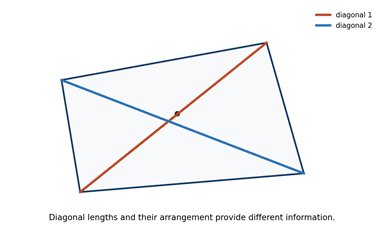
The same diagonal lengths can support different quadrilateral shapes.
Exercise Review Table
| Question | Original | Converse or claim | Key tool |
| 1 | True | True | Corresponding angles criterion |
| 2 | True | False | Non-square rectangle |
| 3 | True | False | Symmetry and a scalene counterexample |
| 4 | True | True | Subtract the same number |
| 5 | True | False | 2 × 8 = 16 |
| 6 | True | False | Opposite real numbers |
| 7 | True | True | Cube function is one-to-one |
| 8 | True | False | lcm(4,6) = 12 |
| 9 | True | True | lcm(5,12) = 60 |
| 10 | True | True | Prime-square factor count |
| 11 | True | False | 8 = 2³ |
| 12 | True | True | gcd(n,n+3) = gcd(n,3) |
| 13 | False claims | Counterexamples | n = 4, 10, and 4 |
| 14 | False claims | Counterexamples | n = 11 and n = 6 |
| 15 | True | False | 12 is the counterexample |
| 16 | True | True | Digit-sum test for 3 |
| 17 | Necessary | Sufficient | Interpret the direction |
PART FOUR
Multiple Choice Questions
Choose the best answer. Answers are provided separately.
1. The converse of “If a number is divisible by 12, then it is divisible by 3” is: (A) If a number is divisible by 3, it is divisible by 12. (B) If a number is not divisible by 12, it is not divisible by 3. (C) Every number divisible by 12 is even. (D) 3 divides 12.
2. Which value disproves “If n is even, then n + 1 is prime”? (A) 2 (B) 4 (C) 8 (D) 10
3. If x = y for real x and y, which conclusion must be true? (A) x² = -y² (B) x³ = y³ (C) x + 1 = y – 1 (D) × and y have opposite signs
4. Which converse is true? (A) Rectangle ⇒ square (B) Divisible by 2 ⇒ divisible by 8 (C) x³ = y³ ⇒ x = y for real numbers (D) Four equal sides ⇒ rectangle
5. A counterexample to “If a quadrilateral has equal diagonals, it is a rectangle” is a: (A) square (B) non-square isosceles trapezium (C) rectangle (D) parallelogram with unequal diagonals
6. The negating example for P ⇒ Q must make: (A) P false and Q false (B) P false and Q true (C) P true and Q false (D) P true and Q true
7. If a positive integer has exactly three positive factors, it must be: (A) a prime (B) a square of a prime (C) a cube of a prime (D) a product of unequal primes
8. Which number is divisible by both 4 and 6 but not by 24? (A) 12 (B) 24 (C) 48 (D) 72
9. The statement P ⇔ Q means: (A) only P ⇒ Q (B) only Q ⇒ P (C) both directions are true (D) both are false
10. Which pair gives a false converse? (A) x = y and x + 4 = y + 4 (B) x = y and x³ = y³ (C) square and four equal angles (D) number divisible by 60 and divisible by 5 and 12
11. If n is not a multiple of 3, then gcd(n,n+3) equals: (A) 0 (B) 1 (C) 2 (D) 3
12. Which is a proposition? (A) Close the door. (B) Is 9 a square? (C) 15 is divisible by 5. (D) x + 2 = 7 with x unspecified.
13. For real numbers, x² = y² implies: (A) x = y only (B) x = -y only (C) x = y or x = -y (D) × and y are positive
14. A number has four positive divisors. Which form is possible? (A) p² only (B) p³ or pq for unequal primes (C) p⁴ only (D) prime only
15. The converse of “If a triangle is equilateral, then it is isosceles” is: (A) If a triangle is isosceles, it is equilateral. (B) If a triangle is not equilateral, it is not isosceles. (C) Every triangle has three sides. (D) Equal angles face equal sides.
16. Which example shows that the converse in Question 15 is false? (A) a 60°-60°-60° triangle (B) a 50°-50°-80° triangle (C) a right triangle (D) a scalene triangle
17. If a number is divisible by both 8 and 9, it must be divisible by: (A) 17 (B) 36 (C) 72 (D) 81
18. Which claim is disproved by n = 6? (A) Even n ⇒ 2ⁿ + 1 is prime (B) Prime n ⇒ 2ⁿ – 1 is prime (C) Divisible by 8 ⇒ divisible by 4 (D) p² has three factors
19. A proof of a universal statement must cover: (A) one convenient example (B) every allowed case (C) only prime cases (D) only positive examples
20. If two statements are converses, then: (A) they always have the same truth value (B) each reverses the condition and conclusion of the other (C) both must be false (D) one must be negative
Multiple Choice Answer Key
| Question | Answer | Reason |
| 1 | A | The condition and conclusion are reversed. |
| 2 | C | 8 is even but 9 is not prime. |
| 3 | B | Equal real numbers have equal cubes. |
| 4 | C | The real cube function is one-to-one. |
| 5 | B | An isosceles trapezium can have equal diagonals without being a rectangle. |
| 6 | C | A counterexample satisfies the condition and violates the conclusion. |
| 7 | B | Only p² has exactly three positive factors. |
| 8 | A | 12 is divisible by 4 and 6 but not 24. |
| 9 | C | The double arrow represents both implications. |
| 10 | C | A non-square rectangle has equal angles. |
| 11 | B | gcd(n,n+3) = gcd(n,3). |
| 12 | C | It is a declarative statement with a truth value. |
| 13 | C | Equal squares permit equal or opposite numbers. |
| 14 | B | Both p³ and pq have four divisors. |
| 15 | A | The converse reverses equilateral and isosceles. |
| 16 | B | It is isosceles but not equilateral. |
| 17 | C | lcm(8,9) = 72. |
| 18 | A | 2⁶ + 1 = 65 is composite. |
| 19 | B | A proof must establish all permitted cases. |
| 20 | B | Converse means reversing condition and conclusion. |
PART FIVE
Assertion and Reason
Use the standard option code and then check the explanations.
Choose: (A) Both Assertion and Reason are true, and Reason correctly explains Assertion. (B) Both are true, but Reason does not correctly explain Assertion. (C) Assertion is true, but Reason is false. (D) Assertion is false, but Reason is true.
1. Assertion: If an integer is divisible by 18, it is divisible by 6. Reason: 18 = 6 × 3.
2. Assertion: If x² = y² for real x and y, then x = y. Reason: Squaring removes the sign of a real number.
3. Assertion: A positive integer with exactly three factors is a square. Reason: Its factor list is 1, p, p² for a prime p.
4. Assertion: If a quadrilateral has equal diagonals, it must be a rectangle. Reason: Some isosceles trapezia have equal diagonals.
5. Assertion: If n is not divisible by 3, then n and n + 3 are coprime. Reason: Any common divisor of n and n + 3 must divide their difference 3.
Answers and Explanations
1. A. Every multiple 18k equals 6(3k), so the factorisation directly explains the assertion.
2. D. The assertion is false because x and y may be opposites; the reason is true.
3. A. Exactly three factors occur for p², namely 1, p, and p².
4. D. The assertion is false, and the reason supplies a valid counterexample type.
5. A. A common divisor must divide 3. Since n is not divisible by 3, the common divisor cannot be 3, so it is 1.
PART SIX
Short Answer Practice
Answer in two to four logical steps.
1. Write the converse of: If an integer ends in 0, then it is divisible by 5. State whether the converse is true.
2. Give a counterexample to: If n² is even, then n is a multiple of 4.
3. Show that the proposition and converse relating x = y and 7x = 7y are both true for real x and y.
4. A learner uses 9 to test “If n is prime, then n is odd.” Explain why 9 is not a counterexample.
5. Decide whether “If a quadrilateral is a rhombus, its diagonals are perpendicular” and its converse are true.
6. Find the least positive counterexample to: If a number is divisible by 6, then it is divisible by 12.
7. Explain why one successful example cannot prove a universal proposition.
8. Write two if-then statements that together express: A whole number is divisible by 9 exactly when its digit sum is divisible by 9.
9. A positive integer has exactly four divisors. Explain why it need not be a product of two unequal primes.
10. Classify the truth values of: If a triangle is equilateral, it is equiangular; and its converse.
Short Answer Solutions
1. Converse: If an integer is divisible by 5, then it ends in 0. This is false; 15 is divisible by 5 but ends in 5.
2. Take n = 2. Then n² = 4 is even, but 2 is not a multiple of 4.
3. If x = y, multiplying by 7 gives 7x = 7y. Conversely, from 7x = 7y, divide by non-zero 7 to obtain x = y.
4. A counterexample must satisfy the condition. Since 9 is not prime, it does not test the proposition. The number 2 is a genuine counterexample because it is prime but not odd.
5. The forward statement is true for a rhombus. The converse is false: a kite can have perpendicular diagonals without all four sides being equal.
6. The least positive multiple of 6 that is not a multiple of 12 is 6 itself.
7. A universal statement concerns every allowed case. One example shows only that the result works once; it does not eliminate a failing case elsewhere.
8. If a whole number is divisible by 9, its digit sum is divisible by 9. If the digit sum of a whole number is divisible by 9, the number is divisible by 9.
9. A number p³ also has four divisors: 1, p, p², p³. For example, 8 has four divisors but is not a product of two unequal primes.
10. Both are true. An equilateral triangle has three equal angles, and an equiangular triangle has three equal sides.
PART SEVEN
Long Answer Practice
Develop a complete argument and include counterexamples where required.
1. For real numbers x and y, analyse the statement x = y ⇒ x² = y² and its converse. State the corrected two-way relationship.
2. Consider the statement: If a positive integer is divisible by 30, then it is divisible by both 6 and 10. Test the statement and its converse using prime factorisation or least common multiples.
3. Analyse the proposition: If a quadrilateral is a square, then its diagonals are equal and perpendicular bisectors of each other. Write the converse and decide whether it is true.
4. Prove that a positive integer has exactly three positive factors if and only if it is the square of a prime.
5. Create one pair in which the proposition is true but its converse is false, one pair in which both are true, and one pair in which both are false. Justify all six truth decisions.
Long Answer Solutions
Question 1
Problem focus: Equality and equality of squares.
Solution: If x = y, squaring gives x² = y², so the forward statement is true. The converse is false because 3² = (-3)² while 3 ≠ -3. Factorisation gives x² – y² = (x-y)(x+y) = 0, so x = y or x = -y. The correct two-way statement is x² = y² if and only if |x| = |y|, equivalently x = ±y.
Question 2
Problem focus: Divisibility by 30 compared with divisibility by 6 and 10.
Solution: If n = 30k, then n = 6(5k) and n = 10(3k), so the original is true. Conversely, divisibility by both 6 and 10 gives divisibility by lcm(6,10) = 30. Therefore the converse is also true and the relationship is two-way.
Question 3
Problem focus: Diagonal properties of a square.
Solution: A square has equal diagonals, the diagonals bisect each other, and they are perpendicular, so the original is true. The converse says that a quadrilateral whose diagonals are equal, perpendicular, and bisect each other is a square. Diagonals that bisect each other give a parallelogram; equal diagonals make that parallelogram a rectangle; perpendicular diagonals make it a rhombus. Being both a rectangle and a rhombus makes it a square. Thus the converse is true.
Question 4: Problem focus: Exactly three factors.
Solution: Forward: if n = p² with prime p, the divisors are 1, p, p², exactly three. Reverse: suppose n has exactly three positive factors. Factors normally pair to product n. An odd number of factors means one pair repeats, so n is a square, say n = a². If a were composite, it would have a proper divisor and n would gain more than three factors. Hence a is prime. Therefore n = p². Both directions hold.
Question 5: Problem focus: Constructing and justifying examples.
Solution: True and false converse: divisible by 8 ⇒ even is true, but even ⇒ divisible by 8 is false; 6 is a counterexample. Both true: an integer is divisible by 10 ⇔ its final digit is 0. Both false: “If a triangle is right-angled, it is equilateral” is false, for example a 3-4-5 triangle; its converse “If a triangle is equilateral, it is right-angled” is also false because its angles are 60° each.
PART EIGHT
Case Based Practice
Read each situation and answer every part.
Case 1 School Bell Schedules
Bell A rings every 6 minutes and Bell B every 8 minutes. A student says: If both bells ring now, they will ring together after a time divisible by both 6 and 8.
a. What is the least positive such time?
b. Write the converse of the student’s statement.
c. Is the converse true? Explain.
Case 2 Shape Sorting
A digital tool labels every quadrilateral with four equal angles as Type R. A learner assumes every Type R shape is a square.
a. Translate the assumption into an if-then proposition.
b. Give a counterexample.
c. State one extra condition that would make the conclusion valid.
Case 3 Access Code
A code is accepted when the sum of its digits is divisible by 3. The system is based on the divisibility rule for 3.
a. Write the rule in both if-then directions.
b. Test the code 5724.
c. Explain why this is a two-way rule.
Case 4 Number of Factors
Meera finds that 49 has exactly three positive factors and predicts that every number with exactly three factors is a prime square.
a. List the factors of 49.
b. Write Meera’s prediction as an implication.
c. Justify its converse as well.
Case 5 Bridge Braces
Two equal metal rods are used as the diagonals of a four-sided frame. A worker claims that the frame must be a rectangle.
a. Is equal diagonal length enough to prove the frame is a rectangle?
b. Name or describe a counterexample.
c. What additional diagonal condition would guarantee a parallelogram before equal diagonals are used to conclude rectangle?
Case Based Solutions
Case 1
a. lcm(6,8) = 24 minutes.
b. Converse: If a time is divisible by both 6 and 8, then both bells ring at that time after a common start.
c. True, because each bell completes a whole number of cycles.
Case 2
a. If a quadrilateral has four equal angles, then it is a square.
b. A non-square rectangle, such as a 3 by 5 rectangle.
c. Require four equal sides as well.
Case 3
a. If a number is divisible by 3, its digit sum is divisible by 3; conversely, if the digit sum is divisible by 3, the number is divisible by 3.
b. 5 + 7 + 2 + 4 = 18, which is divisible by 3, so 5724 is accepted.
c. A whole number and its digit sum have the same remainder when divided by 3.
Case 4
a. 1, 7, and 49.
b. If a positive integer has exactly three positive factors, then it is the square of a prime.
c. If n = p² with p prime, its only factors are 1, p, and p².
Case 5
a. No. Equal diagonals alone are insufficient.
b. A non-rectangular isosceles trapezium can have equal diagonals.
c. Require the diagonals to bisect each other. That makes the frame a parallelogram; a parallelogram with equal diagonals is a rectangle.
Continue Your Practice with Class 9 Mathematics Practice Guide Part II
Found this explanation helpful? Continue learning with our practice guide, which includes:
- Formula banks for quick revision.
- Stepwise solutions showing the method and formulas used.
- Practice questions to strengthen your understanding.
- Sample papers to check your preparation.
Preview the sample pages and explore the available purchase options.
View Sample Pages & Buy the Book
By Tushar Sir & Shweta Ma’am
Science World By Tushar Sir
Frequently Asked Questions: Class 9 Maths Chapter 9 — Propositions and Their Converses
1. What is a proposition in mathematics?
A proposition is a statement that is either true or false. For example, “7 is a prime number” is a true proposition, while “9 is an even number” is a false proposition.
2. What is the converse of a proposition?
For a proposition written as “If P, then Q,” the converse is “If Q, then P.” It interchanges the condition and the conclusion.
3. How do we write the converse of a statement?
First, identify the condition and conclusion. Then interchange them.
Statement: If a number is divisible by 10, then it is divisible by 5.
Converse: If a number is divisible by 5, then it is divisible by 10.
4. Is the converse of a true proposition always true?
No. A true proposition can have a false converse.
For example, “Every square is a rectangle” is true. Its converse, “Every rectangle is a square,” is false because a rectangle need not have all four sides equal.
5. What is a counterexample?
A counterexample is an example that shows a statement is false.
For the statement “Every number divisible by 5 is divisible by 10,” 15 is a counterexample: it is divisible by 5 but not by 10.
6. Can one example prove that a mathematical statement is always true?
One supporting example generally cannot prove a statement about all cases. However, one valid counterexample is enough to disprove a statement that claims something is always true.
7. Can a proposition and its converse both be true?
Yes. For example:
Proposition: If an integer is even, then it is divisible by 2.
Converse: If an integer is divisible by 2, then it is even.
Both statements are true.
8. Are questions and commands propositions?
No. Questions such as “Is 8 even?” and commands such as “Draw a triangle” do not have a truth value, so they are not propositions.
9. How should students solve questions on propositions and their converses?
Identify the condition and conclusion, write the converse, and check each statement separately. Support your answer with a mathematical explanation or a counterexample.
10. What does the Chapter 9 practice guide include?
Our Class 9 Mathematics Practice Guide Part II covers Propositions and Their Converses with a formula and concept bank, detailed stepwise solutions, practice questions, and a sample paper.