
Introduction
Welcome to the free notes for Class 9 Science Chapter 7 notes – Work, Energy & Simple Machines. These notes are based on the latest NCERT Exploration: Textbook of Science for Grade 9. In this chapter, you will learn about work, energy, power, different forms of energy, the law of conservation of energy, and the role of simple machines in making work easier. These notes are perfect for quick revision and exam preparation.
Based on the Latest NCERT Textbook
These notes are prepared according to the latest NCERT Exploration: Textbook of Science for Grade 9 and cover all important concepts in an easy-to-understand format.
Table of Contents
What is Work?
In science, work is said to be done when a force applied on an object causes it to move in the direction of the force.
Formula
Work = Force × Displacement
W = F × s
SI Unit
Joule (J)
Conditions for Work
Work is done only when:
- A force acts on an object.
- The object moves.
- The movement is in the direction of the applied force.
If there is no movement, no work is done.
What is Energy?
Energy is the capacity to do work.
Energy enables us to perform different activities such as walking, lifting objects, running machines, and producing electricity.
SI Unit
Joule (J)
Forms of Energy
Some common forms of energy are:
- Mechanical Energy
- Heat Energy
- Light Energy
- Sound Energy
- Electrical Energy
- Chemical Energy
- Nuclear Energy
Kinetic Energy
Kinetic energy is the energy possessed by an object due to its motion.
Formula
KE = ½ mv²
Where:
- m = Mass
- v = Velocity
Examples
- Moving car
- Flying bird
- Rolling ball
Potential Energy
Potential energy is the energy possessed by an object due to its position or shape.
Formula
PE = mgh
Where:
- m = Mass
- g = Acceleration due to gravity
- h = Height
Examples
- Water stored in a dam
- A stretched rubber band
- A book kept on a shelf
Law of Conservation of Energy
The Law of Conservation of Energy states:
Energy can neither be created nor destroyed. It can only be transformed from one form to another.
Example
A swinging pendulum continuously converts potential energy into kinetic energy and vice versa.
What is Power?
Power is the rate at which work is done.
Formula
Power = Work ÷ Time
SI Unit
Watt (W)
Simple Machines
Simple machines are devices that make work easier by reducing the effort required or changing the direction of the applied force.
Advantages of Simple Machines
- Reduce effort
- Change the direction of force
- Increase speed
- Help lift heavy objects
Types of Simple Machines
1. Lever
Example:
- Seesaw
- Crowbar
- Scissors
2. Pulley
Used to lift heavy loads.
Example:
- Well pulley
- Crane
3. Wheel and Axle
Example:
- Bicycle wheel
- Door knob
4. Inclined Plane
Example:
- Ramp
- Sloping road
5. Screw
Example:
- Bolt
- Jar lid
6. Wedge
Example:
- Knife
- Axe
- Chisel
Mechanical Advantage
Mechanical Advantage (MA) is the ratio of Load to Effort.
Formula
MA = Load ÷ Effort
A higher mechanical advantage means less effort is required.
Important Terms
- Work
- Force
- Displacement
- Energy
- Kinetic Energy
- Potential Energy
- Power
- Mechanical Energy
- Simple Machine
- Lever
- Pulley
- Mechanical Advantage
Chapter Summary
✅ Work is done when force causes displacement.
✅ Energy is the capacity to do work.
✅ Kinetic energy depends on motion.
✅ Potential energy depends on position.
✅ Energy can only change from one form to another.
✅ Power is the rate of doing work.
✅ Simple machines make work easier.
Complete Your Preparation
The notes above cover only the basic concepts of this chapter.
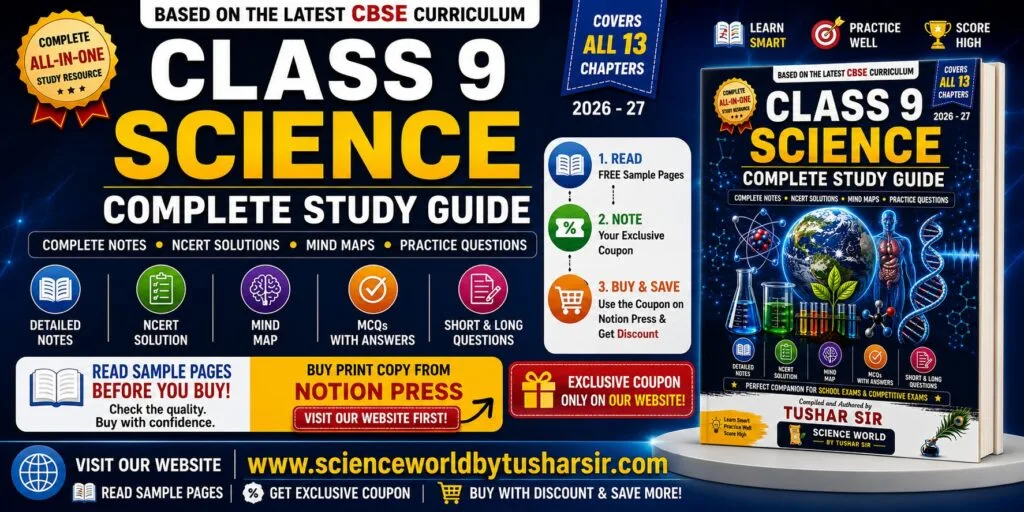
For complete exam preparation based on the latest NCERT Exploration: Textbook of Science for Grade 9, get our premium study material prepared by Science World by Tushar Sir.
The complete study material includes:
✔ Detailed Notes
✔ Mind Maps
✔ NCERT Solutions
✔ MCQs with Answers
✔ Assertion & Reason Questions
✔ Case-Based Questions
✔ Competency-Based Questions
✔ Short & Long Answer Questions
✔ Practice Paper

FAQ
What is work in science?
Work is done when a force causes an object to move in the direction of the force.
What is the SI unit of energy?
The SI unit of energy is the Joule (J).
What is kinetic energy?
Kinetic energy is the energy possessed by an object due to its motion.
What is the law of conservation of energy?
It states that energy can neither be created nor destroyed but can only be converted from one form to another.
What are simple machines?
Simple machines are devices that make work easier by reducing effort or changing the direction of force.
Are these notes enough for exams?
These notes are useful for quick revision. For complete preparation with detailed explanations, NCERT solutions, mind maps, MCQs, assertion-reason questions, case-based questions, and practice papers, the complete eBook is recommended.
📚 Looking for All Class 9 Science Chapters?
Access all 13 chapter-wise notes based on the latest NCERT Exploration: Textbook of Science for Grade 9 from one place.