
Introduction
Welcome to the free notes for Class 9 Science Chapter 8 notes – Journey Inside the Atom. These notes are based on the latest NCERT Exploration: Textbook of Science for Grade 9. In this chapter, you will learn about the structure of atoms, subatomic particles, atomic models, atomic number, mass number, isotopes, ions, and molecules. These notes are ideal for quick revision and exam preparation.
Based on the Latest NCERT Textbook
These notes are prepared according to the latest NCERT Exploration: Textbook of Science for Grade 9 and cover all important concepts in an easy-to-understand format.
Table of Contents
What is an Atom?
An atom is the smallest unit of an element that retains its chemical properties. Atoms combine to form molecules and compounds.
Discovery of the Atom
Scientists proposed different atomic models to explain the structure of the atom.
- John Dalton proposed the first modern atomic theory.
- J. J. Thomson discovered the electron.
- Ernest Rutherford proposed the nuclear model of the atom.
- Niels Bohr explained that electrons move in fixed energy levels around the nucleus.
Structure of an Atom
An atom consists of two main parts:
Nucleus
The nucleus is the central part of the atom containing:
- Protons
- Neutrons
It contains almost all the mass of the atom.
Electrons
Electrons revolve around the nucleus in fixed energy levels or shells.
Subatomic Particles
Proton
- Charge: Positive (+1)
- Location: Nucleus
- Mass: Approximately 1 amu
Neutron
- Charge: Neutral
- Location: Nucleus
- Mass: Approximately 1 amu
Electron
- Charge: Negative (−1)
- Location: Around the nucleus
- Mass: Very small (about 1/1836 amu)
Atomic Models
Dalton’s Atomic Model
- Atoms are indivisible.
- Atoms of the same element are identical.
Thomson’s Model
Known as the Plum Pudding Model.
- Electrons are embedded in a positively charged sphere.
Rutherford’s Model
- Most of the atom is empty space.
- The nucleus is small, dense, and positively charged.
Bohr’s Model
- Electrons revolve in fixed shells.
- Electrons can move between shells by gaining or losing energy.
Atomic Number
The atomic number (Z) is the number of protons present in the nucleus of an atom.
For a neutral atom:
Atomic Number = Number of Protons = Number of Electrons
Mass Number
The mass number (A) is the total number of protons and neutrons in the nucleus.
Formula
Mass Number = Number of Protons + Number of Neutrons
Isotopes
Isotopes are atoms of the same element having the same atomic number but different mass numbers.
Examples
- Carbon-12
- Carbon-14
- Chlorine-35
- Chlorine-37
Isobars
Isobars are atoms of different elements having the same mass number but different atomic numbers.
Ions
An ion is an atom or group of atoms carrying an electric charge.
Cation
A positively charged ion formed by the loss of electrons.
Example:
Na⁺
Anion
A negatively charged ion formed by the gain of electrons.
Example:
Cl⁻
Molecules
A molecule is formed when two or more atoms combine chemically.
Examples
- H₂
- O₂
- H₂O
- CO₂
Important Terms
- Atom
- Molecule
- Proton
- Neutron
- Electron
- Nucleus
- Atomic Number
- Mass Number
- Isotope
- Isobar
- Ion
- Cation
- Anion
Chapter Summary
✅ Atom is the smallest unit of an element.
✅ Protons and neutrons are present in the nucleus.
✅ Electrons revolve around the nucleus.
✅ Atomic number equals the number of protons.
✅ Mass number equals protons plus neutrons.
✅ Isotopes have the same atomic number but different mass numbers.
Complete Your Preparation
The notes above cover only the basic concepts of this chapter.
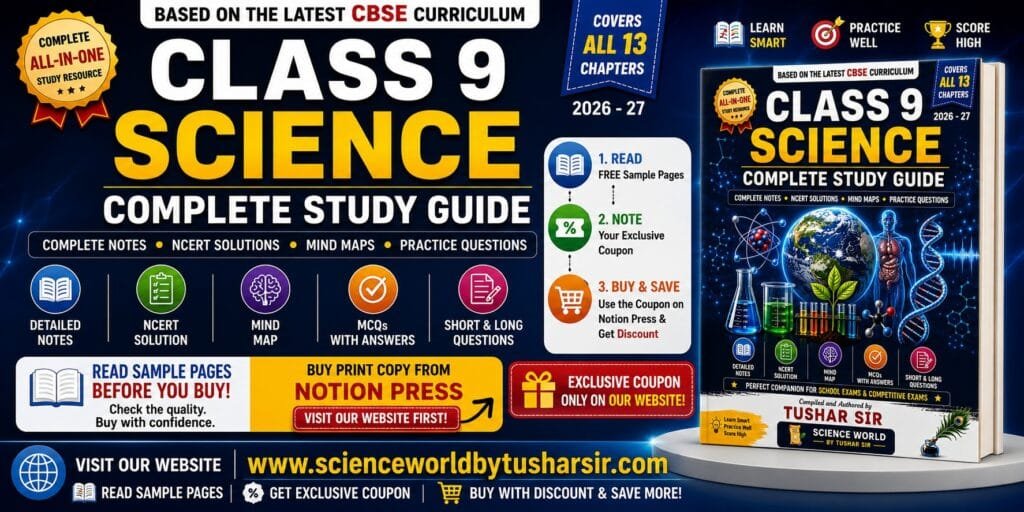
For complete exam preparation based on the latest NCERT Exploration: Textbook of Science for Grade 9, get our premium study material prepared by Science World by Tushar Sir.
The complete study material includes:
✔ Detailed Notes
✔ Mind Maps
✔ NCERT Solutions
✔ MCQs with Answers
✔ Assertion & Reason Questions
✔ Case-Based Questions
✔ Competency-Based Questions
✔ Short & Long Answer Questions
✔ Practice Paper

FAQ
What is an atom?
An atom is the smallest unit of an element that retains its chemical properties.
What is the atomic number?
The atomic number is the number of protons present in the nucleus of an atom.
What is the difference between isotopes and isobars?
Isotopes have the same atomic number but different mass numbers, whereas isobars have the same mass number but different atomic numbers.
What is an ion?
An ion is an atom or group of atoms that carries a positive or negative electric charge.
Are these notes enough for exams?
These notes are useful for quick revision. For complete preparation with detailed explanations, NCERT solutions, mind maps, MCQs, assertion-reason questions, case-based questions, and practice papers, the complete eBook is recommended.
📚 Looking for All Class 9 Science Chapters?
Access all 13 chapter-wise notes based on the latest NCERT Exploration: Textbook of Science for Grade 9 from one place.