
Science Behind Rituals – Part 4: The Science Behind Tilak, Namaste, Temple Bells, Pradakshina & More
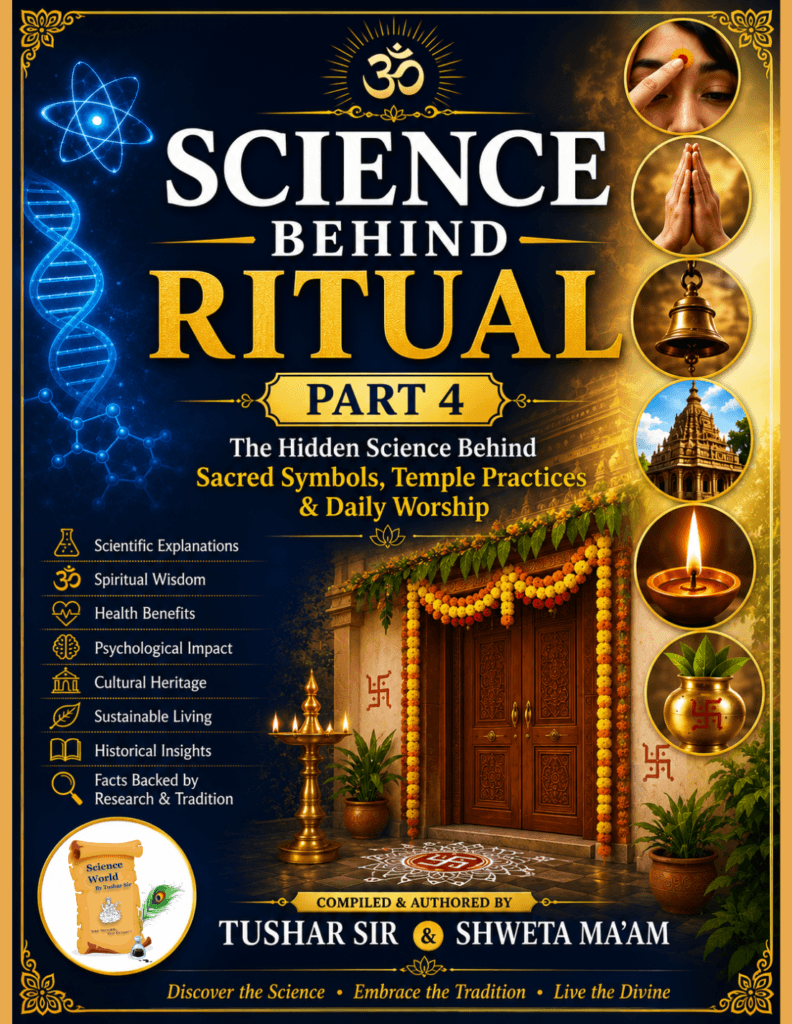
Science Behind Rituals – Part 4 explores ten familiar Indian religious and cultural practices and examines them through the lenses of tradition, psychology, hygiene, acoustics, symbolism, and human behavior.
Many rituals developed over centuries. While their original meanings are often spiritual or symbolic, some practices can also be understood through scientific and psychological perspectives. The purpose is not to replace faith with science, but to understand the possible reasoning behind traditions that continue to be practiced today.
Table of Contents
Chapter 1: Why Should Tilak Be Applied with the Thumb?
Tilak is traditionally applied on the forehead during religious ceremonies and other auspicious occasions. Different communities use different materials and methods, and the finger used can also vary according to tradition.
The thumb is a strong and stable finger, making it convenient for applying a small amount of sandalwood paste, kumkum, or other material evenly. The gentle pressure involved in applying the tilak can also provide a brief tactile sensation that helps a person become attentive and conscious of the ritual.
From a psychological perspective, a repeated physical action can act as a ritual cue. It tells the mind that a particular activity—such as prayer, meditation, or worship—is beginning.
The spiritual meaning of the tilak remains rooted in tradition, while the physical act can simultaneously serve as a simple mindfulness cue.
Key Takeaway
Applying a tilak is primarily a cultural and spiritual practice, but its repetitive and tactile nature may help create a sense of focus and readiness for prayer.
Chapter 2: Why Do We Join Our Hands in Namaste?
Joining both hands and saying Namaste is one of the most recognizable Indian greetings.
Traditionally, Namaste expresses respect, humility, and recognition of the other person. Unlike a handshake, it does not require physical contact.
This can have practical benefits. Avoiding direct hand-to-hand contact can reduce the opportunity for transmission of microorganisms between people, although it does not make a person completely protected from infection.
The gesture also brings both hands together symmetrically. Such deliberate body movements can help create a sense of calm and attentiveness.
From a social-psychological perspective, gestures such as Namaste communicate respect without requiring words alone.
Key Takeaway
Namaste combines cultural symbolism, respectful communication, and a no-contact form of greeting.
Chapter 3: Why Is the Temple Bell Rung Before Prayer?
The sound of a temple bell is an important part of many Hindu temples.
Traditionally, ringing the bell is associated with announcing one’s presence before the deity and preparing the mind for worship.
From a scientific perspective, sound can strongly influence attention. A sudden, clear sound naturally attracts the brain’s attention and can interrupt ongoing thoughts.
Temple bells are generally designed to produce a rich, sustained sound. The resulting resonance can create a distinctive auditory environment inside the temple.
It is sometimes claimed that temple bells produce special frequencies that eliminate harmful microorganisms or purify the environment. Such claims should be treated cautiously because there is no established scientific evidence that ordinary temple-bell sounds sterilize a temple or destroy pathogens.
The more defensible explanation is that the bell functions as an auditory attention cue, helping mark the transition from ordinary activities to worship.
Key Takeaway
The temple bell can serve as a sound-based signal that helps focus attention and begin a prayerful activity.
Chapter 4: Why Do We Circumambulate (Pradakshina) Around a Temple?
Pradakshina, or circumambulation, involves walking around a sacred object or temple, traditionally keeping the sacred center to one’s right.
It has deep spiritual significance and represents reverence and placing the divine at the center of one’s attention.
There can also be simple physical and psychological dimensions to the practice. Walking at a steady pace provides gentle physical movement while the repetitive path can encourage a calmer mental state.
Repetitive walking is also commonly associated with contemplative practices in different cultures. The combination of movement, attention, and repetition can help a person become more mindful.
The number of circumambulations may vary according to the tradition or deity.
Key Takeaway
Pradakshina combines devotional symbolism with repetitive movement, which can encourage reflection, attention, and a calm state of mind.
Chapter 5: Why Is Kumkum Applied on the Forehead?
Kumkum is traditionally applied to the forehead, especially between or near the eyebrows, during religious and cultural practices.
It carries strong symbolic meanings associated with auspiciousness, devotion, and cultural identity.
The forehead is also a highly visible location, so the mark acts as an immediate visual symbol of participation in a ritual or cultural occasion.
Some explanations connect the location of kumkum with the so-called “third eye” or Ajna chakra. This is a concept from Indian spiritual traditions rather than a scientifically established anatomical structure.
It is therefore important to distinguish between spiritual symbolism and scientific anatomy.
The physical application of a small amount of material can also act as a sensory cue, reminding the person of the ritual or occasion.
Key Takeaway
Kumkum has primarily cultural and spiritual significance, while its forehead placement can also function as a visual and sensory reminder of the ritual.
Chapter 6: Why Is a Coconut Offered Before Worship?
The coconut is frequently offered during Hindu worship, ceremonies, inaugurations, and other auspicious occasions.
The coconut has several symbolic associations. Its hard outer shell and edible interior are often interpreted as representing the human ego, while breaking the coconut symbolizes surrender, humility, and offering oneself to the divine.
There is also a practical reason for its popularity in traditional settings. A whole coconut has a naturally protective outer structure and can remain usable for a considerable period compared with many perishable foods.
Coconut water and coconut flesh are nutritious foods containing water, carbohydrates, fats, minerals, and other nutrients. However, the nutritional value of coconut should not be confused with the religious reason for offering it.
The scientific explanation therefore complements, rather than replaces, its traditional symbolism.
Key Takeaway
The coconut is valued both as a symbol of humility and offering and as a naturally protected food resource.
Chapter 7: Why Is the Kalash Filled with Water During Religious Ceremonies?
The Kalash, a sacred vessel filled with water and often decorated with mango leaves and a coconut, is an important element of many Hindu ceremonies.
Water has always been essential to human life. It is therefore a natural symbol of purity, life, renewal, and prosperity.
In traditional ceremonies, the Kalash represents abundance and auspiciousness. The vessel provides a physical focal point for the ritual.
From a practical perspective, water also had enormous importance in ancient societies. Before modern water infrastructure, access to clean and safely stored water was directly connected with survival and community life.
It is important, however, not to assume that ritual Kalash water automatically becomes scientifically purified merely because it is used in worship. Water safety depends on its source, storage, and hygiene.
Key Takeaway
The Kalash symbolizes life, purity, abundance, and auspiciousness, with water serving as its central symbol.
Chapter 8: Why Do We Fold Our Hands and Close Our Eyes During Prayer?
Two common actions during prayer are folding the hands and closing the eyes.
Folding the hands is a traditional gesture of respect and devotion. It can also reduce distracting hand movements and create a deliberate posture.
Closing the eyes reduces visual input from the surrounding environment. This does not automatically produce meditation, but it can make it easier to direct attention inward.
When visual distractions are reduced, a person may concentrate more easily on prayer, breathing, chanting, or personal reflection.
This principle is not unique to religious practice. Quiet environments and reduced sensory distractions are also used in many forms of meditation and relaxation.
Key Takeaway
Folding the hands provides a structured devotional posture, while closing the eyes can reduce visual distractions and support concentration.
Chapter 9: Why Is Camphor Burned During Aarti?
Camphor is traditionally burned during Aarti, producing a bright flame that is offered before a deity.
The symbolism is particularly powerful: camphor burns readily and leaves very little solid residue, so its disappearance is traditionally interpreted as a metaphor for selflessness and surrender of the ego.
Chemically, camphor is a volatile organic compound. When heated, it vaporizes readily and can burn in the presence of oxygen.
The bright flame makes the Aarti visually prominent and marks an important moment in the worship sequence.
However, burning camphor also produces combustion products and should be performed with adequate ventilation and appropriate fire safety. It should never be treated as a method for purifying indoor air.
Key Takeaway
Camphor has strong symbolic importance in Aarti, while its flame is explained scientifically through its volatile and combustible chemical properties.
Chapter 10: Why Is the Swastika Drawn at the Entrance of Homes?
The Swastika is an ancient symbol that has been used in Indian traditions for thousands of years and is associated with auspiciousness, prosperity, well-being, and good fortune.
In Hindu, Jain, and Buddhist traditions, the symbol has long-standing religious and cultural significance.
The word is derived from Sanskrit and is commonly associated with the idea of well-being or good fortune.
It is important to distinguish this ancient South Asian religious symbol from the Nazi appropriation of a visually similar symbol in the 20th century. The historical and cultural contexts are very different.
When drawn at the entrance of a home, the Swastika traditionally represents a wish for prosperity, harmony, and positive beginnings.
Key Takeaway
In Indian traditions, the Swastika is an ancient auspicious symbol, traditionally associated with well-being and prosperity.
🛒 Get Science Behind Rituals – Part 4
Science and Tradition: What Can We Learn?
The rituals discussed in this chapter demonstrate an important principle: not every traditional practice needs to have a hidden scientific explanation to have cultural value.
Some rituals have practical dimensions. Others work as psychological cues, social signals, symbolic actions, or expressions of faith. Some popular claims about their scientific effects, however, are not supported by strong evidence.
Understanding rituals scientifically means asking:
- What is the traditional meaning?
- What physical process is involved?
- What psychological effect might the action have?
- Is there reliable scientific evidence for the claimed benefit?
- Which explanations are symbolic rather than scientific?
This approach allows us to appreciate India’s rich cultural traditions while maintaining scientific curiosity and critical thinking.
Conclusion
Indian rituals are often built from layers of history, spirituality, symbolism, social customs, and everyday human behavior.
From the tilak on the forehead to the ringing of a temple bell, from Namaste to Pradakshina, each practice carries a story.
Science can help us understand the physical and psychological aspects of these practices, while tradition helps us understand their cultural and spiritual meanings.
The goal of Science Behind Rituals is not to prove that every ritual was invented because ancient people already knew modern science. Instead, it is to explore traditions thoughtfully and ask what we can genuinely understand through scientific reasoning.
Tradition gives us questions. Science helps us investigate them.
Explore More from the Series
Science Behind Rituals – Part 1
Discover the possible science and cultural reasoning behind everyday Indian food and eating traditions.
Science Behind Rituals – Part 2
Explore more traditional practices and understand their historical, practical, and scientific perspectives.
Science Behind Rituals – Part 3
Continue the journey into the fascinating connection between Indian traditions and everyday life.
Science Behind Rituals – Part 4
Explore the science, psychology, symbolism, and history behind Tilak, Namaste, Temple Bells, Pradakshina, Kumkum, Coconut Offering, Kalash, Prayer, Camphor, and the Swastika.
📚 Read the Complete Science Behind Rituals eBook Series
If you enjoy exploring the reasoning behind traditional practices, the Science Behind Rituals book series provides a deeper look at many familiar Indian customs and rituals.
Learn the tradition. Understand the reasoning. Think scientifically.