The environment is the foundation of life on Earth. Every living organism, including humans, depends on the environment for food, water, air, shelter, and other essential resources. However, increasing population, industrialization, urbanization, and excessive use of natural resources have disturbed the balance of the environment. Therefore, understanding the relationship between living organisms and their surroundings is essential for protecting nature and ensuring sustainable development. (Our Environment Class 10 Notes)
In this chapter, you will learn about the environment, ecosystems, food chains, food webs, biological magnification, ozone layer, and waste management. These concepts help us understand how nature maintains balance and why conserving the environment is important for future generations.
This chapter is highly scoring in the CBSE Class 10 Science Board Examination, with questions frequently asked on ecosystems, food chains, trophic levels, biodegradable substances, and ozone layer depletion.
Learning Objectives (Our Environment Class 10 Notes)
After studying this chapter, you will be able to:
- Define the term environment.
- Identify the components of the environment.
- Explain the structure and functioning of an ecosystem.
- Differentiate between biotic and abiotic components.
- Understand the interaction between living organisms and their surroundings.
- Explain the importance of maintaining ecological balance.
- Appreciate the need for environmental conservation.
What is Environment?
The environment refers to everything that surrounds us and influences the life of living organisms. It includes both living (biotic) and non-living (abiotic) components that interact continuously.
The environment provides:
- Air for respiration
- Water for survival
- Food for nourishment
- Shelter for protection
- Natural resources for development
Without a healthy environment, life on Earth cannot exist.
Definition
Environment is the sum total of all the living and non-living surroundings that affect the growth, development, and survival of organisms.
Importance of Environment
The environment is essential because it:
- Supports all forms of life.
- Maintains ecological balance.
- Provides natural resources.
- Regulates climate.
- Purifies air and water.
- Maintains the water cycle and nutrient cycle.
- Supports biodiversity.
- Provides habitats for plants and animals.
Types of Environment
The environment can be broadly classified into two types.
1. Natural Environment
The natural environment consists of naturally occurring living and non-living components.
Examples include:
- Forests
- Rivers
- Mountains
- Oceans
- Grasslands
- Deserts
It is formed without human intervention.
2. Human-Made Environment
The human-made environment is created or modified by humans.
Examples include:
- Buildings
- Roads
- Dams
- Industries
- Parks
- Cities
These structures help in development but may also affect the natural environment if not managed responsibly.
Components of Environment
The environment has two major components.
1. Biotic Components
These are the living organisms present in an ecosystem.
Examples:
- Plants
- Animals
- Humans
- Bacteria
- Fungi
- Algae
Biotic components interact with one another for food, shelter, and survival.
2. Abiotic Components
These are the non-living physical and chemical factors of the environment.
Examples:
- Air
- Water
- Soil
- Sunlight
- Temperature
- Minerals
- Humidity
Abiotic factors directly influence the growth and survival of living organisms.
Difference Between Biotic and Abiotic Components
| Biotic Components | Abiotic Components |
|---|---|
| Living organisms | Non-living factors |
| Grow and reproduce | Do not grow or reproduce |
| Depend on abiotic factors for survival | Provide physical conditions for life |
| Examples: Plants, animals, bacteria | Examples: Air, water, sunlight, soil |
Interaction Between Biotic and Abiotic Components
Living organisms continuously interact with non-living components.
Examples:
- Plants use sunlight, water, and carbon dioxide for photosynthesis.
- Animals breathe oxygen and drink water.
- Soil provides minerals for plant growth.
- Temperature influences the distribution of plants and animals.
This interaction maintains the balance of nature.
What is an Ecosystem?
An ecosystem is a functional unit of nature where living organisms interact with one another and with their physical environment.
Every ecosystem consists of:
- Living organisms
- Non-living environment
- Continuous exchange of energy and nutrients
Definition
An ecosystem is a self-sustaining system formed by the interaction between biotic and abiotic components.
Characteristics of an Ecosystem
An ecosystem has the following characteristics:
- Contains both living and non-living components.
- Energy flows from the Sun through living organisms.
- Nutrients are continuously recycled.
- Organisms depend on one another.
- It remains balanced through natural interactions.
Types of Ecosystems
Ecosystems can be classified into two main types.
1. Natural Ecosystem
These ecosystems develop naturally without human intervention.
Examples:
- Forest ecosystem
- Pond ecosystem
- River ecosystem
- Ocean ecosystem
- Desert ecosystem
- Grassland ecosystem
2. Artificial Ecosystem
These ecosystems are created and maintained by humans.
Examples:
- Aquarium
- Agricultural field
- Garden
- Fish farm
- Crop field
Artificial ecosystems require regular human care and management.
Examples of Ecosystems
Forest Ecosystem
A forest ecosystem contains:
- Trees
- Shrubs
- Birds
- Insects
- Wild animals
- Microorganisms
It supports high biodiversity and plays an important role in maintaining ecological balance.
Pond Ecosystem
A pond ecosystem includes:
- Water
- Fish
- Frogs
- Algae
- Aquatic plants
- Insects
- Bacteria
It is an example of a freshwater ecosystem.
Desert Ecosystem
A desert ecosystem is characterized by:
- Low rainfall
- High temperature
- Sparse vegetation
- Animals adapted to dry conditions
Examples include camels, cactus plants, and desert foxes.
Importance of Ecosystems
Ecosystems are important because they:
- Maintain ecological balance.
- Support biodiversity.
- Purify air and water.
- Recycle nutrients.
- Regulate climate.
- Prevent soil erosion.
- Provide food and natural resources.
Healthy ecosystems are essential for the survival of all living organisms
Ecological Balance
Ecological balance is the stable relationship between living organisms and their environment.
A balanced ecosystem ensures:
- Stable populations of organisms.
- Efficient recycling of nutrients.
- Continuous flow of energy.
- Sustainable use of natural resources.
Human activities such as deforestation, pollution, and excessive use of resources can disturb this balance.
Everyday Examples
- A garden with plants, insects, birds, and soil forms a small ecosystem.
- A pond supports fish, frogs, algae, insects, and microorganisms.
- A forest supports thousands of interconnected species.
- Even a flower pot contains living organisms interacting with soil, water, and sunlight.
Key Terms
| Term | Meaning |
|---|---|
| Environment | The surroundings consisting of living and non-living components that influence organisms. |
| Biotic Components | Living parts of the environment such as plants, animals, fungi, and bacteria. |
| Abiotic Components | Non-living factors such as air, water, soil, sunlight, and temperature. |
| Ecosystem | A functional unit where living organisms interact with each other and with the environment. |
| Ecological Balance | A stable relationship between organisms and their surroundings. |
| Natural Ecosystem | An ecosystem formed naturally without human intervention. |
| Artificial Ecosystem | An ecosystem created and maintained by humans. |
Exam Tips
- Remember that an ecosystem includes both biotic and abiotic components.
- Learn the difference between natural and artificial ecosystems with examples.
- Be able to define environment, ecosystem, and ecological balance in simple scientific language.
- Revise examples of forest, pond, and desert ecosystems, as these are commonly used in CBSE questions.
Quick Revision
- The environment includes all living and non-living surroundings.
- Biotic components are living organisms, while abiotic components are non-living factors.
- An ecosystem is formed by the interaction of biotic and abiotic components.
- Ecosystems may be natural or artificial.
- Healthy ecosystems maintain ecological balance and support life on Earth.
- Human activities such as pollution and deforestation can disturb the balance of ecosystems.
Biotic Components
Biotic components are all the living organisms present in an ecosystem.
They interact with one another for food, shelter, reproduction, and survival.
Definition
Biotic components are the living organisms that form the biological part of an ecosystem.
Characteristics of Biotic Components
Biotic components:
- Grow and develop.
- Reproduce to increase their population.
- Respond to environmental changes.
- Require food and energy.
- Interact with other organisms.
- Depend on abiotic factors such as air, water, and sunlight.
Examples of Biotic Components
Plants
Examples:
- Grass
- Trees
- Shrubs
- Algae
Plants are producers because they prepare their own food.
Animals
Examples:
- Cow
- Tiger
- Rabbit
- Fish
- Birds
- Humans
Animals depend directly or indirectly on plants for food.
Microorganisms
Examples:
- Bacteria
- Fungi
- Protozoa
Many microorganisms act as decomposers and recycle nutrients.
Abiotic Components
Abiotic components are the non-living physical and chemical factors of an ecosystem.
These factors determine the survival and distribution of living organisms.
Definition
Abiotic components are the non-living parts of an ecosystem that influence the life of organisms.
Examples of Abiotic Components
- Sunlight
- Air
- Water
- Soil
- Temperature
- Humidity
- Minerals
- Wind
- Rainfall
Importance of Abiotic Components
Abiotic factors are essential because they:
- Provide energy for photosynthesis.
- Supply water for life processes.
- Provide minerals for plant growth.
- Regulate climate.
- Influence the distribution of plants and animals.
- Support nutrient cycling.
Without abiotic components, life cannot exist.
Interaction Between Biotic and Abiotic Components
Biotic and abiotic components continuously interact.
Examples
- Plants use sunlight, water, and carbon dioxide for photosynthesis.
- Animals breathe oxygen from the air.
- Roots absorb water and minerals from the soil.
- Rainfall provides water for ecosystems.
- Temperature affects the growth and distribution of organisms.
These interactions help maintain ecological balance.
Functional Components of an Ecosystem
Based on their role in obtaining food, living organisms are grouped into three categories:
- Producers
- Consumers
- Decomposers
Producers (Autotrophs)
Producers are organisms that prepare their own food using sunlight, carbon dioxide, and water through photosynthesis.
Definition
Producers are green plants and algae that manufacture their own food by photosynthesis.
Why Are Producers Called Autotrophs?
The word autotroph means self-feeding.
These organisms do not depend on other organisms for food.
Instead, they produce organic food from simple inorganic substances.
Examples of Producers
- Grass
- Trees
- Crops
- Aquatic plants
- Algae
Importance of Producers
Producers:
- Form the base of every food chain.
- Convert solar energy into chemical energy.
- Release oxygen during photosynthesis.
- Supply food to all consumers.
- Maintain the balance of oxygen and carbon dioxide in the atmosphere.
Without producers, no ecosystem can survive.
Consumers (Heterotrophs)
Consumers are organisms that cannot prepare their own food.
They depend directly or indirectly on producers.
Definition
Consumers are organisms that obtain food by feeding on other organisms.
They are also called heterotrophs.
Types of Consumers
1. Primary Consumers (Herbivores)
These animals feed directly on plants.
Examples:
- Cow
- Goat
- Deer
- Rabbit
- Grasshopper
2. Secondary Consumers
These animals feed on herbivores.
Examples:
- Frog
- Lizard
- Small fish
3. Tertiary Consumers
These animals feed on secondary consumers.
Examples:
- Snake
- Eagle
- Large fish
4. Top Consumers (Apex Predators)
These are the highest-level consumers in a food chain.
They usually have no natural predators.
Examples:
- Lion
- Tiger
- Eagle
- Crocodile
Herbivores, Carnivores and Omnivores
Herbivores
Eat only plants.
Examples:
- Cow
- Deer
- Rabbit
Carnivores
Eat only animals.
Examples:
- Lion
- Tiger
- Wolf
Omnivores
Eat both plants and animals.
Examples:
- Human beings
- Bears
- Crows
Decomposers
Decomposers play a vital role in maintaining ecosystem balance.
Definition
Decomposers are microorganisms that break down dead plants, dead animals, and organic waste into simpler substances.
Examples of Decomposers
- Bacteria
- Fungi (such as mushrooms and molds)
Process of Decomposition
When plants and animals die:
- Decomposers act on the dead matter.
- Complex organic substances are broken into simpler compounds.
- Nutrients are released into the soil.
- Plants absorb these nutrients again.
This process completes the nutrient cycle.
Importance of Decomposers
Decomposers:
- Clean the environment.
- Recycle nutrients.
- Increase soil fertility.
- Prevent the accumulation of dead organisms.
- Maintain ecological balance.
Without decomposers, dead plants and animals would continue to accumulate, and nutrients would not return to the soil.
Nutrient Recycling
The nutrients released by decomposers are reused by plants.
This continuous movement of nutrients between living organisms and the environment is called nutrient cycling.
It helps maintain soil fertility and ecosystem productivity.
Flow of Energy in an Ecosystem
Energy enters the ecosystem from the Sun.
It flows in one direction:
Sun → Producers → Consumers → Decomposers
Unlike nutrients, energy is not recycled. Instead, some energy is lost as heat at each step.
Comparison of Producers, Consumers and Decomposers
| Feature | Producers | Consumers | Decomposers |
|---|---|---|---|
| Food | Prepare their own food | Depend on other organisms | Feed on dead organic matter |
| Type | Autotrophs | Heterotrophs | Saprotrophs |
| Examples | Plants, algae | Animals, humans | Bacteria, fungi |
| Role | Produce food | Transfer energy | Recycle nutrients |
Everyday Examples
- Grass in a field is a producer.
- A rabbit eating grass is a primary consumer.
- A fox eating the rabbit is a secondary consumer.
- Fungi growing on a fallen tree are decomposers.
- Compost pits work because decomposers convert organic waste into nutrient-rich compost.
Key Terms
| Term | Meaning |
|---|---|
| Producer | Organism that prepares its own food by photosynthesis. |
| Consumer | Organism that depends on other organisms for food. |
| Decomposer | Organism that breaks down dead organic matter into simpler substances. |
| Autotroph | Self-feeding organism that prepares its own food. |
| Heterotroph | Organism that depends on others for food. |
| Nutrient Cycling | Continuous recycling of nutrients through the ecosystem. |
Exam Tips
- Producers form the first trophic level in every ecosystem.
- Consumers cannot prepare their own food and depend on producers directly or indirectly.
- Decomposers recycle nutrients and keep the environment clean.
- Energy flows in one direction, whereas nutrients are recycled.
- Learn examples of herbivores, carnivores, omnivores, and decomposers, as they are commonly asked in CBSE exams.
Quick Revision
- Biotic components are the living organisms of an ecosystem.
- Abiotic components are the non-living factors such as air, water, soil, and sunlight.
- Producers make food through photosynthesis and form the base of the food chain.
- Consumers obtain food by feeding on plants or animals.
- Decomposers break down dead organisms and recycle nutrients.
- Energy flows from the Sun to producers and then to consumers, while nutrients are continuously recycled.
- The interaction of producers, consumers, decomposers, and abiotic factors maintains the balance of an ecosystem.
Food Chain
A food chain is the simplest pathway through which food and energy pass from one organism to another in an ecosystem.
Definition
A food chain is a linear sequence of organisms in which each organism feeds on the one before it and is eaten by the one after it.
A food chain always begins with producers because they prepare food using solar energy.
Characteristics of a Food Chain
A food chain has the following features:
- Begins with producers.
- Ends with top consumers.
- Represents a single pathway of energy flow.
- Shows feeding relationships among organisms.
- Energy decreases at each successive level.
Components of a Food Chain
Every food chain consists of:
1. Producers
These form the first trophic level.
Examples:
- Grass
- Trees
- Algae
- Aquatic plants
2. Primary Consumers
These are herbivores that feed directly on plants.
Examples:
- Rabbit
- Goat
- Deer
- Grasshopper
3. Secondary Consumers
These feed on herbivores.
Examples:
- Frog
- Lizard
- Small fish
4. Tertiary Consumers
These feed on secondary consumers.
Examples:
- Snake
- Owl
5. Top Consumers (Apex Predators)
These are the highest-level consumers.
Examples:
- Eagle
- Tiger
- Lion
- Crocodile
Examples of Food Chains
Example 1 – Grassland Ecosystem
Grass → Grasshopper → Frog → Snake → Eagle
Example 2 – Forest Ecosystem
Grass → Deer → Tiger
Example 3 – Pond Ecosystem
Algae → Small Fish → Large Fish → Kingfisher
Example 4 – Agricultural Field
Crop Plants → Rat → Snake → Eagle
Importance of Food Chains
Food chains are important because they:
- Show the transfer of food and energy.
- Maintain ecological balance.
- Control the population of organisms.
- Explain the interdependence of living organisms.
- Help scientists understand ecosystem functioning.
Food Web
In nature, an organism usually eats more than one type of food and may also be eaten by several organisms.
As a result, different food chains become interconnected.
Definition
A food web is a network of interconnected food chains present in an ecosystem.
A food web provides multiple pathways for the flow of energy.
Characteristics of a Food Web
- Consists of many interconnected food chains.
- More stable than a single food chain.
- Provides alternative food sources.
- Helps maintain ecosystem stability.
Advantages of a Food Web
A food web:
- Prevents ecosystem collapse if one organism disappears.
- Maintains biodiversity.
- Provides greater stability.
- Supports balanced populations.
Difference Between Food Chain and Food Web
| Food Chain | Food Web |
|---|---|
| Single pathway of food transfer | Multiple interconnected pathways |
| Less stable | More stable |
| Simple structure | Complex structure |
| One feeding relationship | Many feeding relationships |
Trophic Levels
Each step in a food chain is called a trophic level.
The word trophic comes from the Greek word meaning feeding.
Definition
A trophic level is each stage of food transfer in a food chain.
Different Trophic Levels
First Trophic Level
Producers
Examples:
- Grass
- Trees
- Algae
These capture solar energy through photosynthesis.
Second Trophic Level
Primary Consumers (Herbivores)
Examples:
- Rabbit
- Cow
- Deer
- Goat
Third Trophic Level
Secondary Consumers
Examples:
- Frog
- Lizard
- Small fish
Fourth Trophic Level
Tertiary Consumers
Examples:
- Snake
- Owl
Fifth Trophic Level
Top Consumers (Apex Predators)
Examples:
- Eagle
- Lion
- Tiger
Energy Flow in an Ecosystem
The Sun is the ultimate source of energy for almost all ecosystems.
The energy flow follows this sequence:
Sun → Producers → Primary Consumers → Secondary Consumers → Tertiary Consumers
At every trophic level:
- Some energy is used for life processes.
- Some is lost as heat.
- Only a small portion is transferred to the next trophic level.
Therefore, energy decreases continuously along the food chain.
Characteristics of Energy Flow
- Energy flows in only one direction.
- Energy is not recycled.
- Solar energy is the primary source.
- Maximum energy is available at the producer level.
- Minimum energy reaches the top consumers.
The 10% Law (Lindeman’s Law)
The 10% Law was proposed by Raymond Lindeman.
It explains the transfer of energy between trophic levels.
Definition
According to the 10% Law, only about 10% of the energy available at one trophic level is transferred to the next trophic level, while approximately 90% is lost as heat and in life processes.
Example of the 10% Law
Suppose:
- Producers contain 10,000 J of energy.
Then:
| Trophic Level | Energy Available |
|---|---|
| Producers | 10,000 J |
| Primary Consumers | 1,000 J |
| Secondary Consumers | 100 J |
| Tertiary Consumers | 10 J |
| Top Consumers | 1 J |
This explains why food chains rarely have more than four or five trophic levels.
Why is Energy Lost?
Energy is used by organisms for:
- Respiration
- Growth
- Movement
- Reproduction
- Excretion
- Maintaining body temperature
A significant amount of energy is released as heat, leaving only about 10% available for the next trophic level.
Ecological Pyramid
An ecological pyramid is a graphical representation of trophic levels.
In terms of energy:
- Producers form the broad base.
- Top consumers occupy the narrow top.
This pyramid shows that energy decreases from the producer level to higher trophic levels.
Importance of the 10% Law
The 10% Law helps us understand:
- Why energy decreases at higher trophic levels.
- Why long food chains are uncommon.
- Why producers are essential for supporting ecosystems.
- Why conserving producers is important for maintaining biodiversity.
Everyday Examples
- Grass in a lawn is eaten by a rabbit, which may be eaten by a fox, illustrating a simple food chain.
- In a pond, algae support fish populations, which in turn provide food for birds.
- In forests, multiple animals feed on different plants and each other, creating a complex food web.
Key Terms
| Term | Meaning |
|---|---|
| Food Chain | A linear sequence showing the transfer of food and energy. |
| Food Web | A network of interconnected food chains. |
| Trophic Level | Each feeding stage in a food chain. |
| Producer | Organism that prepares its own food by photosynthesis. |
| Consumer | Organism that depends on other organisms for food. |
| Apex Predator | Organism at the highest trophic level with few or no natural predators. |
| 10% Law | Only about 10% of energy passes to the next trophic level. |
Exam Tips
- A food chain always starts with producers.
- Energy flows in one direction only and is not recycled.
- Food webs are more stable than food chains because they provide multiple feeding pathways.
- Only about 10% of energy is transferred from one trophic level to the next.
- Learn one grassland, one forest, and one pond food chain for the CBSE examination.
Quick Revision
- A food chain shows a single pathway of food and energy transfer.
- A food web consists of many interconnected food chains.
- Each feeding level is called a trophic level.
- Producers occupy the first trophic level.
- The Sun is the ultimate source of energy for ecosystems.
- Energy decreases at each trophic level because much of it is used in life processes and lost as heat.
- According to the 10% Law, only about 10% of energy is transferred to the next trophic level.
- Food webs help maintain ecosystem stability and support biodiversity.
Biological Magnification (Biomagnification)
Many chemicals used in agriculture and industries do not decompose naturally. These harmful substances remain in the environment for a long time and enter food chains.
As they move through successive trophic levels, their concentration increases.
Definition
Biological magnification (biomagnification) is the gradual increase in the concentration of harmful, non-biodegradable substances in organisms at successive trophic levels of a food chain.
Why Does Biomagnification Occur?
Biomagnification occurs because:
- Harmful chemicals are non-biodegradable.
- They cannot be broken down by decomposers.
- They accumulate in the tissues of living organisms.
- Predators consume many prey, causing a higher concentration of these chemicals in their bodies.
Common Pollutants Responsible for Biomagnification
Examples include:
- DDT (Dichlorodiphenyltrichloroethane)
- Mercury
- Lead
- Arsenic
- Cadmium
- Industrial chemicals
- Certain pesticides and insecticides
These substances persist in the environment for many years.
How Does Biomagnification Occur?
Consider the following food chain:
Water → Phytoplankton → Small Fish → Large Fish → Human
Step 1
Industrial waste containing mercury enters a river or lake.
Step 2
Tiny aquatic plants (phytoplankton) absorb small amounts of mercury.
Step 3
Small fish eat many phytoplankton and accumulate more mercury.
Step 4
Large fish consume many small fish.
The mercury concentration increases further.
Step 5
Humans consume large fish.
As a result, humans receive the highest concentration of mercury in this food chain.
Characteristics of Biomagnification
- Occurs only with non-biodegradable substances.
- Concentration increases at each trophic level.
- Top consumers receive the highest concentration.
- Affects both aquatic and terrestrial ecosystems.
Harmful Effects of Biomagnification
Biomagnification can cause:
- Damage to the brain and nervous system.
- Kidney disorders.
- Liver damage.
- Hormonal imbalance.
- Reproductive problems.
- Birth defects.
- Cancer.
- Death of birds and aquatic animals in severe cases.
Preventing Biomagnification
Biomagnification can be reduced by:
- Limiting the use of harmful pesticides.
- Proper treatment of industrial waste.
- Promoting organic farming.
- Reducing water pollution.
- Strict environmental regulations.
- Safe disposal of hazardous chemicals.
Ozone Layer
The ozone layer is one of Earth’s most important natural protective shields.
It absorbs harmful ultraviolet (UV) rays from the Sun.
Without this layer, life on Earth would be exposed to dangerous radiation.
Definition
The ozone layer is a region of the stratosphere containing a high concentration of ozone (O₃) that absorbs most of the Sun’s harmful ultraviolet radiation.
Location of the Ozone Layer
The ozone layer is located in the:
- Stratosphere
- Approximately 10 km to 50 km above the Earth’s surface.
The maximum concentration of ozone is generally found between 15 km and 35 km.
Formation of Ozone
Ozone is continuously formed in the upper atmosphere.
Step 1
Ultraviolet rays split oxygen molecules (O₂) into individual oxygen atoms.
Step 2
These oxygen atoms combine with oxygen molecules.
O + O₂ → O₃ (Ozone)
This natural process maintains the ozone layer.
Importance of the Ozone Layer
The ozone layer:
- Absorbs harmful ultraviolet rays.
- Protects humans from skin cancer.
- Prevents eye diseases such as cataracts.
- Protects plants and crops.
- Safeguards aquatic organisms.
- Maintains ecological balance.
Ultraviolet (UV) Radiation
Ultraviolet radiation is invisible radiation emitted by the Sun.
Three types of UV rays are commonly recognized:
- UV-A – Least harmful
- UV-B – Harmful; can damage skin and eyes
- UV-C – Most harmful, but almost completely absorbed by the atmosphere
The ozone layer mainly absorbs UV-B and UV-C radiation.
Ozone Layer Depletion
The thinning of the ozone layer due to human activities is called ozone depletion.
Definition
Ozone depletion is the gradual reduction in the concentration of ozone in the stratosphere.
Causes of Ozone Depletion
The major causes include:
1. Chlorofluorocarbons (CFCs)
CFCs are the primary cause of ozone depletion.
They release chlorine atoms in the stratosphere, which destroy ozone molecules.
2. Halons
Used in fire extinguishers.
They release bromine, which also damages ozone.
3. Nitrogen Oxides
Released from aircraft and industries.
They contribute to ozone destruction.
4. Industrial Pollution
Certain industrial gases accelerate ozone depletion.
What are CFCs?
Chlorofluorocarbons (CFCs) are synthetic compounds containing chlorine, fluorine, and carbon.
Earlier, they were widely used in:
- Refrigerators
- Air conditioners
- Aerosol sprays
- Foam manufacturing
Because they damage the ozone layer, their use has been greatly reduced under international agreements.
Effects of Ozone Depletion
Ozone depletion leads to:
- Increased UV radiation reaching Earth.
- Higher risk of skin cancer.
- Eye cataracts.
- Weakening of the immune system.
- Reduced crop productivity.
- Damage to marine plankton.
- Disturbance of ecosystems.
Ozone Hole
The ozone hole refers to a region where the ozone layer becomes extremely thin.
It is observed mainly over Antarctica during the Southern Hemisphere spring.
The ozone hole is caused by reactions involving chlorine and bromine compounds under very cold atmospheric conditions.
Protecting the Ozone Layer
The ozone layer can be protected by:
- Avoiding ozone-depleting substances.
- Using CFC-free refrigerators and air conditioners.
- Proper disposal and recycling of cooling equipment.
- Reducing industrial emissions.
- Following international agreements such as the Montreal Protocol.
- Promoting eco-friendly technologies.
Environmental Protection
Protecting the environment is the responsibility of every individual.
Simple actions can make a significant difference.
Ways to Protect the Environment
- Plant more trees.
- Reduce pollution.
- Save electricity and water.
- Use public transport or bicycles.
- Avoid single-use plastics.
- Practise the 3Rs: Reduce, Reuse, Recycle.
- Segregate waste at home.
- Support renewable energy sources such as solar and wind energy.
- Spread awareness about environmental conservation.
Everyday Examples
- Eating fish from polluted water bodies can expose humans to mercury through biomagnification.
- Using CFC-free refrigerators helps protect the ozone layer.
- Planting trees improves air quality and supports biodiversity.
- Recycling paper reduces the need to cut down forests.
Difference Between Biodegradable and Non-Biodegradable Pollutants (Related to Biomagnification)
| Biodegradable Pollutants | Non-Biodegradable Pollutants |
|---|---|
| Broken down by microorganisms | Cannot be broken down easily |
| Do not accumulate significantly | Accumulate in organisms |
| Less harmful in the long term | Cause biomagnification |
| Example: Vegetable waste | Example: DDT, mercury, plastics |
Key Terms
| Term | Meaning |
|---|---|
| Biological Magnification | Increase in the concentration of harmful substances at higher trophic levels. |
| Ozone Layer | Protective layer of ozone gas in the stratosphere. |
| Ozone Depletion | Thinning of the ozone layer due to harmful chemicals. |
| CFCs | Chlorofluorocarbons that damage the ozone layer. |
| UV Radiation | Ultraviolet rays emitted by the Sun. |
| Ozone Hole | Region where the ozone layer becomes extremely thin. |
Exam Tips
- Biomagnification occurs only with non-biodegradable substances.
- Top consumers have the highest concentration of harmful chemicals.
- The ozone layer is located in the stratosphere.
- CFCs are the main cause of ozone depletion.
- Learn the harmful effects of UV radiation and ways to protect the ozone layer.
- Questions based on DDT, CFCs, and biomagnification are frequently asked in CBSE board exams.
What is Waste?
Waste is any unwanted or unusable material that is discarded after use.
Waste can be produced from:
- Homes
- Schools
- Industries
- Hospitals
- Agriculture
- Markets
If waste is not managed properly, it can become a major source of environmental pollution.
Waste Management
Definition
Waste management is the process of collecting, transporting, treating, recycling, and safely disposing of waste to protect human health and the environment.
Proper waste management helps reduce pollution and conserve natural resources.
Importance of Waste Management
Waste management is necessary because it:
- Prevents environmental pollution.
- Protects public health.
- Conserves natural resources.
- Reduces landfill waste.
- Encourages recycling and reuse.
- Maintains cleanliness.
- Protects wildlife and ecosystems.
Types of Waste
Waste can be classified into two main categories:
1. Biodegradable Waste
These are wastes that can be broken down naturally by microorganisms such as bacteria and fungi.
Definition
Biodegradable substances are materials that can be decomposed into simpler substances by microorganisms.
Examples
- Vegetable peels
- Fruit waste
- Paper
- Cotton cloth
- Leaves
- Wood
- Food waste
- Animal dung
Characteristics of Biodegradable Waste
- Decomposes naturally.
- Can be converted into compost.
- Does not remain in the environment for long.
- Causes less long-term pollution.
Advantages of Biodegradable Waste
- Produces organic manure.
- Improves soil fertility.
- Reduces landfill waste.
- Supports nutrient cycling.
- Eco-friendly.
2. Non-Biodegradable Waste
These are materials that cannot be decomposed easily by microorganisms.
Definition
Non-biodegradable substances are materials that do not break down naturally and remain in the environment for a long time.
Examples
- Plastic bags
- Glass bottles
- Aluminium cans
- Thermocol
- Synthetic fibres
- Batteries
- Electronic waste (e-waste)
- Pesticides
Characteristics of Non-Biodegradable Waste
- Does not decompose naturally.
- Remains in the environment for years or centuries.
- Causes long-term pollution.
- May undergo biomagnification if it contains harmful chemicals.
Harmful Effects of Non-Biodegradable Waste
- Soil pollution.
- Water pollution.
- Air pollution (when burned).
- Harm to wildlife.
- Blockage of drainage systems.
- Biomagnification of toxic chemicals.
- Loss of biodiversity.
Difference Between Biodegradable and Non-Biodegradable Substances
| Biodegradable | Non-Biodegradable |
|---|---|
| Decomposed by microorganisms | Cannot be decomposed easily |
| Environment-friendly | Harmful to the environment |
| Short life in nature | Remains for many years |
| Produces compost | Produces long-term pollution |
| Examples: Food waste, paper | Examples: Plastic, glass, metals |
Methods of Waste Management
Several methods are used for proper waste disposal.
1. Recycling
Recycling is the process of converting waste materials into useful new products.
Examples
- Recycling paper
- Recycling plastic
- Recycling glass
- Recycling aluminium
Benefits
- Saves natural resources.
- Reduces pollution.
- Saves energy.
- Reduces landfill waste.
2. Composting
Composting is the natural decomposition of biodegradable waste to produce nutrient-rich compost.
Materials Used
- Vegetable waste
- Fruit peels
- Dry leaves
- Garden waste
- Animal dung
Advantages
- Produces organic manure.
- Improves soil fertility.
- Reduces household waste.
- Supports organic farming.
3. Vermicomposting
Vermicomposting uses earthworms to convert organic waste into high-quality compost.
Advantages
- Produces nutrient-rich compost.
- Faster than ordinary composting.
- Improves soil structure.
- Eco-friendly.
4. Landfilling
Landfilling involves burying waste in specially designed sites.
Advantages
- Suitable for non-recyclable waste.
- Easy to manage.
Disadvantages
- Requires large land areas.
- May produce methane gas.
- Can contaminate groundwater if not managed properly.
5. Incineration
Incineration means burning waste at high temperatures.
Advantages
- Reduces waste volume.
- Destroys harmful microorganisms.
Disadvantages
- Produces air pollution if emission controls are inadequate.
- Expensive to maintain.
The 3Rs of Waste Management
The most effective way to reduce waste is by following the 3Rs.
1. Reduce
Reduce means using fewer resources and avoiding unnecessary waste.
Examples
- Carry a reusable shopping bag.
- Print only when necessary.
- Avoid single-use plastics.
- Buy only what is needed.
2. Reuse
Reuse means using an item again instead of throwing it away.
Examples
- Reuse glass jars for storage.
- Use cloth bags repeatedly.
- Donate old books and clothes.
- Refill water bottles.
3. Recycle
Recycle means processing used materials into new products.
Examples
- Recycle newspapers.
- Recycle plastic bottles.
- Recycle metal cans.
- Recycle cardboard.
Importance of the 3Rs
The 3Rs help to:
- Reduce pollution.
- Save natural resources.
- Conserve energy.
- Minimise landfill waste.
- Protect biodiversity.
- Support sustainable living.
Sustainable Development
Definition
Sustainable development is development that meets the needs of the present without compromising the ability of future generations to meet their own needs.
It focuses on balancing:
- Economic growth
- Environmental protection
- Social well-being
Importance of Sustainable Development
Sustainable development:
- Conserves natural resources.
- Protects biodiversity.
- Reduces pollution.
- Encourages renewable energy.
- Promotes responsible consumption.
- Ensures a better future for coming generations.
Ways to Achieve Sustainable Development
- Plant more trees.
- Use renewable energy sources.
- Save electricity and water.
- Reduce plastic use.
- Practise the 3Rs.
- Promote organic farming.
- Protect forests and wildlife.
- Spread environmental awareness.
Green Practices at Home
Students and families can help protect the environment by:
- Switching off lights and fans when not in use.
- Collecting rainwater.
- Segregating wet and dry waste.
- Using LED bulbs.
- Carrying reusable water bottles.
- Avoiding food wastage.
- Planting trees in the community.
Everyday Examples
- Vegetable peels placed in a compost pit become organic manure.
- Newspapers can be recycled into new paper products.
- Reusable cloth bags reduce plastic pollution.
- Old mobile phones should be sent to authorised e-waste collection centres instead of being thrown into household bins.
Key Terms
| Term | Meaning |
|---|---|
| Waste | Unwanted material discarded after use. |
| Waste Management | Safe collection, treatment, recycling, and disposal of waste. |
| Biodegradable Substance | Material decomposed naturally by microorganisms. |
| Non-Biodegradable Substance | Material that does not decompose easily. |
| Recycling | Converting waste into useful products. |
| Composting | Preparing organic manure from biodegradable waste. |
| Vermicomposting | Composting using earthworms. |
| Sustainable Development | Development that meets present needs without harming future generations. |
| 3Rs | Reduce, Reuse, Recycle. |
Exam Tips
- Biodegradable waste is broken down by microorganisms, while non-biodegradable waste persists in the environment.
- Learn at least five examples of each type of waste.
- The 3Rs are among the most frequently asked concepts in CBSE examinations.
- Composting and vermicomposting are environmentally friendly methods of waste management.
- Sustainable development aims to balance environmental protection with economic and social progress.
Quick Revision
- Waste management protects both human health and the environment.
- Biodegradable waste decomposes naturally, whereas non-biodegradable waste remains in the environment for long periods.
- Recycling conserves natural resources and reduces pollution.
- Composting converts biodegradable waste into nutrient-rich manure.
- The **3Rs—Reduce, Reuse, and Recycle—**help minimise waste and conserve resources.
- Sustainable development ensures responsible use of resources for present and future generations.
Important Definitions
Environment
Environment is the sum total of all the living (biotic) and non-living (abiotic) surroundings that influence the life of organisms.
Ecosystem
An ecosystem is a functional unit of nature where living organisms interact with one another and with their physical environment.
Biotic Components
Biotic components are the living organisms present in an ecosystem, such as plants, animals, fungi, and microorganisms.
Abiotic Components
Abiotic components are the non-living physical and chemical factors such as air, water, soil, sunlight, and temperature.
Producer
A producer is an autotrophic organism that prepares its own food through photosynthesis.
Examples:
- Green plants
- Algae
Consumer
A consumer is a heterotrophic organism that depends on other organisms for food.
Examples:
- Cow
- Lion
- Human beings
Decomposer
A decomposer is an organism that breaks down dead plants and animals into simpler substances, returning nutrients to the environment.
Examples:
- Bacteria
- Fungi
Food Chain
A food chain is a linear sequence of organisms through which food and energy pass from one organism to another.
Food Web
A food web is a network of interconnected food chains in an ecosystem.
Trophic Level
Each feeding stage in a food chain is called a trophic level.
Biological Magnification
Biological magnification is the increase in the concentration of harmful, non-biodegradable substances at successive trophic levels of a food chain.
Ozone Layer
The ozone layer is a region in the stratosphere containing ozone gas that absorbs most of the Sun’s harmful ultraviolet radiation.
Biodegradable Substance
A biodegradable substance is one that can be broken down naturally by microorganisms.
Non-Biodegradable Substance
A non-biodegradable substance cannot be decomposed easily by microorganisms and remains in the environment for a long time.
Sustainable Development
Sustainable development is development that meets present needs without compromising the ability of future generations to meet their own needs.
Important Comparison Tables
Food Chain vs Food Web
| Food Chain | Food Web |
|---|---|
| Single pathway of food transfer | Network of interconnected food chains |
| Simple | Complex |
| Less stable | More stable |
| Organism has one food source | Organism may have multiple food sources |
Biotic vs Abiotic Components
| Biotic Components | Abiotic Components |
|---|---|
| Living organisms | Non-living factors |
| Grow and reproduce | Do not grow or reproduce |
| Examples: Plants, animals | Examples: Air, water, sunlight |
Producers vs Consumers vs Decomposers
| Producers | Consumers | Decomposers |
|---|---|---|
| Prepare their own food | Eat plants or animals | Break down dead organisms |
| Autotrophs | Heterotrophs | Saprotrophs |
| Plants, algae | Animals | Bacteria, fungi |
Biodegradable vs Non-Biodegradable Waste
| Biodegradable | Non-Biodegradable |
|---|---|
| Broken down by microorganisms | Cannot be broken down easily |
| Eco-friendly | Causes long-term pollution |
| Produces compost | Persists in the environment |
| Example: Vegetable waste | Example: Plastic, glass |
Complete Chapter Summary
- The environment consists of biotic and abiotic components.
- An ecosystem is formed by the interaction between living organisms and their surroundings.
- Producers prepare food through photosynthesis and form the first trophic level.
- Consumers obtain food from producers or other consumers.
- Decomposers recycle nutrients by breaking down dead organic matter.
- A food chain shows the transfer of food and energy through a single pathway.
- A food web is a network of interconnected food chains that increases ecosystem stability.
- Energy flows from the Sun to producers and then to consumers.
- According to the 10% Law, only about 10% of energy is transferred from one trophic level to the next.
- Biological magnification results in an increased concentration of harmful non-biodegradable substances at higher trophic levels.
- The ozone layer in the stratosphere protects Earth from harmful ultraviolet radiation.
- Chlorofluorocarbons (CFCs) are a major cause of ozone depletion.
- Waste can be biodegradable or non-biodegradable.
- Proper waste management includes recycling, composting, and practising the 3Rs: Reduce, Reuse, and Recycle.
- Sustainable development ensures the responsible use of resources for present and future generations.
15 Exam Tips
- Learn all definitions using scientific language.
- Remember that producers occupy the first trophic level.
- Draw food chains with arrows in the correct direction.
- Practise at least one grassland, forest, and pond food chain.
- Understand why food webs are more stable than food chains.
- Remember the 10% Law with a numerical example.
- Revise the causes and effects of biological magnification.
- Learn the location and function of the ozone layer.
- Remember that CFCs are the major cause of ozone depletion.
- Learn examples of biodegradable and non-biodegradable substances.
- Memorise the 3Rs: Reduce, Reuse, Recycle.
- Explain sustainable development with examples.
- Practise labelled diagrams of food chains and trophic levels.
- Solve all NCERT textbook and exemplar questions.
- Revise previous years’ CBSE board questions for this chapter.
Frequently Asked Questions (FAQs)
1. What is the environment?
The environment includes all the living and non-living surroundings that affect the life of organisms.
2. What is an ecosystem?
An ecosystem is a functional unit where living organisms interact with one another and with their physical environment.
3. What are biotic and abiotic components?
Biotic components are living organisms such as plants and animals, whereas abiotic components are non-living factors like air, water, soil, and sunlight.
4. What is a food chain?
A food chain is a linear sequence showing how food and energy pass from one organism to another.
5. What is a food web?
A food web is a network of interconnected food chains in an ecosystem.
6. What is the 10% Law?
The 10% Law states that only about 10% of the energy available at one trophic level is transferred to the next trophic level.
7. What is biological magnification?
Biological magnification is the increase in the concentration of harmful, non-biodegradable substances at higher trophic levels of a food chain.
8. Why is the ozone layer important?
The ozone layer absorbs harmful ultraviolet (UV) radiation from the Sun and protects living organisms from its harmful effects.
9. What is the difference between biodegradable and non-biodegradable waste?
Biodegradable waste can be broken down naturally by microorganisms, whereas non-biodegradable waste persists in the environment for a long time.
10. What is sustainable development?
Sustainable development is development that fulfils present needs without reducing the ability of future generations to meet their own needs.
Final Revision Checklist
Before your CBSE examination, ensure that you can confidently explain:
- ✅ Environment and ecosystem
- ✅ Biotic and abiotic components
- ✅ Producers, consumers, and decomposers
- ✅ Food chain and food web
- ✅ Trophic levels
- ✅ 10% Law of energy transfer
- ✅ Biological magnification
- ✅ Ozone layer and ozone depletion
- ✅ Biodegradable and non-biodegradable substances
- ✅ Waste management methods
- ✅ Reduce, Reuse, Recycle (3Rs)
- ✅ Sustainable development
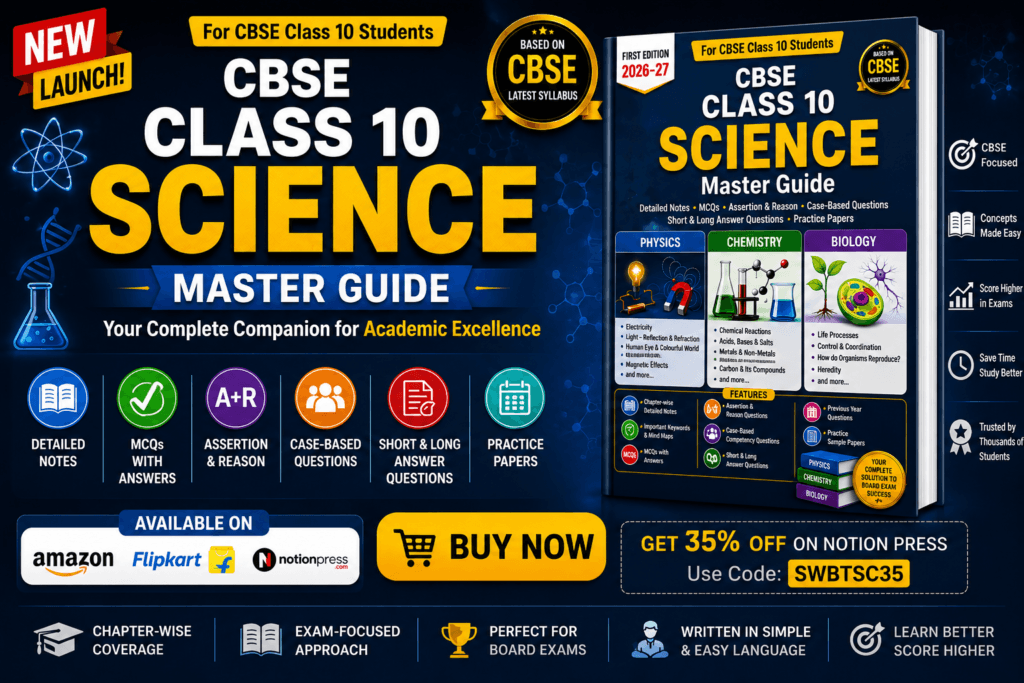
📘 Prepare Smarter with the Complete CBSE Class 10 Science Master Guide
These free notes cover the essential concepts of Control and Coordination. For complete board exam preparation, explore the CBSE Class 10 Science Master Guide by Science World By Tushar Sir.
📖 What’s Inside the Book?
- ✅ Complete chapter-wise theory
- ✅ Easy-to-understand diagrams and flowcharts
- ✅ Mind Maps for quick revision
- ✅ Chapter-wise MCQs
- ✅ Assertion & Reason Questions
- ✅ Case-Based Questions
- ✅ Short & Long Answer Questions
- ✅ Practice Papers
- ✅ Smart Exam Strategies
📚 Available Formats
- 📕 Paperback Edition
- 📱 eBook Edition