Introduction
Reproduction is one of the most important characteristics of living organisms. It is the biological process through which organisms produce new individuals of their own kind, ensuring the continuity of life on Earth. Without reproduction, no species would survive for long.
In this chapter, you will learn how different organisms reproduce through asexual and sexual reproduction, the importance of DNA copying and variation, reproduction in plants, human reproductive systems, fertilization, and reproductive health. These concepts form the foundation of biology and are frequently tested in CBSE examinations.
These Class 10 Science Chapter 7 Notes are written in simple language and follow the latest NCERT syllabus. The notes include easy explanations, important definitions, diagrams, examples, and quick revision points to help you prepare effectively for school and board examinations.
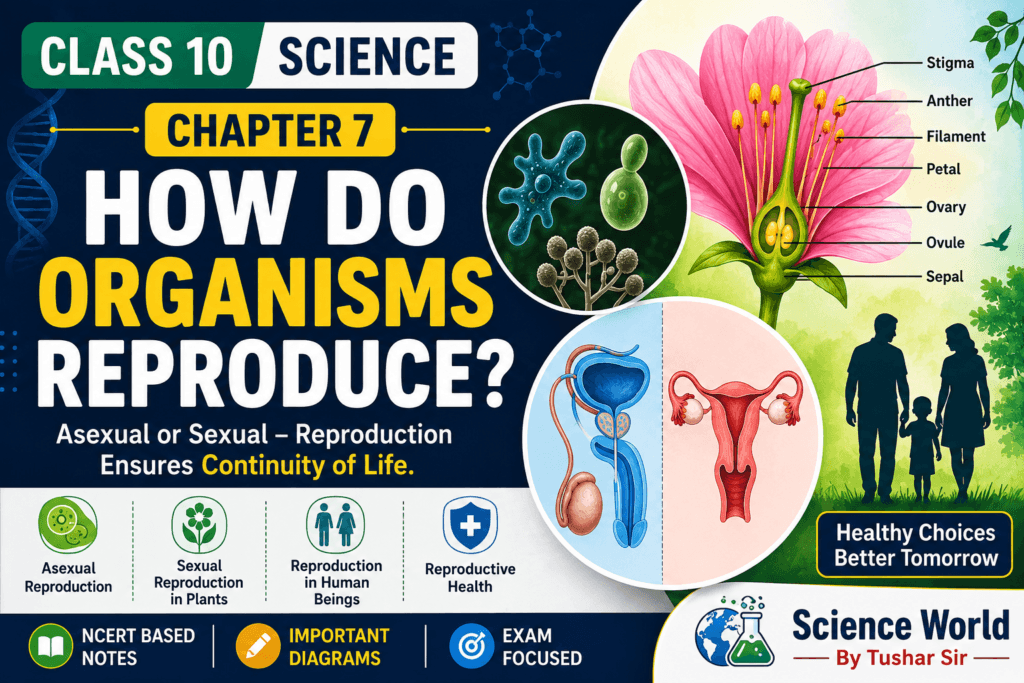
Chapter 7: How Do Organisms Reproduce? – Complete Notes
7.1 What is Reproduction?
Definition
Reproduction is the biological process by which living organisms produce new individuals (offspring) of their own kind. It is one of the most important characteristics of living organisms because it ensures the continuity of a species from one generation to the next.
Although reproduction is essential for the survival of a species, it is not necessary for the survival of an individual organism.
Examples
- A mango tree produces mango seeds that grow into new mango plants.
- A cat gives birth to kittens.
- Bacteria divide to form new bacteria.
Why is Reproduction Important?
Reproduction serves several important functions:
1. Continuity of Species
It prevents the extinction of species by producing new individuals.
2. Transfer of Genetic Information
Parents pass their hereditary information (DNA) to their offspring.
3. Variation
Small genetic variations arise during reproduction. These variations help organisms adapt to changing environmental conditions and play a vital role in evolution.
4. Maintaining Population
Reproduction replaces organisms that die, thereby maintaining the population of a species.
Characteristics of Reproduction
- Produces offspring similar to parents.
- Transfers hereditary characters through DNA.
- Maintains the continuity of life.
- Introduces genetic variation.
- Occurs in both plants and animals.
Life Span vs Reproduction
Different organisms have different life spans.
| Organism | Approximate Life Span |
|---|---|
| Fruit Fly | 1–2 months |
| Dog | 10–15 years |
| Human | 70–80 years |
| Banyan Tree | Hundreds of years |
Regardless of life span, every species must reproduce to continue its existence.
DNA Copying – The Basis of Reproduction
Every living cell contains DNA (Deoxyribonucleic Acid), which stores genetic information.
Before reproduction occurs:
- DNA makes an exact copy of itself.
- The copied DNA is passed to the daughter cells or offspring.
- Occasionally, small errors occur during DNA copying.
- These errors produce variations.
Importance of DNA Copying
- Maintains the characteristics of the species.
- Transfers hereditary traits.
- Creates variations necessary for evolution.
Variation During Reproduction
No two individuals are exactly identical (except identical twins).
Variation occurs because:
- DNA copying is not always perfectly accurate.
- In sexual reproduction, genes from two parents combine.
- Environmental factors also influence characteristics.
Importance of Variation
- Helps organisms adapt to changing environments.
- Increases chances of survival.
- Forms the basis of natural selection and evolution.
Did You Know?
Even brothers and sisters look different because every child receives a unique combination of genes from their parents.
Key Terms
Reproduction: Process of producing offspring.
Offspring: Young one produced by parents.
DNA: Molecule carrying hereditary information.
Variation: Differences among individuals of the same species.
Species: A group of similar organisms capable of reproducing among themselves.
Quick Revision Points
- Reproduction ensures continuity of species.
- DNA carries hereditary information.
- DNA copies itself before reproduction.
- Small DNA copying errors produce variation.
- Variation helps organisms survive and evolve.
- Reproduction may be asexual or sexual.
NCERT Important Question
Why is reproduction important for organisms?
Answer:
Reproduction is important because it ensures the continuity of a species, transfers hereditary information from parents to offspring, maintains population size, and produces variations that help organisms adapt and evolve.
Exam Tip
Remember:
Reproduction → DNA Copying → Variation → Evolution
This sequence is frequently tested in CBSE board examinations and helps in understanding the relationship between reproduction and evolution.
7.2 Modes of Reproduction
Living organisms reproduce by two main methods:
- Asexual Reproduction
- Sexual Reproduction
The method of reproduction depends on the complexity of the organism and its environment.
Asexual Reproduction
Definition
Asexual reproduction is a mode of reproduction in which only one parent is involved in producing offspring. There is no formation or fusion of gametes (sex cells).
The offspring produced are genetically almost identical to the parent and are known as clones.
Characteristics of Asexual Reproduction
- Involves only one parent.
- No male and female gametes are formed.
- Fertilization does not occur.
- Offspring are genetically similar to the parent.
- It is a fast and simple process.
- Common in bacteria, fungi, algae, protozoa, and some plants.
Advantages of Asexual Reproduction
- Requires only one parent.
- Produces a large number of offspring in a short time.
- Saves energy and time.
- Suitable in stable environmental conditions.
- Rapid multiplication of organisms.
Disadvantages of Asexual Reproduction
- Very little genetic variation.
- Poor adaptability to changing environments.
- Diseases can spread quickly through genetically similar individuals.
- Less chance of evolution.
Types of Asexual Reproduction
There are several methods of asexual reproduction.
1. Fission
In this process, the parent organism divides into two or more daughter organisms.
(a) Binary Fission
The parent cell divides into two equal daughter cells.
Examples
- Amoeba
- Paramecium
- Bacteria
Process
- DNA replicates.
- Nucleus divides.
- Cytoplasm divides.
- Two identical daughter cells are formed.
Diagram to Draw in Exam
- Amoeba showing binary fission.
- Bacteria dividing into two cells.
(b) Multiple Fission
The nucleus divides repeatedly before the cytoplasm divides.
Finally, many daughter cells are released simultaneously.
Example
- Plasmodium (malaria parasite)
2. Budding
In budding, a small outgrowth called a bud develops on the parent body.
The bud grows, receives nourishment, and later detaches to become a new individual.
Example
- Hydra
- Yeast
Steps
- Bud formation
- Growth of bud
- Nuclear division
- Separation
- Independent organism
Diagram: Hydra showing a bud.
3. Fragmentation
The body of an organism breaks into several fragments.
Each fragment develops into a complete organism under suitable conditions.
Example
- Spirogyra (green alga)
4. Regeneration
Some organisms can regenerate their entire body from a body part.
Specialized cells divide repeatedly to form missing tissues and organs.
Examples
- Planaria
- Hydra
Important Note
Regeneration is not the same as reproduction in all organisms.
For example:
- A lizard can regenerate its tail.
- The tail alone cannot develop into a complete lizard.
5. Spore Formation
Many fungi reproduce through spores.
Spores are tiny, lightweight reproductive structures enclosed within protective walls.
When favourable conditions return, spores germinate into new organisms.
Examples
- Rhizopus (Bread Mould)
- Mucor
Advantages of Spores
- Survive harsh environmental conditions.
- Easily dispersed by wind.
- Produced in very large numbers.
Diagram: Rhizopus showing sporangium and spores.
6. Vegetative Propagation
In this method, new plants develop from vegetative parts such as roots, stems, or leaves instead of seeds.
Natural Vegetative Propagation
| Plant | Vegetative Part |
|---|---|
| Potato | Stem (Tuber) |
| Ginger | Rhizome |
| Onion | Bulb |
| Bryophyllum | Leaf |
| Sweet Potato | Root |
Artificial Vegetative Propagation
Humans use several methods to produce new plants.
(a) Cutting
Examples:
- Rose
- Sugarcane
- Money Plant
(b) Layering
Example:
- Jasmine
(c) Grafting
Examples:
- Mango
- Citrus
- Rose
(d) Tissue Culture
Small pieces of plant tissue are grown under sterile laboratory conditions to produce many identical plants.
Advantages of Vegetative Propagation
- Rapid multiplication.
- Plants mature quickly.
- Desired characteristics are preserved.
- Seedless plants can be propagated.
- Widely used in agriculture and horticulture.
Disadvantages
- Lack of genetic variation.
- Diseases spread easily.
- Reduced adaptability.
Sexual Reproduction
Definition
Sexual reproduction is the process in which two parents are involved. Male and female gametes fuse during fertilization to form a zygote, which develops into a new organism.
Characteristics
- Two parents are generally involved.
- Gametes are formed.
- Fertilization occurs.
- Offspring inherit characteristics from both parents.
- Produces genetic variation.
- Promotes evolution.
Difference Between Asexual and Sexual Reproduction
| Asexual Reproduction | Sexual Reproduction |
|---|---|
| One parent | Usually two parents |
| No gametes | Gametes formed |
| No fertilization | Fertilization occurs |
| Identical offspring | Variation present |
| Fast process | Comparatively slower |
| Less variation | Greater variation |
Remember This
Asexual Reproduction = One Parent + No Gametes + Identical Offspring
Sexual Reproduction = Two Parents + Gametes + Fertilization + Variation
Key Terms
Clone: Genetically identical offspring.
Binary Fission: Division into two daughter cells.
Budding: Formation of a new individual from a bud.
Fragmentation: Breaking into fragments, each forming a new organism.
Spore: Tiny reproductive structure capable of developing into a new organism.
Vegetative Propagation: Formation of new plants from vegetative parts.
Gamete: Reproductive (sex) cell.
Zygote: Cell formed after fusion of male and female gametes.
Quick Revision
✔ Two modes of reproduction—Asexual and Sexual.
✔ Asexual reproduction involves one parent.
✔ Sexual reproduction involves fusion of gametes.
✔ Binary fission occurs in Amoeba.
✔ Budding occurs in Hydra and Yeast.
✔ Fragmentation occurs in Spirogyra.
✔ Regeneration occurs in Planaria.
✔ Spore formation occurs in Rhizopus.
✔ Vegetative propagation is common in many flowering plants.
Exam Tip
NCERT diagrams that are frequently asked in board exams:
- Binary fission in Amoeba
- Budding in Hydra
- Rhizopus sporangium
- Bryophyllum leaf
- Potato tuber
- Grafting method
Practice labeling these diagrams neatly to score full marks in diagram-based questions.
7.3 Sexual Reproduction in Flowering Plants
Flowering plants reproduce sexually through flowers, which are the reproductive organs of angiosperms. A flower contains both male and female reproductive parts that work together to produce seeds and fruits.
What is a Flower?
A flower is the reproductive structure of a flowering plant. It produces gametes (sex cells) and enables fertilization, leading to the formation of seeds.
Functions of a Flower
- Produces male and female gametes.
- Attracts pollinators such as bees and butterflies.
- Facilitates pollination and fertilization.
- Produces seeds and fruits.
Parts of a Flower
A typical flower consists of four main whorls.
1. Sepals (Calyx)
- Usually green in colour.
- Protect the flower when it is in the bud stage.
- Form the outermost whorl.
2. Petals (Corolla)
- Brightly coloured.
- Attract insects, birds, and other pollinators.
- May produce fragrance and nectar.
3. Stamen (Male Reproductive Part)
The stamen is the male reproductive organ of a flower.
It consists of two parts:
(a) Anther
- Produces pollen grains.
- Contains the male gametes.
(b) Filament
- A slender stalk that supports the anther.
4. Pistil or Carpel (Female Reproductive Part)
The pistil is the female reproductive organ.
It has three parts:
(a) Stigma
- Sticky surface that receives pollen grains.
(b) Style
- A tube connecting the stigma to the ovary.
(c) Ovary
- Contains one or more ovules.
- After fertilization, the ovary develops into a fruit.
Ovule
- Contains the female gamete (egg cell).
- Develops into a seed after fertilization.
Diagram to Practice
Labeled Diagram of a Flower
Include labels for:
- Sepal
- Petal
- Anther
- Filament
- Stigma
- Style
- Ovary
- Ovule
Board Tip: The labeled diagram of a flower is one of the most frequently asked diagrams in Class 10 Science examinations.
Pollination
Definition
Pollination is the transfer of pollen grains from the anther to the stigma of a flower.
It is the first step in sexual reproduction in flowering plants.
Types of Pollination
1. Self-Pollination
In self-pollination, pollen grains are transferred to the stigma of the same flower or another flower on the same plant.
Advantages
- Requires fewer pollen grains.
- Assured seed formation.
- No dependence on pollinators.
Disadvantages
- Produces little genetic variation.
- Less adaptability.
Examples
- Pea
- Wheat
- Rice
2. Cross-Pollination
In cross-pollination, pollen grains are transferred from the flower of one plant to the flower of another plant of the same species.
Agents of Pollination
- Wind
- Water
- Insects
- Birds
- Bats
Advantages
- Produces genetic variation.
- Healthier offspring.
- Better adaptability.
- Promotes evolution.
Disadvantages
- Depends on external agents.
- More pollen grains are wasted.
Examples
- Maize
- Papaya
- Coconut
- Sunflower
Difference Between Self and Cross Pollination
| Self-Pollination | Cross-Pollination |
|---|---|
| Same flower or same plant | Different plants of the same species |
| Less variation | More variation |
| No external agent usually required | External agents required |
| Faster and more certain | Comparatively less certain |
| Limited adaptability | Greater adaptability |
Fertilization
Definition
Fertilization is the fusion of the male gamete and the female gamete to form a zygote.
It takes place inside the ovule.
Process of Fertilization
Step 1
A pollen grain lands on the stigma.
Step 2
The pollen grain germinates and forms a pollen tube.
Step 3
The pollen tube grows through the style towards the ovule.
Step 4
The male gamete travels through the pollen tube.
Step 5
The male gamete fuses with the egg cell.
Step 6
A zygote is formed.
Formation of Seed and Fruit
After fertilization:
- The zygote develops into an embryo.
- The ovule develops into a seed.
- The ovary develops into a fruit.
- The ovary wall forms the fruit wall (pericarp).
Seed Germination
When a seed gets suitable conditions:
- Water
- Oxygen
- Suitable temperature
it begins to grow into a new plant.
The embryo develops into:
- Root (Radicle)
- Shoot (Plumule)
Importance of Fruits
Fruits help in:
- Protecting seeds.
- Seed dispersal.
- Providing nutrition to developing seeds.
- Increasing the chances of survival of the next generation.
Importance of Seeds
Seeds:
- Store food for the embryo.
- Protect the young plant.
- Help plants spread to new places.
- Ensure continuation of plant species.
Key Terms
Pollination: Transfer of pollen grains from anther to stigma.
Self-Pollination: Pollination within the same flower or plant.
Cross-Pollination: Pollination between flowers of different plants of the same species.
Fertilization: Fusion of male and female gametes.
Zygote: The first cell formed after fertilization.
Embryo: Young developing plant inside the seed.
Ovule: Structure containing the egg cell that develops into a seed.
Pericarp: Fruit wall formed from the ovary.
Quick Revision Points
- Flower is the reproductive organ of flowering plants.
- Stamen is the male reproductive part.
- Pistil (carpel) is the female reproductive part.
- Pollination occurs before fertilization.
- Fertilization takes place inside the ovule.
- Ovule develops into a seed.
- Ovary develops into a fruit.
- Cross-pollination produces greater genetic variation.
NCERT Important Questions
1. What is pollination?
Answer: Pollination is the transfer of pollen grains from the anther to the stigma of a flower.
2. Differentiate between self-pollination and cross-pollination.
| Self-Pollination | Cross-Pollination |
|---|---|
| Occurs within the same flower or plant | Occurs between different plants of the same species |
| Less genetic variation | More genetic variation |
| Usually does not require external agents | Requires agents such as wind, water, or insects |
3. What happens after fertilization in a flower?
Answer:
- Zygote develops into an embryo.
- Ovule develops into a seed.
- Ovary develops into a fruit.
- Ovary wall forms the fruit wall (pericarp).
Exam Tip
The following diagrams are very important for CBSE examinations:
- Labeled structure of a flower
- Pollination
- Pollen tube growth
- Fertilization in a flower
- Seed germination
Practice drawing and labeling these diagrams neatly, as diagram-based questions are commonly asked and carry valuable marks.
7.4 Reproduction in Human Beings
Human beings reproduce sexually. Sexual reproduction involves the formation of male and female gametes, their fusion during fertilization, and the development of a new individual.
The human reproductive system becomes functional after puberty, when the body undergoes physical and hormonal changes.
Puberty
Definition
Puberty is the stage of life when the reproductive organs become mature and capable of reproduction. It usually begins during adolescence.
Age of Puberty
- Girls: 10–12 years (approximately)
- Boys: 13–15 years (approximately)
The exact age varies from person to person.
Changes During Puberty
In Boys
- Growth of facial hair (beard and moustache)
- Broadening of shoulders
- Deepening of voice
- Growth of hair in the armpits and pubic region
- Enlargement of testes and penis
- Production of sperm begins
In Girls
- Development of breasts
- Widening of hips
- Growth of hair in the armpits and pubic region
- Maturation of ovaries
- Menstruation begins
- Egg production starts
Hormones Responsible for Puberty
Hormones are chemical messengers produced by endocrine glands.
In Boys
- Testosterone
- Produced by the testes
- Controls male secondary sexual characteristics.
In Girls
- Oestrogen (Estrogen)
- Produced by the ovaries
- Controls female secondary sexual characteristics.
Human Male Reproductive System
The male reproductive system produces sperms and transports them into the female reproductive tract.
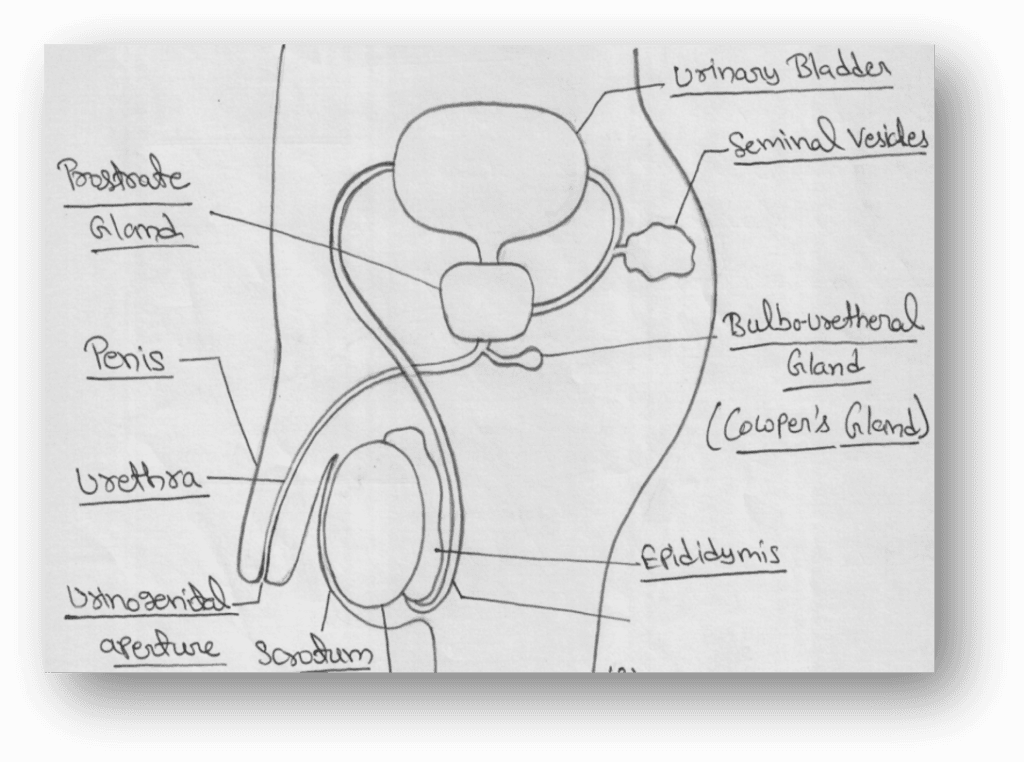
Main Parts
1. Testes
- A pair of reproductive organs.
- Produce sperms.
- Secrete testosterone.
2. Scrotum
- A pouch of skin that holds the testes outside the body.
- Maintains a temperature about 2–3°C lower than body temperature, which is necessary for sperm production.
3. Epididymis
- Stores and allows sperms to mature.
4. Vas Deferens (Sperm Duct)
- Carries sperms from the epididymis to the urethra.
5. Seminal Vesicles
- Produce nutrient-rich fluid.
- This fluid provides energy to sperms.
6. Prostate Gland
- Adds alkaline fluid to semen.
- Helps protect sperms and improves their movement.
7. Urethra
- Common passage for urine and semen.
- Urine and semen do not pass simultaneously.
8. Penis
- Male copulatory organ.
- Transfers semen into the female reproductive tract.
Diagram to Practice
Draw and label the Human Male Reproductive System.
Include:
- Testis
- Scrotum
- Epididymis
- Vas deferens
- Seminal vesicle
- Prostate gland
- Urethra
- Penis
Board Tip: This is one of the most frequently asked diagrams in CBSE examinations.
Human Female Reproductive System
The female reproductive system produces eggs (ova), receives sperms, supports fertilization, and provides nourishment to the developing baby.
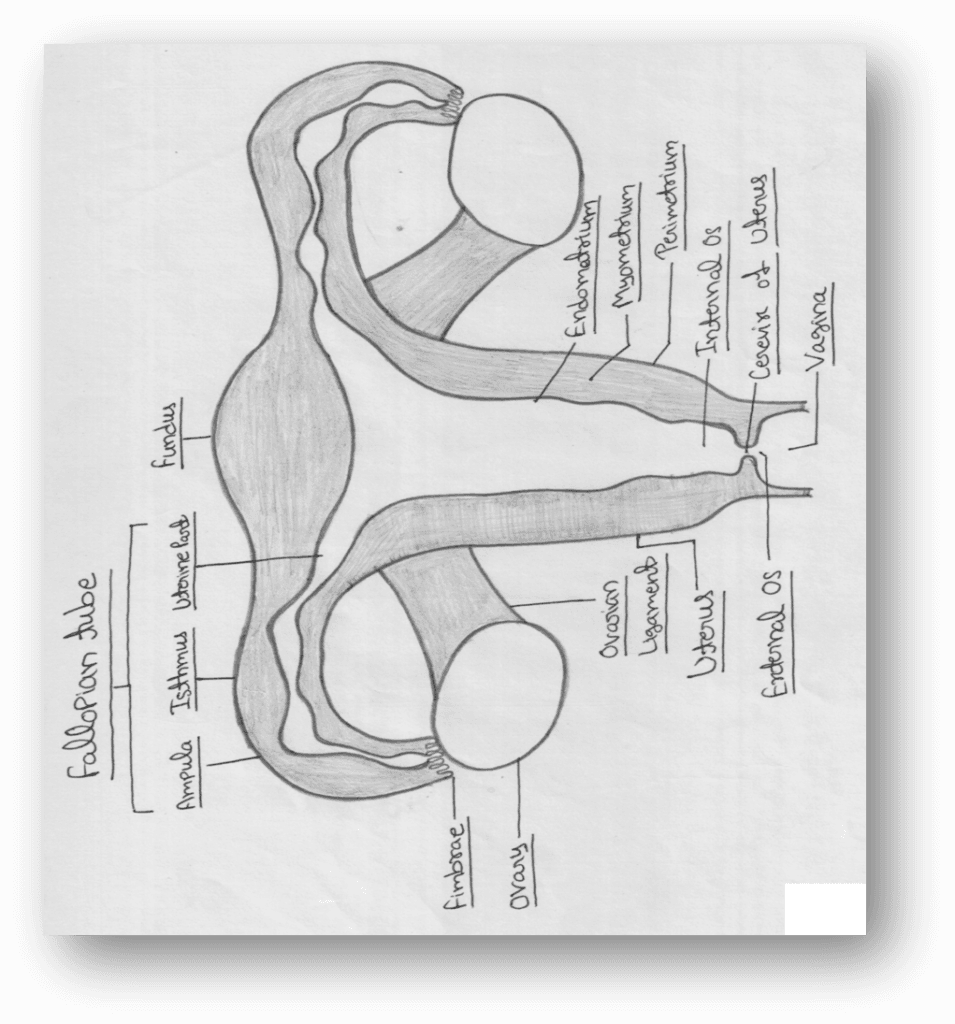
Main Parts
1. Ovaries
- A pair of female reproductive organs.
- Produce eggs (ova).
- Secrete oestrogen and progesterone.
2. Fallopian Tubes (Oviducts)
- Carry the egg from the ovary to the uterus.
- Fertilization usually occurs here.
3. Uterus (Womb)
- A muscular organ where the embryo develops into a baby.
4. Cervix
- Narrow opening of the uterus.
- Connects the uterus to the vagina.
5. Vagina
- Receives sperms during reproduction.
- Acts as the birth canal during childbirth.
Diagram to Practice
Draw and label the Human Female Reproductive System.
Include:
- Ovary
- Fallopian tube
- Uterus
- Cervix
- Vagina
Formation of Gametes
Male Gamete
- Sperm
- Produced continuously in the testes after puberty.
- Very small and motile.
- Has a head, middle piece, and tail.
Female Gamete
- Ovum (Egg)
- Produced in the ovaries.
- Usually one egg matures during each menstrual cycle.
Fertilization in Humans
Definition
Fertilization is the fusion of a sperm and an ovum to form a zygote.
Site of Fertilization
Fallopian tube (Oviduct)
Steps of Fertilization
- Sperm enters the female reproductive tract.
- Sperms travel through the uterus to the fallopian tube.
- One sperm fuses with the ovum.
- A zygote is formed.
- The zygote begins repeated cell divisions.
- It develops into an embryo.
Implantation
The developing embryo moves to the uterus and attaches itself to the thick uterine lining.
This process is called implantation.
After implantation:
- The embryo receives nourishment from the mother.
- Further development takes place in the uterus.
Placenta
Definition
The placenta is a temporary organ that develops inside the uterus during pregnancy.
It connects the mother and the developing foetus.
Functions of Placenta
- Supplies oxygen to the foetus.
- Provides nutrients.
- Removes carbon dioxide.
- Removes waste products.
- Produces hormones required for pregnancy.
Development of the Foetus
- Zygote → Embryo → Foetus → Baby
The developing baby remains inside the uterus for approximately nine months before birth.
Menstruation
If fertilization does not occur:
- The egg degenerates.
- The thick uterine lining breaks down.
- Blood and tissue are discharged through the vagina.
This process is called menstruation.
Menstrual Cycle
- Average duration: 28 days
- Menstrual bleeding usually lasts 3–7 days.
Menstruation is a natural biological process and an important indicator of reproductive health.
Difference Between Sperm and Ovum
| Sperm | Ovum |
|---|---|
| Male gamete | Female gamete |
| Produced in testes | Produced in ovaries |
| Small and motile | Large and non-motile |
| Produced in millions | Usually one released per cycle |
Key Terms
Puberty: Stage when reproductive organs become mature.
Testosterone: Male sex hormone.
Oestrogen: Female sex hormone.
Sperm: Male reproductive cell.
Ovum: Female reproductive cell.
Fertilization: Fusion of sperm and ovum.
Zygote: First cell formed after fertilization.
Embryo: Early stage of development.
Foetus: Developing baby after the embryonic stage.
Placenta: Organ connecting the mother and foetus.
Implantation: Attachment of the embryo to the uterine wall.
Quick Revision Points
- Humans reproduce sexually.
- Testes produce sperms and testosterone.
- Ovaries produce eggs and female hormones.
- Fertilization occurs in the fallopian tube.
- Implantation occurs in the uterus.
- Placenta nourishes the developing foetus.
- Pregnancy lasts about nine months.
- Menstruation occurs when fertilization does not take place.
NCERT Important Questions
1. Where does fertilization occur in human beings?
Answer: Fertilization normally occurs in the fallopian tube (oviduct).
2. What are the functions of the placenta?
Answer:
- Supplies oxygen and nutrients to the foetus.
- Removes carbon dioxide and waste products.
- Produces hormones necessary for pregnancy.
- Connects the mother with the developing foetus.
3. Differentiate between sperm and ovum.
| Sperm | Ovum |
|---|---|
| Male gamete | Female gamete |
| Motile | Non-motile |
| Produced in testes | Produced in ovaries |
| Small in size | Larger in size |
Exam Tip
The following diagrams are very important for CBSE board examinations:
- Human Male Reproductive System
- Human Female Reproductive System
- Structure of Sperm
- Fertilization in Humans
- Placenta and Foetus in the Uterus
Practice neat, well-labeled diagrams to score full marks in biology diagram-based questions.
7.5 Reproductive Health
Reproductive health refers to the physical, mental, emotional, and social well-being related to the reproductive system. It involves maintaining healthy reproductive organs, making informed decisions, and preventing reproductive diseases.
Good reproductive health helps individuals lead a healthy and responsible life.
Importance of Reproductive Health
Maintaining reproductive health is important because it:
- Promotes healthy growth and development.
- Prevents reproductive disorders.
- Helps prevent unwanted pregnancies.
- Reduces the spread of sexually transmitted infections (STIs).
- Ensures the birth of healthy babies.
- Encourages responsible parenthood.
Family Planning
Definition
Family planning is the practice of planning the number of children and the spacing between their births according to the family’s health, resources, and circumstances.
Objectives of Family Planning
- Prevent unwanted pregnancies.
- Maintain the health of the mother and child.
- Improve the quality of life of the family.
- Support population stabilization.
- Ensure proper care and education of children.
Contraception
Definition
Contraception is the use of methods or devices to prevent pregnancy.
The methods of contraception help prevent fertilization or implantation.
Methods of Contraception
1. Barrier Methods
These methods prevent the sperm from reaching the ovum.
Examples
- Male condom
- Female condom
- Diaphragm
Advantages
- Easy to use.
- Help prevent unwanted pregnancy.
- Condoms also help reduce the risk of many sexually transmitted infections (STIs).
2. Hormonal Methods
Hormonal contraceptives contain hormones that prevent ovulation.
Examples
- Oral contraceptive pills
- Hormonal injections
- Hormonal implants
Note: These methods should be used under proper medical guidance.
3. Intrauterine Devices (IUDs)
These are small devices placed inside the uterus by a trained healthcare professional.
Examples
- Copper-T (Cu-T)
- Hormonal IUD
They reduce the chances of fertilization and pregnancy.
4. Surgical Methods
These are permanent methods of contraception.
Vasectomy
- Performed in males.
- The vas deferens is cut and tied.
- Sperms cannot mix with semen.
Tubectomy
- Performed in females.
- The fallopian tubes are cut and tied.
- Prevents the egg and sperm from meeting.
Comparison of Contraceptive Methods
| Method | Example | Main Function |
|---|---|---|
| Barrier | Condom | Prevents sperm from reaching the egg |
| Hormonal | Oral pills | Prevents ovulation |
| IUD | Copper-T | Reduces chances of fertilization |
| Surgical | Vasectomy, Tubectomy | Permanent prevention of pregnancy |
Sexually Transmitted Infections (STIs)
Definition
Sexually Transmitted Infections (STIs) are infections that are mainly spread through sexual contact. Some infections may also spread through infected blood, contaminated needles, or from an infected mother to her baby during pregnancy or childbirth.
Common Examples
- HIV infection (which can lead to AIDS if untreated)
- Gonorrhoea
- Syphilis
- Hepatitis B
Symptoms of STIs
Symptoms vary depending on the infection and some people may have no symptoms. Possible signs include:
- Pain or burning during urination
- Unusual discharge from the reproductive organs
- Sores or ulcers in the genital area
- Itching or irritation
- Fever (in some infections)
Anyone with symptoms or concerns should consult a qualified healthcare professional.
Prevention of STIs
The risk of STIs can be reduced by:
- Practising safe and responsible behaviour.
- Using condoms correctly and consistently.
- Avoiding sharing needles or syringes.
- Ensuring blood transfusions are screened.
- Seeking timely medical advice, testing, and treatment when needed.
- Taking recommended vaccinations, such as the Hepatitis B vaccine.
HIV and AIDS
HIV
Human Immunodeficiency Virus (HIV) attacks the body’s immune system, making it harder to fight infections.
AIDS
Acquired Immunodeficiency Syndrome (AIDS) is the advanced stage of HIV infection if it is not treated. Modern medicines can help people with HIV live long and healthy lives by controlling the virus.
HIV is Not Spread By
- Handshakes
- Hugging
- Sharing food or utensils
- Mosquito bites
- Casual contact
Understanding these facts helps prevent stigma and discrimination.
Responsible Behaviour During Adolescence
Adolescence is a period of rapid physical, emotional, and social changes. Responsible behaviour includes:
- Maintaining personal hygiene.
- Eating a balanced diet.
- Exercising regularly.
- Respecting oneself and others.
- Seeking accurate health information from trusted sources.
- Discussing concerns with parents, teachers, or healthcare professionals.
Key Terms
Reproductive Health: Overall well-being related to the reproductive system.
Family Planning: Planning the number and spacing of children.
Contraception: Methods used to prevent pregnancy.
Barrier Method: Method that blocks sperm from reaching the egg.
Hormonal Method: Method that uses hormones to prevent ovulation.
IUD: Intrauterine device placed inside the uterus to prevent pregnancy.
Vasectomy: Permanent contraceptive surgery for males.
Tubectomy: Permanent contraceptive surgery for females.
STI: Sexually transmitted infection.
HIV: Human Immunodeficiency Virus.
AIDS: Acquired Immunodeficiency Syndrome.
Quick Revision Points
- Reproductive health is important for overall well-being.
- Family planning helps improve the health of families.
- Contraceptive methods help prevent unwanted pregnancies.
- Condoms help reduce the risk of many STIs.
- HIV attacks the immune system.
- HIV is not spread by casual contact such as hugging or sharing food.
- Good hygiene, awareness, and timely medical care support reproductive health.
NCERT Important Questions
1. What is contraception?
Answer: Contraception is the use of methods or devices to prevent pregnancy by preventing fertilization or implantation.
2. Name four methods of contraception.
Answer:
- Barrier methods (e.g., condoms)
- Hormonal methods (e.g., oral contraceptive pills)
- Intrauterine devices (e.g., Copper-T)
- Surgical methods (vasectomy and tubectomy)
3. Why is reproductive health important?
Answer:
- Prevents reproductive diseases.
- Helps prevent unwanted pregnancies.
- Reduces the spread of STIs.
- Promotes healthy families and responsible parenthood.
- Supports overall physical and mental well-being.
Chapter Summary
- Reproduction ensures the continuity of life.
- Organisms reproduce by asexual or sexual methods.
- Flowers are the reproductive organs of flowering plants.
- Pollination is followed by fertilization, leading to seed and fruit formation.
- Humans reproduce sexually through specialized reproductive systems.
- Fertilization occurs in the fallopian tube, and the embryo develops in the uterus.
- Reproductive health includes awareness, hygiene, family planning, and prevention of infections.
- Scientific knowledge and responsible decisions contribute to a healthy life.
Exam Tip
Most Important Topics for CBSE Board Exams
⭐ Difference between asexual and sexual reproduction.
⭐ Binary fission, budding, spore formation, and vegetative propagation.
⭐ Structure of a flower and pollination.
⭐ Human male and female reproductive systems (labeled diagrams).
⭐ Fertilization, implantation, placenta, and menstruation.
⭐ Methods of contraception and reproductive health.
Practice all labeled diagrams and revise the definitions and differences, as these are frequently asked in board examinations.
Chapter 7 Revision Notes (Quick Recap)
One-Minute Revision
- Reproduction is the biological process of producing offspring.
- Reproduction ensures the continuity of a species.
- DNA copying transfers hereditary information and creates variation.
- Reproduction is of two types: Asexual and Sexual.
- Binary fission occurs in Amoeba.
- Budding occurs in Hydra and Yeast.
- Fragmentation occurs in Spirogyra.
- Spore formation occurs in Rhizopus.
- Vegetative propagation occurs through roots, stems, and leaves.
- Flowers are the reproductive organs of flowering plants.
- Pollination is the transfer of pollen from anther to stigma.
- Fertilization is the fusion of male and female gametes.
- Ovule develops into a seed.
- Ovary develops into a fruit.
- Human reproduction is sexual reproduction.
- Fertilization takes place in the fallopian tube.
- Implantation occurs in the uterus.
- Placenta supplies food and oxygen to the developing foetus.
- Menstruation occurs if fertilization does not take place.
- Contraceptive methods help prevent unwanted pregnancy.
- Condoms also help reduce the risk of many STIs.
Important Definitions
Reproduction
The biological process by which organisms produce offspring of their own kind.
Asexual Reproduction
Reproduction involving only one parent without the fusion of gametes.
Sexual Reproduction
Reproduction involving the fusion of male and female gametes.
Pollination
Transfer of pollen grains from the anther to the stigma of a flower.
Fertilization
Fusion of the male and female gametes to form a zygote.
Zygote
The first cell formed after fertilization.
Embryo
The early developing stage of a new organism.
Placenta
A temporary organ that supplies nutrients and oxygen to the developing foetus.
Contraception
Methods used to prevent pregnancy.
Important Differences
Asexual Reproduction vs Sexual Reproduction
| Asexual Reproduction | Sexual Reproduction |
|---|---|
| One parent | Usually two parents |
| No gametes | Gametes formed |
| No fertilization | Fertilization occurs |
| Identical offspring | Variation present |
| Fast process | Slower process |
Self-Pollination vs Cross-Pollination
| Self-Pollination | Cross-Pollination |
|---|---|
| Same flower or same plant | Different plants of the same species |
| Less variation | More variation |
| Usually no external agent | External agents required |
Sperm vs Ovum
| Sperm | Ovum |
|---|---|
| Male gamete | Female gamete |
| Small and motile | Large and non-motile |
| Produced in testes | Produced in ovaries |
Important NCERT Diagrams
Practice drawing and labeling the following diagrams:
- Binary Fission in Amoeba
- Budding in Hydra
- Rhizopus Showing Spore Formation
- Vegetative Propagation in Bryophyllum
- Structure of a Flower
- Human Male Reproductive System
- Human Female Reproductive System
- Germinating Pollen Grain
- Placenta and Foetus
Frequently Asked Questions (FAQs)
Q1. What are the two modes of reproduction?
Answer: Asexual reproduction and sexual reproduction.
Q2. What is the importance of variation?
Answer: Variation helps organisms adapt to changing environmental conditions and plays an important role in evolution.
Q3. Where does fertilization occur in humans?
Answer: Fertilization normally occurs in the fallopian tube (oviduct).
Q4. What is the function of the placenta?
Answer: The placenta supplies nutrients and oxygen to the developing foetus and removes waste products.
Q5. Which reproductive part of a flower develops into a fruit?
Answer: The ovary develops into the fruit after fertilization.
Common Exam Mistakes to Avoid
❌ Confusing pollination with fertilization.
❌ Writing ovary becomes seed (Correct: Ovule → Seed, Ovary → Fruit).
❌ Confusing binary fission with budding.
❌ Forgetting to label diagrams correctly.
❌ Mixing up the site of fertilization (Fallopian tube) and implantation (Uterus).
Memory Tricks
Modes of Reproduction
A → Alone → Asexual
(Asexual reproduction involves one parent.)
Flower Parts
S P S P
Sepal → Petal → Stamen → Pistil
After Fertilization
Z → E → Seed → Fruit
- Zygote → Embryo
- Ovule → Seed
- Ovary → Fruit
Chapter Completion
🎉 Congratulations! You have completed Chapter 7 – How Do Organisms Reproduce?
Make sure to revise the diagrams, definitions, and differences before attempting the exercise questions and board examination.
📘 Prepare Smarter with the Complete CBSE Class 10 Science Master Guide
These free notes cover the essential concepts of Control and Coordination. For complete board exam preparation, explore the CBSE Class 10 Science Master Guide by Science World By Tushar Sir.
📖 What’s Inside the Book?
✅ Complete chapter-wise theory
✅ Easy-to-understand diagrams and flowcharts
✅ Mind Maps for quick revision
✅ Chapter-wise MCQs
✅ Assertion & Reason Questions
✅ Case-Based Questions
✅ Short & Long Answer Questions
✅ Practice Papers
✅ Smart Exam Strategies

📚 Available Formats
- 📕 Paperback Edition
- 📱 eBook Edition