Introduction
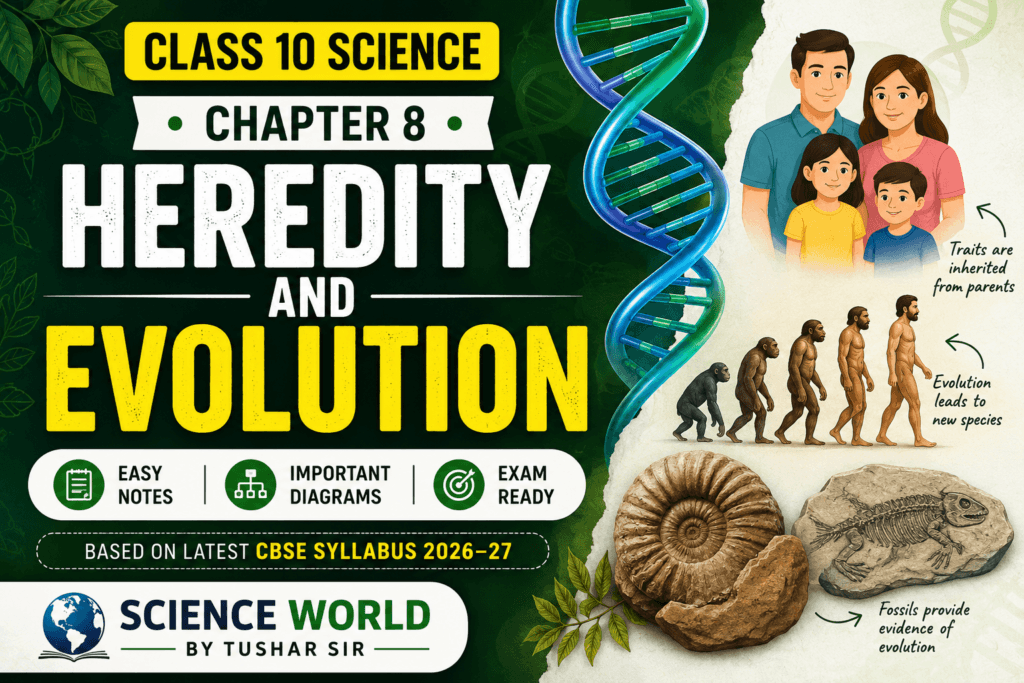
Heredity and Evolution Class 10 Notes – Life on Earth shows an incredible variety of organisms, yet many living beings share common characteristics. Have you ever wondered why children resemble their parents or why different species have changed over millions of years? The answers lie in heredity and evolution.
Heredity is the process by which characteristics or traits are passed from parents to their offspring through genes. These inherited traits determine many features such as eye colour, hair type, blood group, and height.
Evolution is the gradual process of change in living organisms over many generations. Small variations accumulate over time, leading to the formation of new species. Evolution explains the diversity of life found on Earth today.
This chapter helps students understand how traits are inherited, why variations occur, how new species arise, and the scientific evidence supporting evolution. It also introduces important scientists like Gregor Mendel, whose experiments laid the foundation of modern genetics.
Learning Objectives
After studying this chapter, you will be able to:
- Understand the meaning of heredity and evolution.
- Differentiate between inherited and acquired traits.
- Explain Mendel’s experiments on inheritance.
- Understand dominant and recessive traits.
- Learn the role of genes and chromosomes.
- Explain sex determination in humans.
- Understand the causes of variation.
- Explain natural selection and evolution.
- Describe the process of speciation.
- Identify evidence supporting evolution.
What is Heredity?
Heredity is the transmission of characteristics from parents to offspring through genes.
Every organism inherits certain features from its parents. These inherited features are called traits.
Examples of Inherited Traits
| Trait | Example |
|---|---|
| Eye Colour | Brown, Blue, Black |
| Hair Type | Straight, Curly |
| Blood Group | A, B, AB, O |
| Earlobe | Free or Attached |
| Ability to Roll Tongue | Present or Absent |
Exam Tip: Remember that heredity deals only with inherited characteristics, not learned habits. (Heredity and Evolution Class 10 Notes)
What is Variation?
Variation refers to the differences in characteristics among individuals of the same species.
No two individuals are exactly alike, even identical twins show slight differences.
Examples
- Height differs among students.
- Skin colour varies.
- Fingerprints are unique.
- Voice differs from person to person.
Variation is important because it helps organisms survive when environmental conditions change.
Importance of Variation
Variation provides several advantages:
- Helps organisms adapt to changing environments.
- Increases chances of survival.
- Forms the basis of natural selection.
- Leads to evolution of new species.
Without variation, all organisms would be identical, making survival difficult during environmental changes.
Types of Traits
1. Inherited Traits
Inherited traits are passed from parents to offspring through genes.
Examples:
- Eye colour
- Blood group
- Hair colour
2. Acquired Traits
Acquired traits develop during an individual’s lifetime due to environmental influences or personal experiences.
Examples:
- Muscular body due to exercise
- Knowledge gained through education
- Scars from injuries
Acquired traits are not inherited by offspring.
Difference Between Inherited and Acquired Traits
| Inherited Traits | Acquired Traits |
|---|---|
| Passed from parents | Not passed to offspring |
| Controlled by genes | Caused by environment |
| Present from birth | Develop during life |
| Permanent | May change over time |
Mendel’s Experiments and Laws of Inheritance
Gregor Mendel is known as the Father of Genetics because he was the first scientist to explain scientifically how traits are inherited from one generation to the next.
Through carefully planned experiments on pea plants, Mendel discovered the basic principles of heredity that are still accepted today.
Gregor Johann Mendel (1822–1884) was an Austrian monk and scientist. He conducted experiments on garden pea plants (Pisum sativum) between 1856 and 1863 and established the fundamental laws of inheritance.
His work became the foundation of modern genetics.
Why Did Mendel Choose Pea Plants?
Mendel selected pea plants because they possessed several advantages for genetic studies.
Reasons
- Pea plants are easy to grow.
- They have a short life cycle.
- They produce many seeds.
- They show clear contrasting characters.
- Self-pollination naturally occurs.
- Cross-pollination can be performed easily.
These features made pea plants ideal for studying inheritance.
Contrasting Characters Studied by Mendel
| Character | Dominant Trait | Recessive Trait |
|---|---|---|
| Plant Height | Tall | Dwarf |
| Seed Shape | Round | Wrinkled |
| Seed Colour | Yellow | Green |
| Flower Colour | Violet (Purple) | White |
| Pod Shape | Inflated | Constricted |
| Pod Colour | Green | Yellow |
| Flower Position | Axial | Terminal |
Remember: Mendel studied seven pairs of contrasting characters.
Important Terms
Trait
A characteristic feature of an organism.
Example:
- Tallness
- Flower colour
- Seed shape
Gene
A gene is the basic unit of heredity. It carries genetic information from parents to offspring.
Genes are located on chromosomes inside the nucleus of cells.
Alleles
Different forms of the same gene are called alleles.
Example:
- Tall (T)
- Dwarf (t)
These two forms control the same character (plant height).
Dominant Trait
A trait that appears even when only one dominant allele is present.
Example:
Tall (T) is dominant over Dwarf (t).
Recessive Trait
A trait that appears only when both alleles are recessive.
Example:
tt = Dwarf plant
Difference Between Dominant and Recessive Traits
| Dominant Trait | Recessive Trait |
|---|---|
| Expressed in TT and Tt | Expressed only in tt |
| Masks recessive trait | Hidden in presence of dominant allele |
| Represented by capital letter | Represented by small letter |
Mendel’s Monohybrid Cross
A monohybrid cross is a cross involving one pair of contrasting characters.
Example
Tall Plant × Dwarf Plant
Mendel’s First Law
Law of Dominance
This law states that when two contrasting traits are present together, only the dominant trait is expressed, while the recessive trait remains hidden.
Example: Tall (T) dominates over Dwarf (t).
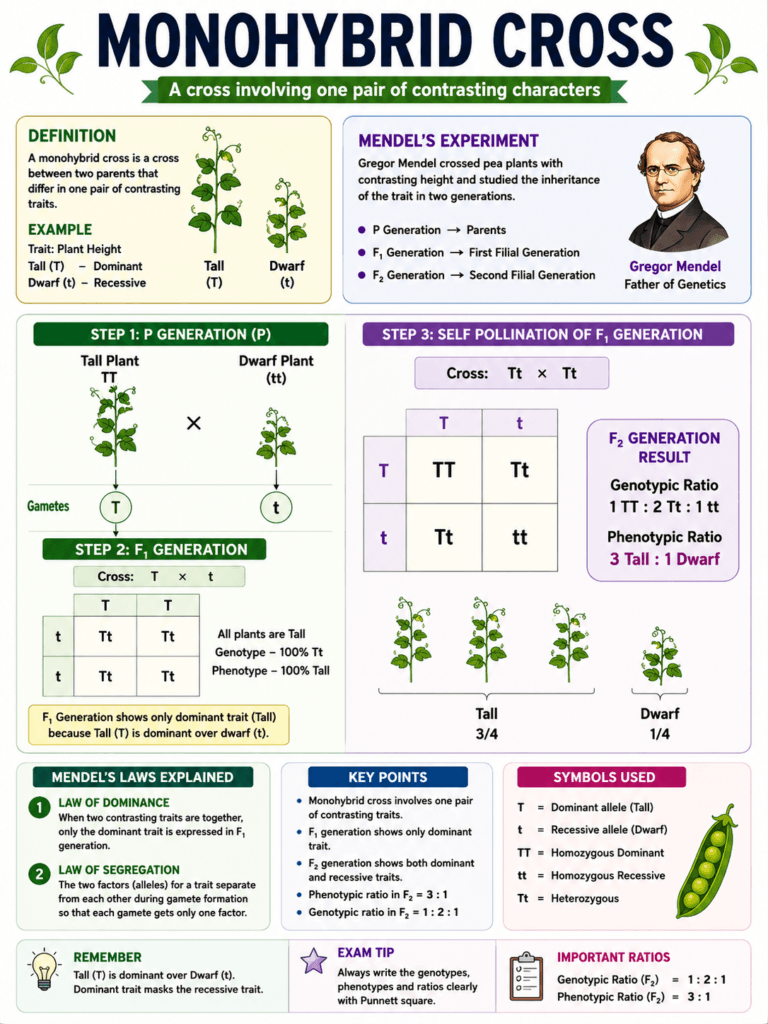
Mendel’s Second Law
Law of Segregation
During gamete formation, the two alleles of a gene separate so that each gamete receives only one allele.
This ensures that offspring inherit one allele from each parent.
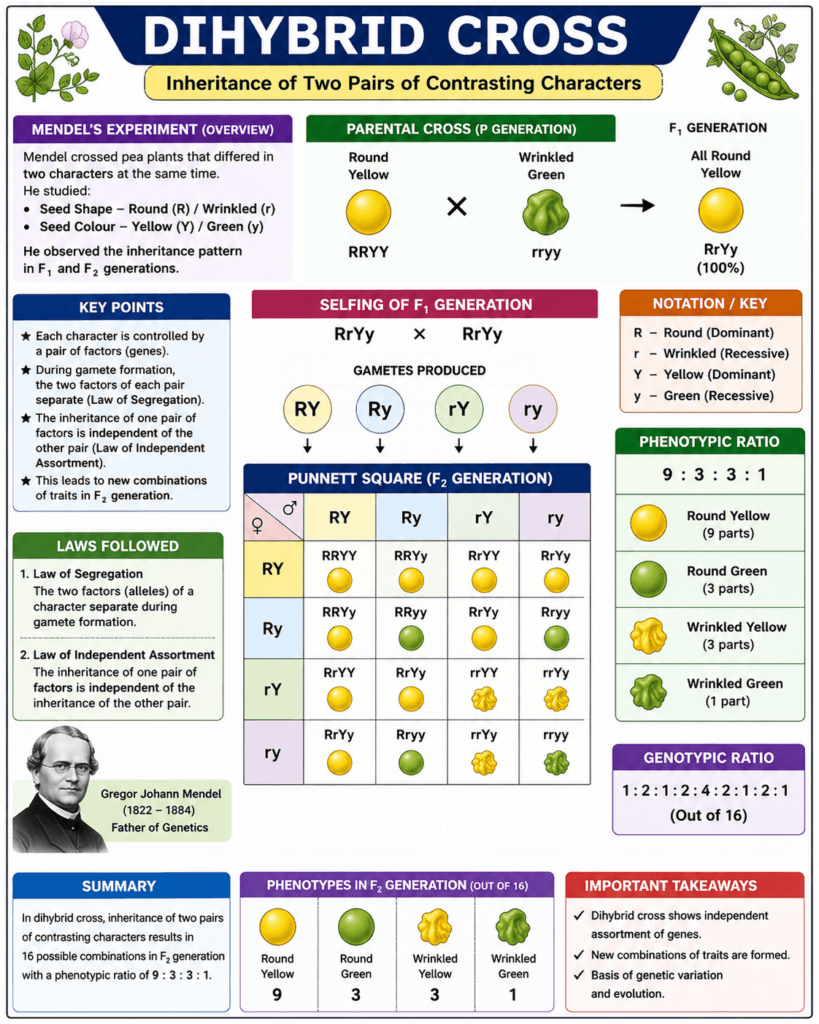
Dihybrid Cross (Overview)
A dihybrid cross studies the inheritance of two contrasting characters simultaneously.
Example:
- Seed Shape
- Seed Colour
Mendel observed the famous 9 : 3 : 3 : 1 phenotypic ratio in the F₂ generation.
DNA (Deoxyribonucleic Acid) is the hereditary material present in almost all living organisms.
DNA stores genetic information and passes it from parents to offspring. It also provides the instructions needed for growth, development, and the functioning of cells.
Functions of DNA
- Stores genetic information.
- Controls inherited characteristics.
- Directs the synthesis of proteins.
- Transfers hereditary information to the next generation.
Fact: Every human body cell contains about 2 metres of DNA, tightly packed inside the nucleus.
What is a Gene?
A gene is the basic unit of heredity.
Genes are small segments of DNA that contain instructions for specific traits.
Examples
- Gene for eye colour
- Gene for blood group
- Gene influencing hair texture
Each person inherits one copy of a gene from the mother and one from the father.
What are Chromosomes?
Chromosomes are thread-like structures found inside the nucleus of every cell.
They are made of DNA and proteins and contain thousands of genes.
Functions of Chromosomes
- Carry genes.
- Transfer hereditary information.
- Ensure proper distribution of genetic material during cell division.
Number of Chromosomes in Humans
| Cell Type | Number of Chromosomes |
|---|---|
| Body Cells (Somatic Cells) | 46 (23 pairs) |
| Gametes (Sperm/Egg) | 23 |
During fertilization:
- Sperm contributes 23 chromosomes.
- Egg contributes 23 chromosomes.
The fertilized egg (zygote) therefore contains 46 chromosomes.
Remember: Genes are segments of DNA, and DNA is packed into chromosomes.
What are Gametes?
Gametes are reproductive cells that participate in sexual reproduction.
Male Gamete
Sperm
Female Gamete
Egg (Ovum)
Gametes contain half the number of chromosomes compared to body cells.
This ensures that the chromosome number remains constant after fertilization.
How are Traits Inherited?
Each parent contributes one set of chromosomes to the offspring.
As a result:
- Children resemble both parents.
- Some traits may resemble grandparents.
- Every individual is genetically unique due to different combinations of genes.
Variation During Reproduction
Although offspring resemble their parents, they are not identical.
Variation occurs because:
- Genes from both parents combine in new ways.
- Crossing over and recombination occur during gamete formation.
- Random fertilization produces different gene combinations.
Variation increases the chances of survival in changing environments.
Importance of Variation
Variation helps organisms to:
- Adapt to environmental changes.
- Resist diseases.
- Improve survival.
- Form the basis of evolution.
Without variation, all members of a species would be nearly identical, making them more vulnerable to environmental changes.
Sex Determination in Humans
One of the most important applications of genetics is understanding how the sex of a child is determined.
Humans have 23 pairs of chromosomes.
Among these:
- 22 pairs are autosomes.
- 1 pair consists of sex chromosomes.
Sex Chromosomes
| Gender | Sex Chromosomes |
|---|---|
| Female | XX |
| Male | XY |
Formation of Gametes
Female
All eggs carry:
X chromosome
Male
Sperms are of two types:
- X chromosome
- Y chromosome
Probability of Child’s Sex
| Combination | Child |
|---|---|
| XX | Girl |
| XY | Boy |
Probability
- Girl = 50%
- Boy = 50%
Important: The father determines the biological sex of the child because only the sperm contributes either an X or a Y chromosome.
Common Misconception
It is scientifically incorrect to blame the mother for the sex of a child.
The mother’s egg always contributes an X chromosome. The father’s sperm contributes either X or Y, determining whether the child is XX (girl) or XY (boy).
Chapter Summary
Heredity and Evolution explains how characteristics are passed from parents to offspring and how living organisms have changed over millions of years. Heredity is the transmission of inherited traits through genes, while evolution is the gradual process by which species change and diversify over time.
Gregor Mendel, known as the Father of Genetics, discovered the basic laws of inheritance through experiments on pea plants. His work showed that traits are controlled by genes and can be dominant or recessive. During reproduction, offspring inherit one set of genes from each parent, leading to similarities as well as variations.
DNA (Deoxyribonucleic Acid) is the hereditary material that carries genetic information. Genes, which are segments of DNA, are located on chromosomes inside the nucleus of cells. Human body cells contain 46 chromosomes (23 pairs), while gametes (sperm and egg) contain 23 chromosomes each.
Variation is the difference in characteristics among individuals of the same species. It arises due to genetic recombination and mutations during reproduction. Variations increase the chances of survival in changing environments and form the basis of evolution.
In humans, sex determination depends on the combination of sex chromosomes. Females have XX chromosomes, while males have XY chromosomes. The mother’s egg always contributes an X chromosome, whereas the father’s sperm contributes either an X or a Y chromosome, determining whether the child is a girl (XX) or a boy (XY).
Evolution occurs through the gradual accumulation of favourable variations over many generations. According to Charles Darwin’s theory of natural selection, organisms with beneficial traits are more likely to survive and reproduce. Over long periods, these changes can lead to the formation of new species, a process known as speciation.
Scientists use various types of evidence to support the theory of evolution, including fossils, homologous organs, analogous organs, and comparative anatomy. Fossils reveal the history of extinct organisms, while homologous organs indicate common ancestry. Analogous organs demonstrate how different organisms can independently evolve similar adaptations for similar functions.
Frequently Asked Questions (FAQs)
1. What is heredity in Class 10 Science?
Heredity is the process by which traits or characteristics are passed from parents to their offspring through genes. It explains why children resemble their parents.
2. What is variation?
Variation refers to the differences in characteristics among individuals of the same species. These differences help organisms adapt to changing environments and play an important role in evolution.
3. Who is known as the Father of Genetics?
Gregor Johann Mendel is known as the Father of Genetics because his experiments on pea plants established the basic laws of inheritance.
4. Why did Mendel choose pea plants for his experiments?
Mendel selected pea plants because they:
- Have clear contrasting traits
- Are easy to grow
- Have a short life cycle
- Produce many seeds
- Can self-pollinate as well as cross-pollinate
5. What is the difference between dominant and recessive traits?
A dominant trait is expressed even if only one dominant allele is present, whereas a recessive trait is expressed only when both alleles are recessive.
6. What is a gene?
A gene is the basic unit of heredity. It is a segment of DNA that carries information for specific inherited traits.
7. What is DNA?
DNA (Deoxyribonucleic Acid) is the hereditary material present in living organisms. It stores genetic information and controls the inheritance of traits.
8. How many chromosomes are present in human body cells?
Human body (somatic) cells contain 46 chromosomes, arranged in 23 pairs. Human gametes (sperm and egg) contain 23 chromosomes.
9. How is the sex of a child determined?
The mother’s egg always carries an X chromosome, while the father’s sperm carries either an X or a Y chromosome. An XX combination results in a girl, and an XY combination results in a boy. Therefore, the biological sex of the child is determined by the father’s sperm.
10. What is evolution?
Evolution is the gradual change in inherited characteristics of organisms over many generations, leading to the development of new species.
11. What is natural selection?
Natural selection is the process in which organisms with favourable variations are more likely to survive and reproduce, passing those beneficial traits to future generations.
12. What is speciation?
Speciation is the process by which new species are formed due to the accumulation of variations and reproductive isolation over a long period.
13. What are homologous organs?
Homologous organs have the same basic structure and origin but perform different functions. They provide evidence for common ancestry and evolution.
Example: Human arm and whale flipper.
14. What are analogous organs?
Analogous organs perform the same function but have different structures and evolutionary origins.
Example: Wings of a bird and wings of a butterfly.
15. Why are fossils important in studying evolution?
Fossils provide evidence of organisms that lived in the past. They help scientists understand how living organisms have changed over millions of years and support the theory of evolution.
📘 Prepare Smarter with the Complete CBSE Class 10 Science Master Guide
These free notes cover the essential concepts of Control and Coordination. For complete board exam preparation, explore the CBSE Class 10 Science Master Guide by Science World By Tushar Sir.
📖 What’s Inside the Book?
- ✅ Complete chapter-wise theory
- ✅ Easy-to-understand diagrams and flowcharts
- ✅ Mind Maps for quick revision
- ✅ Chapter-wise MCQs
- ✅ Assertion & Reason Questions
- ✅ Case-Based Questions
- ✅ Short & Long Answer Questions
- ✅ Practice Papers
- ✅ Smart Exam Strategies

📚 Available Formats
- 📕 Paperback Edition
- 📱 eBook Edition