
Science Behind Rituals Part 3: The Science Behind Traditional Indian Food Practices
Have you ever wondered why food is first offered to God before eating, why Indians traditionally eat with their hands, why water is stored in copper vessels, or why food is served on banana leaves?
Indian food traditions are filled with practices that have been followed for generations.
From the way food is prepared and served to the way we eat, many everyday customs have cultural, religious, nutritional and practical dimensions.
But what happens when we stop and ask:
“Why do we follow this practice?”
That question is at the heart of Science Behind Rituals – Part 3 by Science World By Tushar Sir.
This book takes the exploration of Indian traditions into the world of food, eating habits, nutrition and everyday practices.
Table of Contents
🍽️ What Is Science Behind Rituals – Part 3?
Science Behind Rituals – Part 3 explores 10 familiar Indian food-related traditions and practices.
The book examines questions such as:
- Why is food offered to God before eating?
- Why do Indians traditionally eat with their hands?
- Why is water stored in copper vessels?
- Why is food served on banana leaves?
- Why do we sit on the floor while eating?
- Why is curd eaten before auspicious events?
- Why is ghee considered sacred?
- Why are fasting foods different from daily meals?
- Why is jaggery traditionally eaten after meals?
- Why are spices such as turmeric, cumin and black pepper used so frequently?
These practices provide an interesting opportunity to explore the relationship between tradition, culture, food science, nutrition and human behaviour.
🔬 Tradition Meets Food Science
Food is much more than something we eat when we are hungry.
Our food choices and eating habits are influenced by:
- Culture
- Geography
- Climate
- Availability of ingredients
- Religion
- Family traditions
- Nutrition
- Taste
- Cooking methods
- Social customs
Over generations, these factors have shaped the way different communities prepare, serve and consume food.
But it is important to distinguish between traditional beliefs and scientifically established facts.
A traditional practice may have a practical explanation, a cultural meaning, a symbolic significance—or several of these at the same time.
📖 10 Fascinating Topics Explored in Part 3
1. Why Is Food First Offered to God Before Eating?
In many Indian households, food is traditionally offered to God before it is eaten.
This practice is associated with gratitude, devotion and respect for food.
But why did such a tradition develop?
This chapter explores the cultural and spiritual significance of offering food and considers how the practice encourages people to appreciate food rather than treating it simply as a commodity.
It also provides an opportunity to think about the relationship between food, gratitude and human behaviour.
2. Why Do Indians Traditionally Eat with Their Hands?
Eating with the hands is a long-standing practice in many parts of India.
For some people, it is simply the familiar way they learned to eat.
But why has this practice remained important?
This chapter explores the cultural and practical aspects of eating with the hands, including how touch can become part of our sensory experience of food.
It also examines popular claims about the supposed scientific benefits of this tradition and encourages readers to distinguish evidence from exaggerated explanations.
3. Why Is Water Stored in Copper Vessels?
Storing drinking water in copper vessels is a traditional practice found in many Indian households.
Copper is an important metal with well-known antimicrobial properties under certain conditions.
But does that mean that drinking copper-stored water provides unlimited health benefits?
Not necessarily.
This chapter explores the science of copper, the traditional practice of storing water in copper vessels, and the importance of understanding safe exposure and evidence-based claims.
The topic provides an excellent example of how traditional practices can be examined through modern science.
4. Why Is Food Served on Banana Leaves?
In many parts of India, food is traditionally served on banana leaves, particularly during festivals, ceremonies and special meals.
The practice is interesting from several perspectives.
Banana leaves are:
- Natural
- Biodegradable
- Widely available in tropical regions
- Convenient for traditional food service
This chapter explores the cultural and practical significance of banana leaves and examines why this traditional serving method has continued in many communities.
5. Why Do We Sit on the Floor While Eating?
Sitting on the floor while eating was traditionally common in many Indian households.
Today, dining tables and chairs are much more common, but the traditional practice can still be seen during festivals, ceremonies and family occasions.
Why did people traditionally eat this way?
This chapter explores the cultural, behavioural and physical aspects of sitting on the floor while eating.
It also encourages readers to distinguish between reasonable observations about posture and unsupported claims about automatic health benefits.
6. Science Behind Eating Curd Before Auspicious Events
Have you ever noticed people eating curd, sometimes together with sugar, before an important event?
This tradition is particularly associated with auspicious occasions, examinations, journeys and other significant moments.
Why curd?
This chapter explores the cultural symbolism and food-related aspects of the tradition.
It also examines why curd has become associated with auspicious beginnings and why this familiar food combination continues to appear in Indian customs.
7. Why Is Ghee Considered Sacred and Healthy?
Ghee has an important place in Indian cuisine as well as religious traditions.
It is used in cooking, sweets and several ceremonial practices.
But what makes ghee different from other cooking fats?
This chapter explores the cultural importance, composition and culinary uses of ghee, while also discussing the importance of moderation when considering any calorie-dense food.
The book encourages readers to understand the difference between traditional importance and modern nutritional evidence.
8. Why Are Fasting Foods Different from Daily Meals?
Indian fasting traditions often involve changes in the foods people eat.
Depending on the tradition, foods such as fruits, milk, certain grains or grain alternatives, nuts and other ingredients may be included, while particular foods may be avoided.
But why are fasting foods different from ordinary meals?
This chapter explores the cultural, religious and dietary reasons behind fasting food traditions.
It also demonstrates how food customs can vary considerably between regions, communities and individual traditions.
9. Why Is Jaggery Traditionally Eaten After Meals?
In some Indian food traditions, jaggery (gur) is eaten after a meal.
This practice has a long cultural history.
But does eating jaggery after a meal automatically improve digestion?
Claims like these should be examined carefully.
This chapter explores the traditional role of jaggery, its composition and its place in Indian food culture while encouraging readers to separate traditional beliefs from scientifically established nutritional effects.
10. Why Are Spices Like Turmeric, Cumin and Black Pepper Used Daily?
Indian cuisine is famous for its wide variety of spices.
Turmeric, cumin and black pepper are found in countless traditional recipes.
But spices are not used only for flavour.
They can also contribute:
- Aroma
- Colour
- Taste
- Culinary diversity
- Bioactive compounds
This chapter explores the traditional use of these spices and introduces readers to the science of the compounds found in commonly used Indian spices.
It also reminds us that the presence of a biologically active compound in a food does not automatically mean that consuming it will produce a specific medical effect.
🧠 Why Does Food Tradition Matter?
Food traditions can tell us a great deal about a society.
A single meal can reflect:
Culture — recipes and eating customs passed between generations.
Geography — ingredients influenced by local climate and agriculture.
History — culinary practices shaped over centuries.
Religion — food used in festivals, पूजा and ceremonies.
Nutrition — ingredients selected according to dietary needs and availability.
Environment — traditional use of locally available and biodegradable materials.
This makes food traditions fascinating subjects for scientific and cultural exploration.
🔎 How Can We Examine Traditional Food Practices Scientifically?
When we hear a claim about a traditional practice, we can use a simple process:
Observe
What exactly is the practice?
Ask
Why might people have started doing it?
Investigate
What does history, nutrition or science tell us?
Check the Evidence
Is the explanation supported by reliable scientific evidence?
Understand
What can we reasonably conclude?
This approach helps us avoid two common mistakes:
Blindly accepting every traditional claim
and
Rejecting every traditional practice without investigation.
Science encourages us to do neither.
🌿 Tradition, Nutrition and Science
One of the most interesting features of Indian food traditions is that a practice can have multiple dimensions at the same time.
For example, a traditional food may be:
- Religiously significant
- Culturally important
- Nutritionally interesting
- Environmentally practical
- Symbolically meaningful
Understanding these different dimensions gives us a much richer picture of the tradition.
The purpose of scientific exploration is not to prove that every tradition was invented because of modern science.
Instead, it is to ask:
What can we actually learn about this practice using evidence and reasoning?
📚 What’s Inside Science Behind Rituals – Part 3?
The book contains 10 chapters:
- Why Is Food First Offered to God Before Eating?
- Why Do Indians Traditionally Eat with Their Hands?
- Why Is Water Stored in Copper Vessels?
- Why Is Food Served on Banana Leaves?
- Why Do We Sit on the Floor While Eating?
- Science Behind Eating Curd (Yogurt) Before Auspicious Events
- Why Is Ghee Considered Sacred and Healthy?
- Why Are Fasting Foods Different from Daily Meals?
- Why Is Jaggery Traditionally Eaten After Meals?
- Why Are Spices Like Turmeric, Cumin, and Black Pepper Used Daily?
The book combines:
- 🔬 Scientific explanations
- 🍽️ Food and nutrition insights
- 🏛️ Historical and cultural significance
- 🧠 Behavioural and psychological perspectives
- 🌿 Traditional knowledge
- ⚖️ Myth vs Science comparisons
- 📖 Quick review questions
👨🎓 Who Can Read This Book?
Science Behind Rituals – Part 3 is suitable for:
- Students
- Curious young readers
- Parents
- Teachers
- Readers interested in Indian culture
- Readers interested in food and nutrition
- Anyone who enjoys discovering the reasons behind everyday traditions
It can also provide interesting discussion topics for classrooms and families.
📚 Continue the Science Behind Rituals Journey
The Science Behind Rituals series explores traditional Indian practices from different perspectives.
Book 1 – Science Behind Rituals
The first book explores practices such as Namaste, removing shoes before entering a temple, ringing temple bells, applying tilak, lighting a diya, burning camphor, using incense and offering flowers.
Book 2 – Science Behind Rituals – Part 2
The second book explores practices including touching the feet of elders, Aarti, blowing the conch, Tulsi worship, the sacred Peepal tree, mantra chanting, Ganga water, the Kalash, silence during prayer and temple visits.
Book 3 – Science Behind Rituals – Part 3
The third book turns its attention to food traditions and everyday eating practices.
Together, the books invite readers to explore familiar traditions through curiosity, evidence and scientific thinking.
🛒 Get Science Behind Rituals – Part 3
Want to explore the science and meaning behind traditional Indian food practices?
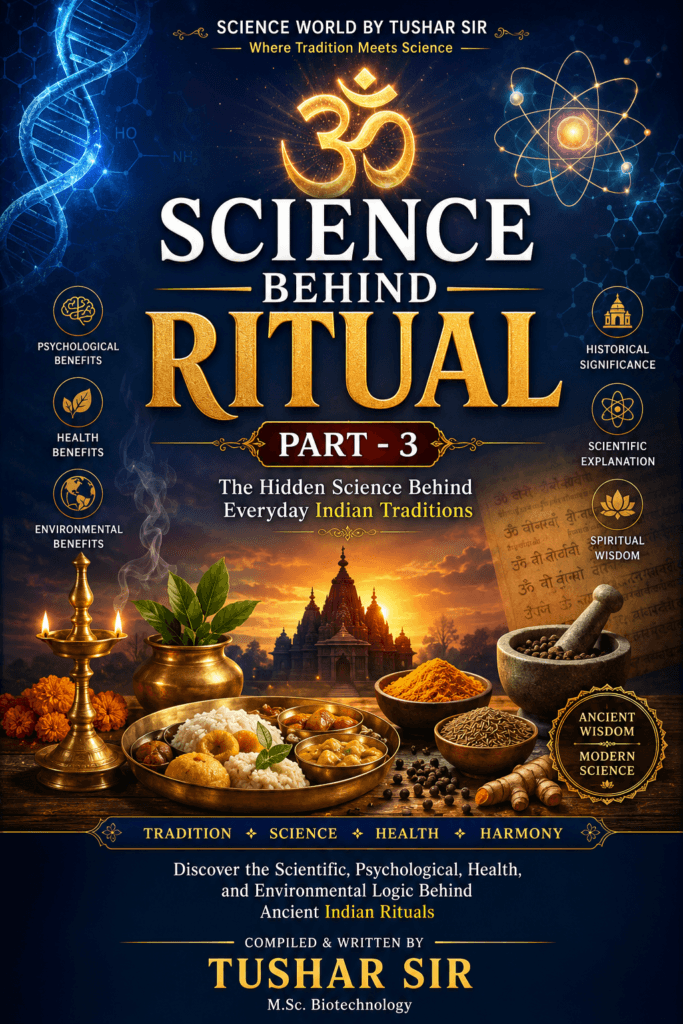
Science Behind Rituals – Part 3 is available on Amazon.
📖 Explore the Complete Science Behind Rituals Series
Book 1: Science Behind Rituals 1
Book 2: Science Behind Rituals 2
Book 3: Science Behind Rituals 3
Book 4: Science Behind Rituals 4
👉 Explore all books in the Science Behind Rituals series
🧪 Science World By Tushar Sir
At Science World By Tushar Sir, science is not limited to textbooks and laboratories.
It can be found in the questions we ask about the world around us.
Why do we eat this way?
Why do we prepare food this way?
Why has a particular ingredient been used for generations?
Why has a particular food tradition survived?
Sometimes, science begins with something as simple as a meal—and one question:
“Why?”
Science Behind Rituals – Part 3 invites you to explore that question.
Learn • Explore • Understand
Read. Question. Explore. Understand.