Introduction
Have you ever wondered how you immediately pull your hand away after touching a hot object, how your eyes blink automatically, or how a sunflower turns towards sunlight? These activities happen because living organisms have special systems that control and coordinate different body functions.
In humans and other animals, control and coordination are mainly carried out by the nervous system and the endocrine (hormonal) system. The nervous system sends quick electrical signals through nerve cells called neurons, enabling the body to respond rapidly to changes in the environment. The endocrine system works by releasing hormones, which travel through the bloodstream to regulate growth, development, metabolism, reproduction, and many other body functions.
Plants do not have a nervous system like animals, yet they also respond to external stimuli such as light, water, gravity, touch, and chemicals. These responses are controlled by plant hormones, allowing plants to grow, survive, and adapt to changing environmental conditions.
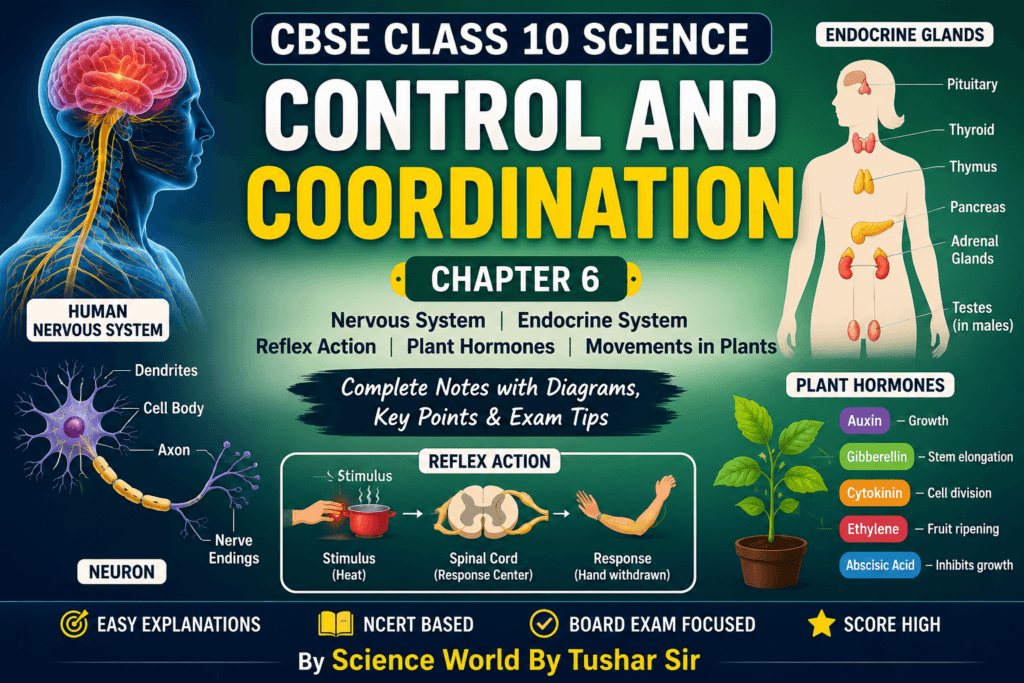
In this chapter, you will explore how different organisms detect stimuli, process information, and produce appropriate responses. You will learn about the human nervous system, neurons, brain, spinal cord, reflex actions, endocrine glands, hormones, coordination in plants, plant hormones, and various plant movements. Understanding these concepts will help you appreciate how living organisms maintain balance, respond to their surroundings, and carry out life processes efficiently.
These concepts are fundamental not only for the CBSE Class 10 Science examination but also for building a strong foundation for higher studies in Biology and everyday understanding of how living organisms function.
Learning Objectives
After studying this chapter, you will be able to:
- Explain the meaning of control and coordination in living organisms.
- Understand how organisms respond to different types of stimuli.
- Describe the structure and functions of a neuron.
- Explain the working of the human nervous system.
- Differentiate between the Central Nervous System (CNS) and the Peripheral Nervous System (PNS).
- Understand the structure and functions of the brain and spinal cord.
- Explain the mechanism of reflex action and identify the components of a reflex arc.
- Understand the role of the endocrine system and various hormones in the human body.
- Identify the major endocrine glands and explain the functions of their hormones.
- Describe coordination in plants and understand how plants respond to different stimuli.
- Differentiate between tropic movements and nastic movements.
- Explain the functions of important plant hormones such as auxins, gibberellins, cytokinins, abscisic acid, and ethylene.
- Solve CBSE board examination questions related to control and coordination with confidence.
What is Control and Coordination?
Living organisms continuously interact with their surroundings. They receive information from the environment, process it, and produce an appropriate response. This process is known as control and coordination.
Definition
Control is the process of regulating and managing different activities of the body.
Coordination is the process by which different organs and organ systems work together in a well-organized manner to perform various functions efficiently.
Together, control and coordination help organisms maintain internal balance and respond effectively to changes in their environment.
Why Do Living Organisms Need Control and Coordination?
Living organisms are constantly exposed to changes in their surroundings. They must respond appropriately to survive and function properly.
Control and coordination help organisms to:
- Respond quickly to environmental changes.
- Maintain body balance (homeostasis).
- Protect themselves from danger.
- Carry out movement and locomotion.
- Coordinate the activities of different organs.
- Regulate growth and development.
- Control reproduction and metabolism.
- Adapt to changing environmental conditions.
Stimulus and Response
The environment around us is constantly changing. Any change that causes an organism to react is called a stimulus.
The reaction shown by an organism after receiving a stimulus is called a response.
Definition of Stimulus
A stimulus is any change in the internal or external environment that triggers a reaction in an organism.
Examples of Stimuli
- Light
- Heat
- Sound
- Touch
- Smell
- Taste
- Gravity
- Water
- Chemicals
Definition of Response
A response is the action or reaction of an organism to a stimulus.
Examples
| Stimulus | Response |
|---|---|
| Touching a hot object | Hand is withdrawn immediately |
| Bright light | Pupils become smaller |
| Smell of food | Saliva secretion increases |
| Loud sound | Turning the head towards the sound |
| Thorn prick | Foot is withdrawn quickly |
Sense Organs – Detecting Stimuli
Humans detect stimuli through specialized sense organs.
| Sense Organ | Stimulus Detected |
|---|---|
| Eyes | Light |
| Ears | Sound |
| Nose | Smell |
| Tongue | Taste |
| Skin | Touch, heat, cold, pressure, pain |
These sense organs contain receptors, which receive information from the environment and send it to the nervous system for processing.
Receptors
Definition
Receptors are specialized sensory cells or nerve endings that detect changes (stimuli) in the environment and transmit information to the nervous system.
Types of Receptors
| Receptor | Detects |
|---|---|
| Photoreceptors | Light |
| Thermoreceptors | Temperature |
| Mechanoreceptors | Touch and pressure |
| Chemoreceptors | Taste and smell |
| Pain receptors | Injury or damage |
Effectors
After the brain processes the information, instructions are sent to effectors.
Definition
Effectors are organs that carry out the response directed by the nervous system.
Effectors include:
- Muscles
- Glands
Examples
- Muscles contract to move the hand away from a hot object.
- Salivary glands release saliva when food is seen or smelled.
Coordination in Animals
Animals perform numerous activities every second, such as walking, running, breathing, digesting food, and responding to danger. These activities require precise coordination between different organs.
In animals, coordination is mainly achieved by two systems:
- Nervous System
- Endocrine (Hormonal) System
The nervous system provides fast, short-term responses, while the endocrine system regulates slower, long-lasting responses.
The Nervous System
The nervous system is the body’s communication network. It receives information, processes it, and sends instructions to different body parts.
Functions of the Nervous System
- Receives stimuli from receptors.
- Processes information.
- Coordinates body activities.
- Controls voluntary and involuntary actions.
- Maintains body balance.
- Enables learning, memory, and thinking.
Components of the Nervous System
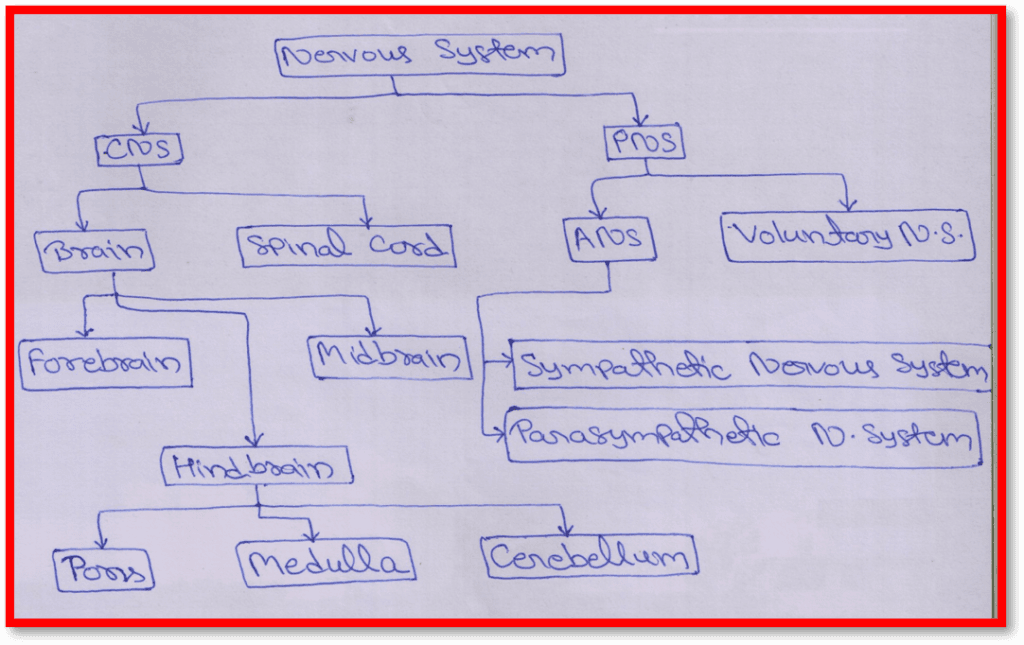
The human nervous system consists of:
- Central Nervous System (CNS)
- Peripheral Nervous System (PNS)
These systems work together to control and coordinate all body activities.
Did You Know?
🧠 The human brain contains approximately 86 billion nerve cells (neurons), making it one of the most complex organs in the human body. Neurons communicate using tiny electrical impulses that travel at remarkable speeds, allowing the body to respond quickly to changes in the environment.
Exam Tip
Remember this sequence:
Stimulus → Receptor → Nervous System → Effector → Response
This pathway forms the basis of many CBSE board questions related to control and coordination.
Quick Revision
- Control regulates body functions.
- Coordination ensures different organs work together.
- A stimulus causes a reaction in an organism.
- A response is the reaction shown after receiving a stimulus.
- Sense organs contain receptors that detect stimuli.
- Effectors (muscles and glands) carry out the response.
- Animals coordinate body functions using the nervous system and the endocrine system.
Neuron – The Structural and Functional Unit of the Nervous System
The nervous system is made up of millions of specialized nerve cells called neurons.
Definition
A neuron is the structural and functional unit of the nervous system that receives, processes, and transmits nerve impulses throughout the body.
Neurons carry electrical signals (nerve impulses) from one part of the body to another, allowing us to react quickly to different stimuli.
Structure of a Neuron
A typical neuron consists of three main parts:
1. Dendrites
- Short, branched extensions.
- Receive nerve impulses from receptors or other neurons.
- Carry impulses towards the cell body.
2. Cell Body (Cyton)
- Contains the nucleus and cytoplasm.
- Controls the activities of the neuron.
- Processes incoming nerve impulses.
3. Axon
- Long, slender extension.
- Carries nerve impulses away from the cell body.
- Ends in many small branches called axon terminals or nerve endings.
Labelled Diagram of a Neuron
Myelin Sheath
Many neurons are covered by a protective fatty layer called the myelin sheath.
Functions of Myelin Sheath
- Protects the axon.
- Increases the speed of nerve impulse transmission.
- Prevents damage to nerve fibres.
Nerve Impulse
Definition
A nerve impulse is an electrical signal that travels through a neuron.
The pathway of a nerve impulse is:
Receptor
↓
Dendrites
↓
Cell Body
↓
Axon
↓
Axon Terminals
↓
Next Neuron / Muscle / Gland
Synapse
Definition
A synapse is the tiny gap between the axon terminal of one neuron and the dendrite of the next neuron.
The nerve impulse crosses the synapse with the help of chemical messengers called neurotransmitters.
Functions of Neurons
Neurons help in:
- Receiving stimuli.
- Carrying nerve impulses.
- Connecting the brain and spinal cord with body organs.
- Controlling body movements.
- Coordinating body activities.
Types of Neurons
There are three main types of neurons.
1. Sensory Neurons
Function
Carry nerve impulses from receptors to the brain or spinal cord.
Example
Touching a hot object sends a signal through sensory neurons.
2. Motor Neurons
Function
Carry nerve impulses from the brain or spinal cord to muscles or glands.
Example
Motor neurons instruct the muscles to pull the hand away from a hot object.
3. Relay (Interneurons)
Function
Connect sensory neurons with motor neurons inside the brain and spinal cord.
They process information and coordinate responses.
Human Nervous System
The human nervous system is divided into two major parts.
Human Nervous System

│
├── Central Nervous System (CNS)
│      ├── Brain
│      └── Spinal Cord
│
└── Peripheral Nervous System (PNS)
       ├── Cranial Nerves
       └── Spinal Nerves
Central Nervous System (CNS)
The Central Nervous System (CNS) consists of:
- Brain
- Spinal Cord
It acts as the control centre of the body.
Functions of CNS
- Receives information.
- Processes information.
- Controls body activities.
- Coordinates voluntary and involuntary actions.
- Stores memory.
- Enables thinking and learning.
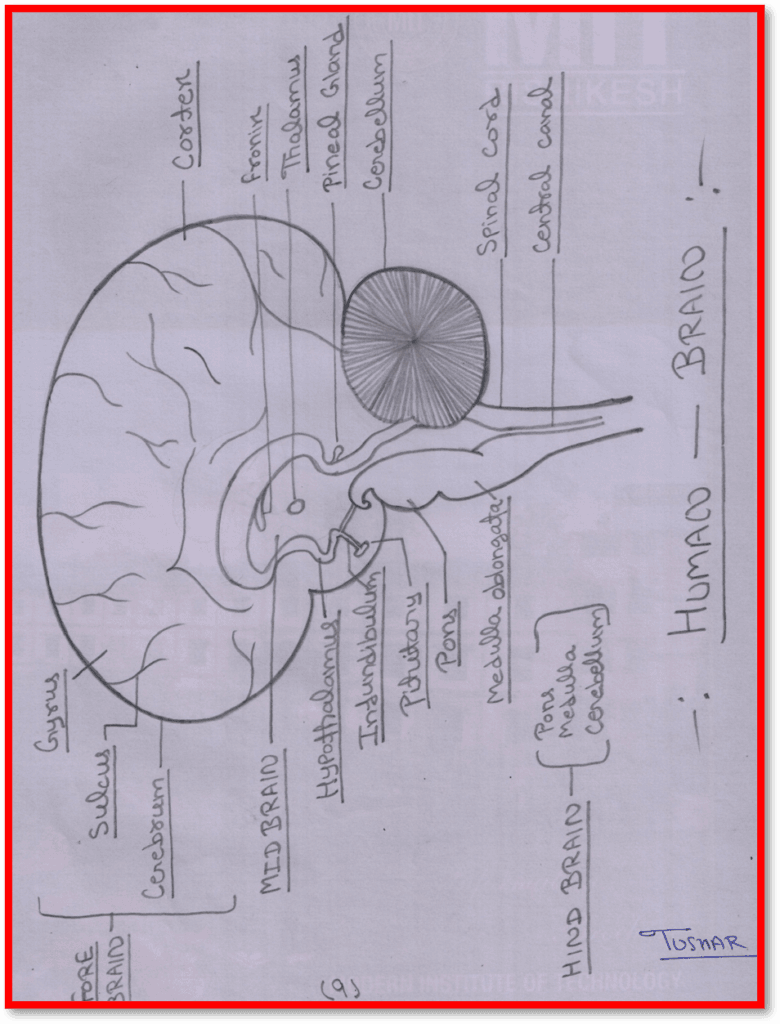
Brain
The brain is the main control centre of the nervous system.
It is protected by:
- Skull (cranium)
- Three protective membranes called meninges
- Cerebrospinal fluid (CSF)
Functions of the Brain
The brain controls:
- Thinking
- Memory
- Intelligence
- Emotions
- Movement
- Vision
- Hearing
- Speech
- Breathing
- Heartbeat
- Body balance
Parts of the Brain
The brain is divided into three main regions.
1. Forebrain
The forebrain is the largest part of the brain.
Functions
- Thinking
- Learning
- Intelligence
- Memory
- Voluntary actions
- Interpretation of sensory information
The cerebrum, the largest part of the forebrain, controls conscious activities such as writing, reading, speaking, and decision-making.
2. Midbrain
The midbrain connects the forebrain with the hindbrain.
Functions
- Controls visual reflexes.
- Controls auditory reflexes.
- Coordinates eye movements.
3. Hindbrain
The hindbrain consists of:
- Cerebellum
- Pons
- Medulla Oblongata
Cerebellum
Functions
- Maintains body balance.
- Coordinates muscle movements.
- Controls posture.
Example:
Riding a bicycle or playing cricket requires a well-functioning cerebellum.
Medulla Oblongata
Controls involuntary actions such as:
- Breathing
- Heartbeat
- Blood pressure
- Swallowing
- Sneezing
- Vomiting
Pons
Acts as a bridge between different parts of the brain and helps regulate breathing.
Summary of Brain Parts
| Brain Part | Main Function |
|---|---|
| Forebrain | Thinking, memory, voluntary actions |
| Midbrain | Visual and auditory reflexes |
| Cerebellum | Balance and coordination |
| Medulla Oblongata | Involuntary actions |
| Pons | Relay centre and breathing regulation |
Spinal Cord
The spinal cord is a long cylindrical bundle of nerve tissue extending from the brain through the vertebral column.
Functions of the Spinal Cord
- Carries messages between the brain and body.
- Controls reflex actions.
- Coordinates simple responses without involving the brain immediately.
Peripheral Nervous System (PNS)
The Peripheral Nervous System consists of all nerves outside the brain and spinal cord.
It connects the CNS with different parts of the body.
Components of the PNS
Cranial Nerves
- Arise from the brain.
- Control the head and neck.
There are 12 pairs of cranial nerves.
Spinal Nerves
- Arise from the spinal cord.
- Connect the spinal cord to the rest of the body.
There are 31 pairs of spinal nerves.
Difference Between CNS and PNS
| Central Nervous System | Peripheral Nervous System |
|---|---|
| Consists of brain and spinal cord | Consists of all nerves outside CNS |
| Processes information | Transmits information |
| Control centre | Communication network |
| Protected by bones | Not protected by bones |
Flow of Information in the Nervous System
Everyday Applications
The nervous system helps us:
- Walk and run.
- Read and write.
- Ride a bicycle.
- Play sports.
- Drive vehicles.
- React quickly to danger.
- Maintain body balance.
Without proper coordination, these activities would not be possible.
Did You Know?
🧠 The human brain weighs about 1.3–1.4 kg and uses nearly 20% of the body’s total oxygen and energy, even though it accounts for only about 2% of body weight.
Exam Tip
Remember the brain functions with this simple trick:
- Forebrain → Think
- Midbrain → See & Hear Reflexes
- Cerebellum → Balance
- Medulla → Heartbeat & Breathing
Questions comparing the functions of different brain parts are common in CBSE board exams.
Quick Revision
- Neuron is the structural and functional unit of the nervous system.
- A neuron has dendrites, cell body, and axon.
- Myelin sheath speeds up nerve impulse transmission.
- Three types of neurons: sensory, motor, and relay.
- The Central Nervous System consists of the brain and spinal cord.
- The Peripheral Nervous System connects the CNS with the rest of the body.
- The forebrain controls thinking and memory.
- The cerebellum controls balance and posture.
- The medulla oblongata regulates involuntary actions.
- The spinal cord conducts nerve impulses and controls reflex actions.
Reflex Action
Have you ever accidentally touched a hot pan and pulled your hand back immediately without thinking? This quick, automatic response is known as a reflex action.
Reflex actions protect our body from injury by producing an immediate response to harmful stimuli.
Definition
A reflex action is a rapid, automatic, involuntary response to a stimulus without conscious thought.
Reflex actions are controlled mainly by the spinal cord, allowing the body to respond quickly before the brain processes the information.
Characteristics of Reflex Action
- Very fast response
- Automatic and involuntary
- Protects the body from injury
- Controlled mainly by the spinal cord
- Does not require conscious thinking
Examples of Reflex Actions
- Pulling your hand away from a hot object.
- Blinking when dust enters the eye.
- Sneezing due to dust or pollen.
- Coughing when food enters the windpipe.
- Knee-jerk reflex during a medical examination.
- Withdrawing the foot after stepping on a sharp object.
Reflex Arc
Definition
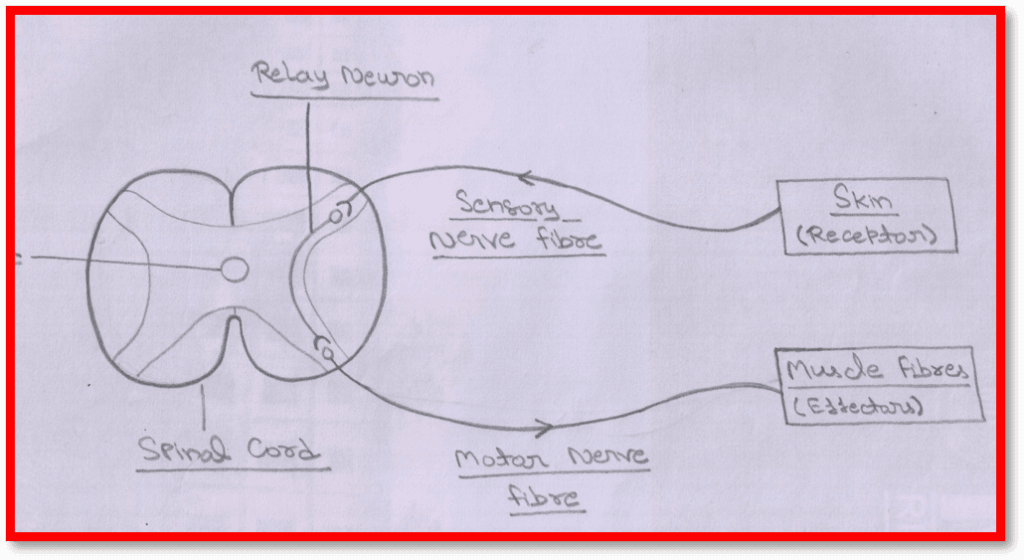
A reflex arc is the pathway followed by a nerve impulse during a reflex action.
It is the shortest route through which information travels to produce a quick response.
Components of a Reflex Arc
- Receptor
- Sensory Neuron
- Spinal Cord (Relay Neuron)
- Motor Neuron
- Effector (Muscle or Gland)
Diagram of Reflex Arc
Why is the Brain Not Involved Immediately?
The brain receives information about the stimulus after the reflex action has occurred.
This arrangement helps save valuable time and reduces the risk of injury.
Example:
When touching a hot iron, waiting for the brain to make a decision could cause severe burns. The spinal cord immediately sends instructions to the muscles to withdraw the hand.
Voluntary and Involuntary Actions
Our body performs two types of actions.
Voluntary Actions
Definition
Voluntary actions are activities performed according to our own will.
These actions are controlled by the forebrain (cerebrum).
Examples
- Walking
- Writing
- Speaking
- Reading
- Playing football
- Riding a bicycle
Involuntary Actions
Definition
Involuntary actions occur automatically without conscious control.
They are mainly controlled by the medulla oblongata and the autonomic nervous system.
Examples
- Heartbeat
- Breathing
- Digestion
- Blinking
- Sweating
- Blood circulation
Difference Between Voluntary and Involuntary Actions
| Voluntary Actions | Involuntary Actions |
|---|---|
| Under conscious control | Automatic |
| Controlled by the cerebrum | Controlled by the medulla and autonomic nervous system |
| Can be started or stopped voluntarily | Cannot be controlled consciously |
| Example: Writing | Example: Heartbeat |
Endocrine System
The nervous system provides quick responses, but some body functions such as growth and reproduction require slower, long-lasting regulation.
These functions are controlled by the endocrine system.
Definition
The endocrine system is a network of glands that secrete hormones directly into the bloodstream.
These hormones regulate various body activities.
Endocrine Glands
Endocrine glands are also called ductless glands because they release hormones directly into the blood instead of through ducts.
Characteristics of Hormones
Hormones are:
- Chemical messengers
- Produced in small quantities
- Secreted by endocrine glands
- Transported by blood
- Act on specific target organs
- Produce slower but longer-lasting effects than nerve impulses
Functions of Hormones
Hormones help regulate:
- Growth and development
- Metabolism
- Reproduction
- Water balance
- Blood sugar level
- Stress response
- Sleep and biological rhythms
Major Endocrine Glands
The human body contains several endocrine glands.
1. Pituitary Gland
Location
Base of the brain.
Known As
Master Gland
Hormones
- Growth Hormone (GH)
- Other hormones that control several endocrine glands
Functions
- Controls growth of bones and muscles.
- Regulates other endocrine glands.
- Coordinates many body functions.
2. Thyroid Gland
Location
Front of the neck.
Hormone
Thyroxine
Functions
- Controls metabolism.
- Regulates growth.
- Helps maintain body temperature.
- Supports brain development.
Requirement
Thyroxine contains iodine.
A lack of iodine may lead to goitre, in which the thyroid gland becomes enlarged.
Goitre
Definition
Goitre is a disorder caused mainly by iodine deficiency, resulting in swelling of the thyroid gland.
Prevention
- Eat iodised salt.
- Consume iodine-rich foods such as seafood and dairy products.
3. Adrenal Glands
Location
One gland is present on the top of each kidney.
Hormone
Adrenaline (Epinephrine)
Functions
Adrenaline prepares the body for emergency situations by:
- Increasing heart rate.
- Increasing breathing rate.
- Raising blood pressure.
- Increasing blood glucose levels.
- Improving blood supply to muscles.
This is called the “Fight or Flight Response.”
Fight or Flight Response
When we face danger or fear, adrenaline prepares the body to either:
- Fight the danger.
- Run away quickly.
Example:
A student suddenly notices a snake while walking in a park. The heartbeat increases, breathing becomes faster, and muscles receive more blood, enabling a quick reaction.
4. Pancreas
Hormone
Insulin
Function
Insulin regulates the amount of glucose in the blood.
Diabetes
If the pancreas does not produce enough insulin, the blood sugar level rises, causing diabetes mellitus.
Symptoms
- Frequent urination
- Excessive thirst
- Increased hunger
- Fatigue
- Slow wound healing
5. Testes
Hormone
Testosterone
Functions
- Development of male reproductive organs.
- Development of secondary sexual characteristics such as a deeper voice, facial hair, and muscle growth.
6. Ovaries
Hormones
- Oestrogen
- Progesterone
Functions
- Development of female reproductive organs.
- Regulation of the menstrual cycle.
- Development of secondary sexual characteristics.
Summary of Major Endocrine Glands
| Gland | Hormone | Main Function |
|---|---|---|
| Pituitary | Growth Hormone | Controls growth and other glands |
| Thyroid | Thyroxine | Regulates metabolism |
| Adrenal | Adrenaline | Emergency response |
| Pancreas | Insulin | Controls blood sugar |
| Testes | Testosterone | Male characteristics |
| Ovaries | Oestrogen, Progesterone | Female characteristics and reproduction |
Difference Between Nervous System and Endocrine System
| Nervous System | Endocrine System |
|---|---|
| Uses nerve impulses | Uses hormones |
| Fast response | Slow response |
| Short-lasting effects | Long-lasting effects |
| Travels through neurons | Travels through blood |
| Specific target cells | Target organs with hormone receptors |
Everyday Applications
The endocrine system helps in:
- Growth during childhood.
- Puberty and adolescence.
- Maintaining blood sugar levels.
- Coping with stress.
- Regulating metabolism.
- Maintaining overall body balance (homeostasis).
Did You Know?
🧠 Although the pituitary gland is only about the size of a pea, it controls many other endocrine glands. That’s why it is often called the “Master Gland” of the human endocrine system.
Exam Tip
Remember these important hormone–gland pairs:
- Pituitary → Growth Hormone
- Thyroid → Thyroxine
- Adrenal → Adrenaline
- Pancreas → Insulin
- Testes → Testosterone
- Ovaries → Oestrogen & Progesterone
These are frequently asked in CBSE board examinations.
Quick Revision
- Reflex actions are rapid, automatic responses controlled mainly by the spinal cord.
- A reflex arc consists of receptor, sensory neuron, spinal cord, motor neuron, and effector.
- Voluntary actions are controlled by the cerebrum.
- Involuntary actions are controlled mainly by the medulla oblongata.
- Hormones are chemical messengers released by endocrine glands.
- The pituitary gland is known as the master gland.
- Thyroxine regulates metabolism and requires iodine.
- Adrenaline prepares the body for emergencies.
- Insulin controls blood sugar levels.
- Testosterone, oestrogen, and progesterone regulate reproductive functions.
Coordination in Plants
Unlike animals, plants do not have a brain, spinal cord, nerves, or muscles. However, they can still detect changes in their surroundings and respond to them effectively.
Plants respond to various environmental stimuli such as light, water, gravity, touch, chemicals, and temperature. These responses help them survive, grow, and reproduce.
Plant responses are mainly controlled by plant hormones, also called phytohormones.
How Do Plants Respond Without a Nervous System?
Plants coordinate their activities through:
- Plant hormones
- Growth movements
- Changes in the rate of cell growth
- Changes in water content within cells
Unlike nerve impulses, plant responses are generally slower because they depend mainly on growth and hormone action.
Plant Hormones (Phytohormones)
Definition
Plant hormones are naturally occurring chemical substances that regulate the growth, development, and responses of plants to different environmental stimuli.
They are produced in very small amounts but have significant effects on plant life.
Major Plant Hormones
According to the CBSE syllabus, five major plant hormones are important.
- Auxins
- Gibberellins
- Cytokinins
- Abscisic Acid (ABA)
- Ethylene
1. Auxins
Functions
Auxins are growth-promoting hormones.
They help in:
- Cell elongation
- Root development
- Shoot growth
- Phototropism
- Apical dominance
Everyday Example
A potted plant placed near a window bends towards sunlight because auxins accumulate on the shaded side, causing cells there to elongate more.
2. Gibberellins
Functions
Gibberellins promote:
- Stem elongation
- Seed germination
- Flowering
- Fruit development
Agricultural Importance
Farmers often use gibberellins to improve the growth and yield of certain crops.
3. Cytokinins
Functions
Cytokinins:
- Stimulate cell division
- Promote shoot formation
- Delay ageing (senescence) of leaves
- Help in tissue culture
Example
Fresh leafy vegetables remain green for a longer time due to the action of cytokinins.
4. Abscisic Acid (ABA)
Abscisic acid is known as the growth-inhibiting hormone.
Functions
- Inhibits plant growth
- Causes dormancy in seeds and buds
- Closes stomata during water shortage
- Helps plants survive drought conditions
5. Ethylene
Ethylene is the only major gaseous plant hormone.
Functions
- Ripens fruits
- Promotes flowering in some plants
- Causes leaf and fruit fall
- Accelerates ageing of plant tissues
Everyday Example
Raw bananas or mangoes ripen faster when kept together because they release ethylene gas.
Summary of Plant Hormones
| Hormone | Main Function |
|---|---|
| Auxin | Cell elongation, phototropism, root growth |
| Gibberellin | Stem growth, seed germination |
| Cytokinin | Cell division, delays ageing |
| Abscisic Acid (ABA) | Growth inhibition, dormancy, closes stomata |
| Ethylene | Fruit ripening, leaf fall |
Plant Movements
Plants show two main types of movements.
- Tropic Movements
- Nastic Movements
Tropic Movements
Definition
A tropic movement is the directional growth movement of a plant in response to an external stimulus.
The direction of movement depends on the direction of the stimulus.
Characteristics of Tropic Movements
- Growth movement
- Direction depends on the stimulus
- Usually slow
- Permanent
Types of Tropic Movements
1. Phototropism
Definition
Growth of a plant in response to light.
Positive Phototropism
Shoot bends towards light.
Negative Phototropism
Roots grow away from light.
Example
A sunflower turns towards sunlight.
2. Geotropism (Gravitropism)
Definition
Growth of a plant in response to gravity.
Positive Geotropism
Roots grow downward towards gravity.
Negative Geotropism
Shoots grow upward against gravity.
3. Hydrotropism
Definition
Growth of roots towards water.
Importance
Helps plants absorb water efficiently.
4. Thigmotropism
Definition
Growth in response to touch.
Example
The tendrils of pea and grape plants coil around a support after touching it.
5. Chemotropism
Definition
Growth in response to chemicals.
Example
The pollen tube grows towards the ovule due to chemical signals released during fertilisation.
Summary of Tropic Movements
| Movement | Stimulus | Example |
|---|---|---|
| Phototropism | Light | Shoot bends towards light |
| Geotropism | Gravity | Roots grow downward |
| Hydrotropism | Water | Roots grow towards water |
| Thigmotropism | Touch | Tendrils coil around support |
| Chemotropism | Chemicals | Pollen tube grows towards ovule |
Nastic Movements
Definition
A nastic movement is a non-directional movement of a plant in response to a stimulus.
The direction of movement does not depend on the direction of the stimulus.
These movements are generally caused by changes in turgor pressure rather than growth.
Characteristics of Nastic Movements
- Non-directional
- Usually reversible
- Fast compared to growth movements
- Caused by changes in water pressure within cells
Examples of Nastic Movements
1. Mimosa pudica (Touch-me-not)
Leaves fold immediately when touched.
This response is called thigmonasty or seismonasty.
2. Opening and Closing of Flowers
Some flowers open during the day and close at night.
3. Venus Flytrap
The leaves snap shut when an insect touches the sensitive hairs.
This helps the plant trap insects for nutrition.
Difference Between Tropic and Nastic Movements
| Tropic Movement | Nastic Movement |
|---|---|
| Direction depends on stimulus | Direction does not depend on stimulus |
| Growth movement | Mostly due to turgor changes |
| Usually permanent | Usually reversible |
| Slow | Relatively faster |
| Example: Phototropism | Example: Mimosa leaf folding |
Importance of Plant Coordination
Plant coordination helps in:
- Obtaining sunlight for photosynthesis
- Absorbing water and minerals
- Climbing supports
- Pollination and fertilisation
- Seed germination
- Survival during drought
- Fruit ripening
- Protection against environmental stress
Everyday Applications
The concepts of plant hormones are widely used in agriculture and horticulture:
- Ethylene is used for artificial fruit ripening.
- Gibberellins improve crop growth and seed germination.
- Auxins promote rooting in plant cuttings.
- Cytokinins are used in plant tissue culture.
- ABA helps plants survive water stress.
Did You Know?
🌻 A sunflower does not continuously follow the Sun throughout its life. Young flower buds track the Sun from east to west, but mature sunflower heads usually remain facing east, helping them warm up quickly in the morning and attract pollinators.
Exam Tip
Remember the five major plant hormones:
Auxin → Growth
Gibberellin → Stem elongation
Cytokinin → Cell division
ABA → Growth inhibitor
Ethylene → Fruit ripening
These hormone functions are frequently tested in CBSE board examinations.
Quick Revision
- Plants coordinate their activities using hormones.
- Auxins promote cell elongation and phototropism.
- Gibberellins stimulate stem growth and seed germination.
- Cytokinins promote cell division.
- ABA inhibits growth and closes stomata.
- Ethylene helps in fruit ripening.
- Tropic movements are directional growth responses.
- Nastic movements are non-directional and generally reversible.
- Phototropism, geotropism, hydrotropism, thigmotropism, and chemotropism are important tropic movements.
Important Definitions
1. Control
Control is the process of regulating and managing different activities of the body.
2. Coordination
Coordination is the harmonious working together of different organs and organ systems to perform various life processes efficiently.
3. Stimulus
A stimulus is any change in the internal or external environment that produces a response in an organism.
4. Response
A response is the reaction of an organism to a stimulus.
5. Receptor
A receptor is a specialized sensory cell or nerve ending that detects a stimulus and sends information to the nervous system.
6. Effector
An effector is a muscle or gland that performs the response after receiving instructions from the nervous system.
7. Neuron
A neuron is the structural and functional unit of the nervous system that transmits nerve impulses.
8. Synapse
A synapse is the tiny gap between two neurons through which nerve impulses pass using neurotransmitters.
9. Reflex Action
A reflex action is a rapid, automatic, and involuntary response to a stimulus, usually controlled by the spinal cord.
10. Reflex Arc
A reflex arc is the pathway followed by a nerve impulse during a reflex action.
11. Hormone
A hormone is a chemical messenger secreted by endocrine glands that regulates various body functions.
12. Endocrine Gland
An endocrine gland is a ductless gland that releases hormones directly into the bloodstream.
13. Plant Hormone
A plant hormone is a chemical substance that regulates plant growth, development, and responses to stimuli.
14. Tropic Movement
A tropic movement is a directional growth response of a plant towards or away from a stimulus.
15. Nastic Movement
A nastic movement is a non-directional movement of a plant in response to a stimulus.
NCERT Keywords
- Control
- Coordination
- Stimulus
- Response
- Receptor
- Effector
- Neuron
- Dendrite
- Axon
- Synapse
- Nerve Impulse
- Brain
- Spinal Cord
- Central Nervous System
- Peripheral Nervous System
- Reflex Action
- Reflex Arc
- Endocrine System
- Hormone
- Pituitary Gland
- Thyroid Gland
- Thyroxine
- Adrenaline
- Insulin
- Testosterone
- Oestrogen
- Progesterone
- Plant Hormones
- Auxin
- Gibberellin
- Cytokinin
- Abscisic Acid (ABA)
- Ethylene
- Phototropism
- Geotropism
- Hydrotropism
- Thigmotropism
- Chemotropism
- Nastic Movement
Important Differences
Nervous System vs Endocrine System
| Nervous System | Endocrine System |
|---|---|
| Uses nerve impulses | Uses hormones |
| Fast response | Slower response |
| Short-lasting effects | Long-lasting effects |
| Travels through neurons | Travels through blood |
| Acts on specific cells quickly | Acts on target organs over time |
Voluntary vs Involuntary Actions
| Voluntary Actions | Involuntary Actions |
|---|---|
| Under conscious control | Automatic |
| Controlled by cerebrum | Controlled mainly by medulla |
| Can be started or stopped consciously | Cannot be consciously controlled |
| Example: Writing | Example: Heartbeat |
Tropic vs Nastic Movements
| Tropic Movement | Nastic Movement |
|---|---|
| Direction depends on stimulus | Direction does not depend on stimulus |
| Growth movement | Mostly due to changes in turgor pressure |
| Usually permanent | Usually reversible |
| Slower | Faster |
| Example: Phototropism | Example: Folding of Mimosa leaves |
Major Endocrine Glands and Hormones
| Endocrine Gland | Hormone | Main Function |
|---|---|---|
| Pituitary | Growth Hormone | Growth and regulation of other glands |
| Thyroid | Thyroxine | Controls metabolism |
| Adrenal | Adrenaline | Emergency (fight or flight) response |
| Pancreas | Insulin | Regulates blood sugar |
| Testes | Testosterone | Male secondary sexual characteristics |
| Ovaries | Oestrogen & Progesterone | Female reproductive functions |
Major Plant Hormones
| Plant Hormone | Main Function |
|---|---|
| Auxin | Cell elongation and phototropism |
| Gibberellin | Stem elongation and seed germination |
| Cytokinin | Cell division and delay of ageing |
| Abscisic Acid (ABA) | Growth inhibition and stomatal closure |
| Ethylene | Fruit ripening and leaf fall |
One-Page Quick Revision
Remember These Key Points
- Control and coordination help organisms respond to stimuli.
- The nervous system provides quick responses through neurons.
- The endocrine system regulates body functions through hormones.
- The brain consists of the forebrain, midbrain, and hindbrain.
- The spinal cord controls reflex actions.
- A reflex arc includes receptor, sensory neuron, relay neuron, motor neuron, and effector.
- Hormones are secreted by endocrine glands directly into the bloodstream.
- The pituitary gland is called the master gland.
- Auxins promote plant growth.
- Ethylene is responsible for fruit ripening.
- Tropic movements are directional; nastic movements are non-directional.
Board Exam Tips
✅ Learn all important definitions.
✅ Practice drawing labelled diagrams of:
- Neuron
- Human brain
- Reflex arc
✅ Memorise the functions of:
- Forebrain
- Midbrain
- Cerebellum
- Medulla oblongata
✅ Remember all hormone–gland pairs.
✅ Revise the five major plant hormones and their functions.
✅ Practice differences between:
- Nervous system and endocrine system
- Voluntary and involuntary actions
- Tropic and nastic movements
✅ Solve all NCERT textbook questions and exemplar problems.
Frequently Asked Questions (FAQs)
Q1. What is control and coordination?
Control and coordination is the process by which living organisms regulate body activities and respond to internal and external stimuli in an organized manner.
Q2. What is a neuron?
A neuron is the structural and functional unit of the nervous system responsible for transmitting nerve impulses.
Q3. What is a reflex action?
A reflex action is a rapid, automatic, involuntary response to a stimulus, mainly controlled by the spinal cord.
Q4. Why is the pituitary gland called the master gland?
It is called the master gland because it secretes hormones that regulate the activities of several other endocrine glands.
Q5. Which hormone regulates blood sugar levels?
Insulin, secreted by the pancreas, regulates blood sugar levels.
Q6. Which hormone is responsible for the fight-or-flight response?
Adrenaline, secreted by the adrenal glands, prepares the body for emergency situations.
Q7. What are plant hormones?
Plant hormones are chemical substances that regulate growth, development, and responses to environmental stimuli in plants.
Q8. What is phototropism?
Phototropism is the directional growth of a plant in response to light.
Q9. What is the difference between tropic and nastic movements?
Tropic movements are directional growth responses towards or away from a stimulus, while nastic movements are non-directional responses that do not depend on the direction of the stimulus.
Q10. Which topics from this chapter are most important for the CBSE Board Examination?
Students should focus on:
- Neuron structure and function
- Brain and spinal cord
- Reflex action and reflex arc
- Endocrine glands and hormones
- Plant hormones
- Tropic and nastic movements
- Important diagrams and differences
Chapter Summary
Control and coordination enable living organisms to detect stimuli and respond appropriately. In animals, this coordination is achieved through the nervous system and the endocrine system. The nervous system provides quick responses using neurons and nerve impulses, while the endocrine system regulates long-term functions through hormones.
The chapter explains the structure and functions of neurons, the organization of the human nervous system, the roles of the brain and spinal cord, and the mechanism of reflex actions. It also introduces the endocrine glands and the hormones they secrete to regulate growth, metabolism, reproduction, and emergency responses.
Plants, although lacking a nervous system, coordinate their activities using plant hormones. They respond to environmental stimuli through tropic and nastic movements, allowing them to grow, reproduce, and survive under changing environmental conditions.
Understanding these concepts builds a strong foundation for Biology and helps students appreciate how both plants and animals maintain internal balance and adapt to their surroundings.
💡 Did You Know?
🧠 The human nervous system can transmit nerve impulses at speeds of up to 120 metres per second in some myelinated neurons. This rapid communication allows your body to react almost instantly to dangerous situations, such as touching a hot object.
📘 Prepare Smarter with the Complete CBSE Class 10 Science Master Guide
These free notes cover the essential concepts of Control and Coordination. For complete board exam preparation, explore the CBSE Class 10 Science Master Guide by Science World By Tushar Sir.
📖 What’s Inside the Book?
- ✅ Complete chapter-wise theory
- ✅ Easy-to-understand diagrams and flowcharts
- ✅ Mind Maps for quick revision
- ✅ Chapter-wise MCQs
- ✅ Assertion & Reason Questions
- ✅ Case-Based Questions
- ✅ Short & Long Answer Questions
- ✅ Practice Papers
- ✅ Smart Exam Strategies

📚 Available Formats
- 📕 Paperback Edition
- 📱 eBook Edition
📚 Continue Learning
Previous Chapter: Life Processes – Class 10 Notes (Chapter 5)
Next Chapter: How Do Organisms Reproduce? – Class 10 Notes (Chapter 7)