NCERT Solutions for Class 9 Science Chapter 2
NCERT Exercise Questions with answers
1. Differentiate between the following pairs of terms: (📘 For the exact question, refer to the NCERT textbook.)
(i) Cell membrane and Cell wall (Permeability)
| Cell Membrane | Cell Wall |
| It is selectively permeable (allows only some substances to pass). | It is freely permeable (allows most substances to pass). |
| Present in all cells. | Present mainly in plant cells, fungi and bacteria. |
| Flexible and living structure. | Rigid and non-living structure. |
(ii) RER and SER (Structure)
| RER (Rough Endoplasmic Reticulum) | SER (Smooth Endoplasmic Reticulum) |
| Ribosomes are present on its surface. | Ribosomes are absent on its surface. |
| Surface appears rough. | Surface appears smooth. |
| Mostly made of flattened sacs. | Mostly made of tubular structures. |
(iii) Chloroplasts and Chromoplasts (Pigments)
| Chloroplasts | Chromoplasts |
| Contain green pigment called chlorophyll. | Contain coloured pigments like red, yellow or orange carotenoids. |
| Help in photosynthesis. | Give colour to fruits and flowers. |
2. Two similar animal cells are placed in two different solutions: (📘 For the exact question, refer to the NCERT textbook.)
(i) Cell X is placed in pure water
Answer
- Water enters the cell by osmosis.
- The cell swells and may burst because animal cells do not have a cell wall.
(ii) Cell Y is placed in a concentrated salt solution
Answer
- Water moves out of the cell by osmosis.
- The cell shrinks.
(iii) Cells are observed after some time. Cell X swells, & Cell Y shrinks. Which statement provides the correct explanation for the above observation? Correct explanation for the observations
- Salt molecules moved into cell Y, causing it to shrink.
- water moved into cell X and more water moved out of cell Y. Then the salt solution entered it.
- Water moved into cell X and moved out of cell Y through the cell membrane.
- Solute movement caused osmosis in both cells.
Answer: The correct option is: (iii)
Water moved into Cell X and moved out of Cell Y through the cell membrane.
- Cell X swelled because water entered by osmosis.
- Cell Y shrank because water moved out into the concentrated salt solution.
3. Identify the labelled parts and match with functions (📘 For the exact question, refer to the NCERT textbook.)
| Label | Cell Part | Function |
| (a) | Mitochondria | Site of cellular respiration |
| (b) | Nucleus | Controlling all the activities of a cell |
| (c) | Golgi apparatus | Packs and stores materials received from ER |
| (d) | Chloroplast | Helps in manufacturing food |
| (e) | Cell membrane | Separates the cell contents from surroundings |
| (f) | Cell wall | Provides structural rigidity to the cell |
| (g) | Vacuole | Storage organelle that also provides rigidity to the cell |
4. Select correct option of the pairs of cell organelles are correctly placed under the given categories? (📘 For the exact question, refer to the NCERT textbook.)
Correct Answer: (i)
| Present in plant cells | Absent in animal cells |
| Leucoplast | Cell wall |
Explanation:
- Leucoplasts are found in plant cells.
- Animal cells do not have a cell wall.
5. Who is correct? Justify. (📘 For the exact question, refer to the NCERT textbook.)
Renu is correct.
- Roots also contain plastids called leucoplasts.
- Leucoplasts store food materials such as starch, oils and proteins.
- Roots do not contain chloroplasts because photosynthesis does not occur there.
6. Give Similarities and differences between mitochondria and chloroplasts (📘 For the exact question, refer to the NCERT textbook.)
Similarities
- Both are double membrane-bound organelles.
- Both contain their own DNA and ribosomes.
- Both can replicate independently inside the cell.
Differences
| Mitochondria | Chloroplast |
| Present in plant and animal cells | Present only in plant cells |
| Site of cellular respiration | Site of photosynthesis |
| Produces energy (ATP) | Makes food using sunlight |
| Does not contain chlorophyll | Contains chlorophyll |
7. Which pairs of organelles contain DNA? (📘 For the exact question, refer to the NCERT textbook.)
Correct Answer: (ii) Mitochondria, Nucleus
Both mitochondria and nucleus contain DNA.
8. Carrot Experiment (📘 For the exact question, refer to the NCERT textbook.)
(i) Hypothesis
The researcher wants to test that:
Water moves through a semipermeable membrane from a dilute solution to a concentrated solution by osmosis.
(ii) Suggestion for improvement
- Take more carrots of the same size for accurate results.
- Keep both carrots under the same conditions of temperature and time.
- Measure the change in size or weight properly.
(iii) Reason for different observations
- In plain water, water enters the carrot cells by osmosis, making them turgid, stiff and crunchy.
- In concentrated salt solution, water moves out of the carrot cells, making them flaccid, rubbery and limp.
9. Presence or absence of structures (📘 For the exact question, refer to the NCERT textbook.)
| Structure | Bacterial Cell | Animal Cell |
| Chromosome | Present | Present |
| Nucleus | Absent | Present |
| Mitochondria | Absent | Present |
| Golgi complex | Absent | Present |
| Chromoplasts | Absent | Absent |
10. Potato Cup Experiment (📘 For the exact question, refer to the NCERT textbook.)
(i) Why does water gather in Cups B and C?
- Sugar in Cup B and salt in Cup C create a concentrated solution.
- Water moves into the hollow part by osmosis through potato cells.
(ii) Why is Cup A necessary?
- Cup A acts as a control setup for comparison.
- It shows that water does not collect without sugar or salt.
(iii) Why does water not gather in Cups A and D?
Cup A:
- No concentration difference is present, so osmosis does not occur.
Cup D:
- The boiled potato cells are dead and their membranes are damaged.
- Therefore, osmosis cannot take place.
11. Incorrectly matched pair (📘 For the exact question, refer to the NCERT textbook.)
Correct Answer: (ii) SER — Lipid and cellulose synthesis
Reason:
- SER helps in lipid synthesis, but cellulose synthesis is not its function.
12. What happens if mitochondria are removed? (📘 For the exact question, refer to the NCERT textbook.)
- Cellular respiration will stop.
- The cell will not produce enough ATP (energy).
- Eventually, the cell will die due to lack of energy.
13. Which phenomenon inhibits tumour formation? Can plants develop tumours? (📘 For the exact question, refer to the NCERT textbook.)
Phenomenon:
Controlled cell division inhibits tumour formation.
Can plants develop tumours?
Yes, plants can also develop tumours due to uncontrolled cell division, often caused by infections like bacteria (for example, crown gall disease).
14. Cell membrane formation (📘 For the exact question, refer to the NCERT textbook.)
Organelles involved
- Ribosomes on Rough Endoplasmic Reticulum (RER) synthesize proteins.
- Smooth Endoplasmic Reticulum (SER) synthesizes lipids.
- Golgi apparatus modifies, packages and transports them to the cell membrane.
Path of movement
Proteins:
Ribosomes → RER → Golgi apparatus → Cell membrane
Lipids:
SER → Golgi apparatus → Cell membrane
Simple labelled flow diagram
Proteins:
Ribosomes → RER → Golgi Apparatus → Cell Membrane
Lipids:
SER → Golgi Apparatus → Cell Membrane
15. What would happen if gametes were formed by mitosis? (📘 For the exact question, refer to the NCERT textbook.)
- Gametes would contain the same number of chromosomes as body cells.
- After fertilization, the chromosome number would double in every generation.
- This would disturb the normal chromosome number of the species.
16. Food Preservation Case Study (📘 For the exact question, refer to the NCERT textbook.)
(i) Scientific concept used
The farmer applied the concept of food preservation by using high concentration of salt and sugar, based on osmosis.
(ii) How do salt and sugar prevent spoilage?
- High concentrations of salt and sugar remove water from microorganisms by osmosis.
- Microorganisms lose water, shrink and die or become inactive.
- Therefore, bacteria and fungi cannot grow easily.
(iii) Suggest one healthy preserved recipe
Example:
- Lemon pickle
- Fruit jam
- Amla candy
(iv) Scientific values addressed
- Prevention of food wastage
- Food preservation
- Sustainable use of resources
- Increase in farmers’ income
- Promotion of agro-processing
- Better food security
- Scientific and hygienic storage methods Top of Form
Intext question answer
- Plants remain fixed at one location while animals move from place to place. Explain why a cell wall is important in plant cells under these conditions. (📘 For the exact question, refer to the NCERT textbook.)
Answer:
Plants are fixed in one place and cannot move away from harmful conditions, so they need a rigid cell wall for support, protection, and maintaining shape. The cell wall also helps plants stand upright. Animals move from place to place and need flexible cells for movement, so they do not have a rigid cell wall.
- Predict what may happen to a plant cell if its cell wall becomes as flexible as the cell membrane. (📘 For the exact question, refer to the NCERT textbook.)
Answer:
If the plant cell wall became as flexible as the cell membrane:
- The cell would lose its fixed shape.
- It would not get proper support and strength.
- Cells could burst easily when excess water enters.
- Plants would become weak and unable to stand upright.
- Why should both potato pieces be cut to approximately the same size and weighed before they are placed in different solutions? (📘 For the exact question, refer to the NCERT textbook.)
Answer:
The two potato pieces should be of nearly equal size and their initial weight should be measured to ensure a fair comparison. This helps determine the actual change in weight caused by osmosis, without differences due to size or initial mass.
These are concise Class 9 answer-sheet style responses.
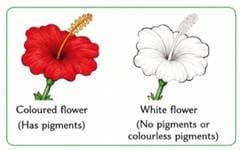
- Do white flowers possess pigments? Justify your answer. (📘 For the exact question, refer to the NCERT textbook.)
Yes, white flowers do contain pigments.
They appear white because they either lack coloured pigments or reflect all colours of light. Some white flowers may contain colourless pigments present inside their cells.
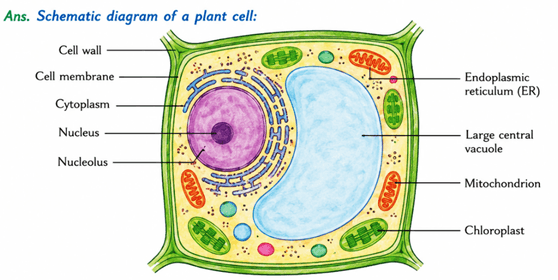
- Well-labelled schematic diagram of a plant cell (📘 For the exact question, refer to the NCERT textbook.)
- Why do cells contain several small mitochondria instead of one large mitochondrion? Explain with reference to surface area. (📘 For the exact question, refer to the NCERT textbook.)
A cell has many small mitochondria instead of one giant mitochondrion because smaller mitochondria provide a larger total surface area.
A larger surface area helps in faster exchange of materials and more efficient release of energy during respiration.
If there were one giant mitochondrion, its surface area compared to volume would be less, making energy production less efficient.
- Predict what would happen to the healing of a skin wound if skin cells underwent meiosis instead of mitosis. (📘 For the exact question, refer to the NCERT textbook.)
If skin cells divide by meiosis instead of mitosis, the cut on the skin would not heal properly.
Meiosis produces cells with half the number of chromosomes and is meant for formation of reproductive cells.
Skin repair requires mitosis, which produces identical body cells for growth and healing.
FAQs – Class 9 Science Chapter 2
1. What is Chapter 2 of Class 9 Science?
Chapter 2 of the new Class 9 Science textbook Exploration: A Textbook of Science for Grade 9 is “Cell: The Building Block of Life.” The chapter introduces students to cells and their role as the basic structural and functional units of living organisms.
2. What are the main topics covered in Class 9 Science Chapter 2?
The chapter covers important concepts related to cells, including cell structure, different types of cells, cell organelles, their functions, and the differences between plant and animal cells, as covered in the current NCERT textbook.
3. What is the basic unit of life?
The cell is considered the basic structural and functional unit of life. Living organisms are made up of cells, and cells perform the essential activities needed for life.
4. What are NCERT Solutions for Class 9 Science Chapter 2?
NCERT Solutions for Chapter 2 provide answers and explanations for the questions and activities given in Cell: The Building Block of Life. Students can use them to check their answers and understand the concepts discussed in the textbook.
5. What is the difference between a plant cell and an animal cell?
Plant and animal cells share many common structures, but they also have important differences. Plant cells generally have structures such as a cell wall and plastids, while animal cells do not have these structures. The detailed differences should be studied from the current NCERT textbook.
6. What are cell organelles?
Cell organelles are specialised structures within cells that perform particular functions. Examples include the nucleus, mitochondria, ribosomes, endoplasmic reticulum, Golgi apparatus, and vacuoles. Their functions should be learned along with their structure and location.
7. How should I prepare Class 9 Science Chapter 2?
Start by reading the NCERT chapter carefully and studying the diagrams and activities. Then practise the textbook questions and use the NCERT Solutions to check your answers. Revise the functions of important cell structures and practise drawing and labelling relevant diagrams.
8. Are NCERT Solutions enough to study Chapter 2?
NCERT Solutions are useful for understanding and checking textbook questions, but they should be used along with the NCERT textbook. Students should read the chapter, understand the activities and diagrams, and practise answering questions independently.
9. Is Chapter 2 important for the Class 9 Science exam?
Yes. Cell: The Building Block of Life introduces fundamental concepts of cell biology. Students should understand the concepts, structures, functions, diagrams, and textbook activities rather than relying only on memorisation.