Prepare for your exams with this Class 9 Science Chapter 9 Test Paper based on NCERT Exploration. This 50-mark test includes MCQs, short-answer questions, numerical problems, and long-answer questions with complete solutions to help you practise and assess your understanding of Atomic Foundations of Matter.
Table of Contents
CLASS 9 SCIENCE – Test
Chapter 9: Atomic Foundations of Matter
Maximum Marks: 50 Time: 2 Hours
General Instructions
- All questions are compulsory.
- Show all calculations clearly in numerical questions.
- Use the atomic masses provided in the question wherever required.
- Write chemical symbols and formulae correctly.
Section A – Multiple-Choice Questions
10 × 1 = 10 marks
Q1. Which scientist proposed the atomic theory of matter?
(a) Isaac Newton
(b) John Dalton
(c) Ernest Rutherford
(d) Niels Bohr
Q2. The law of conservation of mass states that in a chemical reaction:
(a) Mass is always increased.
(b) Mass is always decreased.
(c) Total mass remains conserved.
(d) Atoms are destroyed.
Q3. According to the law of constant proportions, a pure chemical compound always contains its elements in:
(a) Random proportions by mass
(b) A fixed proportion by mass
(c) Equal masses
(d) Equal numbers of atoms in every sample
Q4. What is the chemical symbol for sodium?
(a) S
(b) So
(c) Na
(d) N
Q5. What is the valency of oxygen in water?
(a) 1
(b) 2
(c) 3
(d) 4
Q6. What is the correct chemical formula of magnesium chloride?
(a) MgCl
(b) Mg₂Cl
(c) MgCl₂
(d) Mg₂Cl₂
Q7. How many atoms are present in one molecule of carbon dioxide, CO₂?
(a) 1
(b) 2
(c) 3
(d) 4
Q8. The molecular mass of water (H₂O) is: (H = 1 u, O = 16 u)
(a) 16 u
(b) 17 u
(c) 18 u
(d) 20 u
Q9. Which of the following represents a molecule of an element?
(a) H₂
(b) H₂O
(c) CO₂
(d) NaCl
Q10. The relative molecular mass of oxygen gas, O₂, is: (O = 16 u)
(a) 8
(b) 16
(c) 32
(d) 64
Section B – Very Short Answer Questions
5 × 2 = 10 marks
Q11. Define an atom and a molecule. Give one example of each. (2)
Q12. State the law of conservation of mass. (2)
Q13. What is valency? Write the valencies of sodium, magnesium, oxygen and chlorine. (2)
Q14. Differentiate between an atom and an ion. Give one example of each. (2)
Q15. Write the chemical formulae of the following compounds. (2)
(a) Calcium oxide
(b) Aluminium chloride
Section C – Short Answer Questions
4 × 3 = 12 marks
Q16. State Dalton’s atomic theory. Write any three postulates of the theory. (3)
Q17. Explain the law of constant proportions with a suitable example. (3)
Q18. Calculate the molecular masses of the following. (3)
(a) Ammonia, NH₃ (N = 14 u, H = 1 u)
(b) Calcium carbonate, CaCO₃ (Ca = 40 u, C = 12 u, O = 16 u)
Q19. Write the chemical formulae of the following compounds using the given valencies. Show how the formulae are obtained. (3)
(a) Aluminium oxide: Al = 3, O = 2
(b) Calcium hydroxide: Ca = 2, OH = 1
(c) Magnesium nitride: Mg = 2, N = 3
Section D – Application-Based and Numerical Questions
2 × 4 = 8 marks
Q20. A compound contains 12 g of carbon and 32 g of oxygen. (4)
(a) Calculate the total mass of the compound. (1)
(b) Find the ratio of the mass of carbon to oxygen in the compound. (1)
(c) If another sample of the same compound contains 6 g of carbon, what mass of oxygen will it contain? Explain using the law of constant proportions. (2)
Q21. Answer the following questions about the mole concept. (4)
(a) What is one mole of a substance? (1)
(b) How many particles are present in one mole of a substance? (1)
(c) Calculate the number of moles present in 36 g of water. The molar mass of water is 18 g/mol. (2)
Section E – Long Answer Questions
2 × 5 = 10 marks
Q22. Answer the following questions. (5)
(a) State the law of conservation of mass. (1)
(b) State the law of constant proportions. (1)
(c) Explain why chemical equations must be balanced in accordance with the law of conservation of mass. (1)
(d) In a chemical reaction, 12 g of carbon reacts completely with 32 g of oxygen to form carbon dioxide. Calculate the mass of carbon dioxide formed. (2)
Q23. Answer the following questions about atoms, molecules and chemical formulae. (5)
(a) What is atomic mass? (1)
(b) Calculate the molecular mass of sulphuric acid, H₂SO₄. (2)
Use H = 1 u, S = 32 u and O = 16 u.
(c) Write the chemical formula of aluminium sulphate using Al = 3 and SO₄ = 2 as the respective valencies. (1)
(d) How many oxygen atoms are present in one formula unit of Al₂(SO₄)₃? (1)
Class 9 Science – Chapter 9 Solutions
NCERT Exploration | Atomic Foundations of Matter | Complete Answer Key
Science World By Tushar Sir
These are the solutions to all 23 questions in the 50-mark test paper, with calculations and explanations suitable for Class 9 students.
Section A – Multiple-Choice Questions
10 × 1 = 10 marks
| Q. No. | Correct answer | Explanation |
|---|---|---|
| 1 | (b) John Dalton | Dalton proposed an atomic theory to explain the nature of matter. |
| 2 | (c) Total mass remains conserved | Matter is neither created nor destroyed in a chemical reaction. |
| 3 | (b) A fixed proportion by mass | A pure compound contains its constituent elements in a definite ratio by mass. |
| 4 | (c) Na | Na is the chemical symbol for sodium. |
| 5 | (b) 2 | Oxygen has valency 2 in water, H₂O. |
| 6 | (c) MgCl₂ | Magnesium has valency 2 and chlorine has valency 1. |
| 7 | (c) 3 | CO₂ contains one carbon atom and two oxygen atoms. |
| 8 | (c) 18 u | Molecular mass = \(2(1)+16=18\) u. |
| 9 | (a) H₂ | H₂ is a molecule made of atoms of the same element. |
| 10 | (c) 32 | Molecular mass of O₂ = \(2\times16=32\) u. |
Section B – Very Short Answer Questions
5 × 2 = 10 marks
Q11. Define an atom and a molecule. Give one example of each. (2 marks)
Atom: An atom is the smallest unit of an element that retains its chemical identity.
Example: He (helium).
Molecule: A molecule is a group of two or more atoms chemically bonded together that acts as a distinct unit.
Example: H₂O (water).
Q12. State the law of conservation of mass. (2 marks)
The law of conservation of mass states that mass can neither be created nor destroyed in a chemical reaction.
Therefore,
\[ \text{Total mass of reactants} = \text{Total mass of products} \]
Q13. What is valency? Write the valencies of sodium, magnesium, oxygen and chlorine. (2 marks)
Valency is the combining capacity of an atom, based on how it combines with other atoms.
| Element | Symbol | Valency |
|---|---|---|
| Sodium | Na | 1 |
| Magnesium | Mg | 2 |
| Oxygen | O | 2 |
| Chlorine | Cl | 1 |
Q14. Differentiate between an atom and an ion. Give one example of each. (2 marks)
| Atom | Ion |
|---|---|
| Electrically neutral particle. | Particle carrying a positive or negative charge. |
| Example: Na (sodium atom). | Example: Na⁺ (sodium ion). |
An ion forms when an atom or a group of atoms loses or gains electrons.
Q15. Write the chemical formulae of calcium oxide and aluminium chloride. (2 marks)
(a) Calcium oxide
- Calcium: Ca, valency 2
- Oxygen: O, valency 2
The valencies reduce to a 1:1 ratio.
Answer: \(\boxed{\mathrm{CaO}}\)
(b) Aluminium chloride
- Aluminium: Al, valency 3
- Chlorine: Cl, valency 1
Crossing the valencies gives:
Answer: \(\boxed{\mathrm{AlCl_3}}\)
Section C – Short Answer Questions
4 × 3 = 12 marks
Q16. State Dalton’s atomic theory. Write any three postulates. (3 marks)
Dalton’s atomic theory explains that matter is made up of atoms.
Three postulates are:
- All matter is composed of extremely small particles called atoms.
- Atoms of the same element were proposed to have the same mass and chemical properties, while atoms of different elements differ.
- Atoms combine in simple whole-number ratios to form compounds.
Note: Dalton’s original theory was an important early model; modern science has established that atoms contain subatomic particles and that isotopes of an element can have different masses.
Q17. Explain the law of constant proportions with an example. (3 marks)
The law of constant proportions states that a pure chemical compound always contains the same elements combined in a fixed proportion by mass, regardless of its source or method of preparation.
Example: Water
Water, H₂O, contains hydrogen and oxygen in a mass ratio of 1:8.
- 9 g of water contains 1 g of hydrogen and 8 g of oxygen.
- 18 g of water contains 2 g of hydrogen and 16 g of oxygen.
In both samples, the mass ratio of hydrogen to oxygen is 1:8.
Therefore, water obeys the law of constant proportions.
Q18. Calculate the molecular masses. (3 marks)
(a) Ammonia, NH₃
Given: N = 14 u, H = 1 u.
\[ \begin{aligned} \text{Molecular mass of NH}_3 &=14+3(1)\\ &=14+3\\ &=\boxed{17\text{ u}} \end{aligned} \]
Answer: 17 u
(b) Calcium carbonate, CaCO₃
Given: Ca = 40 u, C = 12 u, O = 16 u.
\[ \begin{aligned} \text{Molecular/formula mass} &=40+12+3(16)\\ &=40+12+48\\ &=\boxed{100\text{ u}} \end{aligned} \]
Answer: 100 u
Strictly speaking, calcium carbonate is an ionic compound, so 100 u is its formula unit mass, rather than molecular mass.
Q19. Write the chemical formulae using valencies. (3 marks)
(a) Aluminium oxide
Al valency = 3; O valency = 2.
Cross the valencies:
\[ \mathrm{Al^{3+},\ O^{2-}} \]
\[ \boxed{\mathrm{Al_2O_3}} \]
(b) Calcium hydroxide
Ca valency = 2; OH valency = 1.
Two hydroxide ions are required for one calcium ion.
\[ \boxed{\mathrm{Ca(OH)_2}} \]
Parentheses are necessary because the hydroxide group occurs twice.
(c) Magnesium nitride
Mg valency = 2; N valency = 3.
Cross the valencies:
\[ \boxed{\mathrm{Mg_3N_2}} \]
Three magnesium atoms combine with two nitrogen atoms in the formula unit.
Section D – Application-Based and Numerical Questions
2 × 4 = 8 marks
Q20. A compound contains 12 g of carbon and 32 g of oxygen. (4 marks)
(a) Calculate the total mass of the compound. (1 mark)
Given:
- Mass of carbon = 12 g
- Mass of oxygen = 32 g
\[ \begin{aligned} \text{Total mass}&=12+32\\ &=\boxed{44\text{ g}} \end{aligned} \]
Answer: 44 g
(b) Find the mass ratio of carbon to oxygen. (1 mark)
\[ \begin{aligned} C:O&=12:32\\ &=\boxed{3:8} \end{aligned} \]
Answer: 3:8
(c) If another sample contains 6 g of carbon, calculate the mass of oxygen. (2 marks)
According to the law of constant proportions,
\[ \frac{\text{Mass of oxygen}}{\text{Mass of carbon}} =\frac{32}{12} \]
Let the required mass of oxygen be \(x\).
\[ \frac{x}{6}=\frac{32}{12} \]
\[ x=\frac{32\times6}{12} \]
\[ \boxed{x=16\text{ g}} \]
Answer: 16 g of oxygen. The carbon-to-oxygen mass ratio remains 3:8.
Q21. Answer the questions about the mole concept. (4 marks)
(a) What is one mole of a substance? (1 mark)
One mole is the amount of substance containing approximately \(6.022\times10^{23}\) specified elementary entities, such as atoms, molecules or ions.
(b) How many particles are present in one mole? (1 mark)
One mole contains Avogadro’s number of entities:
\[ \boxed{6.022\times10^{23}\text{ particles}} \]
(c) Calculate the number of moles in 36 g of water. (2 marks)
Given:
- Mass = 36 g
- Molar mass of water = 18 g/mol
Formula:
\[ \text{Number of moles} =\frac{\text{Given mass}}{\text{Molar mass}} \]
Substituting:
\[ n=\frac{36}{18}=2 \]
\[ \boxed{n=2\text{ mol}} \]
Answer: 2 moles of water.
Section E – Long Answer Questions
2 × 5 = 10 marks
Q22. Answer the following questions. (5 marks)
(a) State the law of conservation of mass. (1 mark)
Mass can neither be created nor destroyed during a chemical reaction. The total mass of the reactants is equal to the total mass of the products.
(b) State the law of constant proportions. (1 mark)
A pure chemical compound always contains the same elements combined in a fixed proportion by mass.
(c) Why must a chemical equation be balanced? (1 mark)
A chemical equation must be balanced because atoms are neither created nor destroyed in a chemical reaction. Therefore, the number of atoms of each element must be equal on both sides of the equation.
(d) Calculate the mass of carbon dioxide formed when 12 g of carbon reacts completely with 32 g of oxygen. (2 marks)
Given:
- Mass of carbon = 12 g
- Mass of oxygen = 32 g
Chemical equation:
\[ \mathrm{C+O_2\rightarrow CO_2} \]
According to the law of conservation of mass,
\[ \begin{aligned} \text{Mass of CO}_2 &=\text{Mass of C}+\text{Mass of O}_2\\ &=12+32\\ &=\boxed{44\text{ g}} \end{aligned} \]
Answer: 44 g of carbon dioxide.
Q23. Answer the following questions about atoms, molecules and chemical formulae. (5 marks)
(a) What is atomic mass? (1 mark)
Atomic mass is the mass of an atom, commonly expressed in unified atomic mass units (u). One unified atomic mass unit is defined as one-twelfth of the mass of a carbon-12 atom.
(b) Calculate the molecular mass of sulphuric acid, H₂SO₄. (2 marks)
Given:
- H = 1 u
- S = 32 u
- O = 16 u
Formula:
\[ \text{Mass of H}_2\text{SO}_4 =2H+S+4O \]
Substituting the values:
\[ \begin{aligned} &=2(1)+32+4(16)\\ &=2+32+64\\ &=\boxed{98\text{ u}} \end{aligned} \]
Answer: 98 u
(c) Write the chemical formula of aluminium sulphate. (1 mark)
Given:
- Valency of aluminium (Al) = 3
- Valency of sulphate (SO₄) = 2
Crossing the valencies gives:
\[ \boxed{\mathrm{Al_2(SO_4)_3}} \]
Answer: Al₂(SO₄)₃
(d) How many oxygen atoms are present in one formula unit of Al₂(SO₄)₃? (1 mark)
The formula contains three sulphate groups, and each sulphate group contains four oxygen atoms.
\[ \text{Number of oxygen atoms}=3\times4 \]
\[ \boxed{12\text{ oxygen atoms}} \]
Answer: 12 oxygen atoms.
Final Answer Key – Quick Revision
| Question | Answer |
|---|---|
| Q1–Q10 | B, C, B, C, B, C, C, C, A, C |
| Q15(a) | CaO |
| Q15(b) | AlCl₃ |
| Q18(a) | 17 u |
| Q18(b) | 100 u |
| Q19(a) | Al₂O₃ |
| Q19(b) | Ca(OH)₂ |
| Q19(c) | Mg₃N₂ |
| Q20(a) | 44 g |
| Q20(b) | 3:8 |
| Q20(c) | 16 g |
| Q21(c) | 2 mol |
| Q22(d) | 44 g |
| Q23(b) | 98 u |
| Q23(c) | Al₂(SO₄)₃ |
| Q23(d) | 12 oxygen atoms |
Class 9 Mathematics Complete NCERT Solution – Ganita Manjari
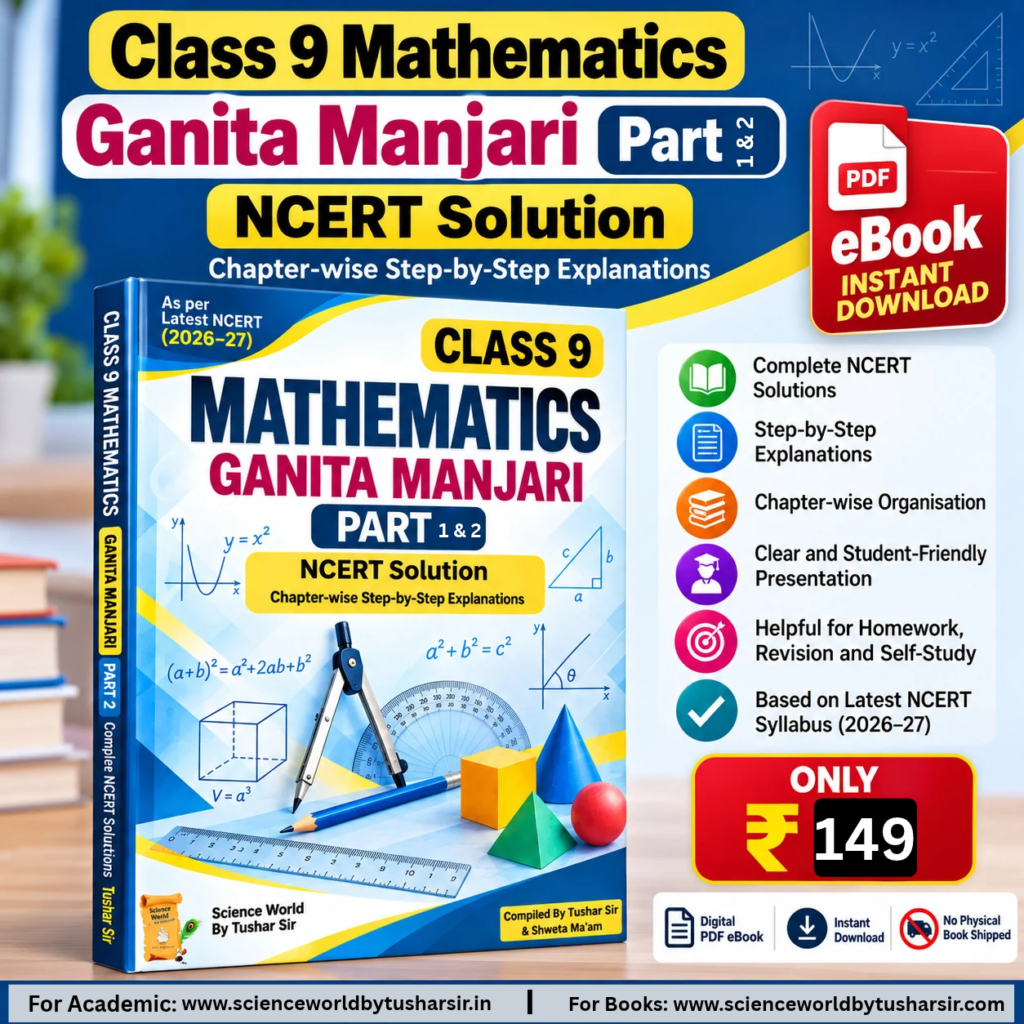
Class 9 Mathematics Ganita Manjari Part 1 & 2 – Complete NCERT Solutions PDF Bundle
Get both Class 9 Mathematics Ganita Manjari Part 1 and Part 2 NCERT Solutions PDFs in one affordable bundle.
- Complete chapter-wise NCERT solutions for both parts
- Step-by-step explanations
- Helpful for homework, practice, and revision
- Includes two downloadable PDF eBooks
Bundle price: ₹149
Digital product only. No physical books will be shipped.