
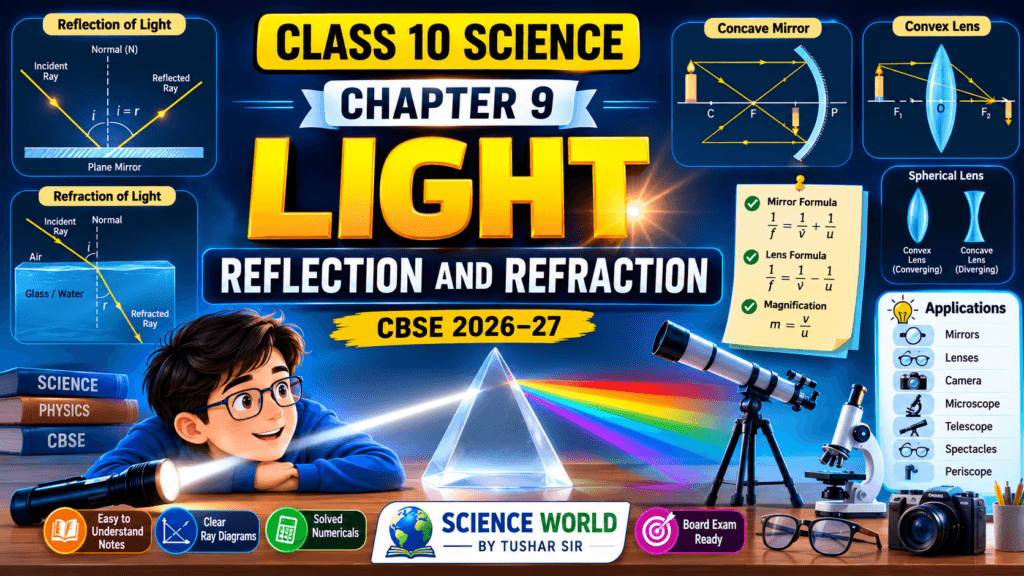
Introduction
Light is a form of energy that enables us to see objects around us. Without light, our eyes cannot detect the shape, colour, or size of objects. The Sun is the primary natural source of light for Earth, while electric bulbs, candles, LEDs, and tube lights are common artificial sources.
Light travels in a straight line and exhibits several important phenomena such as reflection, refraction, dispersion, scattering, and absorption. In this chapter, we focus on reflection and refraction, which explain the working of mirrors, lenses, cameras, microscopes, telescopes, spectacles, and many other optical devices.
Understanding these concepts is essential for solving numerical problems and answering theory questions in the CBSE Class 10 Board Examination. (Light – Reflection and Refraction Class 10 Notes)
Learning Objectives
After studying this part, you will be able to:
- Understand the meaning of light.
- Identify natural and artificial sources of light.
- Differentiate between luminous and non-luminous objects.
- Explain the properties of light.
- Define reflection of light.
- State and explain the laws of reflection.
- Distinguish between regular and diffused reflection.
- Understand image formation by a plane mirror.
What is Light?
Light is a form of energy that produces the sensation of vision. It travels as electromagnetic waves and allows us to see objects when it enters our eyes.
Definition:
Light is a form of energy that enables us to see objects.
Characteristics of Light
- Light is a form of energy.
- It travels in a straight line in a uniform medium.
- It does not require a material medium for propagation.
- It travels fastest in a vacuum.
- It can be reflected, refracted, dispersed, absorbed, and scattered.
- The speed of light in a vacuum is 3 × 10⁸ m/s.
Sources of Light
Objects that emit light are called sources of light.
1. Natural Sources
These occur naturally in nature.
Examples
- Sun
- Stars
- Lightning
- Fireflies
2. Artificial Sources
These are made by humans.
Examples
- Electric bulb
- LED lamp
- Candle
- Torch
- Tube light
Luminous and Non-Luminous Objects
Luminous Objects
Objects that produce their own light are called luminous objects.
Examples
- Sun
- Electric bulb
- Candle flame
- LED
Non-Luminous Objects
Objects that do not emit light but become visible by reflecting light are called non-luminous objects.
Examples
- Moon
- Table
- Chair
- Book
- Earth
- Human body
Did You Know?
The Moon does not produce its own light. It shines because it reflects sunlight.
Types of Transparent Materials
| Material | Light Passes Through? | Examples |
|---|---|---|
| Transparent | Completely | Glass, Pure Water, Air |
| Translucent | Partially | Butter Paper, Frosted Glass |
| Opaque | Does Not Pass | Wood, Stone, Metal |
Rectilinear Propagation of Light
Light always travels in a straight line in a homogeneous medium.
This property is known as the rectilinear propagation of light.
Everyday Examples
- Formation of shadows
- Solar eclipse
- Lunar eclipse
- Straight beam from a torch
- Sunlight entering through a small hole
Reflection of Light
When light falls on a smooth surface, it bounces back into the same medium. This phenomenon is called reflection of light.
Definition:
Reflection is the bouncing back of light into the same medium after striking a surface.
Examples of Reflection
- Mirror
- Calm water
- Polished metal
- Glass surface
Reflection enables us to see images in mirrors and shiny objects.
Important Terms Related to Reflection
1. Incident Ray
The ray of light that strikes the reflecting surface.
2. Reflected Ray
The ray of light that bounces back after striking the reflecting surface.
3. Point of Incidence
The point at which the incident ray strikes the reflecting surface.
4. Normal
An imaginary line drawn perpendicular (90°) to the reflecting surface at the point of incidence.
5. Angle of Incidence (∠i)
The angle between the incident ray and the normal.
6. Angle of Reflection (∠r)
The angle between the reflected ray and the normal.
Laws of Reflection
Reflection of light follows two important laws.
First Law of Reflection
The angle of incidence is equal to the angle of reflection.
Formula
∠i = ∠r
Second Law of Reflection
The incident ray, reflected ray, and the normal at the point of incidence all lie in the same plane.
Types of Reflection
Reflection can be of two types.
1. Regular (Specular) Reflection
Regular reflection occurs when light falls on a smooth and polished surface.
Examples:
- Plane mirror
- Calm water
- Polished steel
Characteristics
- Forms a clear image.
- Reflected rays remain parallel.
- Occurs on smooth surfaces.
2. Diffused (Irregular) Reflection
Diffused reflection occurs when light falls on a rough surface.
Examples:
- Wall
- Paper
- Road
- Cloth
Characteristics
- No clear image is formed.
- Reflected rays scatter in different directions.
- Makes objects visible from different angles.
Difference Between Regular and Diffused Reflection
| Regular Reflection | Diffused Reflection |
|---|---|
| Smooth surface | Rough surface |
| Clear image formed | No clear image |
| Rays remain parallel | Rays scatter |
| Mirror is an example | Wall is an example |
Plane Mirror
A plane mirror is a mirror with a flat reflecting surface.
It produces images that are easy to study and understand.
Characteristics of Image Formed by a Plane Mirror
| Property | Description |
|---|---|
| Nature | Virtual |
| Position | Behind the mirror |
| Size | Same as object |
| Orientation | Erect |
| Lateral Inversion | Present |
| Distance | Image distance = Object distance |
What is Lateral Inversion?
The left side of an object appears as the right side in the mirror, and the right side appears as the left.
This phenomenon is known as lateral inversion.
Example
The word AMBULANCE is written in reverse on the front of ambulances so that drivers can read it correctly in their rear-view mirrors.
Everyday Applications of Reflection
Reflection is used in:
- Dressing mirrors
- Vehicle rear-view mirrors
- Solar cookers
- Periscopes
- Kaleidoscopes
- Optical instruments
- Decorative mirrors
What are Spherical Mirrors?
A spherical mirror is a mirror whose reflecting surface forms part of a hollow sphere.
Unlike a plane mirror, spherical mirrors can produce images of different sizes and positions depending on the object’s location. They are widely used in vehicles, hospitals, telescopes, solar furnaces, and optical instruments.
There are two types of spherical mirrors:
- Concave Mirror
- Convex Mirror
1. Concave Mirror
A concave mirror is a mirror whose reflecting surface is curved inward (towards the centre of the sphere).
It is also known as a converging mirror because it converges parallel rays of light to a single point called the principal focus.
Examples
- Shaving mirror
- Dentist’s mirror
- Solar furnace
- Headlights of vehicles
- Reflecting telescopes
2. Convex Mirror
A convex mirror is a mirror whose reflecting surface is curved outward.
It is also called a diverging mirror because it causes parallel rays of light to spread out after reflection.
Examples
- Rear-view mirrors
- Security mirrors in shops
- Road safety mirrors at blind turns
Difference Between Concave and Convex Mirrors
| Concave Mirror | Convex Mirror |
|---|---|
| Curved inward | Curved outward |
| Converges light rays | Diverges light rays |
| Can form real or virtual images | Always forms virtual images |
| Image may be magnified or diminished | Image is always diminished |
| Small field of view | Large field of view |
Important Terms Related to Spherical Mirrors
Understanding these terms is essential before learning image formation and numerical problems.
1. Pole (P)
The pole is the geometric centre of the reflecting surface of a spherical mirror.
It is represented by P.
2. Centre of Curvature (C)
The centre of curvature is the centre of the sphere of which the mirror is a part.
It is represented by C.
3. Radius of Curvature (R)
The radius of curvature is the distance between the pole (P) and the centre of curvature (C).
4. Principal Axis
The principal axis is the straight line passing through the pole (P) and the centre of curvature (C).
All important measurements are taken along this axis.
5. Principal Focus (F)
The principal focus is the point where rays parallel to the principal axis:
- Meet after reflection (concave mirror), or
- Appear to diverge from (convex mirror).
6. Focal Length (f)
The focal length is the distance between the pole (P) and the principal focus (F).f=PF
Relationship Between Radius of Curvature and Focal Length
For all spherical mirrors,R=2f
orf=2R
⭐ Very Important Formula for CBSE Exams
Important Rays Used in Ray Diagrams
These rays are frequently used in CBSE examinations.
Ray 1
A ray parallel to the principal axis passes through the principal focus after reflection.
Applicable to: Concave mirror
Ray 2
A ray passing through the principal focus becomes parallel to the principal axis after reflection.
Ray 3
A ray passing through the centre of curvature retraces its path after reflection.
Ray 4
A ray striking the pole reflects such that the angle of incidence equals the angle of reflection.
Comparison of Concave and Convex Mirrors
| Feature | Concave Mirror | Convex Mirror |
|---|---|---|
| Nature | Converging | Diverging |
| Focus | In front of mirror | Behind mirror |
| Real image possible | Yes | No |
| Virtual image possible | Yes | Yes |
| Magnification | May increase or decrease | Always decreases |
| Field of View | Small | Large |
Uses of Concave Mirror
1. Shaving Mirror
Produces a magnified, erect image when the face is placed close to the mirror.
2. Dentist’s Mirror
Provides an enlarged image of teeth for detailed examination.
3. Reflectors in Headlights
Concave mirrors reflect light into a nearly parallel beam, increasing visibility.
4. Solar Furnaces
Concentrate sunlight at one point to generate high temperatures.
5. Reflecting Telescopes
Used to collect and focus light from distant celestial objects.
Uses of Convex Mirror
1. Rear-View Mirrors
Provide a wide field of view, allowing drivers to see more of the road behind.
2. Security Mirrors
Installed in shopping malls and banks for surveillance.
3. Road Safety Mirrors
Placed at blind turns and parking exits to improve visibility.
Everyday Applications
| Mirror | Application |
|---|---|
| Concave | Shaving mirror |
| Concave | Dentist’s mirror |
| Concave | Vehicle headlights |
| Concave | Solar cooker |
| Convex | Rear-view mirror |
| Convex | Security mirror |
| Convex | Traffic mirrors |
Image Formation by Spherical Mirrors, Sign Convention, Mirror Formula and Magnification
This is one of the most important sections of Chapter 9 and is frequently tested in the CBSE Class 10 Board Examination. Students should understand the image formation by concave and convex mirrors, learn the New Cartesian Sign Convention, and practice applying the mirror formula and magnification formula to solve numerical problems.
Image Formation by a Concave Mirror
The position, size, and nature of the image formed by a concave mirror depend on the position of the object with respect to the Pole (P), Principal Focus (F), and Centre of Curvature (C).
Case 1: Object at Infinity
Case 2: Object Beyond Centre of Curvature (Beyond C)
Case 3: Object at Centre of Curvature (At C)
Case 4: Object Between C and F
Case 5: Object at Principal Focus (F)
Summary Table: Image Formation by Concave Mirror
| Object Position | Image Position | Nature | Size |
|---|---|---|---|
| At Infinity | At F | Real, Inverted | Point-sized |
| Beyond C | Between C and F | Real, Inverted | Diminished |
| At C | At C | Real, Inverted | Same Size |
| Between C & F | Beyond C | Real, Inverted | Enlarged |
| At F | At Infinity | Real, Inverted | Highly Enlarged |
| Between F & P | Behind Mirror | Virtual, Erect | Enlarged |
Image Formation by a Convex Mirror
A convex mirror always forms:
- Virtual image
- Erect image
- Diminished image
- Behind the mirror
Case 1: Object at Infinity
Image
- At Focus (F)
- Virtual
- Erect
- Highly Diminished
Case 2: Object Anywhere in Front of Mirror
Image
- Between Pole (P) and Focus (F)
- Virtual
- Erect
- Diminished
Summary Table: Convex Mirror
| Object Position | Image Position | Nature | Size |
|---|---|---|---|
| At Infinity | At F | Virtual, Erect | Point-sized |
| Anywhere | Between P and F | Virtual, Erect | Diminished |
New Cartesian Sign Convention
To solve numerical problems correctly, follow the New Cartesian Sign Convention.
Rules
- Pole (P) is taken as the origin.
- Principal axis is the reference line.
- All distances are measured from the pole.
- Distances measured towards the left are negative.
- Distances measured towards the right are positive.
- Heights measured upwards are positive.
- Heights measured downwards are negative.
Mirror Formula
The mirror formula relates the object distance, image distance, and focal length.
Formula
Where:
- f = Focal length
- u = Object distance
- v = Image distance
Important Formula: Frequently asked in CBSE Board Exams.
Magnification
Magnification tells us how much larger or smaller the image is compared to the object.
Formula
Also,
Where:
- hi = Height of image
- ho = Height of object
- v = Image distance
- u = Object distance
Interpretation of Magnification
| Magnification | Meaning |
|---|---|
| m > 1 | Enlarged image |
| m = 1 | Same size |
| m < 1 | Diminished image |
| Positive | Virtual and erect |
| Negative | Real and inverted |
Question
An object is placed 20 cm in front of a concave mirror of focal length 10 cm.
Find the image distance.
Given
- u=−20 cm
- f=−10 cm
Using the mirror formula:
Answer
Image Distance = -20 cm
The image is formed at the centre of curvature, is real, inverted, and same in size.
Solved Numerical 2
Question
An object is placed 15 cm in front of a convex mirror of focal length 10 cm.
Find the image distance.
Given
- u=−15 cm
- f=+10 cm
Using the mirror formula:
Answer
The image forms 6 cm behind the mirror, and it is virtual, erect, and diminished.
Formula Box
Mirror Formula
Magnification
Radius of Curvature
R=2f
What is Refraction of Light?
When light travels from one transparent medium to another (such as from air to water or air to glass), its speed changes. Due to this change in speed, the light ray bends at the boundary between the two media. This bending of light is called refraction.
Definition:
Refraction of light is the bending of light when it passes obliquely from one transparent medium to another because of a change in its speed.
Refraction is responsible for many everyday phenomena, such as a pencil appearing bent in water, the apparent depth of a swimming pool, and the formation of images by lenses.
Why Does Refraction Occur?
Refraction occurs because the speed of light changes when it enters a medium of different optical density.
- Light travels fastest in a vacuum.
- It travels slower in water than in air.
- It travels even slower in glass than in water.
Since the speed changes, the direction of light also changes.
Refraction Through Different Media
Case 1: Light Travels from a Rarer Medium to a Denser Medium
Examples:
- Air → Water
- Air → Glass
In this case:
- The speed of light decreases.
- The light ray bends towards the normal.
Case 2: Light Travels from a Denser Medium to a Rarer Medium
Examples:
- Glass → Air
- Water → Air
In this case:
The light ray bends away from the normal.
The speed of light increases.
Terms Related to Refraction
Incident Ray
The ray of light falling on the surface separating two media.
Refracted Ray
The ray of light that changes direction after entering the second medium.
Normal
An imaginary line drawn perpendicular to the surface at the point of incidence.
Angle of Incidence (∠i)
The angle between the incident ray and the normal.
Angle of Refraction (∠r)
The angle between the refracted ray and the normal.
Laws of Refraction
Refraction follows two important laws.
First Law of Refraction
The incident ray, the refracted ray, and the normal at the point of incidence all lie in the same plane.
Second Law of Refraction (Snell’s Law)
For a given pair of media,
This constant is called the refractive index of the second medium with respect to the first.
Refractive Index
The refractive index of a medium indicates how much light slows down in that medium compared to a vacuum.
Formula
Where:
- n = Refractive Index
- c = Speed of light in vacuum
- v = Speed of light in the medium
Meaning of Refractive Index
- Larger refractive index → Light travels more slowly.
- Smaller refractive index → Light travels faster.
Optical Density
Optical density refers to how much a medium slows down light.
- Higher optical density → Higher refractive index.
- Lower optical density → Lower refractive index.
Note: Optical density is not the same as mass density.
Refraction Through a Rectangular Glass Slab
When light passes through a rectangular glass slab:
- It bends towards the normal while entering the slab.
- It travels in a straight line inside the slab.
- It bends away from the normal while leaving the slab.
- The emergent ray is parallel to the incident ray but is shifted sideways.
This sideways shift is called lateral displacement.
Factors Affecting Refraction
The amount of bending depends on:
- Nature of the two media.
- Angle of incidence.
- Difference in refractive indices.
- Wavelength (colour) of light.
Real-Life Examples of Refraction
1. Pencil Appears Bent in Water
A pencil placed in a glass of water appears bent because light from the submerged part is refracted when it enters the air.
2. Coin Appears Raised
A coin placed at the bottom of a bowl appears higher than its actual position due to refraction.
3. Swimming Pool Appears Shallower
The bottom of a swimming pool appears closer because light bends as it emerges from water into air.
4. Twinkling of Stars
Changes in the Earth’s atmosphere continuously refract starlight, making stars appear to twinkle.
5. Formation of Rainbow
Rainbows form due to refraction, dispersion, and internal reflection of sunlight inside raindrops.
Difference Between Reflection and Refraction
| Reflection | Refraction |
|---|---|
| Light bounces back into the same medium | Light enters a new medium |
| Speed of light remains the same | Speed of light changes |
| Occurs at reflecting surfaces | Occurs at the boundary of two transparent media |
| Governed by laws of reflection | Governed by laws of refraction |
Formula Box
Snell’s Law
Refractive Index
What is a Lens?
A lens is a transparent optical medium bounded by two curved surfaces or by one curved surface and one plane surface. Lenses refract light and are used to form images.
Lenses are widely used in:
- Spectacles
- Cameras
- Microscopes
- Telescopes
- Magnifying glasses
- Projectors
- Binoculars
There are two main types of spherical lenses.
1. Convex Lens
A convex lens is thicker at the centre and thinner at the edges.
It is also called a converging lens because it converges parallel rays of light to a single point.
Characteristics
- Thicker in the middle
- Converges light rays
- Can form both real and virtual images
- Positive focal length
Uses
- Magnifying glass
- Camera
- Microscope
- Telescope
- Human eye correction (Hypermetropia)
2. Concave Lens
A concave lens is thinner at the centre and thicker at the edges.
It is also called a diverging lens because it diverges parallel rays of light.
Characteristics
- Thin in the middle
- Diverges light rays
- Always forms virtual images
- Negative focal length
Uses
- Spectacles for Myopia
- Door viewers (peepholes)
- Optical instruments
Difference Between Convex and Concave Lens
| Convex Lens | Concave Lens |
|---|---|
| Thick at centre | Thin at centre |
| Thin at edges | Thick at edges |
| Converges light | Diverges light |
| Positive focal length | Negative focal length |
| Forms real or virtual images | Always forms virtual images |
Important Terms Related to Lenses
Optical Centre (O)
The optical centre is the point through which a ray of light passes without deviation.
It is represented by O.
Principal Axis
The straight line passing through the optical centre and the centres of curvature of both surfaces is called the principal axis.
Principal Focus (F)
The point where rays parallel to the principal axis converge (convex lens) or appear to diverge from (concave lens) after refraction.
Each lens has two principal foci.
Summary Table: Convex Lens
| Object Position | Image Position | Nature | Size |
|---|---|---|---|
| Infinity | F₂ | Real | Point-sized |
| Beyond 2F₁ | Between F₂ & 2F₂ | Real | Diminished |
| At 2F₁ | At 2F₂ | Real | Same Size |
| Between F₁ & 2F₁ | Beyond 2F₂ | Real | Enlarged |
| At F₁ | Infinity | Real | Highly Enlarged |
| Between F₁ & O | Same Side | Virtual | Enlarged |
Image Formation by Concave Lens
A concave lens always forms:
- Virtual image
- Erect image
- Diminished image
- Same side of the lens
Summary Table: Concave Lens
| Object Position | Image Position | Nature | Size |
|---|---|---|---|
| Anywhere | Between F₁ and O | Virtual | Diminished |
Sign Convention for Lenses
The New Cartesian Sign Convention is also used for lenses.
Rules
- Optical centre is the origin.
- Distances measured towards the left are negative.
- Distances measured towards the right are positive.
- Heights above the principal axis are positive.
- Heights below the principal axis are negative.
Lens Formula
The relationship between focal length, object distance, and image distance is given by:f1=v1−u1
Where:
- f = Focal length
- u = Object distance
- v = Image distance
Magnification by Lens
Magnification is defined as:
Also,
Power of a Lens
The power of a lens measures its ability to converge or diverge light.
Formula
P=f1
Where:
- P = Power (Dioptre)
- f = Focal length (in metres)
SI Unit
Dioptre (D)
Examples
Iff=0.5m
ThenP=0.51=2D
Iff=−0.5m
ThenP=−2D
Sign of Power
| Lens | Power |
|---|---|
| Convex Lens | Positive |
| Concave Lens | Negative |
Solved Numerical 1
Question
A convex lens has a focal length of 20 cm.
Find its power.
Solution
Convert focal length into metres.20cm=0.20m
UsingP=f1 P=0.201=+5D
Answer
Power = +5 D
Solved Numerical 2
Question
A concave lens has a focal length of −50 cm.
Find its power.
Solution
f=−0.50m P=−0.501 P=−2D
Answer
Power = −2 D
Formula Box
Lens Formula
f1=v1−u1
Magnification
m=uv
Power
P=f1
Everyday Applications of Lenses
| Instrument | Lens Used |
|---|---|
| Magnifying Glass | Convex Lens |
| Camera | Convex Lens |
| Microscope | Convex Lens |
| Telescope | Convex Lens |
| Spectacles for Hypermetropia | Convex Lens |
| Spectacles for Myopia | Concave Lens |
| Door Peephole | Concave Lens |
Board Exam Tips
⭐ Memorize all six image formation cases for a convex lens.
⭐ Learn the lens formula and power formula accurately.
⭐ Always convert focal length from centimetres to metres before calculating power.
⭐ Practice neat ray diagrams for both convex and concave lenses.
⭐ Numerical questions on lens formula and power of a lens are frequently asked in CBSE board examinations.
Complete Formula Sheet
This formula sheet contains all the important formulas from Chapter 9: Light – Reflection and Refraction. Learn them thoroughly for the CBSE Board Examination.
1. Mirror Formula
f1=v1+u1
Where:
- f = Focal length
- u = Object distance
- v = Image distance
2. Magnification (Mirror)
m=hohi
Also,m=−uv
3. Radius of Curvature
R=2f
4. Lens Formula
f1=v1−u1
5. Magnification (Lens)
m=hohi
Also,m=uv
6. Power of Lens
P=f1
(Focal length must be in metres.)
7. Refractive Index
n=vc
8. Snell’s Law
sinrsini=n
Important Sign Convention
| Quantity | Concave Mirror | Convex Mirror | Convex Lens | Concave Lens |
|---|---|---|---|---|
| Object Distance (u) | Negative | Negative | Negative | Negative |
| Focal Length (f) | Negative | Positive | Positive | Negative |
| Image Distance (v) | Depends on image | Positive | Depends on image | Negative |
Solved Numerical 1
Question
A concave mirror has a focal length of 15 cm. An object is placed 30 cm in front of the mirror. Find the image distance.
Given
- f=−15 cm
- u=−30 cm
Formula
f1=v1+u1
Solution
−151=v1+−301 v1=−151+301 v1=−301 v=−30 cm
Answer
Image Distance = -30 cm
Image is real, inverted, and same size.
Solved Numerical 2
Question
A convex lens has a focal length of 25 cm.
Find its power.
Solution
Convert into metres.25cm=0.25m P=0.251 P=+4D
Answer
Power = +4 D
Solved Numerical 3
Question
A concave lens has a power of −5 D.
Find its focal length.
Formula
f=P1
Solution
f=−51 f=−0.20m f=−20cm
Answer
Focal Length = −20 cm
Most Important NCERT Points
✔ Light travels in straight lines.
✔ Reflection follows two laws.
✔ Refraction occurs because the speed of light changes in different media.
✔ Concave mirrors are converging mirrors.
✔ Convex mirrors are diverging mirrors.
✔ Convex lenses are converging lenses.
✔ Concave lenses are diverging lenses.
✔ Rear-view mirrors are convex mirrors.
✔ Dentists use concave mirrors.
✔ Magnifying glasses use convex lenses.
✔ Power of lens is measured in Dioptre.
✔ Diamond has a high refractive index.
✔ Rectangular glass slabs produce lateral displacement.
Common Mistakes to Avoid
❌ Using the wrong sign convention.
❌ Forgetting to convert centimetres into metres while calculating power.
❌ Using the mirror formula for lens questions.
❌ Drawing incomplete ray diagrams.
❌ Forgetting units in numerical answers.
❌ Ignoring the nature of the image (real/virtual, erect/inverted).
Last-Minute Revision Table
| Topic | Formula / Fact |
|---|---|
| Mirror Formula | 1/f=1/v+1/u |
| Lens Formula | 1/f=1/v−1/u |
| Mirror Magnification | m=−v/u |
| Lens Magnification | m=v/u |
| Radius of Curvature | R=2f |
| Power | P=1/f |
| Refractive Index | n=c/v |
| Snell’s Law | sini/sinr=n |
Assertion–Reason Questions
Question 1
Assertion (A): A convex mirror always forms a virtual and diminished image.
Reason (R): A convex mirror diverges light rays.
Answer: Both A and R are true, and R is the correct explanation of A.
Question 2
Assertion (A): A convex lens is called a converging lens.
Reason (R): It converges parallel rays of light to a principal focus.
Answer: Both A and R are true, and R is the correct explanation of A.
Question 3
Assertion (A): Refraction occurs due to a change in the speed of light.
Reason (R): The frequency of light changes when it enters another medium.
Answer: Assertion is true, but Reason is false. The frequency remains constant; only the speed and wavelength change.
Case-Based Questions
Case Study 1
A driver uses a rear-view mirror while driving. The mirror always provides an upright and smaller image of vehicles behind.
Questions
- Which mirror is used?
- What is the nature of the image?
- Why is this mirror preferred?
- Is the image real or virtual?
Answers
- Convex mirror
- Erect and diminished
- It provides a wide field of view.
- Virtual
Case Study 2
A student uses a magnifying glass to observe the wings of an insect.
Questions
- Which type of lens is used?
- What kind of image is formed?
- Why does the image appear enlarged?
Answers
- Convex lens
- Virtual, erect, and magnified
- The object is placed between the optical centre and the principal focus.
Important Board Questions
Very Short Answer
- Define reflection of light.
- State Snell’s Law.
- What is the SI unit of power?
- Why is a convex mirror used as a rear-view mirror?
- Define refractive index.
Short Answer Questions
- Differentiate between reflection and refraction.
- Explain image formation by a concave mirror.
- State the lens formula.
- Explain the laws of reflection.
- Define magnification.
Long Answer Questions
- Explain image formation by a convex lens with ray diagrams.
- Derive the mirror formula (as per syllabus requirements, if applicable).
- Describe refraction through a glass slab with a labelled diagram.
- Compare concave and convex mirrors with suitable examples.
- Explain the applications of mirrors and lenses in daily life.
Chapter Summary
Light is a form of energy that enables us to see objects. It travels in straight lines and exhibits important phenomena such as reflection and refraction. Reflection is the bouncing back of light from a surface and follows two laws: the angle of incidence equals the angle of reflection, and the incident ray, reflected ray, and normal lie in the same plane.
Spherical mirrors are of two types: concave and convex. A concave mirror can form both real and virtual images depending on the object’s position, while a convex mirror always forms a virtual, erect, and diminished image, making it suitable for rear-view mirrors.
Refraction is the bending of light when it passes from one transparent medium to another due to a change in its speed. It follows Snell’s Law, and the refractive index indicates how much light slows down in a medium.
Lenses are transparent optical devices that refract light. A convex lens converges light rays and can form both real and virtual images, whereas a concave lens diverges light rays and always forms virtual, erect, and diminished images. Important formulas such as the mirror formula, lens formula, magnification, and power of a lens are widely used in numerical problems.
Understanding these concepts is essential for solving board-level questions and explaining the working of many optical instruments used in everyday life.
Frequently Asked Questions (FAQs)
1. What is reflection of light?
Reflection is the bouncing back of light into the same medium after striking a reflecting surface.
2. What is refraction of light?
Refraction is the bending of light when it passes from one transparent medium to another due to a change in its speed.
3. Why is a convex mirror used as a rear-view mirror?
A convex mirror provides a wide field of view and always forms a virtual, erect, and diminished image, allowing drivers to see more of the traffic behind them.
4. What is the mirror formula?
f1=v1+u1
5. What is the lens formula?
6. What is the SI unit of power of a lens?
The SI unit of power is the dioptre (D).
7. Which lens is used to correct myopia?
A concave lens is used to correct myopia (short-sightedness).
8. Which lens is used to correct hypermetropia?
A convex lens is used to correct hypermetropia (long-sightedness).
9. What is the refractive index?
The refractive index is the ratio of the speed of light in a vacuum to its speed in a medium.
10. Which topics are most important for the CBSE Class 10 Board Exam?
The most important topics include:
- Laws of reflection and refraction
- Ray diagrams for mirrors and lenses
- Image formation
- Mirror formula
- Lens formula
- Magnification
- Power of a lens
- Numerical problems
- Applications of mirrors and lenses
📘 Prepare Smarter with the Complete CBSE Class 10 Science Master Guide
These free notes cover the essential concepts of Control and Coordination. For complete board exam preparation, explore the CBSE Class 10 Science Master Guide by Science World By Tushar Sir.
📖 What’s Inside the Book?
- ✅ Complete chapter-wise theory
- ✅ Easy-to-understand diagrams and flowcharts
- ✅ Mind Maps for quick revision
- ✅ Chapter-wise MCQs
- ✅ Assertion & Reason Questions
- ✅ Case-Based Questions
- ✅ Short & Long Answer Questions
- ✅ Practice Papers
- ✅ Smart Exam Strategies

📚 Available Formats
- 📕 Paperback Edition
- 📱 eBook Edition