📘 Based on the Latest NCERT Curriculum
CBSE Class 10 Science Complete Study Guide
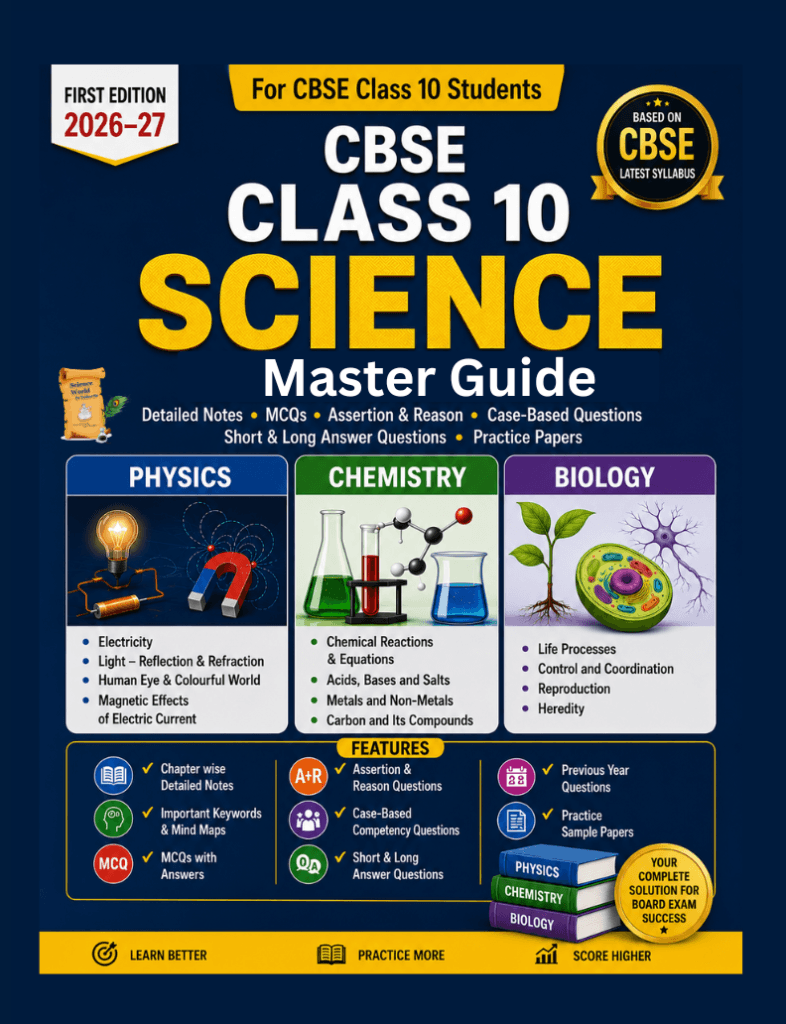
Master the complete CBSE Class 10 Science syllabus with chapter-wise notes, mind maps, MCQs, assertion–reason questions, case-based questions, competency-based questions, practice papers, and exam-ready question banks—all in one place.
- ✅ Chapter-wise Notes
- ✅ Mind Maps
- ✅ MCQs
- ✅ Assertion–Reason Questions
- ✅ Case-Based Questions
- ✅ Competency-Based Questions
- ✅ Practice Papers
Everything You Need to Excel
- 📘 Based on the Latest NCERT Exploration Curriculum
- 🧪 Covers All 13 Science Chapters
- 📝 Exam-Oriented Practice Questions
- 🎯 Perfect for School Exams & Olympiad Preparation
Trusted by Students & Designed by Science World By Tushar Sir
Why Choose Science World By Tushar Sir?
Science World By Tushar Sir provides high-quality CBSE Class 10 Science learning resources based on the latest NCERT Exploration curriculum. From easy-to-understand notes to exam-oriented practice questions, everything is designed to help students build concepts, improve problem-solving skills, and score higher in school examinations.
📘 Latest NCERT Curriculum
Study material based on the latest NCERT textbook and CBSE guidelines.
🗺️ Mind Maps
Quick revision mind maps to remember concepts efficiently before exams.
📝 Chapter-wise Notes
Easy-to-understand notes that simplify every topic and concept.
🎯Exam-Oriented Content
Questions and explanations designed to improve accuracy and confidence.
🧠 Smart Practice
MCQs, Assertion–Reason, Case-Based & Competency-Based Questions for exam preparation.
👨🏫Expert Guidance
Prepared by Tushar Sir (M.Sc. Biotechnology) with 18+ years of teaching experience.
Explore All Class 10 Science Chapters
Browse all 13 chapters based on the latest NCERT textbook. Each chapter includes detailed notes, important concepts, MCQs, assertion–reason questions, case-based questions, competency-based questions, and additional practice resources.
Chapter 1
Chemical reaction and equations.
Learn how substances change during chemical reactions and how these changes can be represented using chemical equations. This chapter covers different types of chemical reactions, balancing equations, oxidation and reduction, and everyday examples of chemical changes.
Chapter 2
Acids, Bases and Salts.
Explore the properties and uses of acids, bases, and salts in everyday life. Learn about indicators, the pH scale, neutralisation reactions, and important salts such as baking soda, washing soda, and bleaching powder.
Chapter 3
Metal and non-metal
Understand the physical and chemical properties of metals and non-metals. This chapter explains their reactions with oxygen, water and acids, the reactivity series, ionic compounds, extraction of metals, corrosion, and methods of preventing corrosion.
Chapter 4
Carbon and its compounds
Discover why carbon forms such a large variety of compounds. Learn about covalent bonding, hydrocarbons, homologous series, functional groups, chemical properties of carbon compounds, and important substances such as ethanol, ethanoic acid, soaps, and detergents.
Chapter 5
Life processes
Learn how living organisms carry out essential life processes needed for survival. This chapter covers nutrition, respiration, transportation, and excretion in plants and animals, with a focus on how different organs and systems work together.
Chapter 6
Control and coordination
Understand how organisms respond to changes in their surroundings. This chapter explains the nervous system, reflex actions, the brain, hormones, and coordination in plants through movements and plant hormones.
Chapter 7
How Do Organisms Reproduce?
Explore how organisms produce new individuals and continue their species. Learn about asexual and sexual reproduction, reproductive organs in humans, reproductive processes, and the importance of reproductive health.
Chapter 8
Heredity
Learn how characteristics are passed from parents to their offspring. This chapter introduces Mendel’s experiments, dominant and recessive traits, inheritance, chromosomes, sex determination, and the role of variations in living organisms.
Chapter 9
Light – Reflection and Refraction
Explore how light behaves when it strikes different surfaces and materials. Learn the laws of reflection, spherical mirrors, refraction, lenses, image formation, mirror and lens formulas, and their applications in everyday life.
Chapter 10
The Human Eye and the Colourful World
Understand the structure and working of the human eye and how we see objects around us. This chapter covers accommodation, common eye defects and their correction, atmospheric refraction, dispersion of light, and the formation of a rainbow.
Chapter 11
Electricity
Learn the fundamentals of electric current and electric circuits. This chapter explains electric potential difference, resistance, Ohm’s law, series and parallel combinations of resistors, electrical power, energy, and their practical applications.
Chapter 12
Magnetic Effects of Electric Current
Discover the relationship between electricity and magnetism. Learn about magnetic fields produced by electric currents, magnetic field lines, electromagnets, electric motors, electromagnetic induction, and generators.
Chapter 13
Our Environment
Understand how living organisms interact with one another and with their physical surroundings. This chapter covers ecosystems, food chains and food webs, energy flow, biodegradable and non-biodegradable substances, and the environmental impact of human activities.
Everything You Need to Master Class 10 Science
Find all the essential study resources in one place. Access chapter-wise notes, NCERT solutions, MCQs, mind maps, question banks, and practice papers designed to help you build strong concepts and excel in examinations.
📖Chapter-wise Simplified Notes
Easy-to-understand explanations covering every chapter with important concepts, handmade diagrams and key points.
📘NCERT Intext & Exercise Solutions
Step-by-step solutions to Latest NCERT textbook questions with clear explanations.
📝MCQs & Practice Questions
Prepare with topic-wise MCQs, assertion–reason, competency-based, & case-based questions.
🧠Simplified Mind Maps
Revise quickly using visual mind maps and concept summaries before exams.
📄Chapter wise Sample Papers
Practice exam-style papers to improve speed, accuracy, and confidence.
📚Question Banks
Access chapter-wise question banks with detailed solutions for exam preparation.
Complete Study Guide for CBSE Class 9 Science
Complete Class 10 Science Study Guide
Prepare confidently for school exams with a comprehensive study guide based on the latest NCERT curriculum. This book combines concept-building notes, solved examples, MCQs, assertion–reason questions, case-based questions, competency-based questions, and practice papers to support complete exam preparation.
- ✅ Based on the Latest NCERT Curriculum
- ✅ Covers All 13 Chapters ✅ Chapter-wise Notes
- ✅ 50+ MCQs per Chapter
- ✅ Assertion–Reason Questions
- ✅ Case-Based Questions
- ✅ Competency-Based Questions
- ✅ Practice Papers ✅ Detailed Solutions
FAQs
1. What is Class 10 Science?
Class 10 Science covers important concepts from Physics, Chemistry and Biology, including chemical reactions, life processes, electricity, light, heredity, reproduction, metals and non-metals, and the environment.
2. Where can I find Class 10 Science notes?
You can find chapter-wise Class 10 Science notes on Science World By Tushar Sir. These notes are designed to help students understand important concepts, revise chapters and prepare effectively for CBSE examinations.
3. Are these Class 10 Science notes based on the latest CBSE syllabus?
The Class 10 Science study material is prepared according to the applicable CBSE syllabus and NCERT curriculum. Students should also check the latest CBSE syllabus for their examination year.
4. Where can I find Class 10 Science NCERT solutions?
Science World By Tushar Sir provides Class 10 Science NCERT solutions and chapter-wise study resources to help students understand textbook questions and prepare for examinations.
5. Are Class 10 Science MCQs available chapter-wise?
Yes. Chapter-wise Class 10 Science MCQs can help students test their conceptual understanding and practise objective-type questions along with their NCERT and chapter notes.
6. How should I prepare for the Class 10 Science board exam?
Start with the NCERT textbook, understand each concept thoroughly, revise chapter-wise notes, practise numerical problems and diagrams, solve previous-year questions, and regularly attempt sample papers and mock tests.
7. Which topics are important in Class 10 Science?
Important topics include chemical reactions and equations, acids and bases, metals and non-metals, carbon compounds, life processes, heredity, reproduction, light, electricity, magnetic effects of electric current and environmental concepts.
8. Are Class 10 Science important questions available?
Yes. Practising important and exam-oriented questions can help students identify commonly tested concepts and improve their preparation. However, students should study the complete syllabus rather than relying only on selected questions.
9. Are Class 10 Science sample papers available?
Yes. Sample papers are useful for practising the examination format, managing time and identifying topics that need more revision. Students should attempt them after completing the relevant concepts and textbook preparation.
10. How can I score well in Class 10 Science?
Focus on NCERT concepts, practise regularly, learn important definitions and diagrams, solve numerical problems step by step, revise frequently, and practise different types of questions under exam-like conditions.
11. Is Class 10 Science difficult?
Class 10 Science becomes easier when concepts are understood systematically. Regular revision, NCERT-based study, diagrams, numerical practice and question-solving can make the subject more manageable.
12. How can I use Science World By Tushar Sir for Class 10 Science preparation?
Start with the Class 10 Science pillar page, select a chapter, study the chapter notes, revise important concepts and diagrams, practise questions and MCQs, and then use sample papers and previous-year questions for exam preparation.
Meet Your Educator

Science World By Tushar Sir
SCIENCE EDUCATOR
Meet Your Educator
Tushar Sir
Tushar Sir is the founder of Science World By Tushar Sir and has been dedicated to helping students build strong scientific concepts through simple, structured, and exam-focused learning resources. Every note, question bank, and study guide is carefully designed to make learning easier and help students prepare with confidence for school examinations.
- ✅ Concept-Based Teaching
- ✅ Latest NCERT Curriculum
- ✅ Chapter-wise Study Resources
- ✅ Exam-Oriented Practice Questions
- ✅ Comprehensive Study Guides
- ✅ Helping Students Learn with Confidence
Ready to Master Class 10 Science?
Begin your learning journey with comprehensive chapter-wise notes, NCERT solutions, mind maps, MCQs, and exam-oriented practice resources. Everything you need to succeed in CBSE Class 9 Science is available in one place.
✓ Latest NCERT Curriculum • ✓ 13 Complete Chapters • ✓ Exam-Oriented Resources
Explore More Learning Resources
Continue your learning journey with additional study materials, practice resources, and educational guides from Science World By Tushar Sir.
📘 Class 10 Science Notes
Access chapter-wise notes for all 13 chapters that based on NCERT.
📝 Class 10 NCERT Solutions
Step-by-step solutions for latest NCERT textbook exercises.
🧠 Class 10 Mind Maps
Quick revision resources for every chapter of NCERT.
📄 Sample Papers
Practice exam-style papers to improve your confidence to questions.
📚 Question Banks
Chapter-wise practice with detailed solutions.
🎓 Class 10 Science
Continue your learning with CBSE Class 10 Science resources.
Start Learning with Confidence
Join thousands of learners exploring CBSE Science with structured notes, practice questions, and comprehensive study guides.