
📚 CHAPTER-WISE QUESTION BANK
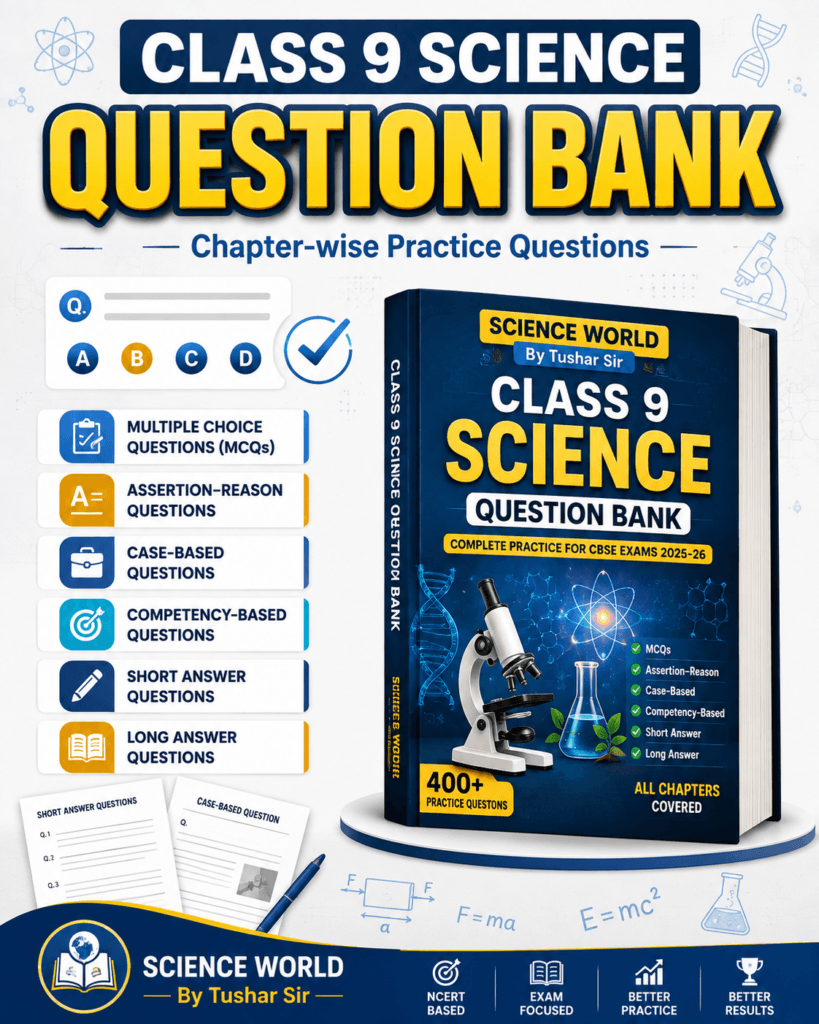
Class 9 Science Question Bank
Strengthen your Class 9 Science preparation with chapter-wise question banks covering important concepts, practice questions, and exam-oriented exercises based on the NCERT Exploration curriculum. Practise systematically, identify weak areas, and build confidence for school examinations.
✓ All 13 Chapters • ✓ Practice Answers • ✓ NCERT-Based
Why Use a Class 9 Science Question Bank?
A good question bank helps students move beyond reading and start practising. Chapter-wise questions allow you to test your understanding, identify weak areas, practise different question types, and prepare more confidently for school examinations.
📖 Practice Important Questions
Practise a variety of questions from each Class 9 Science chapter and strengthen your understanding through regular practice.
🎯 Strengthen Concepts
Question practice helps you apply scientific concepts instead of simply memorising definitions and facts.
🧠Chapter-wise Preparation
Focus on one chapter at a time and systematically complete your Class 9 Science preparation.
✍️Different Question Types
Practise MCQs, short-answer, long-answer, case-based, competency-based, and other exam-oriented questions.
🔍Find Weak Areas
Regular practice helps you identify concepts that need more study and revision.
⚡Build Exam Confidence
Practising questions regularly can improve familiarity with question formats and help you approach examinations with greater confidence.
💡 Smart Practice Tip
Don’t wait until the exam to start solving questions. Practise after completing each chapter, review your mistakes, and return to difficult concepts before moving to the next chapter.
Chapter-wise Class 9 Science Question Bank
Explore chapter-wise Class 9 Science question banks covering important concepts and different question formats from the NCERT Exploration curriculum. Practise each chapter systematically and use the questions to strengthen your exam preparation.
Chapter 1
Entering the World of Secondary Science
Practise questions on scientific methods, observations, measurements, experiments, and essential laboratory skills.
Chapter 2
Cell: The Building Block of Life
Test your understanding of cell structure, organelles, their functions, and the organization of living cells.
Chapter 3
Tissues in Action
Practise questions covering plant and animal tissues, their structures, functions, and importance in living organisms.
Chapter 4
Describing Motion Around Us
Strengthen your understanding of motion, distance, displacement, speed, velocity, and related concepts.
Chapter 5
Exploring Mixtures and Their Separation
Practise questions on mixtures, solutions, components, properties, and different separation techniques.
Chapter 6
How Forces Affect Motion
Test your understanding of forces, interactions, motion, and the effects of forces on objects.
Chapter 7
Work, Energy, and Simple Machines
Practise questions on work, energy, power, and the working principles of simple machines.
Chapter 8
Journey Inside the Atom
Revise and practise questions related to atomic structure, subatomic particles, and models of the atom.
Chapter 9
Atomic Foundations of Matter
Practise questions on atoms, molecules, chemical formulae, and the composition of matter.
Chapter 10
Sound Waves: Characteristics and Applications
Test your knowledge of sound production, propagation, characteristics of sound, and its applications.
Chapter 11
Reproduction: How Life Continues
Practise questions covering reproduction, life cycles, and the continuity of life.
Chapter 12
Patterns in Life: Diversity and Classification
Strengthen your understanding of biological diversity, classification, groups of organisms, and their relationships.
Chapter 13
Earth as a System: Energy, Matter, and Life
Practise questions connecting Earth’s systems, energy, matter, environment, and life.
Question Types Included in the Class 9 Science Question Bank
Practise different question formats to develop conceptual understanding, improve application skills, and become familiar with the types of questions commonly used in school assessments.
Multiple-Choice Questions (MCQs)
Test your understanding with objective questions covering important concepts, facts, definitions, and applications.
Assertion–Reason Questions
Practise questions that require you to evaluate statements and understand the relationship between an assertion and its reason.
Short-Answer Questions
Build concise answers by practising questions that require key concepts, explanations, definitions, and scientific reasoning.
Long-Answer Questions
Develop detailed responses and practise explaining scientific concepts, processes, observations, and applications clearly.
Case-Based Questions
Apply your Science knowledge to given situations, passages, data, or real-life contexts and answer related questions.
Competency-Based Questions
Strengthen application, reasoning, interpretation, and problem-solving skills through competency-focused questions.
Practice More. Understand Better. Prepare Smarter.
A balanced question bank should not focus only on memorisation. Use different question formats to practise knowledge, understanding, application, analysis, and scientific reasoning.
How to Use the Class 9 Science Question Bank Effectively
Follow a simple study-and-practice cycle to get more value from your Class 9 Science question bank. Study the concepts first, practise questions, analyse your mistakes, and retest yourself after revision.
① Study
Understand the Chapter
Read the relevant NCERT chapter and your notes carefully before beginning extensive question practice.
② Practise
Solve Without Looking
Attempt the questions independently. Avoid checking the answer immediately so you can genuinely test your understanding.
③ Check
Analyse Your Answers
Check your answers after completing a set. Pay special attention to questions you answered incorrectly or found difficult.
④ Revise
Return to Weak Concepts
Go back to the relevant textbook section, notes, or mind map and revise the concept behind your mistakes.
⑤ Retest
Try Again
After revision, solve similar questions again. This helps you check whether the concept has actually improved.
📖 Learn First
Use NCERT and our detailed notes to understand the chapter before attempting a large question set.
📝 Practise & Analyse
Use the question bank to test your knowledge, analyse mistakes, and identify concepts that require additional revision.
Use the Question Bank Throughout Your Exam Preparation
Don’t wait until the final examination to start solving questions. Use the Class 9 Science question bank at different stages of your preparation to build understanding, practise concepts, and improve your confidence.
Before a Class Test
After completing a chapter, solve relevant questions to check your understanding and identify concepts that need more attention.
During Regular Revision
Revisit previously completed chapters and practise selected questions to keep important concepts fresh.
Before School Examinations
Solve questions from multiple chapters to practise applying your knowledge and become familiar with different question formats.
Final Revision
Use important questions and previously difficult topics for focused revision when your examination is approaching.
1. 📖 Learn
Understand the concepts
Study NCERT and your notes first.
2. 📝 Practise
Solve different questions
Use the question bank to test your understanding.
3. 🎯 Revise
Focus on weak areas
Review mistakes and practise again.
Frequently Asked Questions About Class 9 Science Question Banks
Find answers to common questions about Class 9 Science question banks, including chapter-wise practice, question types, NCERT alignment, answers, and exam preparation.
A Class 9 Science question bank is a collection of practice questions organized around the topics and chapters of the Class 9 Science curriculum. It can help students test their understanding and prepare for assessments.
Yes. The chapter-wise solutions available on our website are provided as free educational resources for students to learn, practise, and revise Class 9 Science.
Yes. The resources are organized chapter-wise so students can practise questions from the chapter they are currently studying or revising.
Depending on the chapter and resource, the question bank can include MCQs, Assertion–Reason questions, short-answer questions, long-answer questions, case-based questions, and competency-based questions.
Where answers or solutions are provided, they help students check their responses and understand where they made mistakes. Always review the explanation behind an incorrect answer rather than simply memorising the correct option.
You can use it after completing a chapter, during regular revision, before school tests, and as part of your examination preparation.
No. The question bank should be used as a practice and revision resource. Students should study the NCERT textbook and understand the concepts before relying on question practice.
First study the chapter, then attempt questions without looking at the answers. Check your responses afterward, identify mistakes, revise the related concepts, and attempt similar questions again.
Yes. Regular question practice can help students become familiar with different question formats, apply concepts, identify weak areas, and improve examination readiness.
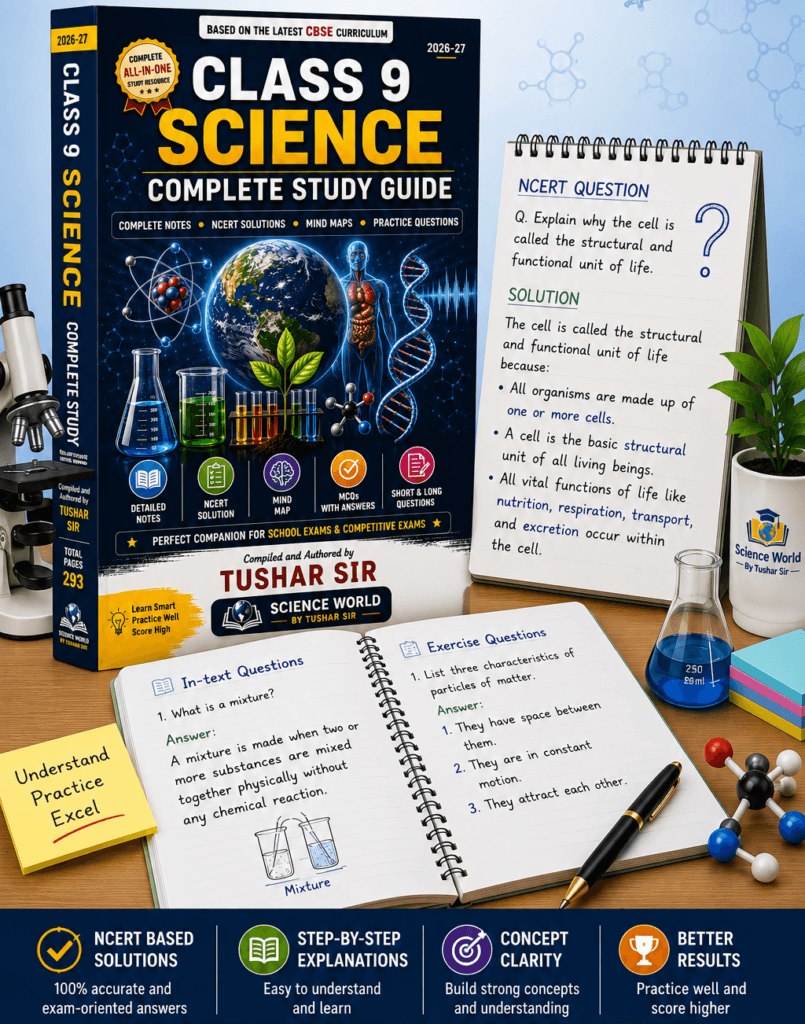
For more complete preparation, combine the question bank with Class 9 Science Notes, NCERT Solutions, MCQs, Mind Maps, Sample Papers, and the Complete Class 9 Science Study Guide.
Explore More Class 9 Science Resources
A question bank is one part of effective Science preparation. Explore our other Class 9 Science resources for learning concepts, revising chapters, practising objective questions, and preparing for examinations.
📘Class 9 Science Notes
Study chapter-wise concepts, important points, diagrams, and revision notes.
📝Class 9 Science MCQs
Practise chapter-wise multiple-choice questions and test your understanding.
🧠Class 9 Science Mind Maps
Revise important concepts quickly with visual chapter-wise mind maps.
📚Class 9 Science NCERT Solutions
Find clear solutions and explanations for NCERT questions and exercises.
📄Class 9 Science Sample Papers
Test your preparation with sample papers and exam-style practice.
🏠Complete Class 9 Science Guide
Explore all Class 9 Science resources, chapters, and study materials in one place.
Ready to Strengthen Your Class 9 Science Preparation?
Start practising chapter-wise Class 9 Science questions to strengthen your concepts, identify weak areas, and prepare confidently for school examinations. Combine question-bank practice with Notes, NCERT Solutions, MCQs, Mind Maps, and Sample Papers for more complete preparation.
✓ 13 Chapters • ✓ Multiple Question Types • ✓ NCERT-Based • ✓ Exam-Oriented Practice