Introduction (Human Eye and Colourful World Class 10 Notes)
The human eye is one of the most important and sensitive sense organs of the human body. It enables us to see the colourful world around us by detecting light reflected from objects. Like a camera, the eye focuses light to form an image, but unlike a camera, it is a living organ that automatically adjusts to changing light conditions and different object distances. (Human Eye and Colourful World Class 10 Notes)
The human eye works together with the brain. Light enters the eye through the cornea and pupil, is focused by the eye lens onto the retina, and the resulting nerve signals are carried by the optic nerve to the brain. The brain interprets these signals and creates the images that we see.
This chapter explains the structure and functioning of the human eye, common vision defects and their correction, and fascinating optical phenomena such as atmospheric refraction, dispersion, and scattering of light.
Human Eye
The human eye is a natural optical instrument that allows us to see objects by receiving and focusing light.
It works on the principle of refraction of light.
Main Functions of the Human Eye
- Detects light.
- Forms images of objects.
- Distinguishes colours.
- Adjusts focus for near and distant objects.
- Sends visual information to the brain.
Structure of the Human Eye
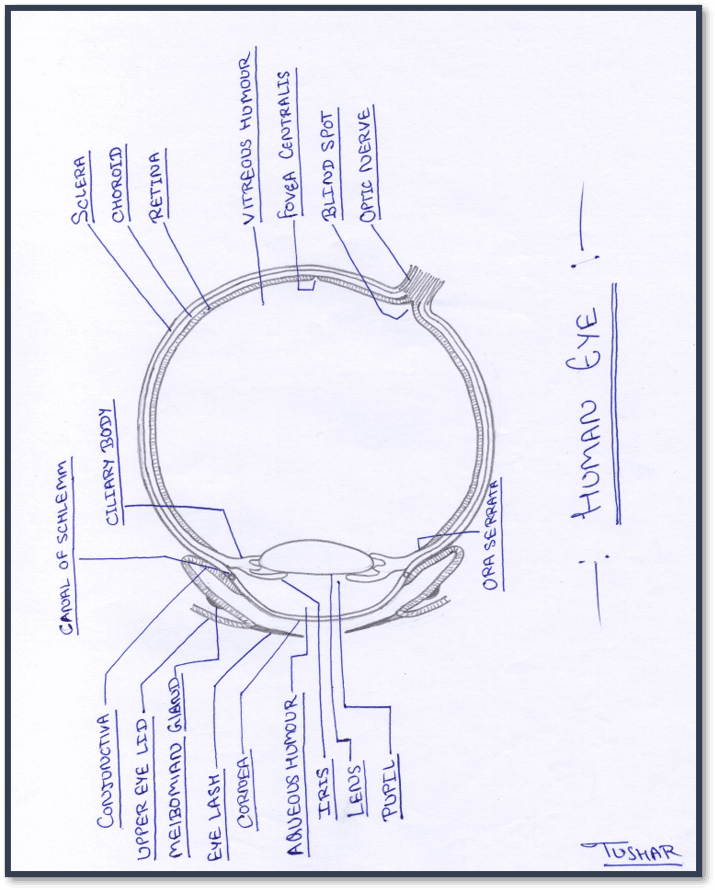
The human eye consists of several important parts that work together for clear vision.
1. Cornea
The cornea is the transparent, curved front surface of the eye.
Functions
- Protects the eye from dust and germs.
- Allows light to enter.
- Provides most of the refraction (bending) of incoming light.
Fact: Most of the eye’s focusing power comes from the cornea.
2. Iris
The iris is the coloured muscular part of the eye.
It may appear:
- Brown
- Black
- Blue
- Green
- Hazel
Functions
- Controls the size of the pupil.
- Regulates the amount of light entering the eye.
3. Pupil
The pupil is the small circular opening at the centre of the iris.
Functions
- Allows light to enter the eye.
- Changes size depending on light intensity.
In Bright Light
- Pupil becomes smaller.
- Less light enters the eye.
In Dim Light
- Pupil becomes larger.
- More light enters the eye.
4. Eye Lens
The eye lens is a transparent, flexible, convex lens located behind the pupil.
Functions
- Focuses light onto the retina.
- Changes its shape to focus objects at different distances.
This ability is called the power of accommodation.
5. Ciliary Muscles
The ciliary muscles surround the eye lens.
Functions
- Hold the lens in position.
- Change the curvature (shape) of the lens.
- Control the focal length of the lens.
6. Retina
The retina is the light-sensitive inner layer at the back of the eye.
It contains millions of photoreceptor cells.
Types of Photoreceptors
Rod Cells
- Sensitive to dim light.
- Help us see in darkness.
- Do not detect colours.
Cone Cells
- Detect bright light.
- Responsible for colour vision.
- Provide sharp, detailed vision.
7. Yellow Spot (Fovea)
The yellow spot, also called the fovea, is the most sensitive part of the retina.
Functions
- Produces the sharpest vision.
- Contains a high concentration of cone cells.
8. Blind Spot
The blind spot is the point where the optic nerve leaves the eye.
Characteristics
- Contains no rods or cones.
- No image is formed at this point.
9. Optic Nerve
The optic nerve connects the retina to the brain.
Functions
- Carries electrical impulses from the retina.
- The brain interprets these impulses as images.
Diagram of the Human Eye
Working of the Human Eye
The human eye functions in the following steps:
Step 1: Light reflected from an object enters the eye through the cornea.
↓
Step 2: The cornea bends (refracts) the light.
↓
Step 3: The iris controls the amount of light entering through the pupil.
↓
Step 4: The eye lens focuses the light onto the retina.
↓
Step 5: The retina converts light into electrical impulses.
↓
Step 6: The optic nerve carries these impulses to the brain.
↓
Step 7: The brain interprets the signals, allowing us to see the object clearly.
Human Eye vs Camera
| Human Eye | Camera |
|---|---|
| Cornea and lens focus light | Camera lens focuses light |
| Iris controls light | Aperture controls light |
| Pupil allows light to enter | Aperture opening allows light |
| Retina receives image | Film/Sensor receives image |
| Optic nerve sends signals | Electronic circuits process image |
| Brain interprets image | Computer processes image |
Interesting Facts
- The eye can distinguish millions of colours.
- The human eye blinks about 15–20 times per minute.
- The image formed on the retina is real, inverted, and diminished.
- The brain automatically interprets the image as upright.
- The cornea performs most of the eye’s focusing before the lens fine-tunes the image.
Key Terms
| Term | Meaning |
|---|---|
| Cornea | Transparent front layer that refracts light |
| Iris | Coloured muscular part controlling the pupil |
| Pupil | Opening through which light enters |
| Eye Lens | Flexible convex lens that focuses light |
| Retina | Light-sensitive layer where the image forms |
| Rod Cells | Cells responsible for vision in dim light |
| Cone Cells | Cells responsible for colour vision |
| Yellow Spot | Area of sharpest vision |
| Blind Spot | Area without photoreceptors |
| Optic Nerve | Carries visual signals to the brain |
Power of Accommodation
The power of accommodation is the ability of the human eye to change the focal length of its eye lens so that it can focus clearly on objects at different distances.
This adjustment is made by the ciliary muscles, which change the curvature of the eye lens.
Definition:
Power of accommodation is the ability of the eye lens to adjust its focal length and focus clearly on both nearby and distant objects.
How Accommodation Works
When Viewing a Distant Object
- Ciliary muscles relax.
- Eye lens becomes thin (less curved).
- Focal length increases.
- Light is focused on the retina.
When Viewing a Nearby Object
- Ciliary muscles contract.
- Eye lens becomes thicker (more curved).
- Focal length decreases.
- Image is focused on the retina.
Near Point of the Eye
The near point is the minimum distance at which an object can be seen clearly without strain.
For a Normal Eye
- Near Point = 25 cm
Objects placed closer than 25 cm appear blurred because the eye lens cannot increase its curvature further.
Far Point of the Eye
The far point is the maximum distance at which an object can be seen clearly.
For a Normal Eye
- Far Point = Infinity (∞)
A normal eye can clearly see distant mountains, stars, and other faraway objects.
Range of Vision
The distance between the near point and the far point is called the range of vision.
For a Normal Eye
- Near Point = 25 cm
- Far Point = Infinity
Persistence of Vision
When an image is formed on the retina, it remains there for about 1/16th of a second, even after the object is removed.
This phenomenon is called persistence of vision.
Applications
- Movies
- Television
- Animation
- LED displays
Defects of Vision
Sometimes the eye cannot focus light properly on the retina, resulting in blurred vision. Such conditions are called defects of vision.
The three main defects studied in CBSE Class 10 are:
- Myopia (Short-sightedness)
- Hypermetropia (Long-sightedness)
- Presbyopia
1. Myopia (Short-sightedness)
Definition
Myopia is a defect of vision in which a person can see nearby objects clearly but distant objects appear blurred.
Causes of Myopia
- Eyeball becomes longer than normal.
- Eye lens has excessive converging power.
As a result, light from distant objects is focused in front of the retina.
Correction of Myopia
A concave (diverging) lens is used.
The concave lens diverges incoming light so that the image forms correctly on the retina.
Everyday Example
A student can read a book clearly but cannot read the writing on a classroom board.
2. Hypermetropia (Long-sightedness)
Definition
Hypermetropia is a defect of vision in which a person can see distant objects clearly but nearby objects appear blurred.
Causes of Hypermetropia
- Eyeball is shorter than normal.
- Eye lens has insufficient converging power.
As a result, light from nearby objects is focused behind the retina.
Correction of Hypermetropia
A convex (converging) lens is used.
The convex lens converges incoming light before it enters the eye, bringing the image onto the retina.
Everyday Example
A person can see distant objects but needs reading glasses to read a newspaper.
3. Presbyopia
Definition
Presbyopia is an age-related defect of vision caused by a gradual loss of the eye’s power of accommodation.
It usually develops after the age of 40 years.
Causes
- Weakening of ciliary muscles.
- Reduced flexibility of the eye lens.
Symptoms
- Difficulty reading small print.
- Need to hold books farther away.
- Eye strain during reading.
Correction
Depending on the condition, presbyopia may be corrected using:
- Convex lenses
- Bifocal lenses
- Progressive lenses
Bifocal Lenses
A bifocal lens has:
- Upper part: For distant vision.
- Lower part: For near vision.
Comparison of Vision Defects
| Feature | Myopia | Hypermetropia | Presbyopia |
|---|---|---|---|
| Difficulty in seeing | Distant objects | Nearby objects | Nearby objects (age-related) |
| Image forms | In front of retina | Behind retina | Due to reduced accommodation |
| Cause | Long eyeball / strong lens | Short eyeball / weak lens | Ageing of lens and muscles |
| Corrected by | Concave lens | Convex lens | Convex or bifocal lens |
Everyday Applications
| Situation | Related Concept |
|---|---|
| Reading a book | Accommodation |
| Watching TV | Far point |
| Reading in old age | Presbyopia |
| School student cannot see blackboard | Myopia |
| Reading with spectacles | Hypermetropia |
Quick Revision
✔ Power of accommodation allows the eye to focus on objects at different distances.
✔ Near point of a normal eye = 25 cm.
✔ Far point of a normal eye = Infinity.
✔ Persistence of vision lasts about 1/16 second.
✔ Myopia is corrected using a concave lens.
✔ Hypermetropia is corrected using a convex lens.
✔ Presbyopia occurs due to ageing and is often corrected using bifocal lenses.
Board Exam Tips
⭐ Learn the definitions, causes, and correction of all three vision defects.
⭐ Practice neat ray diagrams for myopia and hypermetropia.
⭐ Memorize:
- Near point = 25 cm
- Far point = Infinity
- Persistence of vision = 1/16 second
Questions comparing myopia, hypermetropia, and presbyopia are frequently asked in CBSE board examinations.
Refraction Through a Prism
A prism is a transparent optical object made of glass or another transparent material. It has two triangular ends and three rectangular faces.
When a beam of light passes through a prism, it undergoes refraction at both surfaces. As a result, the light bends towards the base of the prism.
Why Does Light Bend in a Prism?
When light enters the prism:
- It travels from air to glass.
- Its speed decreases.
- It bends towards the normal.
When light leaves the prism:
- It travels from glass to air.
- Its speed increases.
- It bends away from the normal.
Due to these two refractions, the light ray deviates from its original path.
Dispersion of White Light
What is Dispersion?
When white light passes through a glass prism, it splits into its constituent colours. This phenomenon is called dispersion of light.
Definition:
Dispersion is the splitting of white light into its seven constituent colours when it passes through a prism.
Colours Produced
The seven colours are remembered by the acronym:
VIBGYOR
| Letter | Colour |
|---|---|
| V | Violet |
| I | Indigo |
| B | Blue |
| G | Green |
| Y | Yellow |
| O | Orange |
| R | Red |
Why Does Dispersion Occur?
Each colour of light has a different wavelength.
Since the refractive index of glass is different for different wavelengths:
- Violet light bends the most.
- Red light bends the least.
Important Facts
- Red light has the longest wavelength and least deviation.
- Violet light has the shortest wavelength and maximum deviation.
Spectrum
The colourful band produced after dispersion is called the spectrum.
A spectrum always contains the seven colours:
Violet → Indigo → Blue → Green → Yellow → Orange → Red
Rainbow Formation
A rainbow is a natural spectrum seen in the sky after rainfall when sunlight shines on water droplets.
How is a Rainbow Formed?
Three phenomena occur inside each raindrop:
- Refraction of sunlight.
- Dispersion into seven colours.
- Internal reflection followed by refraction as the light emerges.
These processes produce the visible rainbow.
Conditions for Seeing a Rainbow
- The Sun should be behind the observer.
- Water droplets should be in front of the observer.
- Usually seen after rainfall.
Atmospheric Refraction
Atmospheric refraction is the bending of light as it passes through different layers of the Earth’s atmosphere.
The atmosphere has varying density due to changes in temperature and pressure. Therefore, light continuously changes direction while travelling through it.
Twinkling of Stars
Stars appear to twinkle because their light undergoes continuous atmospheric refraction.
As starlight passes through layers of air with changing density:
- Its path keeps changing.
- The apparent position and brightness of the star fluctuate.
This makes stars appear to twinkle.
Important: Planets generally do not twinkle noticeably because they appear as small discs rather than point sources.
Advanced Sunrise and Delayed Sunset
Atmospheric refraction also explains why:
- The Sun appears about 2 minutes before the actual sunrise.
- The Sun remains visible about 2 minutes after the actual sunset.
This is called:
- Advanced Sunrise
- Delayed Sunset
Scattering of Light
Scattering is the phenomenon in which tiny particles in a medium cause light to spread in different directions.
Dust particles, smoke, water droplets, and air molecules scatter light.
Tyndall Effect
The scattering of light by very small particles suspended in a medium is known as the Tyndall Effect.
Everyday Examples
- Sunlight entering a dusty room.
- Car headlights visible in fog.
- Projector beam visible in a cinema hall.
- Torch beam visible in smoke.
Why is the Sky Blue?
The Earth’s atmosphere contains tiny molecules that scatter sunlight.
Blue light has a shorter wavelength than red light and is scattered much more strongly.
As a result:
- Blue light reaches our eyes from all directions.
- The sky appears blue during the day.
Why Does the Sun Appear Red at Sunrise and Sunset?
During sunrise and sunset:
- Sunlight travels a much longer distance through the atmosphere.
- Most of the blue light is scattered away.
- Red light, which has a longer wavelength and is scattered less, reaches our eyes.
Therefore, the Sun appears reddish.
Difference Between Dispersion and Scattering
| Dispersion | Scattering |
|---|---|
| Splitting of white light into colours | Spreading of light in different directions |
| Caused by refraction in a prism | Caused by particles in a medium |
| Produces a spectrum | Does not produce a spectrum |
| Example: Rainbow | Example: Blue sky |
Everyday Applications
| Phenomenon | Explanation |
|---|---|
| Rainbow | Dispersion, refraction, and internal reflection |
| Blue sky | Scattering of blue light |
| Red sunrise | Less scattering of red light |
| Twinkling of stars | Atmospheric refraction |
| Advanced sunrise | Atmospheric refraction |
| Dusty light beam | Tyndall Effect |
Important Values to Remember
| Quantity | Value |
|---|---|
| Near Point of Normal Eye | 25 cm |
| Far Point of Normal Eye | Infinity (∞) |
| Persistence of Vision | 1/16 second |
| Eye Lens | Convex Lens |
| Retina Image | Real, Inverted, Diminished |
| Vision Defect Corrected by Concave Lens | Myopia |
| Vision Defect Corrected by Convex Lens | Hypermetropia |
| Presbyopia Correction | Convex/Bifocal Lens |
Important Definitions
Human Eye
The human eye is a natural optical instrument that enables us to see objects by focusing light on the retina.
Power of Accommodation
The ability of the eye lens to change its focal length to focus on nearby and distant objects.
Near Point
The minimum distance at which an object can be seen clearly without strain.
Near Point = 25 cm
Far Point
The farthest distance at which an object can be seen clearly.
Far Point = Infinity
Myopia
A defect of vision in which nearby objects are seen clearly but distant objects appear blurred.
Hypermetropia
A defect of vision in which distant objects are seen clearly but nearby objects appear blurred.
Presbyopia
An age-related defect caused by the reduced power of accommodation of the eye.
Dispersion
The splitting of white light into its seven constituent colours.
Spectrum
The band of seven colours obtained after the dispersion of white light.
Atmospheric Refraction
The bending of light as it passes through different layers of the Earth’s atmosphere.
Scattering of Light
The phenomenon in which tiny particles cause light to spread in different directions.
Difference Between Myopia and Hypermetropia
| Myopia | Hypermetropia |
|---|---|
| Cannot see distant objects clearly | Cannot see nearby objects clearly |
| Image forms in front of retina | Image forms behind retina |
| Long eyeball or highly curved lens | Short eyeball or less curved lens |
| Corrected by concave lens | Corrected by convex lens |
Difference Between Dispersion and Scattering
| Dispersion | Scattering |
|---|---|
| Splitting of white light | Spreading of light |
| Occurs due to refraction | Occurs due to tiny particles |
| Produces a spectrum | Does not produce a spectrum |
| Example: Rainbow | Example: Blue sky |
Difference Between Rod Cells and Cone Cells
| Rod Cells | Cone Cells |
|---|---|
| Work in dim light | Work in bright light |
| No colour vision | Colour vision |
| Less detailed vision | Sharp and detailed vision |
| More numerous | Fewer in number |
Important NCERT Points
✔ The eye lens is a convex lens.
✔ The image on the retina is real, inverted, and diminished.
✔ The brain interprets the image as upright.
✔ Near point of a normal eye is 25 cm.
✔ Far point of a normal eye is infinity.
✔ Myopia is corrected using a concave lens.
✔ Hypermetropia is corrected using a convex lens.
✔ Presbyopia develops with age.
✔ Violet light deviates the most in a prism.
✔ Red light deviates the least.
✔ Blue light is scattered more than red light.
✔ Stars twinkle because of atmospheric refraction.
✔ The Sun appears reddish at sunrise and sunset due to scattering.
Assertion–Reason Questions
Question 1
Assertion (A): A person suffering from myopia can see nearby objects clearly.
Reason (R): In myopia, the image of distant objects forms in front of the retina.
Answer: Both A and R are true, and R is the correct explanation of A.
Question 2
Assertion (A): The sky appears blue during the day.
Reason (R): Blue light is scattered more than red light by air molecules.
Answer: Both A and R are true, and R is the correct explanation of A.
Question 3
Assertion (A): A convex lens is used to correct hypermetropia.
Reason (R): A convex lens converges light rays before they enter the eye.
Answer: Both A and R are true, and R is the correct explanation of A.
Case-Based Questions
Case Study 1
A 14-year-old student has difficulty reading the writing on the classroom board but can read books comfortably.
Questions
- Identify the defect of vision.
- Where is the image formed?
- Which lens is used for correction?
- Why does this defect occur?
Answers
- Myopia
- In front of the retina
- Concave lens
- Due to an elongated eyeball or excessive converging power of the eye lens
Case Study 2
After rainfall, a student notices a rainbow in the sky.
Questions
- Which optical phenomenon is responsible for the rainbow?
- Name the seven colours of the spectrum.
- Which colour deviates the least in a prism?
- Which colour deviates the most?
Answers
- Refraction, dispersion, internal reflection, and refraction
- Violet, Indigo, Blue, Green, Yellow, Orange, Red
- Red
- Violet
Common Mistakes to Avoid
❌ Confusing myopia with hypermetropia.
❌ Writing the wrong lens for correcting vision defects.
❌ Forgetting that the image on the retina is real and inverted.
❌ Incorrect order of VIBGYOR.
❌ Confusing dispersion with scattering.
❌ Writing that planets twinkle like stars (planets generally do not twinkle noticeably).
Last-Minute Revision Box
| Topic | Key Point |
|---|---|
| Human Eye | Natural optical instrument |
| Image on Retina | Real, Inverted, Diminished |
| Near Point | 25 cm |
| Far Point | Infinity |
| Myopia | Concave lens |
| Hypermetropia | Convex lens |
| Presbyopia | Bifocal/Convex lens |
| Dispersion | Splitting of white light |
| Spectrum | VIBGYOR |
| Rainbow | Refraction + Dispersion + Internal Reflection |
| Twinkling of Stars | Atmospheric refraction |
| Blue Sky | Scattering of blue light |
| Red Sunset | Less scattering of red light |
Chapter Summary
The human eye is a natural optical instrument that helps us see the colourful world by focusing light onto the retina. The cornea, iris, pupil, eye lens, retina, and optic nerve work together to produce vision. The eye adjusts its focal length through the power of accommodation, enabling clear vision of objects at different distances.
Common vision defects include myopia, hypermetropia, and presbyopia, each of which can be corrected using suitable lenses. The chapter also explains fascinating optical phenomena such as dispersion of light, rainbow formation, atmospheric refraction, and scattering of light, which account for the blue colour of the sky, the twinkling of stars, and the reddish appearance of the Sun during sunrise and sunset.
A thorough understanding of these concepts, along with labelled diagrams and practical examples, is essential for success in the CBSE Class 10 Science Board Examination.
Frequently Asked Questions (FAQs)
1. What is the power of accommodation?
It is the ability of the eye lens to change its focal length so that objects at different distances can be focused clearly on the retina.
2. What is the near point of a normal eye?
The near point of a normal eye is 25 cm.
3. What is the far point of a normal eye?
The far point of a normal eye is infinity.
4. Which lens is used to correct myopia?
A concave (diverging) lens is used to correct myopia.
5. Which lens is used to correct hypermetropia?
A convex (converging) lens is used to correct hypermetropia.
6. Why does the sky appear blue?
The sky appears blue because blue light has a shorter wavelength and is scattered more strongly by air molecules than other colours.
7. Why do stars twinkle?
Stars twinkle because their light undergoes atmospheric refraction as it passes through layers of air with varying density.
8. Why does the Sun appear reddish at sunrise and sunset?
At sunrise and sunset, sunlight travels a longer path through the atmosphere. Most of the shorter wavelengths (blue and violet) are scattered away, allowing the less scattered red light to reach our eyes.
9. What is dispersion of light?
Dispersion is the splitting of white light into its seven constituent colours (VIBGYOR) when it passes through a prism.
10. Which topics are most important for the CBSE Class 10 Board Exam?
Focus especially on:
- Structure and functions of the human eye
- Power of accommodation
- Myopia, hypermetropia, and presbyopia
- Correction of vision defects
- Dispersion and spectrum
- Rainbow formation
- Atmospheric refraction
- Scattering of light
- Blue sky and red sunrise/sunset
- Labelled diagrams and concept-based questions
📘 Prepare Smarter with the Complete CBSE Class 10 Science Master Guide
These free notes cover the essential concepts of Control and Coordination. For complete board exam preparation, explore the CBSE Class 10 Science Master Guide by Science World By Tushar Sir.
📖 What’s Inside the Book?
- ✅ Complete chapter-wise theory
- ✅ Easy-to-understand diagrams and flowcharts
- ✅ Mind Maps for quick revision
- ✅ Chapter-wise MCQs
- ✅ Assertion & Reason Questions
- ✅ Case-Based Questions
- ✅ Short & Long Answer Questions
- ✅ Practice Papers
- ✅ Smart Exam Strategies

📚 Available Formats
- 📕 Paperback Edition
- 📱 eBook Edition